The calendar task is green. Finance believes the company secretary filed the return; the company secretary believes finance completed the last step. The attachment is a draft, and nobody can produce an acknowledgement for the correct entity and period.
A reminder can bring a date to someone's attention. It cannot prove that the obligation was assessed, the right version was submitted or a required payment was made. The control needs to connect each of those events to an owner and evidence, with a separate route for a supported decision that no filing is required.
Before redesigning the calendar, select one recently completed filing task and ask the owner to show what the tick represents. Possible answers include “the draft was sent”, “the reviewer approved it”, “the filing was submitted” and “the acknowledgement was checked”. These are useful milestones, but they are not interchangeable.
Write the completion condition in terms another person can verify. For a submission, it might require the correct entity, period, filing type, submitted version and acknowledgement reference, checked by the designated reviewer. If there is a payment obligation, record its own amount, due date, authority and execution evidence rather than hiding it inside the filing status.
An acknowledgement generally proves something about receipt or submission. It does not necessarily prove that the authority has accepted every substantive position in the filing. Use status labels that match what the evidence actually establishes.
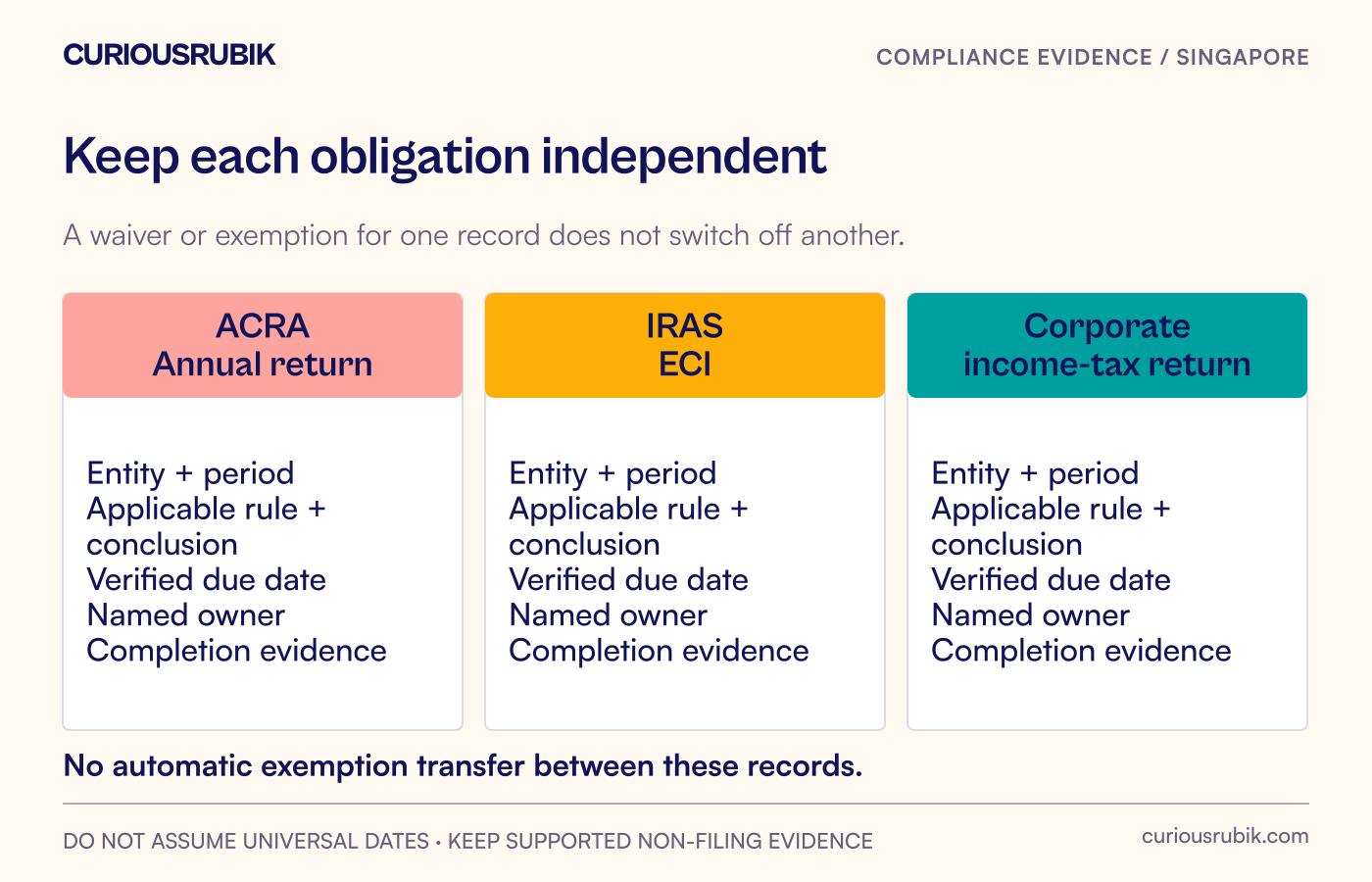
ACRA annual returns and IRAS tax filings are distinct. ACRA says live Singapore-incorporated companies must file annual returns even if inactive or dormant, including where IRAS has granted a tax waiver. Treating “dormant” as a universal switch that disables all reminders would therefore be unsafe.
Annual-return timing also depends on company type and financial year end. For example, ACRA's ordinary deadline for a non-listed company is within seven months after financial year end, while a non-listed company with share capital and an overseas branch register has an eight-month deadline. The responsible adviser should establish the applicable route for the actual company.
ECI has a different trigger. IRAS generally requires filing within three months after financial year end unless a waiver or specific exclusion applies. The common waiver requires both annual revenue of S$5 million or below and nil ECI, using IRAS's definitions. Nil ECI is assessed before deducting the partial or new start-up tax exemptions. A nil accounting profit or a general description of the company as “small” does not, by itself, establish that conclusion.
Keep the corporate income-tax return as its own obligation too. A decision about ECI does not replace assessment of the applicable return requirements. The useful calendar begins with separate rules and applicability evidence, not a single repeated task called “annual compliance”.
CURIOUSRUBIK COMPLIANCE EVIDENCE / SINGAPORE Keep each obligation independent A waiver or exemption for one record does not switch off another. ACRA Annual return Entity + period Applicable rule + conclusion Verified due date Named owner Completion evidence IRAS ECI Entity + period Applicable rule + conclusion Verified due date Named owner Completion evidence Corporate income-tax return Entity + period Applicable rule + conclusion Verified due date Named owner Completion evidence No automatic exemption transfer between these records. DO NOT ASSUME UNIVERSAL DATES · KEEP SUPPORTED NON-FILING EVIDENCE curiousrubik.com
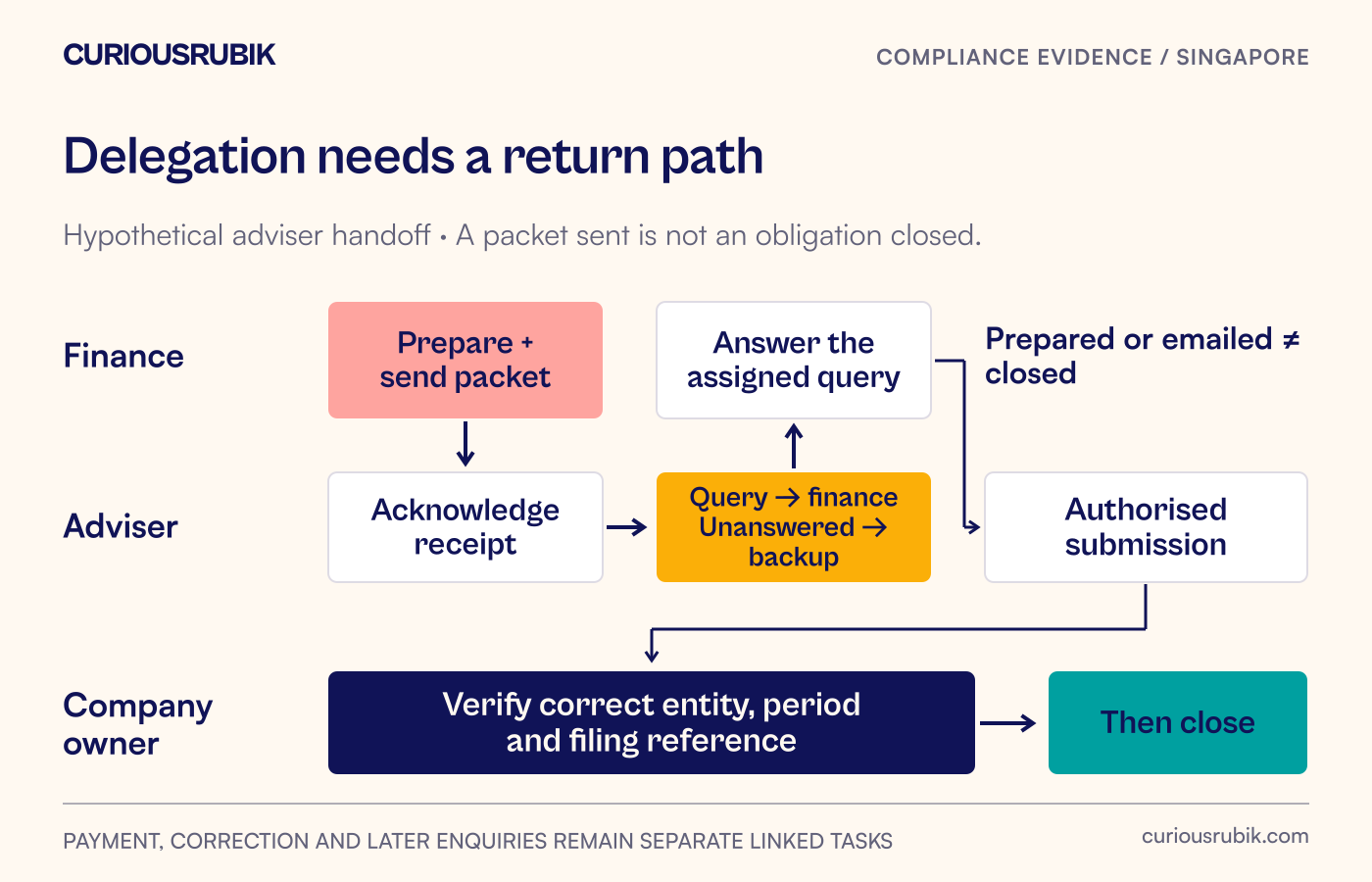
Consider a hypothetical non-listed Singapore company. Its finance team prepares a filing packet and emails it to an external adviser. An administrator marks the shared task complete because the packet has left finance. The adviser still needs an answer to a question, but that message goes to an employee who is away.
The process has two failures. Its completion condition is wrong, and its waiting state has no active owner. Adding more deadline reminders to the same administrator will not resolve either problem.
A revised handoff records “packet delivered; adviser acknowledgement pending”. When the adviser accepts it, the status becomes “under review”. A query identifies the specific missing fact, the finance owner and the latest internal response date. The main obligation remains open.
When the authorised filer submits, the evidence comes back to the designated company owner. That person verifies the entity, period and filing reference against the register. Any payment or later enquiry remains separately visible. The business can now show both what it delegated and what it checked.
The example is an operating recommendation, not a claim that every filing requires the same roles. A small business may combine some responsibilities, but it should still make the verification explicit and use independent review where the risk warrants it.
A practical register should make it difficult to attach last year's receipt or another entity's acknowledgement to the current task. Use a unique obligation reference and include:
Do not fill every record with the same date. An internal preparation target is a management choice, while a statutory deadline has a legal basis. Showing both lets the owner see when an internal delay threatens the external obligation.
A supported “not required” conclusion needs evidence too. Record the criteria checked, relevant facts, reviewer and period covered. Review it when the underlying circumstances change; last year's waiver assessment is not automatically this year's answer.
The most useful statuses often describe unfinished work: awaiting information, query received, submission failed, acknowledgement missing, correction required or payment unresolved. Each should have a next action and escalation route.
If a submission attempt produces an uncertain outcome, the filer should check the official status before retrying. Otherwise, an automation can create duplicate submissions or obscure which version is operative. Preserve the attempted action and the eventual confirmed result.
If the deadline is near and the usual approver is unavailable, the backup needs the necessary authority and access through approved arrangements. Sharing the absent person's credentials is not a sensible continuity plan. The company owner should resolve access and authority in advance.
When a correction is needed after filing, open a linked correction task. Keep the original submission history intact. A new green tick should not erase the fact that a different version was previously sent.
CURIOUSRUBIK COMPLIANCE EVIDENCE / SINGAPORE Delegation needs a return path Hypothetical adviser handoff · A packet sent is not an obligation closed. Finance Adviser Company owner Prepare + send packet Answer the assigned query Acknowledge receipt Query → finance Unanswered → backup Authorised submission Verify correct entity, period and filing reference Then close Prepared or emailed ≠ closed PAYMENT, CORRECTION AND LATER ENQUIRIES REMAIN SEPARATE LINKED TASKS curiousrubik.com
Automation can calculate dates from approved rules, request missing evidence, remind the next owner and flag a task whose acknowledgement has not arrived. The rule itself needs a named maintainer and a review when guidance or company circumstances change.
Send reminders to the person who can advance the current state. A preparation reminder is unhelpful when the packet is already with a reviewer. An escalation should explain what is missing, the consequence of delay and the action needed, rather than simply repeat “overdue”.
Keep a visible list of obligations awaiting applicability assessment. A calendar populated only after an owner confirms a filing is needed can hide the cases nobody has assessed at all.
Ask someone outside the preparation chain to select three records: a submitted filing, a supported non-filing conclusion and an open exception. Can they reconstruct each outcome without relying on a verbal assurance?
For the submission, they should identify the right entity and period. For the non-filing conclusion, they should see the applicable criteria. For the exception, they should know who acts next and when escalation is needed.
Track completed tasks lacking evidence, queries left without owners and corrections caused by wrong periods or versions. A high on-time tick rate is not enough if the ticks have no dependable meaning. Start by changing the completion condition for one obligation; the reminders will become more useful once they point towards a result that can actually be checked.