An employee asks to change their working pattern. The manager worries about customer coverage, while HR waits for a response that never arrives. After several weeks, the request is still sitting in an inbox and the concern has never been translated into something the team can assess.
A fair process gives the request an owner and a response date, then examines the work itself. What needs coverage? Which handoffs depend on shared hours? Could an alternative arrangement meet both the employee's needs and the role's requirements? Where a trial is useful and agreed, it should test those questions using clear measures.
Singapore's Tripartite Guidelines on Flexible Work Arrangement Requests took effect on 1 December 2024 and cover formal requests. MOM says employers should provide a written decision within two months of receiving a formal request, including a reason where it is rejected. The guidelines do not require approval of every requested arrangement.
Employees who have completed probation can make formal requests under these guidelines; employers may also consider requests during probation. A valid formal request follows the employer's communicated requirements. Where no requirements or process exist, the written request should state its date, the arrangement sought with frequency and duration, the reason, and proposed start and relevant end date. An informal or incomplete message is not automatically a valid formal request.
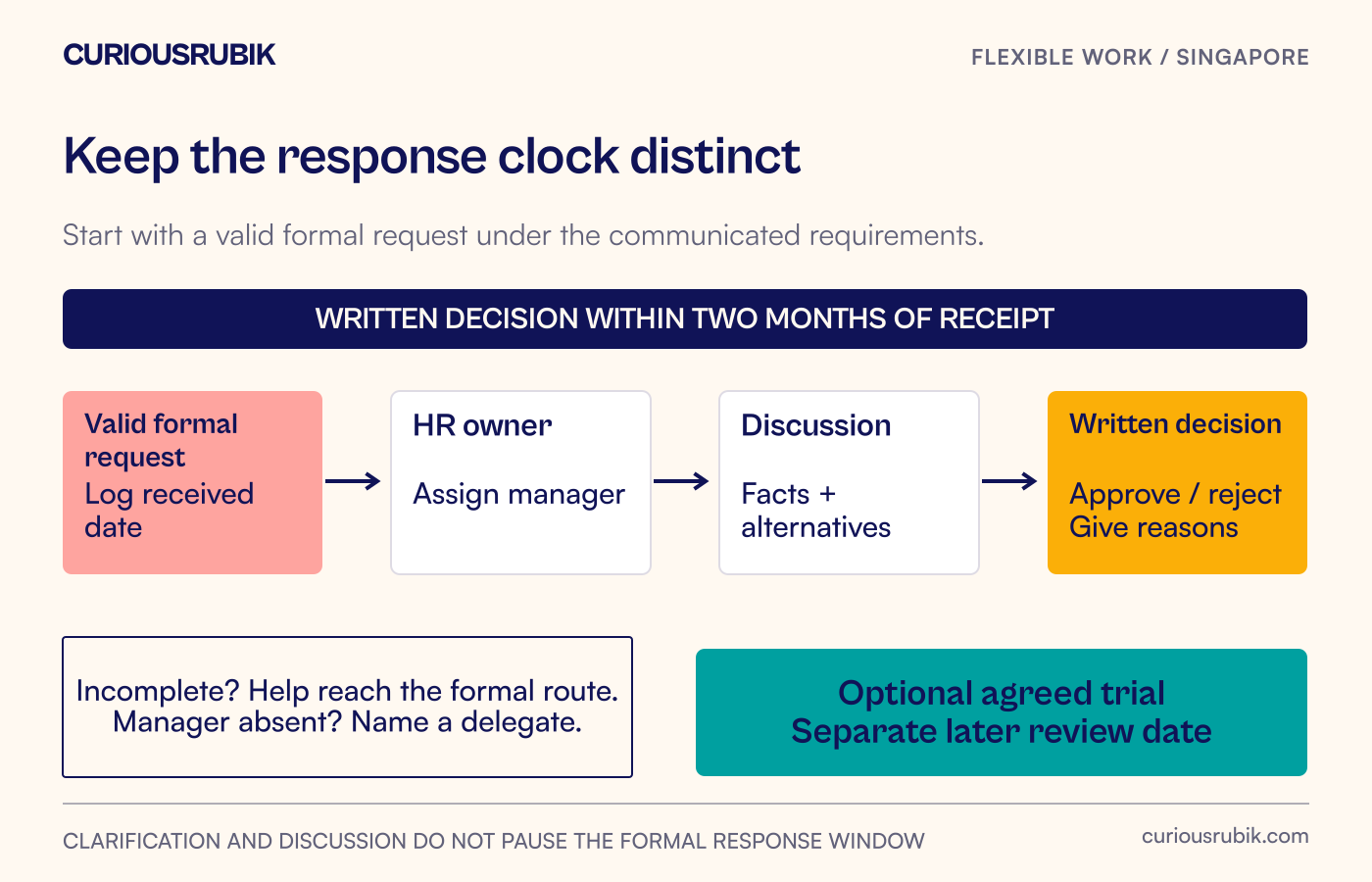
Clarification and discussion about a valid formal request belong within that response window. A proposed trial should not become a device for leaving the formal request unanswered indefinitely. HR should record when the valid formal request was received, the responsible manager, required discussions and the written decision. Help employees correct incomplete requests promptly and explain the formal route; do not use administrative uncertainty to leave them without a response.
Communicate any company requirements for making a formal request upfront. Informal arrangements that work for both sides can continue, but the business should still have a clear formal route. Staff should not need to guess which inbox or manager can start the process.
“Teamwork may suffer” is a concern, but it is not yet an assessment. Identify the work that depends on particular hours, locations or interactions and explain why.
For a customer-support role, the issue might be coverage of a defined morning service window. For a laboratory role, some work may require physical facilities. For a project role, the issue may be a poorly designed approval handoff rather than the requested location. Different constraints deserve different responses.
MOM's guidelines direct employers towards job-related factors and reasonable business grounds, rather than personal bias against flexible arrangements. The manager should therefore connect the concern to evidence and business outcomes. An employee's personal reason should not become a speculative score about their commitment or future performance.
Discuss the concern with the employee. They may know a workable handoff, a different working pattern or an unnecessary meeting that the manager has overlooked. The aim is a reasoned decision, not a questionnaire designed to produce a predetermined answer.
CURIOUSRUBIK FLEXIBLE WORK / SINGAPORE Keep the response clock distinct Start with a valid formal request under the communicated requirements. WRITTEN DECISION WITHIN TWO MONTHS OF RECEIPT Valid formal request Log received date HR owner Assign manager Discussion Facts + alternatives Written decision Approve / reject Give reasons Incomplete? Help reach the formal route. Manager absent? Name a delegate. Optional agreed trial Separate later review date CLARIFICATION AND DISCUSSION DO NOT PAUSE THE FORMAL RESPONSE WINDOW curiousrubik.com
Consider a hypothetical support employee requesting a later daily start and finish. The manager's specific concern is coverage from 8 am to 10 am. Rather than assuming the arrangement will fail, the team examines the volume and nature of work in that window and the available coverage.
An agreed trial might assign a colleague to the morning queue, with the requesting employee taking a later coverage period. The team needs to check that the arrangement is feasible for both people and does not simply transfer an unreasonable burden to the colleague.
Before the trial begins, record the working pattern, scope, duration, review date and responsibilities. Agree the service measures and how concerns will be raised. Document any effect on duties or other terms through the appropriate process; do not assume that a trial permits unilateral changes to pay or responsibilities.
The formal request still receives the required written decision in time. The trial and its later review should be described clearly so the employee understands what has been agreed and what remains subject to review.
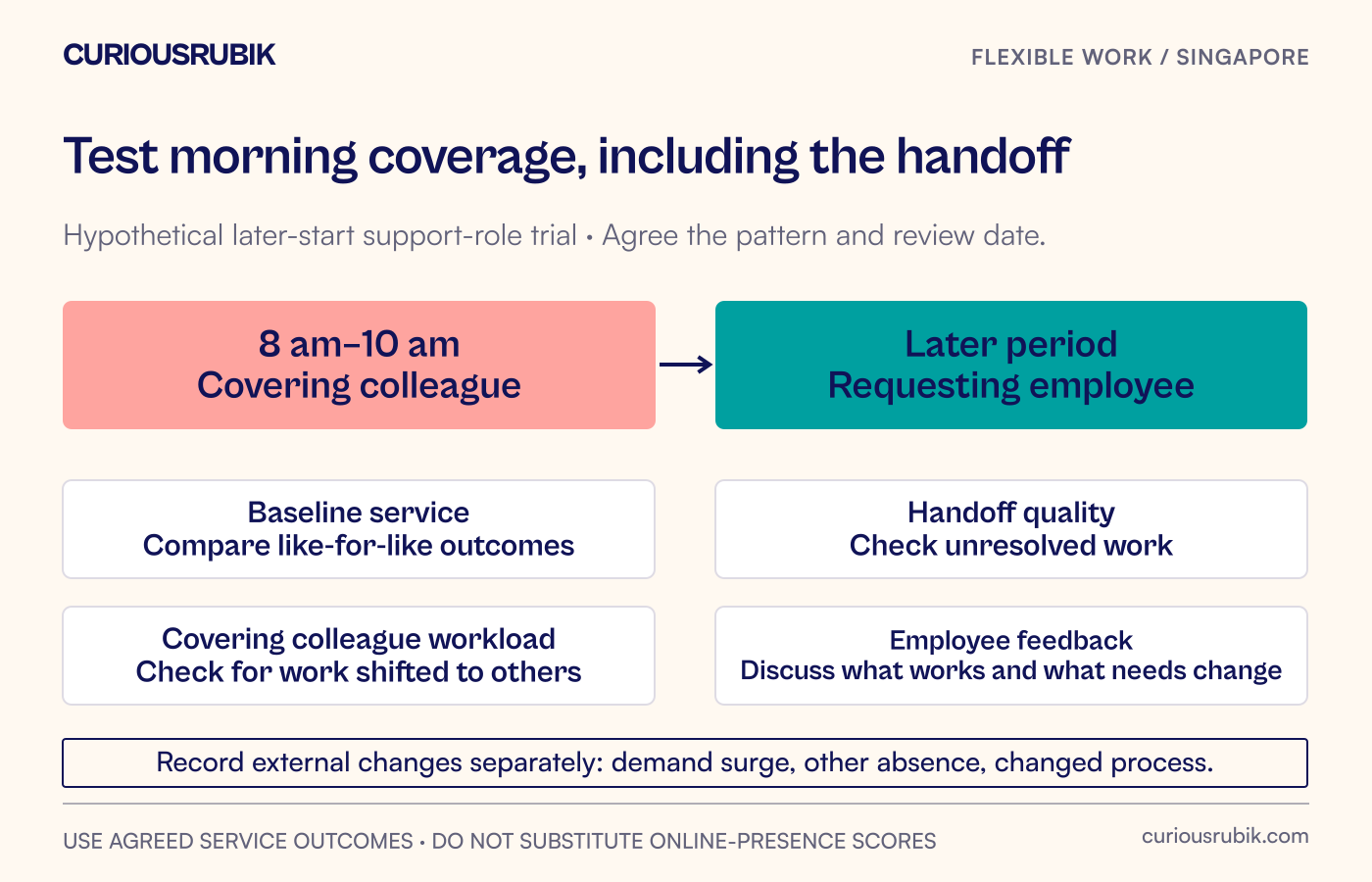
The support team might compare response times in the affected window, unresolved handoffs, customer escalations and workload for the covering colleague. Establish the existing position before the trial. Without that baseline, a problem that already existed can be blamed on the new arrangement.
Use consistent service expectations. A different attendance pattern should not silently introduce a harsher performance standard for one employee. Include the employee's view of whether the arrangement works, alongside the operational evidence.
Avoid measures that merely track visible presence. A count of online minutes may say little about customer service or completed work and can encourage unhelpful monitoring. Collect the minimum information needed to answer the agreed work-design question, with proportionate access and privacy controls.
Also record material events that affect the comparison. A surge in demand, another team member's absence or a changed customer process can influence the result. The reviewer should examine those causes rather than attribute every difference to the flexible arrangement.
CURIOUSRUBIK FLEXIBLE WORK / SINGAPORE Test morning coverage, including the handoff Hypothetical later-start support-role trial · Agree the pattern and review date. 8 am–10 am Covering colleague Later period Requesting employee Baseline service Compare like-for-like outcomes Handoff quality Check unresolved work Covering colleague workload Check for work shifted to others Employee feedback Discuss what works and what needs change Record external changes separately: demand surge, other absence, changed process. USE AGREED SERVICE OUTCOMES · DO NOT SUBSTITUTE ONLINE-PRESENCE SCORES curiousrubik.com
The manager and HR should be able to explain what was considered, the relevant job constraints and the resulting decision. If the request is rejected, the written reason should identify the business basis. Where a workable alternative exists, discuss it with the employee.
A practical decision record contains the requested arrangement, facts reviewed, discussions held, alternatives considered, conclusion and any agreed review date. Keep personal circumstances and supporting sensitive information restricted. Other team members may need to know the coverage plan; they do not need the employee's private reasons.
If several requests affect the same service window, assess the coverage problem openly and consistently. Do not rank employees using protected characteristics, family circumstances or an automated judgment of who “deserves” flexibility. HR should guide a fair process based on the work and applicable requirements.
Where disagreement remains, explain the available internal review or grievance route and relevant support. A respectful process can still reach a difficult decision; leaving the request unanswered makes the difficulty worse.
Automation can acknowledge receipt, distinguish a valid formal request from information still needed, track the applicable two-month response window and remind the manager of a pending discussion. It can also assemble the agreed trial measures for review.
The assessment and communication remain human. Avoid automatic rejection because a field is incomplete or a role has historically been labelled unsuitable. Route the missing information or genuine operational concern to the responsible person.
Design absence cover for the decision maker. If the line manager is away, HR should know who can continue the assessment within the required window. A reminder sent to an unavailable manager does not discharge the process.
At the agreed review, compare the evidence with the original question. Did the morning window receive adequate coverage? Did handoffs work? Was the colleague's workload reasonable? What did the employee experience?
If the arrangement needs adjustment, identify the problem and discuss a proportionate change. Do not introduce new objections only after the agreed measures were met. Where circumstances genuinely changed, explain the change and handle the review through the applicable process.
For the business, useful process measures include timely written responses, repeated clarification requests, decisions with a clear job-related rationale and trials that receive an actual review. Approval rate alone says little about whether requests were considered fairly.
The most useful first step is often to rewrite one vague objection as a question the team can answer. Once “coverage may suffer” becomes “who handles these requests between these hours, and what evidence will show it works?”, a practical discussion can begin.