At the payroll review, a supervisor reports additional hours worked last week. The time file has already been finalised. The employee says the hours were submitted; the supervisor says the approval arrived late. Payroll must now establish what happened and what must be paid, with little time left.
The first question is about the work and entitlement. The second is about why the handoff failed. Keep both questions visible, but do not make the employee's pay depend on the business finishing an internal process investigation.
Consider a hypothetical operations team with an employee who reports four additional hours. The roster shows the planned shift. A supervisor's message indicates that work continued, but the time submission lists a different finishing time.
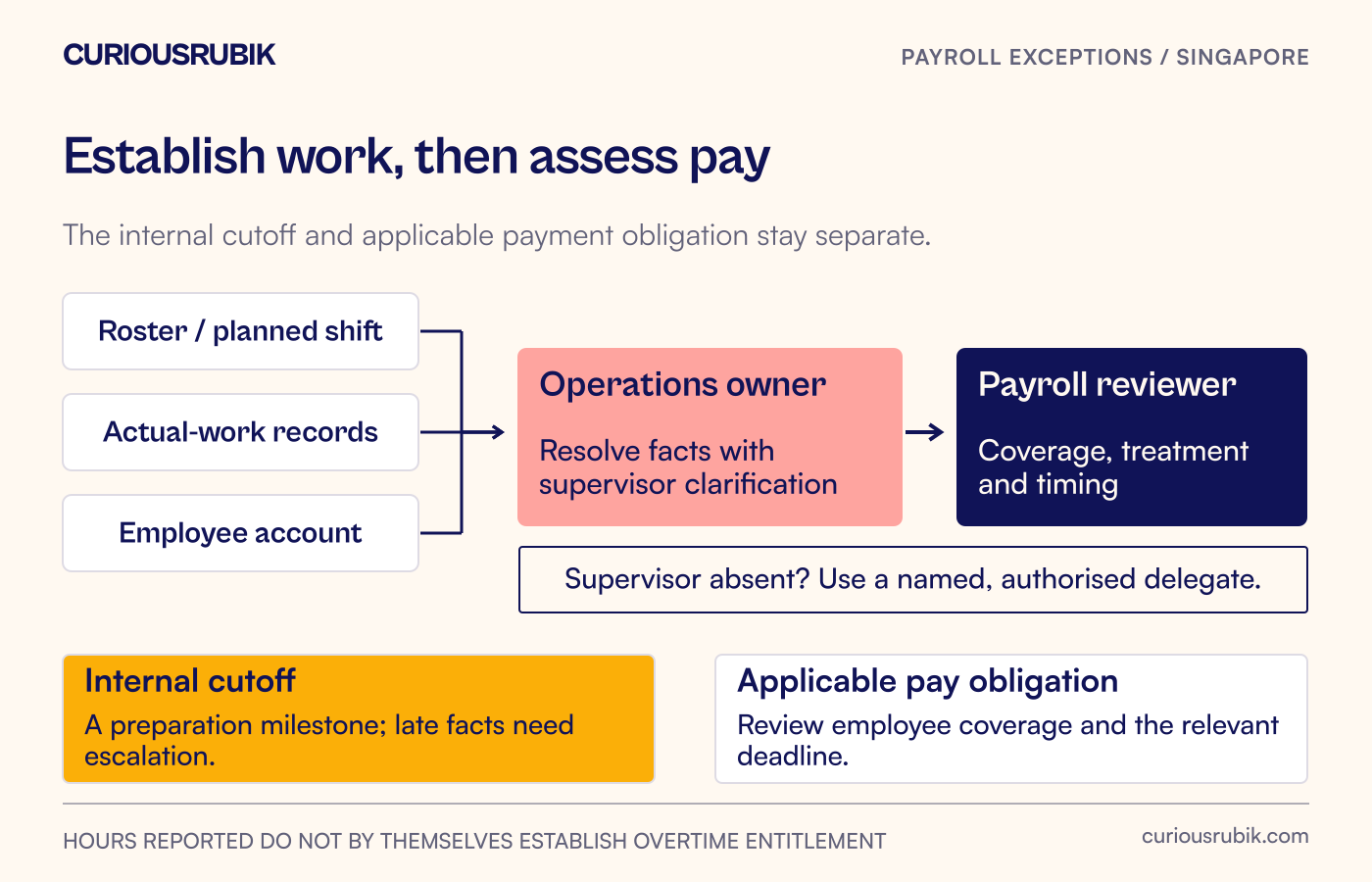
Payroll should not choose whichever source is easiest to import. The operations manager needs to establish the actual work using relevant records and the employee's account. A roster describes the plan; a clocking record may need explanation; a supervisor's recollection may be incomplete. The evidence has to be considered together.
Record the disputed period, hours claimed, available support and exact point of disagreement. If the issue is simply an approval timestamp, distinguish it from a disagreement about whether work occurred. The two situations should not enter the same vague “late timesheet” category.
The payroll owner then determines the appropriate pay treatment using the employee's coverage, contract and applicable rules. Four additional hours in a hypothetical example do not establish a universal overtime entitlement or calculation.
For employees covered by the Employment Act, MOM states that salary must generally be paid within seven days after the salary period and overtime within fourteen days. Final-pay situations have their own rules. Part IV coverage also matters when assessing statutory hours-of-work and overtime provisions; it is not identical for every employee.
A company's earlier submission and approval cutoffs are operational controls. They should create enough time for checking and payment. Missing one does not, by itself, determine that wages are not due or authorise a deduction.
Show the applicable payment obligation and the remaining preparation time in the exception record. Payroll may need an urgent reviewed correction, an approved off-cycle process or another lawful route. The correct response depends on the facts and timing, and should be determined by the responsible payroll or employment specialist.
Do not conceal a late item by moving its work date into the next period. Preserve when the work occurred, when the business learned of the issue and how the eventual payment was handled.
CURIOUSRUBIK PAYROLL EXCEPTIONS / SINGAPORE Establish work, then assess pay The internal cutoff and applicable payment obligation stay separate. Roster / planned shift Actual-work records Employee account Operations owner Resolve facts with supervisor clarification Payroll reviewer Coverage, treatment and timing Supervisor absent? Use a named, authorised delegate. Internal cutoff A preparation milestone; late facts need escalation. Applicable pay obligation Review employee coverage and the relevant deadline. HOURS REPORTED DO NOT BY THEMSELVES ESTABLISH OVERTIME ENTITLEMENT curiousrubik.com
A workable log is more useful than a folder of corrected time files. For each case it should show:
Use the minimum personal information needed and restrict access. A broad operations tracker usually needs a case reference and status, not the employee's full pay history.
The log should retain the original submission and approved correction. Replacing a file without a change record makes it difficult to distinguish a legitimate amendment from an accidental alteration. Note who changed what and why.
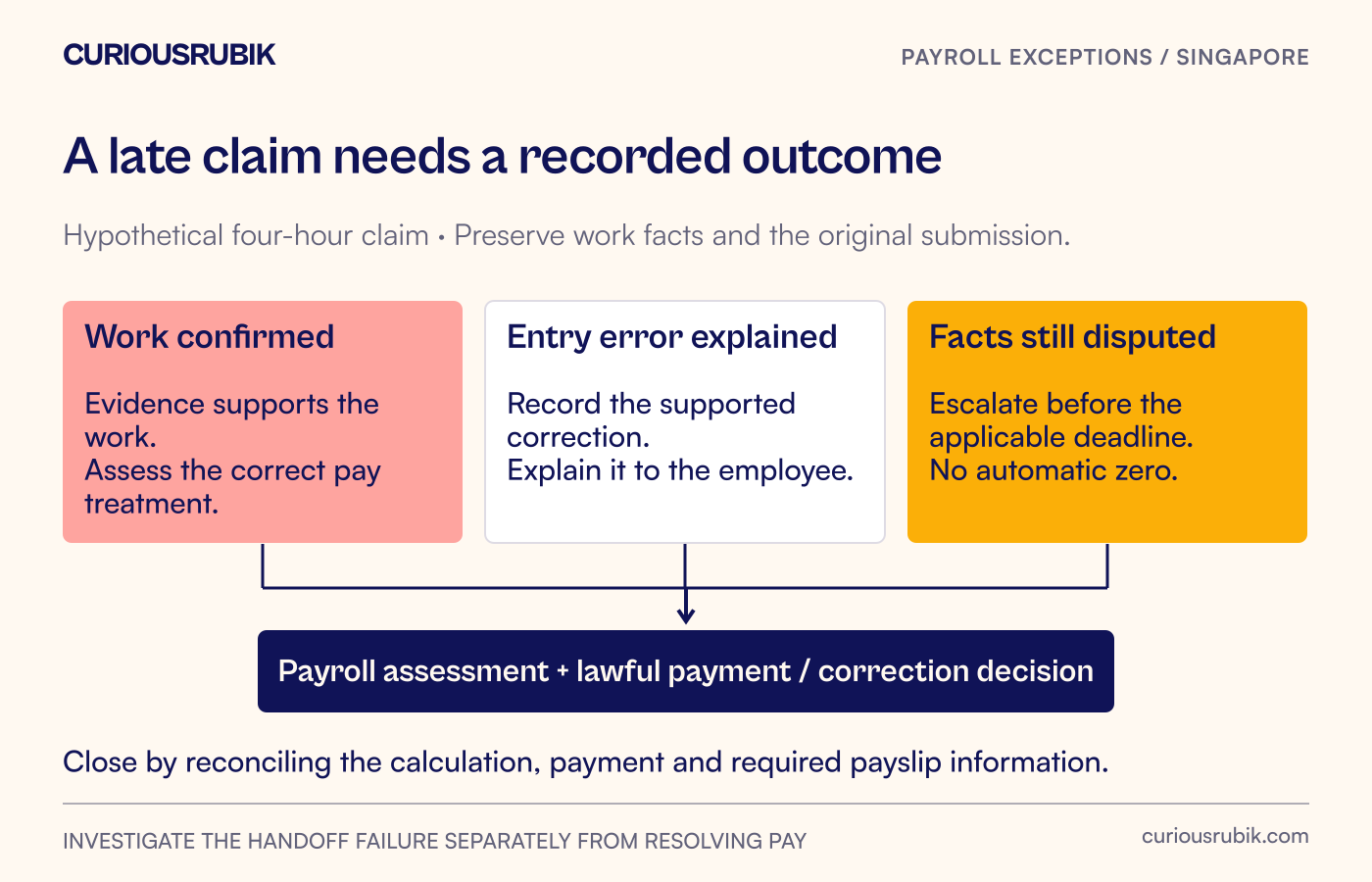
In the first outcome, the records support the four additional hours and the supervisor confirms the work. Payroll assesses the correct treatment and incorporates the approved correction through the appropriate route. The case closes only when the calculation and payment are reconciled, with any required payslip information handled.
In the second outcome, the employee's entry contains an error. Operations explains the discrepancy and records the evidence and resolved facts. Payroll uses the supported result. The employee should receive a clear explanation and a route to raise a remaining concern; a silent change to the time file invites confusion.
In the third outcome, the evidence remains genuinely disputed as the payment deadline approaches. The operations manager and payroll owner escalate immediately to the authorised specialist. The case needs a lawful decision on what to pay and how to resolve the remaining dispute. Automation should surface that decision, not default the contested amount to zero.
These outcomes separate factual review from process blame. The business can investigate why a supervisor repeatedly misses approvals without treating every affected employee as responsible for the delay.
CURIOUSRUBIK PAYROLL EXCEPTIONS / SINGAPORE A late claim needs a recorded outcome Hypothetical four-hour claim · Preserve work facts and the original submission. Work confirmed Evidence supports the work. Assess the correct pay treatment. Entry error explained Record the supported correction. Explain it to the employee. Facts still disputed Escalate before the applicable deadline. No automatic zero. Payroll assessment + lawful payment / correction decision Close by reconciling the calculation, payment and required payslip information. INVESTIGATE THE HANDOFF FAILURE SEPARATELY FROM RESOLVING PAY curiousrubik.com
A reminder only reaches the items the system knows about. Before payroll closes, compare the expected population with the submitted population. Which employees were scheduled to work but have no record? Which shifts changed? Which submissions remain unreviewed?
Give supervisors a concise exception list instead of asking them to reconfirm every ordinary shift. Require an answer that resolves the fact: confirmed work, correction attached or a specific question requiring escalation. “Will check later” should carry an owner and a deadline that reflects the remaining payroll window.
Absence cover matters here. A supervisor on leave should have a delegate who can access the relevant evidence and has authority to confirm the work. Sending repeated reminders to the absent supervisor does not provide a control.
Where source data fails, make the affected population visible. A successful import of a partial file can be more misleading than an obvious technical failure. Payroll needs to know which employees or dates may be missing before approving the run.
Late facts will not disappear completely. Agree a controlled route for adding a correction after the normal cutoff, including who approves it, how duplicate payment is prevented and how the original period remains traceable.
A correction submitted through that route should enter the same entitlement and calculation review as an on-time item. Urgency may justify faster coordination; it does not justify an unreviewed amount or an unexplained manual adjustment.
Check the downstream records. MOM requires itemised payslips for covered employees, with applicable components shown. The employee, payroll records and payment record should tell a consistent story after the correction. A bank transfer alone may leave the underlying payroll explanation incomplete.
After resolving the pay question, review the cause. Was the roster inaccurate, the submission route inaccessible, the approval owner absent or the cutoff misunderstood? Different causes need different fixes.
Track repeated late approvals by process, unresolved cases near payment deadlines, corrections after release and duplicate or missed payments. Avoid using the number of reminders as the success measure. A process that requires daily chasing may still depend on an unclear handoff.
For the next payroll cycle, ask the operations manager to identify who can resolve a missing-hours case when the normal supervisor is unavailable. Give that person the evidence route and escalation authority. A named, prepared backup is more valuable than another automatic reminder sent to the wrong inbox.