A customer sends a purchase order by email. Later, another contact submits a revised copy through a different channel. One version changes the delivery date and removes a line. If both messages become new orders, the distributor may pick twice, reserve too much stock and invoice against instructions the customer thought it had replaced.
The control begins with order identity and customer intent. A revised document should be compared with the accepted order before it changes fulfilment. The purchase-order number is useful evidence, but it cannot safely make that decision on its own.
For a Singapore distributor serving local and regional customers, the task is to maintain one explainable sequence from customer instruction to accepted revision, fulfilment and billing. Automation can find similarities and differences. People must resolve ambiguity and decide what can still change.
Begin with the customer's legal entity, the seller's legal entity, the customer reference and the relevant commercial context. A regional group may reuse purchase-order numbers across companies. A customer may also place repeat orders under a blanket reference. Identical numbers do not necessarily mean duplicate demand.
Conversely, a revised document may have a different filename or an amended reference. The content and customer instruction can still show that it replaces an earlier order. A duplicate check that compares only filenames or exact reference text will miss that relationship.
Create a stable internal order identity once the original instruction is accepted. Keep each incoming document or message as a separate source event linked to that identity when confirmed. Record whether it is an original, duplicate copy, proposed revision, additional order or unresolved instruction.
This is especially important when the revised file arrives through a different team. The channel should not determine whether an order is new. Sales, the order desk and fulfilment need a common place to see the accepted version and unresolved changes.
A customer can insert a new line and renumber everything below it. Treating line three in one file as identical to line three in the next can produce a misleading comparison. Match using product identity, specification and context, while presenting uncertain matches for review.
A revision comparison sheet should show:
Show omissions explicitly. If a line disappears from the revised document, it may mean cancellation, an incomplete attachment or a separate instruction for that line. The order desk should not assume which explanation is correct when customer intent is unclear.
Keep unit changes visible. A revision from “10 cartons” to “10 units” is not an unchanged quantity. Likewise, a new delivery address can require a different operational and commercial review even when every product line stays the same.
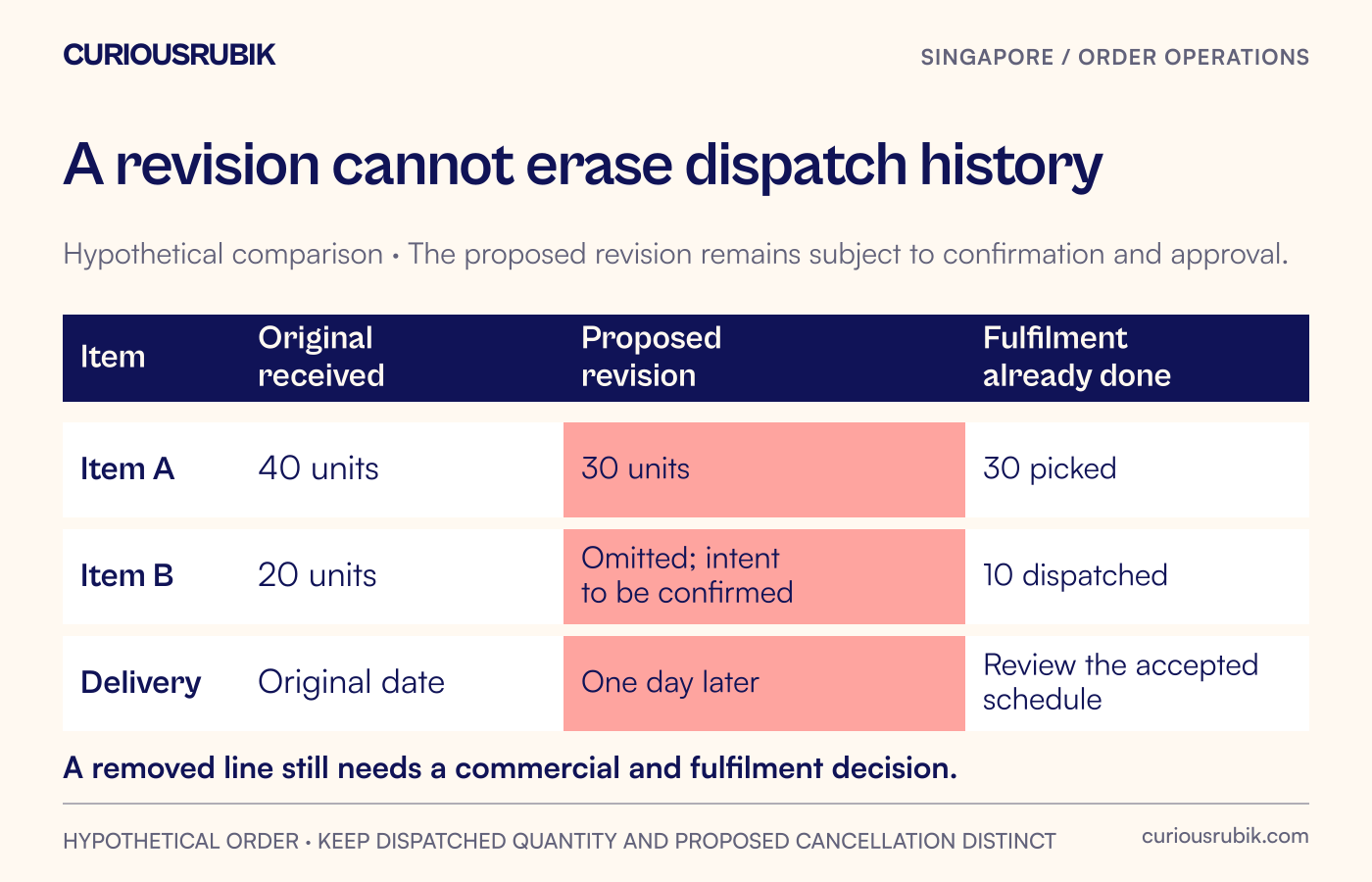
Consider a hypothetical order for forty units of one item and twenty of another. The revised document reduces the first item to thirty, removes the second and requests delivery one day later. Before allocation or picking, the order desk can confirm the customer's intent and obtain any required commercial approval before updating the accepted order.
The same request is harder after thirty units of the first item have been picked and ten units of the second have been dispatched. The revision cannot erase the physical movement. Fulfilment needs to determine what can be stopped or returned, and the account owner needs to resolve the commercial treatment with the customer.
The comparison should distinguish requested final demand from the additional action still possible. For example, “remove the second line” is not automatically an instruction to record zero delivered. Keep dispatched quantity, remaining quantity and proposed cancellation separate.
CURIOUSRUBIK SINGAPORE / ORDER OPERATIONS A revision cannot erase dispatch history Hypothetical comparison · The proposed revision remains subject to confirmation and approval. Item Original received Proposed revision Fulfilment already done Item A 40 units 30 units 30 picked Item B 20 units Omitted; intent to be confirmed 10 dispatched Delivery Original date One day later Review the accepted schedule A removed line still needs a commercial and fulfilment decision. HYPOTHETICAL ORDER · KEEP DISPATCHED QUANTITY AND PROPOSED CANCELLATION DISTINCT curiousrubik.com
A practical set of internal freeze points might include order acceptance, stock allocation, picking, dispatch and invoicing. These are recommended operational boundaries. They do not replace contract terms or establish that a customer has lost a legal right to request a change.
For each point, specify who must participate. The order desk may resolve a duplicate copy without involving the warehouse. A change after allocation may require stock release. A change after dispatch needs logistics and commercial review. An invoiced transaction may need the appropriate document correction rather than an edit to the original invoice.
The exception owner is the order desk until the revision is classified and assigned. The account owner confirms ambiguous customer instructions. Fulfilment decides what is operationally possible, while the authorised commercial owner decides the agreed outcome. Record disagreement rather than letting the last person to edit a field determine the result.
Use a visible pending state for affected work. If only one line is unresolved, decide whether the unaffected lines can continue. A blanket hold can unnecessarily delay valid demand; no hold at all can release stock against instructions everyone knows are under review.
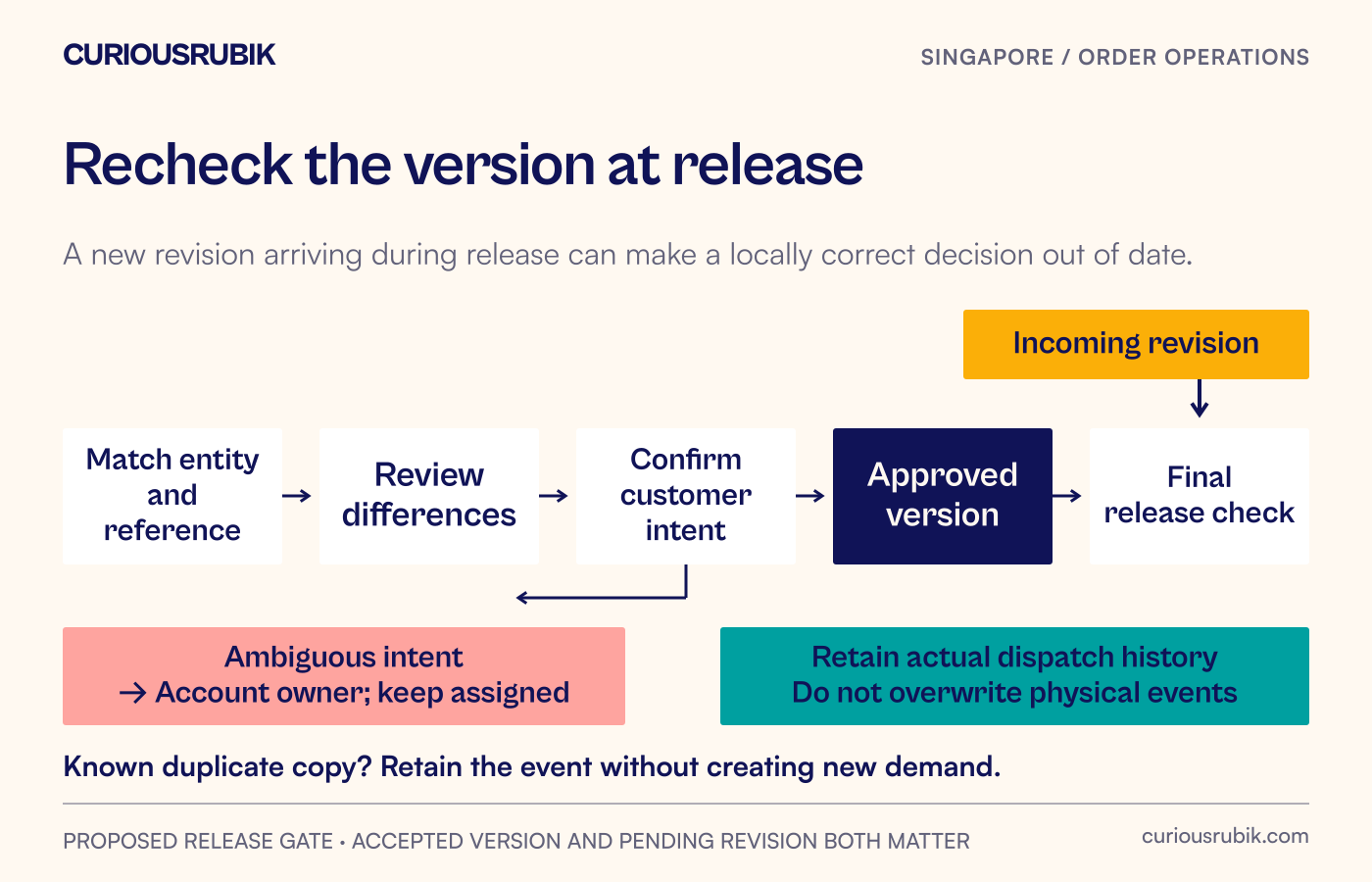
The most subtle failure occurs when two teams act almost simultaneously. One releases the original order while another approves the revision. Both may follow their local process correctly, yet the combined result is wrong.
Require a version check at release. The release decision should identify which accepted version it used and whether a pending revision affects its lines. If the accepted version changes before release completes, the relevant work should be rechecked. The precise implementation can vary, but the business rule needs to be explicit.
Protect against a customer resending the same file several times too. Once a source instruction is linked and classified as a duplicate copy, a repeated import should not create another order or reopen a completed change unnecessarily. Keep the received event for traceability while preserving the existing outcome.
CURIOUSRUBIK SINGAPORE / ORDER OPERATIONS Recheck the version at release A new revision arriving during release can make a locally correct decision out of date. Incoming revision Match entity and reference Review differences Confirm customer intent Approved version Final release check Ambiguous intent → Account owner; keep assigned Retain actual dispatch history Do not overwrite physical events Known duplicate copy? Retain the event without creating new demand. PROPOSED RELEASE GATE · ACCEPTED VERSION AND PENDING REVISION BOTH MATTER curiousrubik.com
Automation can flag likely duplicates across incoming channels using several attributes, including entities, references, products and dates. It can display a difference view and bring together open fulfilment activity. That gives the order desk a useful starting point.
The match should express uncertainty. A common customer reference used for many orders will generate false positives. Tune the check using reviewed cases and retain a clear reason when two similar documents are confirmed as separate orders.
Do not automatically merge by purchase-order number, replace the original document or delete a cancelled line's history. Those shortcuts may reduce visible duplication while making disputes harder to explain. The retained record should show what the customer sent, what the business accepted and what was carried out.
For Singapore companies, IRAS's record-keeping guidance requires transactions to remain explainable through supporting records. The comparison sheet is a recommended way to preserve that explanation for revisions. It is not itself proof that a customer accepted the revised commercial terms.
A pilot should include a duplicate copy, a genuine additional order with a reused reference, a changed legal entity, an omitted line and a revision arriving during picking. Use hypothetical or suitably controlled records and have both the order desk and fulfilment team review the expected outcome.
Measure duplicate orders released, time spent resolving ambiguous resubmissions and revisions discovered only after dispatch. Also measure false holds. A duplicate detector that stops every repeat customer order can create a different service problem while reporting high detection activity.
Review a sample of closed cases. Can another person reconstruct the accepted quantity, the source of customer confirmation and the effect on picking, dispatch and billing? If not, the team has recorded a status without preserving the decision.
Start with the last purchase order that a customer resent. Place the versions beside the fulfilment history and identify the point at which the business decided whether the second message replaced, added to or merely repeated the first. That is the handoff to make explicit before automating more order intake.