An accounts payable program should be designed around a controlled path from an authorized purchase to a correctly settled obligation. Reading an invoice is one step in that path. If the supplier record is unreliable, the receipt is missing, or the payment instruction cannot be trusted, faster extraction simply moves the invoice into another queue.
For a finance operations leader, the investment decision is where automation will remove the constraint that prevents valid obligations from becoming payment-ready. The answer may lie in procurement, receiving, supplier maintenance, exception ownership, or settlement reconciliation. Measuring success only by invoices captured per hour can reward improvement in the least constrained part of the process.
Define the intended outcome precisely: a valid obligation, supported by appropriate evidence, assigned to the correct entity, approved under the organization’s rules, paid through an authorized process, and reconciled to settlement. Local tax, accounting, and payment requirements must be assessed separately. A standard workflow diagram does not establish compliance across jurisdictions.
A purchase request describes a need. An approved order establishes the authorized arrangement within the organization’s process. Receipt evidence shows what was delivered or accepted. An invoice states the supplier’s claim. Payment evidence records settlement activity. These records are related, but none should silently stand in for all the others.
For physical goods, receipt evidence may be a warehouse event. For services, it may be an accountable confirmation of completed work or an agreed milestone. A generic “received” field can be too weak when the underlying service is disputed. Design the evidence requirement for the type of purchase.
Preserve the relationships among records. One invoice can cover several orders; one order can produce several invoices; credits and partial receipts can change the remaining obligation. A system built around a simplistic one-to-one match will generate avoidable exceptions or encourage users to bypass checks.
A useful process design makes disagreements explicit. If the price differs, procurement or the contract owner may need to resolve it. If quantity is disputed, receiving may hold the facts. If the tax treatment is uncertain, an appropriately qualified specialist may need to assess it. AP should coordinate the issue without becoming the default owner of every missing business fact.
An invoice can be genuine while a proposed payment destination is fraudulent or incorrect. Keep supplier identity, contractual terms, and payment instructions under controlled ownership. Changes to payment details deserve a distinct verification and approval route rather than flowing through ordinary invoice extraction.
The FBI’s December 2016 business-email-compromise guidance recommends verifying payment requests and vendor-payment changes using previously known telephone numbers rather than numbers supplied in the requesting email. This is a practical security reference, not proof that any single verification step eliminates fraud. FBI, business-email-compromise prevention guidance
Translate that principle into an operating procedure. Record the request, the established contact method used for verification, the person who performed the check, the approval, and the effective change. Avoid relying on contact details supplied only in the same change request. Escalate conflicting evidence rather than treating urgency as justification to bypass the process.
Separate responsibilities where feasible. The person who maintains payment details should not automatically gain the ability to release the resulting payment. Smaller teams may need carefully designed alternative reviews. The appropriate design depends on the risk, staffing, systems, and applicable obligations, and should be evaluated by the responsible control owner.
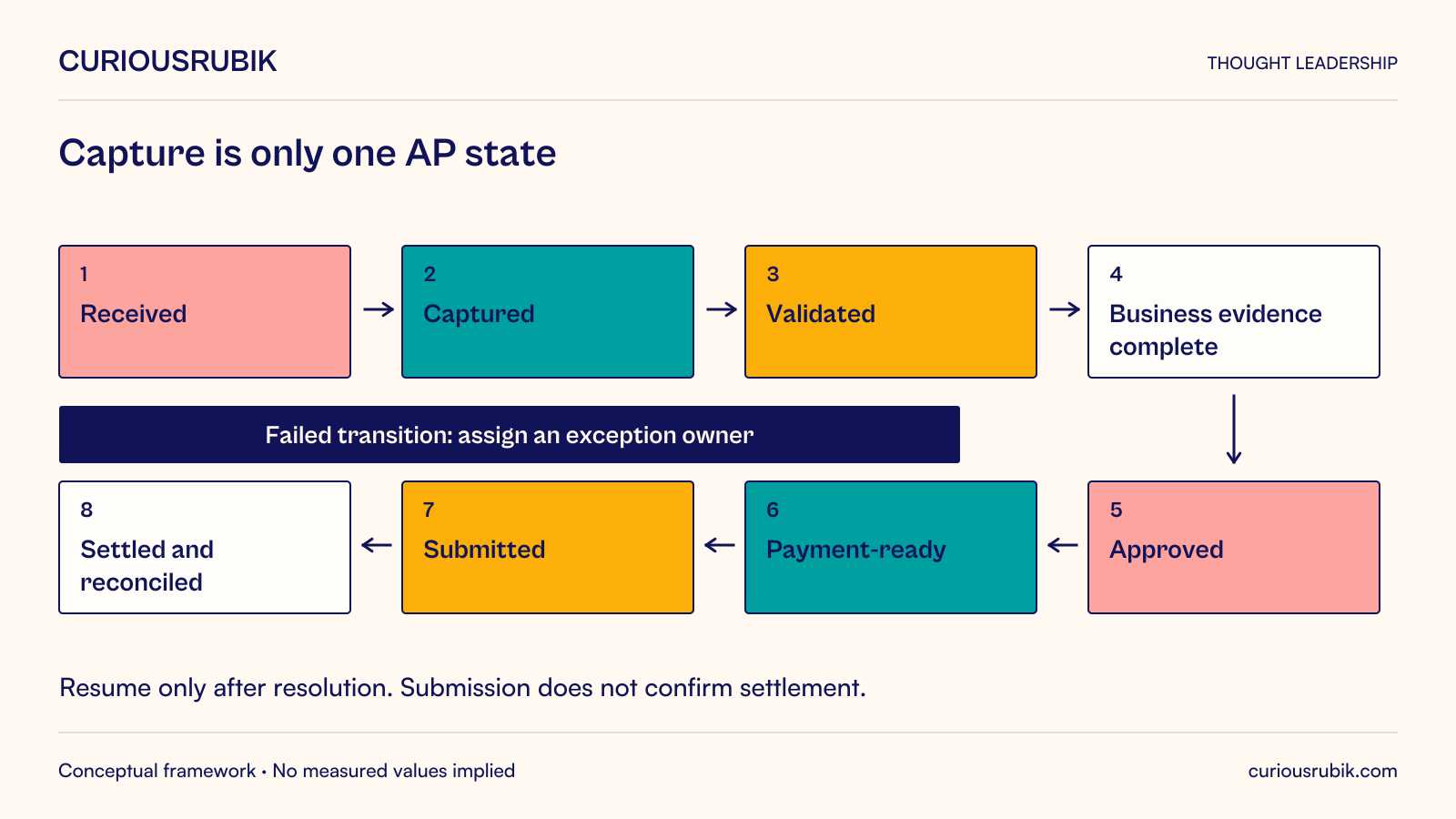
Define the states that matter: received, captured, validated, awaiting business evidence, awaiting approval, payment-ready, submitted for payment, and reconciled as settled. These are suggested operating states, not universal accounting categories. State transitions should have clear entry evidence and ownership.
“Submitted for payment” must remain distinct from “settled.” A bank or payment service may reject a file, an instruction may fail, or a payment may be returned. The process needs a way to establish the actual outcome and prevent a duplicate instruction during recovery.
Use a unique identifier that survives capture, approval, payment preparation, and reconciliation. For duplicate detection, consider the available supplier, invoice, amount, currency, and entity context instead of relying on one field. A suspected duplicate should be investigated; similar invoices can be legitimate recurring charges.
When a document is corrected or resubmitted, retain the relationship to the earlier version. Otherwise the system can treat the correction as a new obligation while leaving the original active. The workflow should establish which version is authoritative before payment preparation.
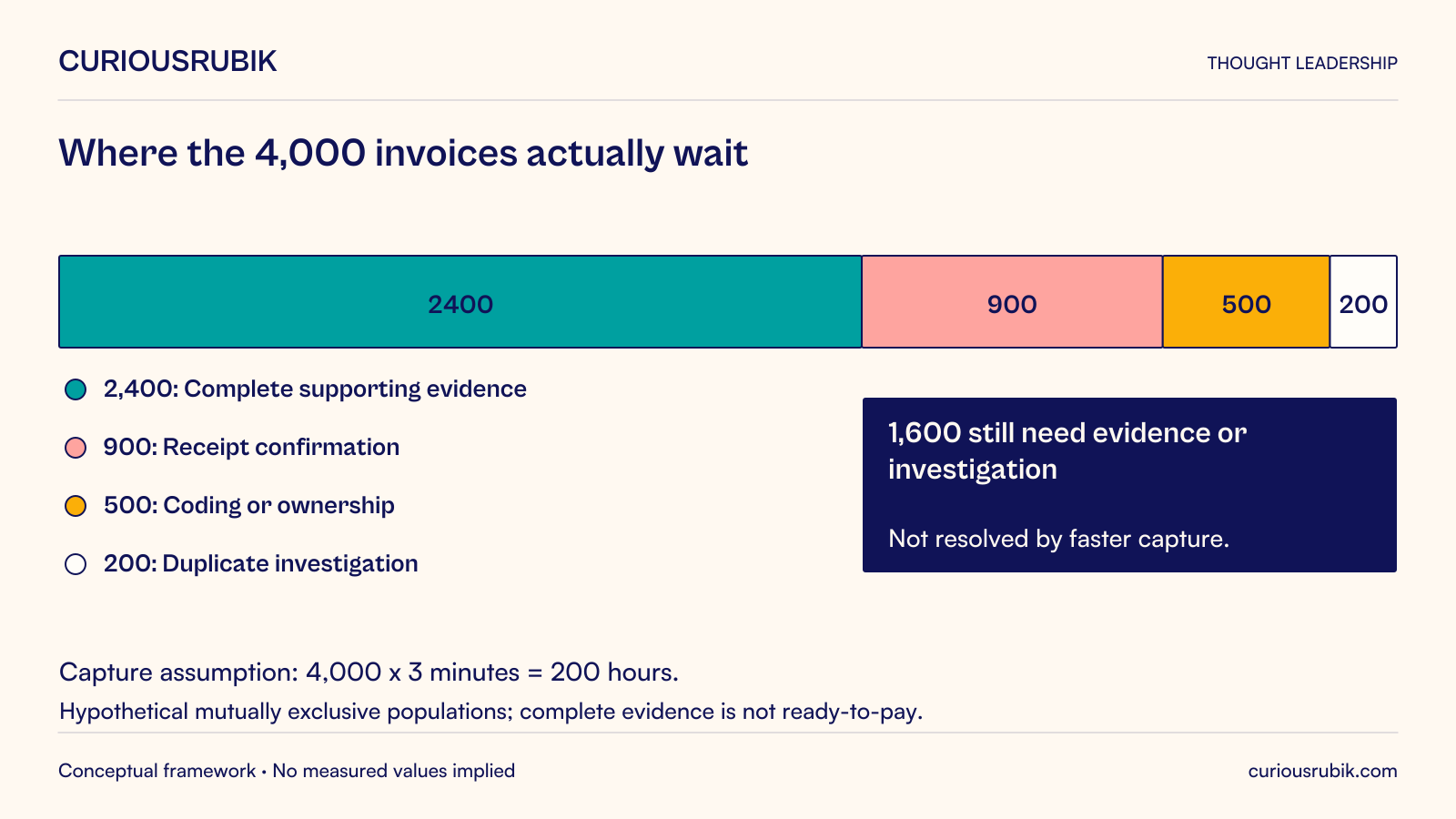
Suppose a hypothetical company receives 4,000 invoices per month. Analysis finds 2,400 with complete supporting evidence, 900 awaiting receipt confirmation, 500 needing coding or ownership resolution, and 200 requiring duplicate investigation. These categories are mutually exclusive for this example and total the 4,000 received invoices.
A capture tool is projected to remove three minutes of entry work per invoice, equivalent to 12,000 minutes or 200 hours. That is a planning assumption to test, not a promised saving. It does not resolve the 1,600 invoices outside the ready-evidence group, nor establish that the 2,400 can all be paid immediately under the approval rules.
Suppose receipt confirmation currently takes a median of five working days in the hypothetical sample, while capture takes one hour. Reducing capture to minutes leaves the primary receipt delay largely intact. A receiving workflow that assigns an accountable owner and exposes unconfirmed deliveries may have greater influence on end-to-end time.
The finance leader should request a combined design: reliable extraction for all applicable documents, a specific improvement to receipt confirmation, and separate coding and duplicate queues. The business case should count entry effort and waiting time independently. A reduction in elapsed time does not automatically release labor, and released labor does not automatically reduce expenditure.
The first pilot should include all four populations. Selecting only complete invoices would demonstrate extraction and matching under favorable conditions while excluding the cases that determine the operating workload. Measure investigation effort as well as completion speed before deciding how far to expand.
Each exception should contain a reason that someone can act on. “Failed match” is a technical outcome; “invoiced quantity exceeds accepted quantity by ten units” directs the issue to receiving or the order owner. Attach the relevant evidence and identify the decision needed.
Use routing based on the underlying question, with a fallback owner when the system cannot determine the right person. Define escalation according to the payment deadline and business consequence. The queue should show age, blocking reason, and next action, not merely the number of documents waiting.
Measure repeated exceptions by supplier, purchasing team, purchase category, and reason where those dimensions are reliable. A supplier repeatedly omitting an order reference may need clearer instructions. A business unit repeatedly confirming receipt late may need a workflow change. Do not treat every recurring issue as a reason to relax matching tolerances.
Allow an authorized override only with a recorded rationale and appropriate review. Overrides are sometimes necessary, but patterns of overrides can reveal a broken process or an overly restrictive rule. Reviewing them is more informative than celebrating a low visible exception count produced by silent bypasses.
Payment reconciliation should connect authorized obligations, submitted instructions, and confirmed settlement. Investigate differences such as rejected items, returned payments, charges, and unexpected amounts through the appropriate owners. The exact treatment will depend on the payment method, agreement, and accounting policy.
Supplier communication should reflect the actual status. A remittance notice generated from a prepared file may be misleading if the payment has not been accepted. Decide which event triggers the notice and how later failures are communicated through authorized channels. The workflow should prevent staff from telling a supplier that a payment is complete based only on an internal approval.
Preserve evidence across the process. The controller should be able to trace an item from source document through corrections and approvals to settlement, and identify who changed a consequential field. Access to that evidence must still respect information sensitivity and retention obligations.
COSO’s 2013 framework addresses risk-responsive control activities and continuing evaluation. These principles support evaluating the complete AP process; they do not prescribe one matching rule or automation percentage. COSO Executive Summary, Principles 10 and 16
Track payment-ready lead time, exception age, repeated root causes, rejected or returned payments, and the effort required to investigate them. Interpret invoice capture metrics alongside these measures. Improvements that move work from AP to procurement or suppliers should be assessed across the full process rather than reported as an isolated saving.
There are limits to automation. A low-volume service purchase with ambiguous acceptance may still require a conversation. Suppliers may not provide structured documents. Some entities may need different approval or evidence arrangements. A common operating model can accommodate these variations when they are explicit and owned.
Take the last payment cycle and identify the largest population of valid obligations that was not ready when needed. Trace its blocking evidence to the responsible source. Fund the change that improves that handoff, and verify its effect through settlement. That is how AP automation grows beyond document capture into a dependable financial operation.