An enterprise program can use two-week development cycles and still postpone its most important learning until final integration. Another can have formal approval gates while testing difficult assumptions early and adapting its design. The methodology label does not tell the sponsor how quickly uncertainty is reduced or how safely the business can adopt a release.
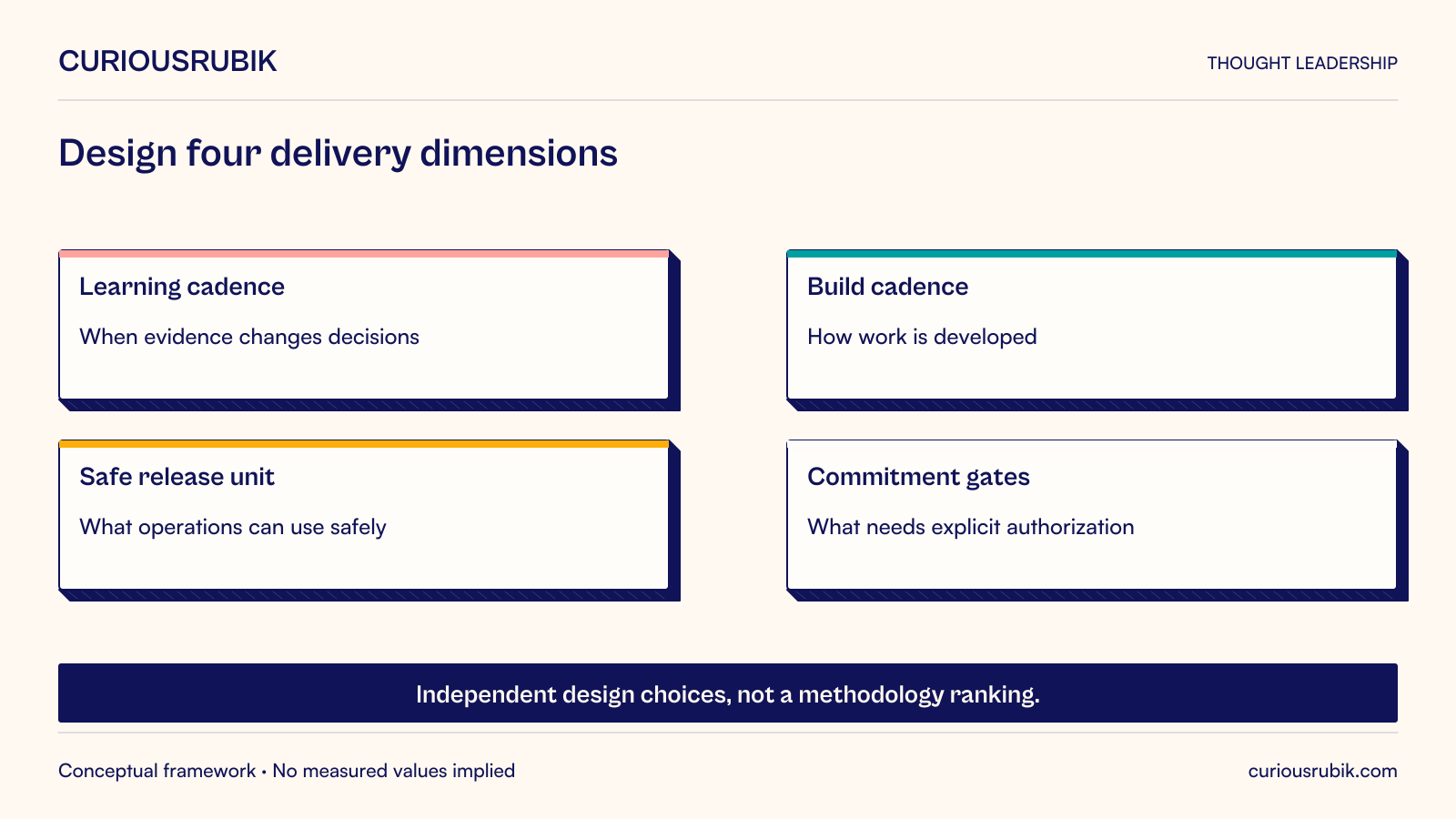
Choose a delivery model by separating four decisions: how the team learns, how it builds, how capabilities are released and how consequential commitments are authorized. Those decisions need to fit the work, the operating environment and the organization’s capacity to participate.
For a CIO or program sponsor, the useful question is therefore not which label is most modern. It is which combination of feedback, sequencing, release boundaries and governance makes the next commitment credible.
In common project usage, waterfall describes a largely sequential progression through defined phases, with substantial requirements and design work preceding build and test. Agile approaches emphasize iterative development, feedback and adaptation. Hybrid is used for many combinations, so it has little meaning until the team explains its actual operating model.
Avoid caricatures. A sequential plan can include prototypes and feedback. An agile team still needs architecture, security, planning and financial discipline. A hybrid approach can be thoughtful or can simply duplicate ceremonies from incompatible methods.
The Agile Manifesto’s principles emphasize frequent delivery of useful software, collaboration between business and development, technical quality and regular improvement. Those principles do not imply that every enterprise capability can safely be released independently every few weeks. The release unit depends on the business and technical boundaries. Principles behind the Agile Manifesto.
Write down the practices the program will use instead of relying on the label. How are priorities chosen? Who provides feedback? What counts as completed work? When can a design decision change? What evidence authorizes release? Those answers reveal the model the organization is actually buying.
A team can learn every week without deploying every week. Prototypes, configuration demonstrations, data rehearsals and end-to-end tests can expose uncertainty before a production release is safe.
Conversely, a frequent deployment schedule does not guarantee useful learning. If the team releases minor changes while avoiding the difficult data or operating-model questions, it may be moving quickly around the real risk.
Choose feedback activities around assumptions that matter. A user-interface question may benefit from repeated task testing with representative users. A data-conversion question may require profiling and reconciliation. An integration question may require testing failure and recovery against a real dependency.
Specify what the feedback can change. Inviting users to demonstrations while treating every comment as out of scope creates a misleading appearance of participation. The program needs a route to evaluate learning, update priorities and revise commitments where justified.
The smallest buildable feature is not always the smallest operable release. A customer-order process may require pricing, availability, fulfillment, billing and support to work together. Releasing only one element can create a new manual boundary unless coexistence is deliberately designed.
Look for slices that produce a usable business outcome with controlled dependencies. A pilot for one product line, location or transaction class may be viable if the surrounding systems can support it and the limitations are clear. A technical component with no usable operational path is not equivalent to an incremental business release.
Account for data ownership during coexistence. If old and new systems both operate, define which owns each fact, how changes move between them and how the transition ends. A phased rollout can reduce some risks while increasing the duration of reconciliation and support complexity.
Where a coordinated cutover is necessary, preserve early learning through rehearsals and integrated testing. A single production transition does not require waiting until the end to discover whether the design works.
Some choices are inexpensive to revise; others create durable obligations or operational exposure. A prototype screen can change quickly. A major commercial agreement, migration of authoritative records or shutdown of an old service needs stronger evidence and appropriate approval.
Use gates for those consequential commitments. A gate should evaluate evidence and alternatives, not merely confirm that a document was produced. The team should know what decision the gate will make and what would justify proceeding, narrowing scope or pausing.
Within approved boundaries, allow delivery teams to make routine decisions without unnecessary escalation. A program that requires executive approval for every small backlog adjustment cannot obtain the responsiveness it expects from iterative work.
This distinction supports a coherent hybrid model: frequent learning and delivery within boundaries, with explicit authorization when the business crosses a material commitment. It does not require combining every meeting and artifact associated with several methodologies.
Consider a hypothetical distributor replacing its customer-order platform. Its storefront navigation is uncertain because different customer groups use the catalog differently. Its core pricing rules are comparatively well understood. Its warehouse interface depends on an external operator with scheduled test windows. Its final transition requires a controlled transfer of open orders.
The team can iterate rapidly on navigation using representative tasks and feedback. It can specify and test stable pricing rules with concrete examples, while retaining a change process for discovered exceptions. It must schedule interface validation around the operator’s availability and expose that dependency in the integrated plan.
The production release may use a bounded customer group only if order ownership, service support and rollback or forward recovery are credible during coexistence. If those conditions cannot be met, the team can still perform repeated end-to-end rehearsals before a coordinated release.
Calling the whole program agile does not remove the external test dependency. Calling it waterfall does not justify postponing customer feedback. Calling it hybrid adds value only when these different cadences and boundaries are explicit.
The example is illustrative, not evidence that this combination is optimal for every distributor. The choice depends on the actual contracts, architecture, operating constraints and risk tolerance.
Iterative delivery needs timely access to business judgment. If the product owner cannot make decisions or users are unavailable for feedback, short cycles can produce repeated rework or a backlog of unanswered questions.
A more sequential approach needs enough stability and evidence to support its early commitments. If the business model or requirements remain highly uncertain, detailed upfront plans may conceal assumptions that will change later.
Both approaches need environments, data, testing, integration and operational ownership. A team cannot compensate for a missing test environment simply by changing its meeting format.
GAO’s 2012 review of agile practices in federal projects identified challenges including staff availability, collaboration, procurement and review practices. It was based on a limited set of government experiences, not a universal comparison of methodology success rates. Its relevance is that delivery practices depend on the surrounding organization, not only the development team. GAO review of agile practices and challenges.
Before selecting a model, ask the proposed team to show how decisions, feedback and external dependencies will work with the people actually available.
A delivery model can be undermined by a contract or reporting system that rewards different behavior. If learning is expected but every change to an early specification becomes a prolonged dispute, the program needs a clearer commercial mechanism for discovery and reprioritization.
Likewise, a fixed milestone can be appropriate when its scope and dependencies are credible. The issue is not whether fixed commitments are inherently wrong, but whether the evidence supports them and the consequences of change are understood.
Track progress through usable outcomes and risk reduction, alongside cost and schedule. A high volume of completed tasks can coexist with unresolved integration or acceptance problems. A gate passed through document approval can coexist with untested operating assumptions.
Avoid comparing teams using incompatible activity measures. Story points, document counts and configuration tasks are not interchangeable units of business value. Management needs a common view of the outcome, evidence and remaining exposure even when teams use different local planning methods.
Document the chosen learning cadence, build approach, release units and authorization points in a short delivery design. State why each fits the work and which assumptions would cause it to change.
Pilot the model on a representative slice. Observe whether feedback arrives in time, dependencies are visible and completed work can be accepted. Adjust practices when evidence shows friction, while preserving the controls needed for consequential commitments.
The best delivery model is one the organization can operate honestly. It makes learning early enough to matter, sequences dependent work credibly and releases capabilities the business can actually use. Select those properties first; the methodology label can follow.