The payroll attachment went to the wrong recipient. The employee reports it immediately, but the report lands in a general inbox. An automatic reply confirms receipt. Nobody has yet accepted responsibility for containing the exposure or assessing what it means.
That gap matters more than the speed of the acknowledgement. A useful incident workflow gets the report to a person who can act, records what is known and preserves uncertainty until qualified responders resolve it. It should work when the sender is worried, the usual manager is absent and the first account of events is incomplete.
The assessment route below concerns personal data in the business's own possession or control. If the business acts as a data intermediary processing personal data for another organisation, it must notify that organisation without undue delay when it has reason to believe a breach occurred. The response plan needs that escalation route rather than assuming the intermediary owns the same notification decisions.
Employees should know how to report a suspected incident without first deciding whether it is legally notifiable. Ask for the event, when it happened or was noticed, the systems or records involved and how the responder can reach them. Provide an urgent alternative if the usual route fails.
Do not require the reporter to forward the exposed attachment into a widely accessible ticket. A short description and a controlled evidence reference may be enough to start. The response team can arrange secure access to the underlying material.
The receiving route needs acknowledgement by an accountable responder, not merely successful message delivery. Define the primary incident lead, an available deputy and escalation if neither accepts the case. Make the response arrangement realistic for the business's operating hours and risk.
A useful initial status is “reported; assessment owner accepted”. It says something verifiable. “Resolved” or “no breach” would say more than the available evidence supports.
Consider a hypothetical payroll file sent to an external contact with a similar name to the intended internal recipient. The sender believes it contains this month's payment information. They have requested deletion, but no reply has arrived.
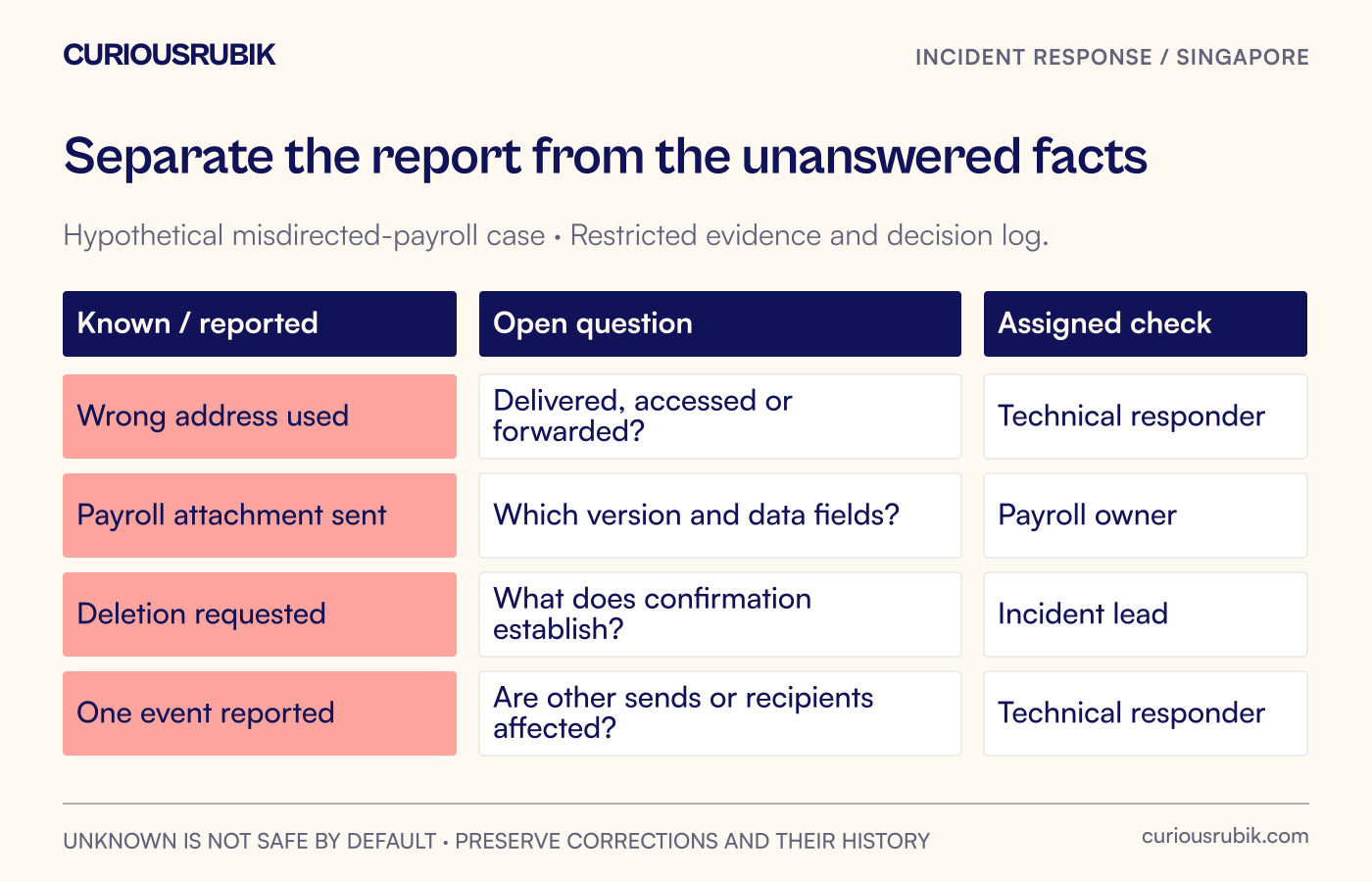
The incident lead opens a restricted decision log. The initial entries separate facts from questions:
| Known or reported fact | Unresolved question | Assigned check |
|---|---|---|
| A message was sent to an unintended address | Was it delivered, accessed or forwarded? | Technical responder examines available evidence |
| The sender identifies a payroll attachment | Which exact version and data fields were included? | Payroll owner checks the retained source |
| Deletion was requested | What confirmation exists, and what does it establish? | Incident lead coordinates recipient contact |
| The event was reported at a recorded time | Are other sends or recipients affected? | Technical responder checks the defined scope |
None of these rows determines notifiability by itself. A small recipient count does not establish low harm. Nor does a large spreadsheet prove how many individuals were actually affected. The qualified privacy or legal owner needs the facts relevant to the applicable tests.
Preserve the original report and evidence. If a later check shows that an older file was attached, update the assessment and keep the correction visible. Do not rewrite the initial account to make it look as though the right facts were known from the beginning.
CURIOUSRUBIK INCIDENT RESPONSE / SINGAPORE Separate the report from the unanswered facts Hypothetical misdirected-payroll case · Restricted evidence and decision log. Known / reported Open question Assigned check Wrong address used Delivered, accessed or forwarded? Technical responder Payroll attachment sent Which version and data fields? Payroll owner Deletion requested What does confirmation establish? Incident lead One event reported Are other sends or recipients affected? Technical responder UNKNOWN IS NOT SAFE BY DEFAULT · PRESERVE CORRECTIONS AND THEIR HISTORY curiousrubik.com
The response plan should authorise appropriate containment by qualified people. Depending on the incident, that could involve restricting an exposed link or stopping an affected sharing route while preserving relevant evidence. The right action depends on the actual system and risk; a generic checklist cannot safely prescribe every technical step.
For an emailed attachment, recalling the message or receiving a deletion assurance may help, but neither should be treated automatically as proof that no exposure occurred. Record what was attempted, what succeeded and what remains uncertain. The assessor determines how that evidence affects the case.
Avoid improvisations that create another exposure. Do not circulate the attachment to every manager for an opinion, post identifying details in a broad incident channel or ask staff to test access using unauthorised accounts. Give each responder the information needed for their assigned check.
The log should distinguish a proposed containment action, approval where required and confirmed completion. An action assigned to someone is still unfinished until its result is known. If containment disrupts a business process, name the person coordinating safe continuity without reopening the exposure.
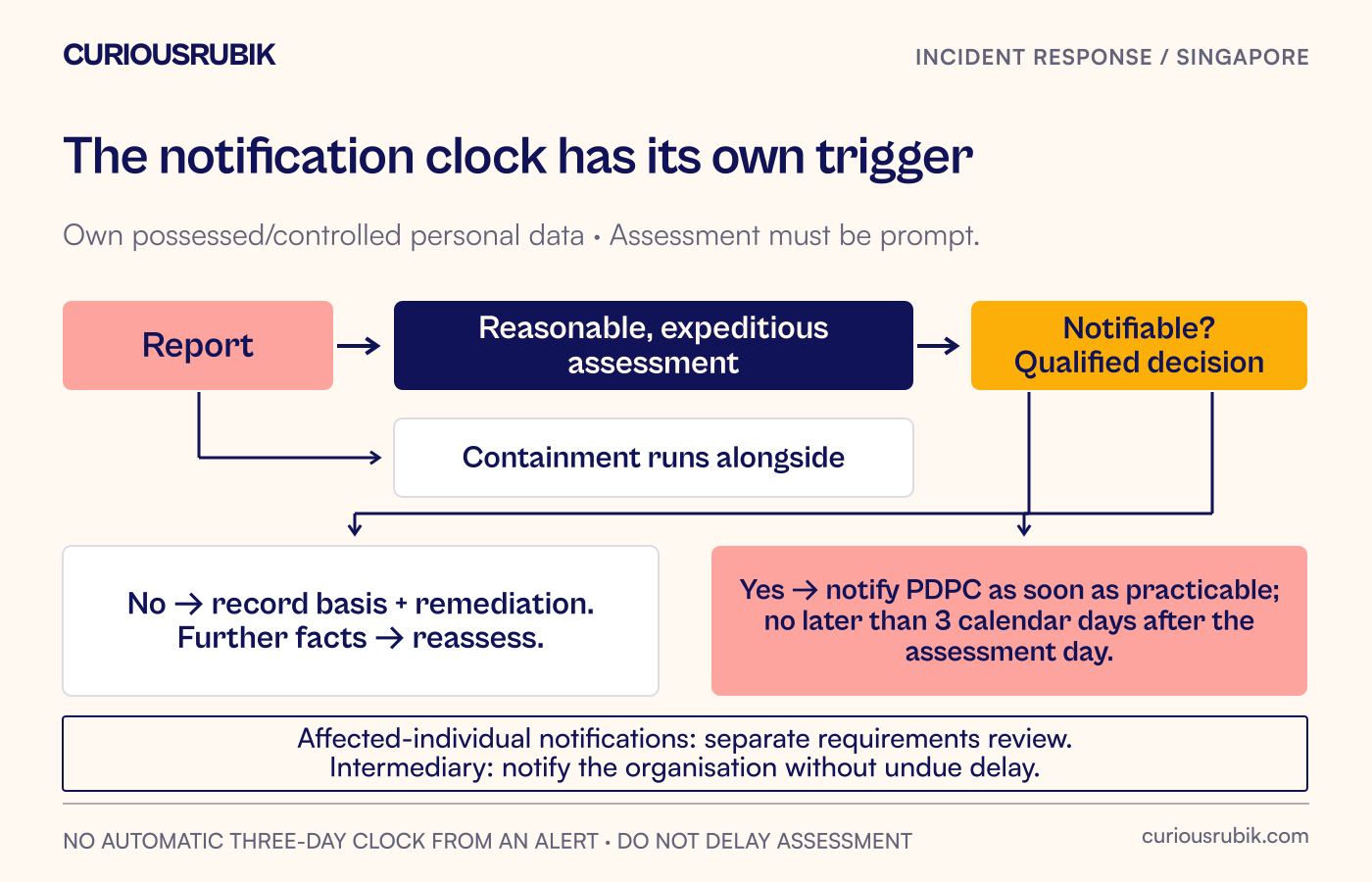
PDPC's breach guidance requires reasonable and expeditious assessment when there are credible grounds to believe a breach occurred, with the assessment steps documented. The business should not wait for a routine weekly review or use incomplete facts as a reason to leave the case unowned.
Once a breach is assessed as notifiable, the PDPA requires notification to PDPC as soon as practicable and no later than three calendar days after the day of that assessment. That is not a rule to notify every automated alert within three days. It is also not permission to delay the assessment.
The privacy or legal owner should assess the significant-harm and significant-scale criteria, the relevant data and circumstances, and any applicable exceptions. Notification to affected individuals has its own requirements; it should not be decided simply by copying the regulator-notification outcome. Specialist review is important, and additional contractual or sector-specific duties may need separate attention.
Record the assessment conclusion, its time, the decision maker, supporting facts and unresolved matters. If the conclusion changes as evidence develops, preserve the sequence and act on the revised assessment. A workflow status should never obscure when the substantive determination was made.
CURIOUSRUBIK INCIDENT RESPONSE / SINGAPORE The notification clock has its own trigger Own possessed/controlled personal data · Assessment must be prompt. Report Reasonable, expeditious assessment Notifiable? Qualified decision Containment runs alongside No → record basis + remediation. Further facts → reassess. Yes → notify PDPC as soon as practicable; no later than 3 calendar days after the assessment day. Affected-individual notifications: separate requirements review. Intermediary: notify the organisation without undue delay. NO AUTOMATIC THREE-DAY CLOCK FROM AN ALERT · DO NOT DELAY ASSESSMENT curiousrubik.com
Automation can notify the response team, preserve timestamps, collect task updates and flag unacknowledged checks. It can prepare a factual summary that clearly separates confirmed information from the reporter's initial account.
It should not announce a breach to all employees, contact affected individuals or submit a regulatory notification just because a classifier applied a label. The authorised responders need to approve the audience, content and required route using the actual assessment. Equally, an automated “low risk” label must not block a human escalation.
Test the summary against the source. If the reporter wrote “I think the file included bank details”, a generated summary must not turn that into either “bank details exposed” or “no financial data involved”. The uncertainty is part of the evidence.
Design the deputy route before it is needed. A reminder that repeatedly reaches the absent DPO without reaching an available authorised responder adds activity while the incident remains unmanaged.
Closure should explain the incident's scope, the assessment and any notifications, completed containment, outstanding commitments and the owner of preventive changes. A non-notifiable conclusion still needs a supported record and appropriate follow-through.
For the hypothetical attachment case, a useful repair might concern recipient verification, file-sharing design or how payroll information is packaged. Investigate the cause before selecting a control. Requiring every employee to acknowledge another reminder may not address an address-selection problem.
Rehearse the reporting route using synthetic data. Include a missing attachment version, an unavailable primary responder and a later fact that changes the assessment. Check whether someone accepts responsibility, evidence stays restricted and the timeline remains reconstructable.
The practical test is not whether the system sent an alert. It is whether a qualified person can show what happened next, which decision remains open and who is responsible for reaching it.