A supplier updates a product's description and sends the next shipment under the same item reference. The purchasing team sees a familiar code, so the old import classification is reused. The change may be a harmless wording improvement. It may also reflect different materials, functions or contents that deserve review.
The business needs a way to distinguish those possibilities before a declaration relies on the old decision. Keep the product evidence, classification rationale and authority to reuse it together. Let automation flag changes and assemble comparisons; a suitably qualified trade reviewer decides what the changes mean.
For a Singapore importer, the useful starting point is an evidence file for one changed product. The questions below describe what that file should answer. They do not assign a code to a fictional item or replace a Customs specialist's assessment.
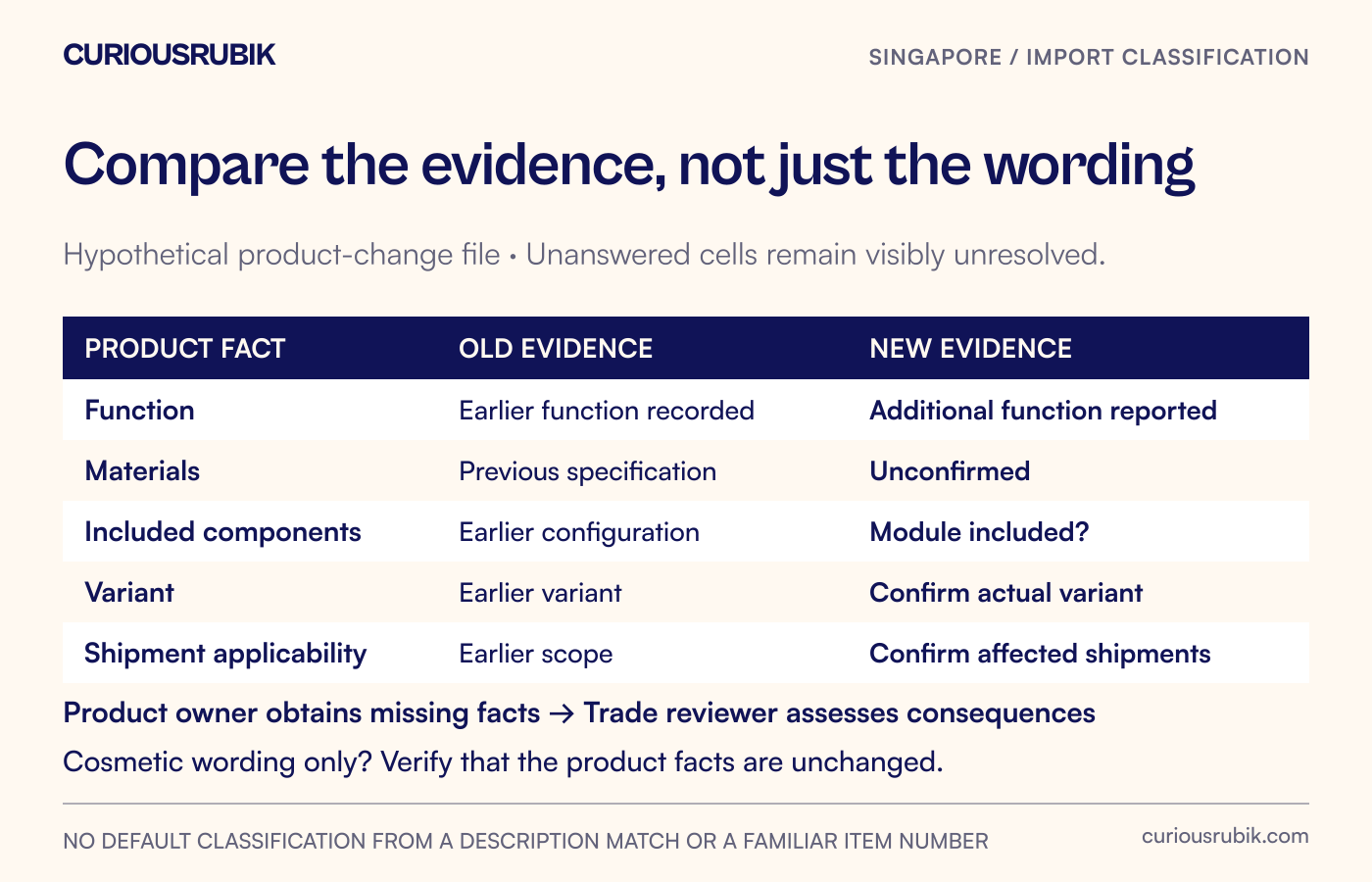
Ask the product owner to compare the old and new specifications. Has the function changed? Are the materials or composition different? Is the item now supplied as a set, with another component, or in a different state of assembly? Which details are confirmed and which remain unclear?
In a hypothetical example, a supplier describes an item as an improved replacement while retaining the commercial item number. The new datasheet mentions an additional function, but the sales description remains almost identical. The product owner should obtain the technical facts rather than treating “replacement” as evidence of equivalence.
A spelling correction can take a lighter route if the responsible person verifies that the product facts remain the same. A change in composition needs the appropriate review even if the supplier considers it commercially minor. The process should be sensitive to meaning, not merely to how many characters changed.
Preserve the old specification. Without it, the reviewer cannot establish what the previous classification relied on or identify which shipments may be affected by the new facts.
A catalogue may describe a product family, while the shipment contains a particular variant. A supplier email may refer to a future design that has not yet been shipped. Link the evidence to the actual variant, order or batch rather than assuming that the latest document applies to everything.
The product-change checklist should identify the supplier, product reference, variant, relevant technical documents and the shipment boundary. Include the person who confirmed applicability and the date. If old and new variants coexist, make that distinction available to the declaration process.
Singapore Customs' official ruling application guidance lists supporting information such as product specifications, composition and manufacturing details where applicable. That illustrates why a short invoice description may be insufficient for a classification question. The required evidence depends on the goods; do not demand a chemical composition sheet for every product regardless of relevance.
If information is missing, record the exact question and its owner. “Awaiting supplier response” is less useful than “product owner to confirm whether the additional module is included in this shipment”. A precise question allows the buyer to pursue the right evidence.
CURIOUSRUBIK SINGAPORE / IMPORT CLASSIFICATION Compare the evidence, not just the wording Hypothetical product-change file · Unanswered cells remain visibly unresolved. PRODUCT FACT OLD EVIDENCE NEW EVIDENCE Function Earlier function recorded Additional function reported Materials Previous specification Unconfirmed Included components Earlier configuration Module included? Variant Earlier variant Confirm actual variant Shipment applicability Earlier scope Confirm affected shipments Product owner obtains missing facts → Trade reviewer assesses consequences Cosmetic wording only? Verify that the product facts are unchanged. NO DEFAULT CLASSIFICATION FROM A DESCRIPTION MATCH OR A FAMILIAR ITEM NUMBER curiousrubik.com
The old code should point to its rationale, relevant evidence, review date and approving person. A record that contains only a code and “used before” provides little support for deciding whether it still applies.
The trade reviewer checks the earlier reasoning against the changed facts and current applicable guidance. A supplier-provided code can be an input, but the process should establish its relevance to the Singapore declaration. Do not assume a number used in another country establishes every local classification or control requirement.
Where an official ruling is relevant, keep the ruling and its scope with the product evidence. Singapore Customs states that its classification rulings apply within Singapore; importing into another country requires the relevant authority's advice. The business should also review the ruling's stated validity and any changed facts rather than treating it as permanent approval for a broad product family.
Avoid making an old ruling fit a new product by preserving an outdated description. The record should faithfully describe the goods, even when that creates another review task.
The item owner supplies the technical facts. The trade-compliance owner decides the classification position within the organisation's authority and obtains further advice when needed. The person maintaining item records implements the approved decision without inventing its rationale.
Record one of several meaningful outcomes: previous treatment confirmed for the identified goods; revised treatment approved; additional evidence required; or formal ruling route to be considered. Each needs its basis and the affected scope. “Reviewed” alone does not tell the declaration team what it can use.
If the next shipment is imminent and facts are unresolved, escalate the business consequence to the responsible manager and trade reviewer. Time pressure should not turn uncertainty into a default code. Any decision about shipment timing or permitted action needs to stay within the applicable requirements.
An item-data administrator may be able to edit the code, but access to a field is different from authority to determine classification. Keep those responsibilities visible even if a small team combines roles.
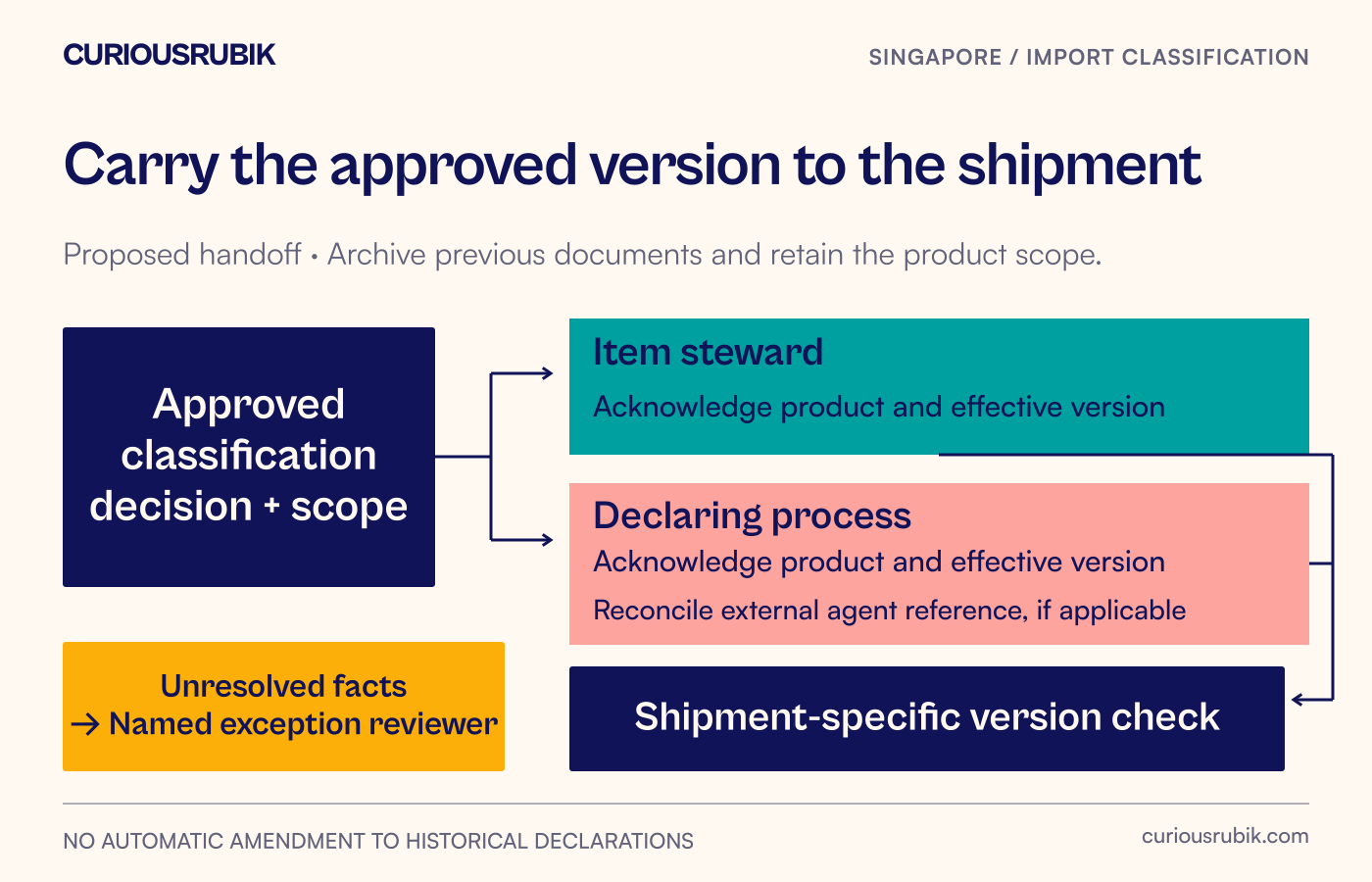
A reviewed decision is incomplete if the declaring process continues using an old extract. Identify the internal and external parties that rely on the classification record, and communicate the approved version through the authorised handoff.
The acknowledgement should confirm the product and effective scope. If an external declaring agent maintains its own reference, reconcile that reference to the approved evidence. Sending a general email saying “product updated” leaves too much room for the wrong variant to remain in use.
Check open orders and planned shipments. The review may apply only to a new variant, or it may reveal that earlier declarations need specialist investigation. Do not automatically rewrite historical declarations or delete the previous code. The trade specialist should determine any corrective action and preserve the evidence.
CURIOUSRUBIK SINGAPORE / IMPORT CLASSIFICATION Carry the approved version to the shipment Proposed handoff · Archive previous documents and retain the product scope. Approved classification decision + scope Item steward Acknowledge product and effective version Declaring process Acknowledge product and effective version Reconcile external agent reference, if applicable Shipment-specific version check Unresolved facts → Named exception reviewer NO AUTOMATIC AMENDMENT TO HISTORICAL DECLARATIONS curiousrubik.com
Automation can detect a new datasheet, highlight changed fields, locate open shipments and request confirmation from the product owner. It can flag use of a superseded classification record or a review whose evidence is incomplete.
A similarity score or description match should remain an aid to review. It cannot establish the physical composition of goods that the source documents do not describe. Filling a missing field with the most likely value may make an item record look complete while weakening the declaration evidence.
Measure declarations prepared using unreviewed changed specifications, repeated evidence gaps and time spent resolving ambiguous product facts. Also inspect false alerts from cosmetic edits. The purpose is to direct qualified attention to meaningful changes, not to maximise the number of items flagged.
Take one supplier update received this month and reconstruct its route. Can the business show what changed, who confirmed the product facts, who approved the classification position and which declaration used it? If that sequence is unclear, improve the evidence handoff before adding more automatic code reuse.