The useful question in an emergency purchase is how to restore operations within a clear boundary. Asking everyone to complete the normal paperwork while an outlet is down can make the process irrelevant. Allowing a manager to buy anything and explain it later leaves finance with an equally difficult problem.
Consider a hypothetical Singapore outlet whose cooling equipment fails during trading. A replacement component is available locally, but the normal approver is unavailable. The outlet manager needs a decision about necessity, supplier and spending authority. Finance will later need to understand what was ordered, received and paid. Those are connected decisions, made at different times.
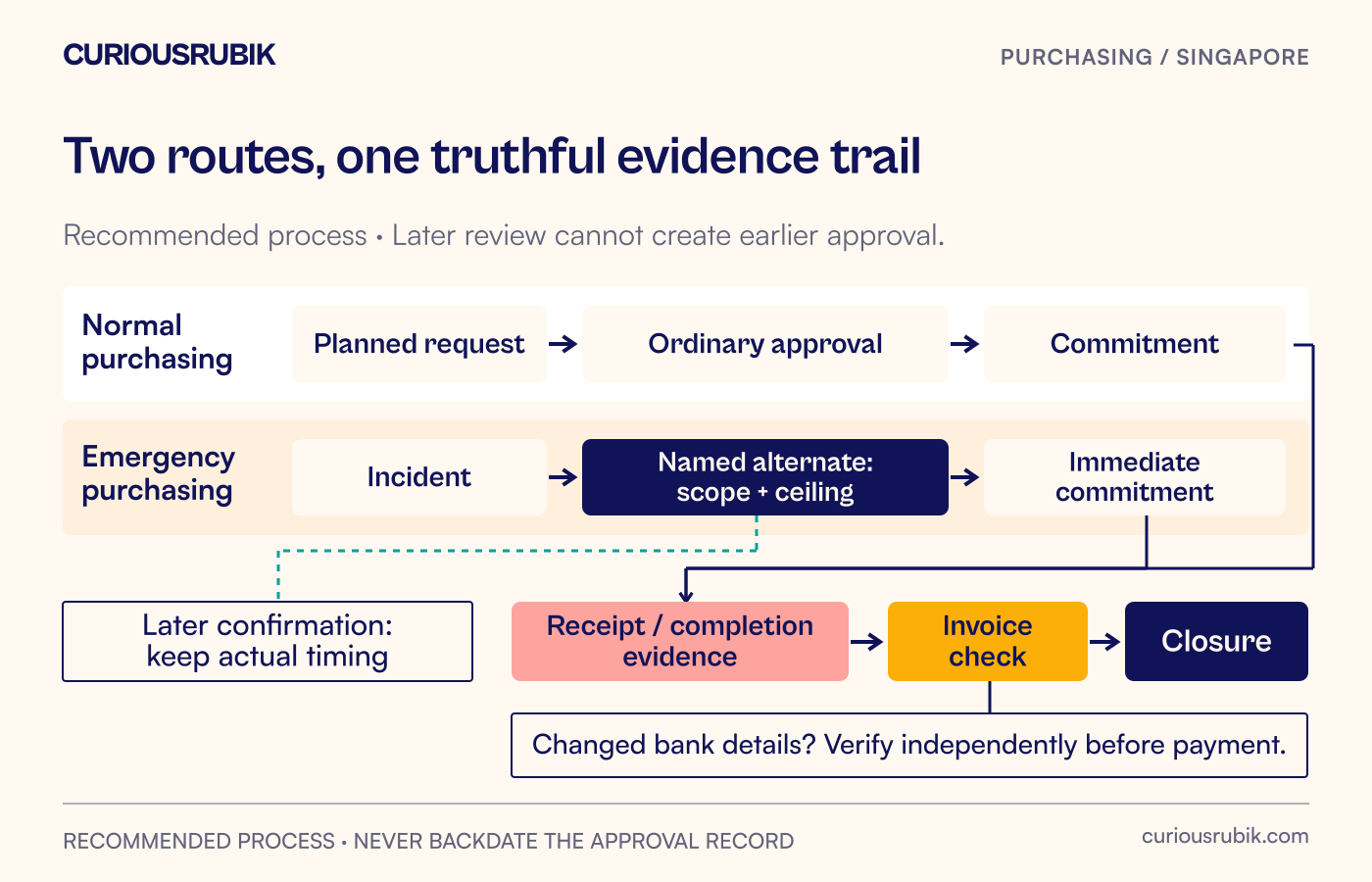
A workable emergency route keeps that sequence honest. It records the authority that actually existed, limits the immediate commitment and makes the unfinished evidence visible. It also creates a route back to normal purchasing when the same failure happens again.
Start with a short definition of the harm the emergency route is meant to prevent. Examples might include an immediate safety concern requiring qualified attention, a breakdown that stops an essential operation, or an unexpected supply interruption with no workable substitute. The response must still respect applicable safety requirements and competent-person decisions.
A missed internal deadline is different. A requester who forgot a planned event may need a fast decision, but the cause should remain visible as avoidable late purchasing. Treating both situations identically makes it impossible to distinguish resilience from poor planning.
The policy should state who can declare the emergency, who can authorise expenditure and which decisions remain reserved. It should also name an alternate who is genuinely available outside ordinary hours. A telephone number on an old organisation chart is weak cover if that person cannot approve the supplier, access the evidence or communicate a decision.
Set limits appropriate to the operation, including scope as well as amount. Authority to buy a replacement component should not silently extend to a long-term maintenance agreement. Split purchases that arise from the same incident should be considered together when checking the boundary.
The initial emergency-purchase record can be brief. Give it an incident reference and capture these facts:
These fields answer the questions an approver actually needs. They do not require the outlet to write an essay while managing a breakdown. Where the first approval is given verbally, record that fact and obtain the approver's confirmation promptly. Do not backdate a purchase order to imply a sequence that never occurred.
For the hypothetical cooling failure, the record might authorise a named repairer to supply and fit the identified part within a stated total limit. If inspection reveals a different fault, the repairer must seek a revised decision before expanding the work. The maintenance lead confirms technical suitability; the commercial approver decides whether the additional commitment is acceptable. One person need not be qualified to make both decisions.
CURIOUSRUBIK PURCHASING / SINGAPORE Two routes, one truthful evidence trail Recommended process · Later review cannot create earlier approval. Normal purchasing Emergency purchasing Planned request Ordinary approval Commitment Incident Named alternate: scope + ceiling Immediate commitment Receipt / completion evidence Invoice check Closure Later confirmation: keep actual timing Changed bank details? Verify independently before payment. RECOMMENDED PROCESS · NEVER BACKDATE THE APPROVAL RECORD curiousrubik.com
A genuine breakdown can coincide with a suspicious payment request. A familiar supplier name does not establish that newly supplied bank details are genuine. Singapore Police Force advice calls for extra verification of unusual emailed payment instructions through another medium. Use an independently established contact, rather than the new contact details supplied in the request being checked.
The emergency decision record should therefore separate permission to obtain the repair from permission to use a payment destination. If the repairer requests a changed account, a named finance or procurement reviewer verifies it through the established process. Operational pressure is a reason to make that review easy to reach, not to hide the issue.
Where a supplier is new, identify which checks can be completed before commitment and which cannot. Some unknowns may be acceptable within a tightly bounded purchase; others may make the proposal unacceptable. The authorised manager must decide, with suitable specialist input. An automated urgency label should never make that decision for them.
The same principle applies to employee reimbursement. A receipt can show expenditure, but does not by itself prove the buyer had authority, that the item was received for business use or that the supplier instruction was genuine. The process must capture those facts without pretending that every emergency will have the normal document sequence.
The operations owner remains responsible after trading resumes. They confirm what was received, whether work is complete, which assets or stock were affected and whether the final charge matches the authorised scope. Finance checks the resulting invoice or reimbursement against that record and routes differences to the decision maker.
IRAS requires companies to keep source records that explain business transactions. The emergency record recommended here supports that purpose; IRAS does not prescribe this particular worksheet. Attach or reference the actual quote, approval, receipt and completion evidence rather than replacing them with a single tick marked “reviewed”.
Give unresolved items a person and a next action. “Awaiting documents” is too broad. “Outlet manager to obtain itemised repair invoice from supplier” is actionable. If evidence cannot be recovered, the reviewer should record the missing item, the alternative evidence considered and the resulting decision. That exception should remain identifiable for later review.
Useful automation starts with routing. An emergency request can alert the authorised alternate, display the relevant limit and collect a timestamped decision. It can group purchases under the same incident, remind the receipt owner and flag a final invoice above the approved amount.
It can also prevent a familiar failure: the request disappears from the operational queue as soon as equipment starts working, while finance continues chasing evidence. Keep separate milestones for operational recovery and financial closure. Both can be visible without making the outlet manager administer payment processing.
Escalation must lead somewhere. If a follow-up date passes, notify the responsible manager with the missing evidence and the consequence. Repeating the same reminder indefinitely produces activity without resolution. Define who may accept alternative support and who must address recurring non-compliance.
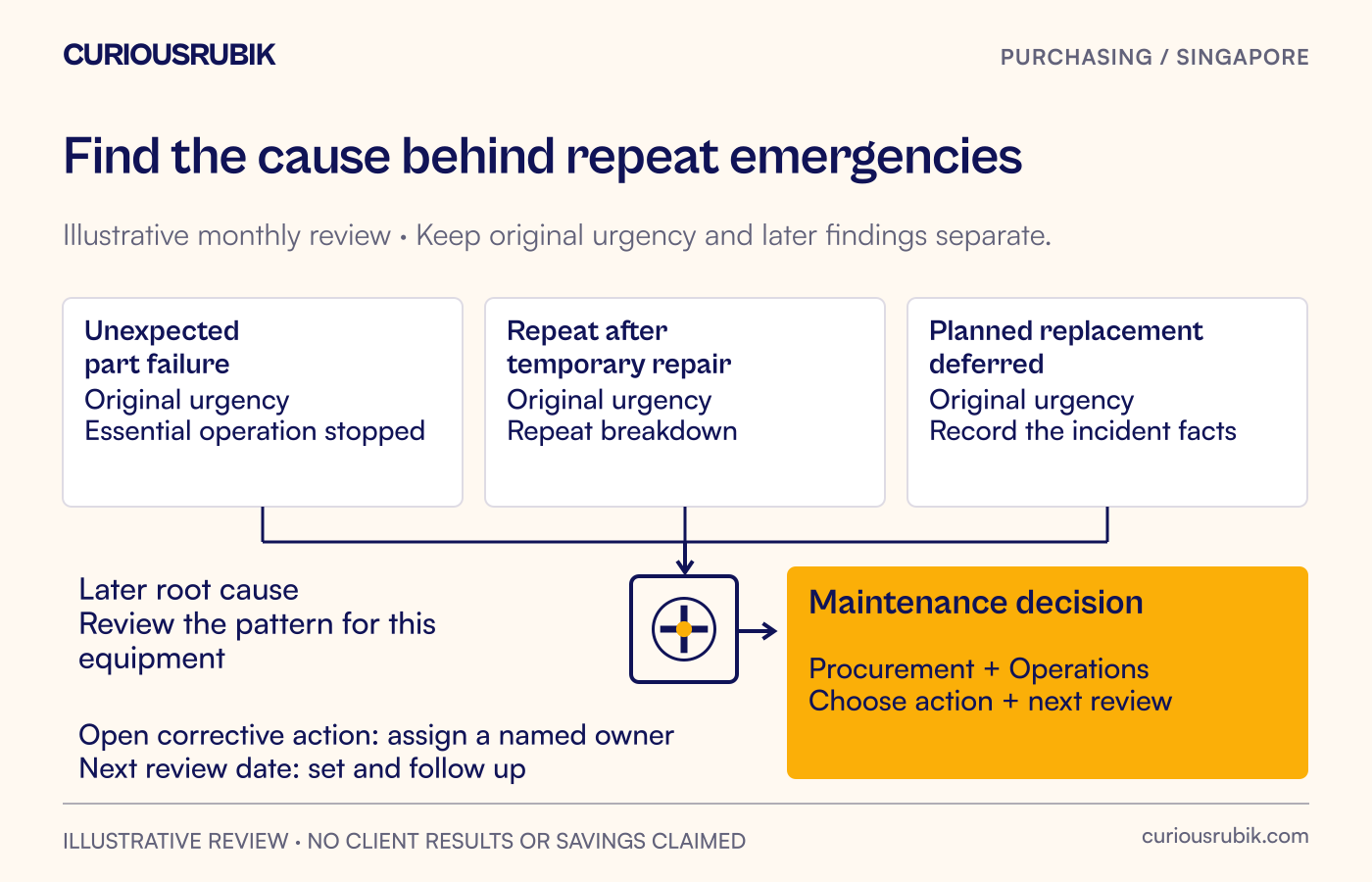
A monthly repeat-cause review should group incidents by equipment, supplier, site and underlying cause. An individual purchase may have been sensible while the pattern is unacceptable. Repeated replacement of the same component may justify maintenance, replacement equipment or a different spare-parts policy.
In an illustrative log, three entries might read: unexpected part failure; repeat failure after temporary repair; planned replacement deferred. The first two can involve genuine urgency, while the third exposes a prior management decision. Keep the original incident classifications and record the subsequent finding separately. Rewriting the past to improve a metric destroys the diagnostic value.
CURIOUSRUBIK PURCHASING / SINGAPORE Find the cause behind repeat emergencies Illustrative monthly review · Keep original urgency and later findings separate. Unexpected part failure Original urgency Essential operation stopped Repeat after temporary repair Original urgency Repeat breakdown Planned replacement deferred Original urgency Record the incident facts Later root cause Review the pattern for this equipment Maintenance decision Procurement + Operations Choose action + next review Open corrective action: assign a named owner Next review date: set and follow up ILLUSTRATIVE REVIEW · NO CLIENT RESULTS OR SAVINGS CLAIMED curiousrubik.com
Track the number of repeat incidents, incomplete evidence cases, unapproved scope changes and time to an authorised decision. Measure actual operational downtime where reliable timestamps exist. Do not describe all downtime after an incident as “avoided”, or convert an estimate into a claimed saving without a defensible comparison.
Enterprise Singapore's continuity guidance recommends clear responsibilities, contingency planning, exercises and review. Apply that thinking to one realistic purchasing exercise: the usual approver is unavailable, the supplier proposes extra work and an invoice arrives with changed payment details. Can the team reach a legitimate decision at each step?
Start with the most recent emergency purchase. Reconstruct who decided, what they authorised and what remained unresolved after operations recovered. That single incident will show which part of the exception route needs designing first.