A customer service colleague promises a refund. The warehouse is waiting for the goods, finance has not approved the adjustment and the payment team receives a new bank account in an email. The customer sees one request; the business has several decisions to resolve.
Connect those decisions in one case while preserving who can approve each one. A return, a credit note and a payment are related events, but completing one does not prove that the others are correct or authorised.
Begin with the reason for the request. Returned goods, an incorrect price, a duplicate payment and a goodwill concession are different situations. Asking for a warehouse receipt in every case delays legitimate price corrections. Issuing a sales credit for every cash refund can misrepresent a simple overpayment.
Create a reason-based decision matrix with four questions: what evidence establishes the issue, who can approve the remedy, which financial documents are needed, and what must happen before any money is released?
For returned goods, the returns owner confirms receipt, condition and the relevant transaction. The commercial owner checks entitlement under the applicable terms and any legal requirements. Finance determines the adjustment and tax documentation. The payment team controls release of the approved refund.
For a price correction, evidence may be the accepted quotation, original invoice and agreed correction. There may be no physical movement. For goodwill, the decision maker needs a reason, delegated authority and a clear statement of what is being offered, without presenting it as a correction of an error unless that is what occurred.
Consumer rights and business-to-business contract terms can differ. This matrix is a recommended operating tool, not a universal returns policy or a way to override a customer's rights. Unclear entitlement questions need appropriate commercial or legal review.
A refund case should reference the original customer, supplying entity, order, invoice and payment. Add any return, replacement, credit or earlier refund against that history. This makes it possible to answer how much has already been adjusted and how much remains to resolve.
Record the request date and the promise made to the customer. If the promise exceeded the colleague's authority, escalate it promptly rather than letting finance discover it at payment time. The customer-facing response should accurately describe what has been approved and what information is still needed.
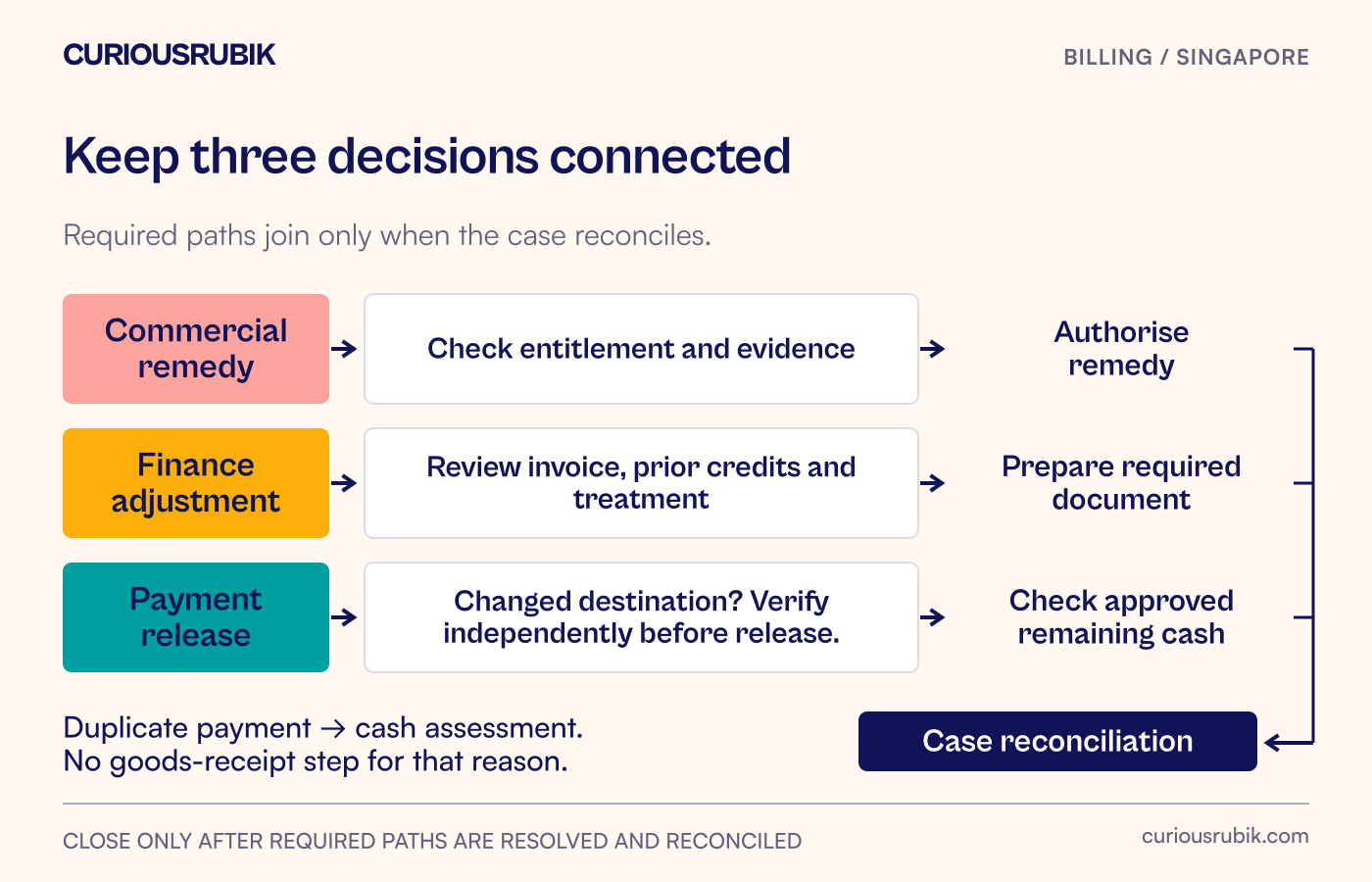
Use separate states for commercial approval, financial-document readiness and payment readiness. A credit note can exist without a refund being due immediately. A refund request may concern a payment that did not require a sales credit. The case owner must ensure the states fit the actual event.
CURIOUSRUBIK BILLING / SINGAPORE Keep three decisions connected Required paths join only when the case reconciles. Commercial remedy Check entitlement and evidence Authorise remedy Finance adjustment Review invoice, prior credits and treatment Prepare required document Payment release Changed destination? Verify independently before release. Check approved remaining cash Case reconciliation Duplicate payment → cash assessment. No goods-receipt step for that reason. CLOSE ONLY AFTER REQUIRED PATHS ARE RESOLVED AND RECONCILED curiousrubik.com
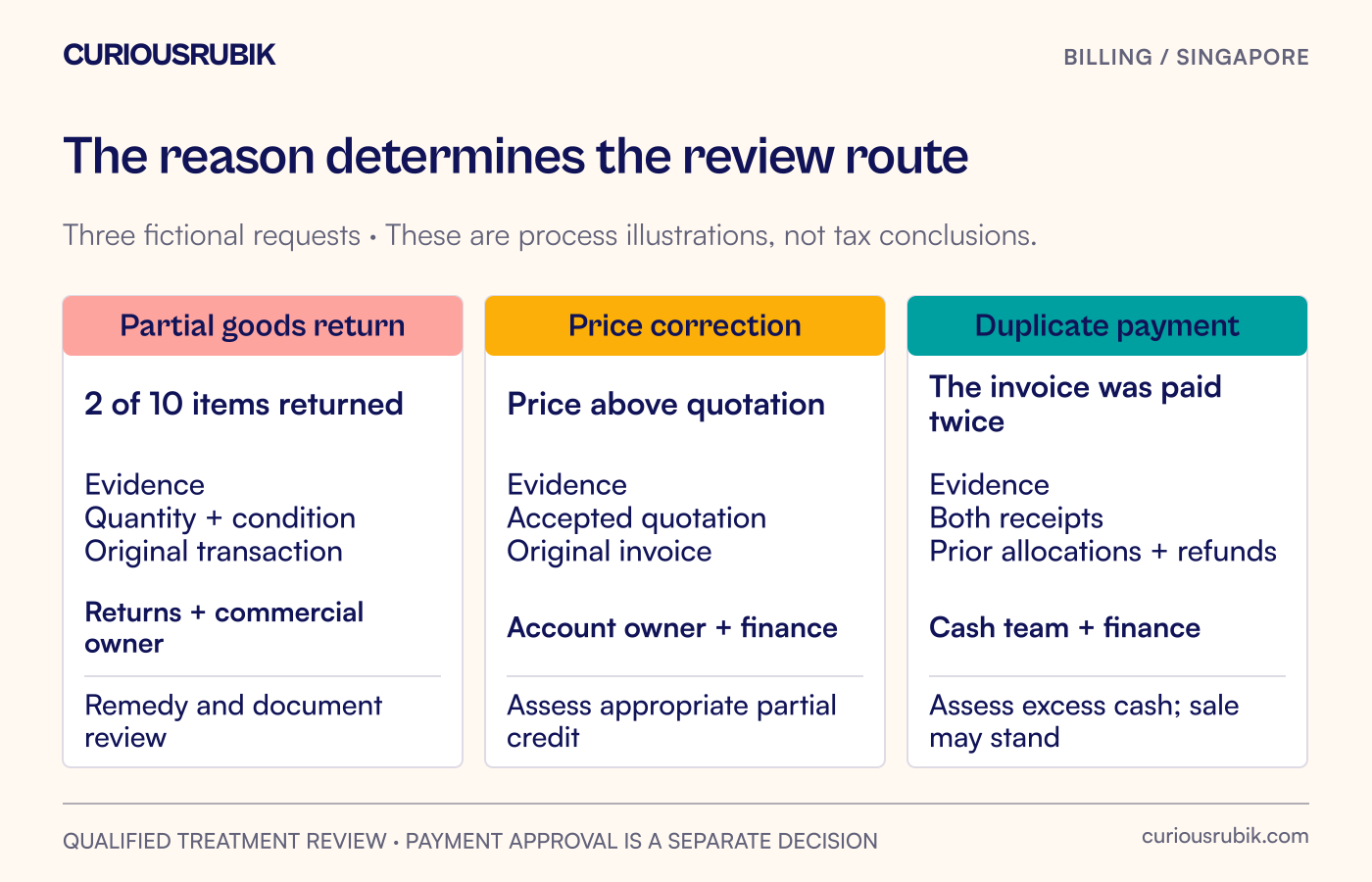
In a hypothetical first case, a customer returns two items from an order of ten. The returns team confirms the quantities and condition, and the commercial owner approves a refund under the relevant terms. Finance checks the original invoice, prior adjustments and the amount attributable to the two items before preparing the appropriate credit. The payment instruction references the same case.
In a second case, the customer keeps the goods but identifies an invoiced price above the accepted quotation. The account owner confirms the agreed price. Finance assesses a partial credit based on that evidence. Waiting for a goods receipt would add an irrelevant obstacle.
In a third case, the customer accidentally paid the same invoice twice. The cash team verifies both receipts and checks whether either has already been allocated or returned. The refund approval addresses the excess cash; the original sale may remain unchanged. Treating the refund automatically as a sales reversal would create a different error.
These examples are process illustrations, not tax conclusions. The qualified reviewer should assess the facts, documentation and treatment for the actual transaction.
CURIOUSRUBIK BILLING / SINGAPORE The reason determines the review route Three fictional requests · These are process illustrations, not tax conclusions. Partial goods return 2 of 10 items returned Evidence Quantity + condition Original transaction Returns + commercial owner Remedy and document review Price correction Price above quotation Evidence Accepted quotation Original invoice Account owner + finance Assess appropriate partial credit Duplicate payment The invoice was paid twice Evidence Both receipts Prior allocations + refunds Cash team + finance Assess excess cash; sale may stand QUALIFIED TREATMENT REVIEW · PAYMENT APPROVAL IS A SEPARATE DECISION curiousrubik.com
For a GST-registered business, IRAS's GST invoicing guidance specifies credit-note information, including the reason and amount of the credit, and links to the original tax invoice. Where that invoice cannot be identified, its guidance requires other documentary evidence supporting the GST originally accounted for.
Its returned-goods guidance also distinguishes refunds from replacement scenarios. A free similar replacement, a lower-value replacement and a higher-value replacement can have different documentary routes. The returns team should therefore report the actual remedy rather than mark every case “refund” to move it through the queue.
Finance must also assess how the adjustment belongs in the GST records and whether the original transaction was treated correctly. Do not let the date a refund leaves the bank automatically decide the treatment of a credit note or correction. Any unusual tax situation should remain with a qualified reviewer until the appropriate route is established.
Suppose a hypothetical case authorises a S$600 refund. A first payment of S$400 has already been made while the remaining issue was resolved. The next payment proposal must show the prior S$400 and the S$200 balance. These illustrative figures are about payment reconciliation, not a prescribed tax calculation.
A duplicate request can arrive through another channel, perhaps when the customer contacts both sales and support. Match it to the existing case and preserve the additional correspondence. Do not create a second independent approval simply because a different colleague received the request.
A changed refund destination deserves separate verification. Confirm the intended payee and permitted route through trusted information and the company's payment controls. An approved commercial remedy does not authenticate new account details supplied in the same conversation. Where the request involves another entity or third-party recipient, obtain the appropriate review and authority before proceeding.
Goods may arrive damaged, quantities may differ or the original payment may not be found. Give each issue a factual owner and a decision owner. The warehouse confirms what arrived; the commercial owner decides the remedy within authority; finance assesses the corresponding adjustment.
Record a specific next action and date. “Awaiting finance” tells nobody whether the problem is missing evidence, a tax judgment or payment scheduling. The case owner should provide an accurate update based on the actual blocker and avoid promising a release date that has not been approved.
Where a partial decision is possible, document its scope. An approved refund for one item should not silently settle a dispute about the rest of the order. Preserve the remaining issue and any customer communication that explains the distinction.
Automation can assemble the original transaction, identify previous credits and refunds, compare returned quantities and prepare a proposed adjustment. It can flag two open requests against the same payment and prevent a payment proposal from exceeding the approved remaining amount.
The commercial entitlement and exceptional tax or payment decisions remain human. A complete set of attachments should not trigger a refund if the evidence conflicts. A missing warehouse document should not block a case that involves only a price correction.
Test the process with the three reason types above, a partial refund and a duplicate request. Measure time to a reasoned decision, repeat customer contacts, payment reversals and cases where the credit and cash records do not reconcile.
Start with the last refund that required several internal conversations. Reconstruct which decision was actually missing at each handoff, then put that question and its owner into the matrix. The next customer should not have to navigate the same confusion.