“Customer is overseas” is useful commercial information. It is rarely a complete set of facts for a GST decision.
A Singapore service business can avoid repeated billing questions by collecting a few specific details during the sales handoff: which entity is contracting, what service it will receive, who directly benefits and which locations or assets are involved. Sales supplies the facts. The qualified GST reviewer determines whether the relevant zero-rating provision and its conditions are satisfied.
For a GST-registered Singapore supplier assessing zero-rating, IRAS states that only services falling within the relevant descriptions in Section 21(3) of the GST Act can qualify as international services for zero-rating. Not all services supplied to an overseas customer qualify.
Depending on the provision, the service's nature, the customer's belonging status, the direct beneficiary and relevant locations can matter. A foreign invoice address cannot establish all of those facts. Nor should a local beneficiary automatically be treated as disqualifying every arrangement; the specific provision and conditions require assessment.
The process problem appears when sales must choose a tax label without enough context. Staff may copy the last transaction or select the treatment the customer expects. Finance then has to undo the choice after the quotation has become a commercial commitment.
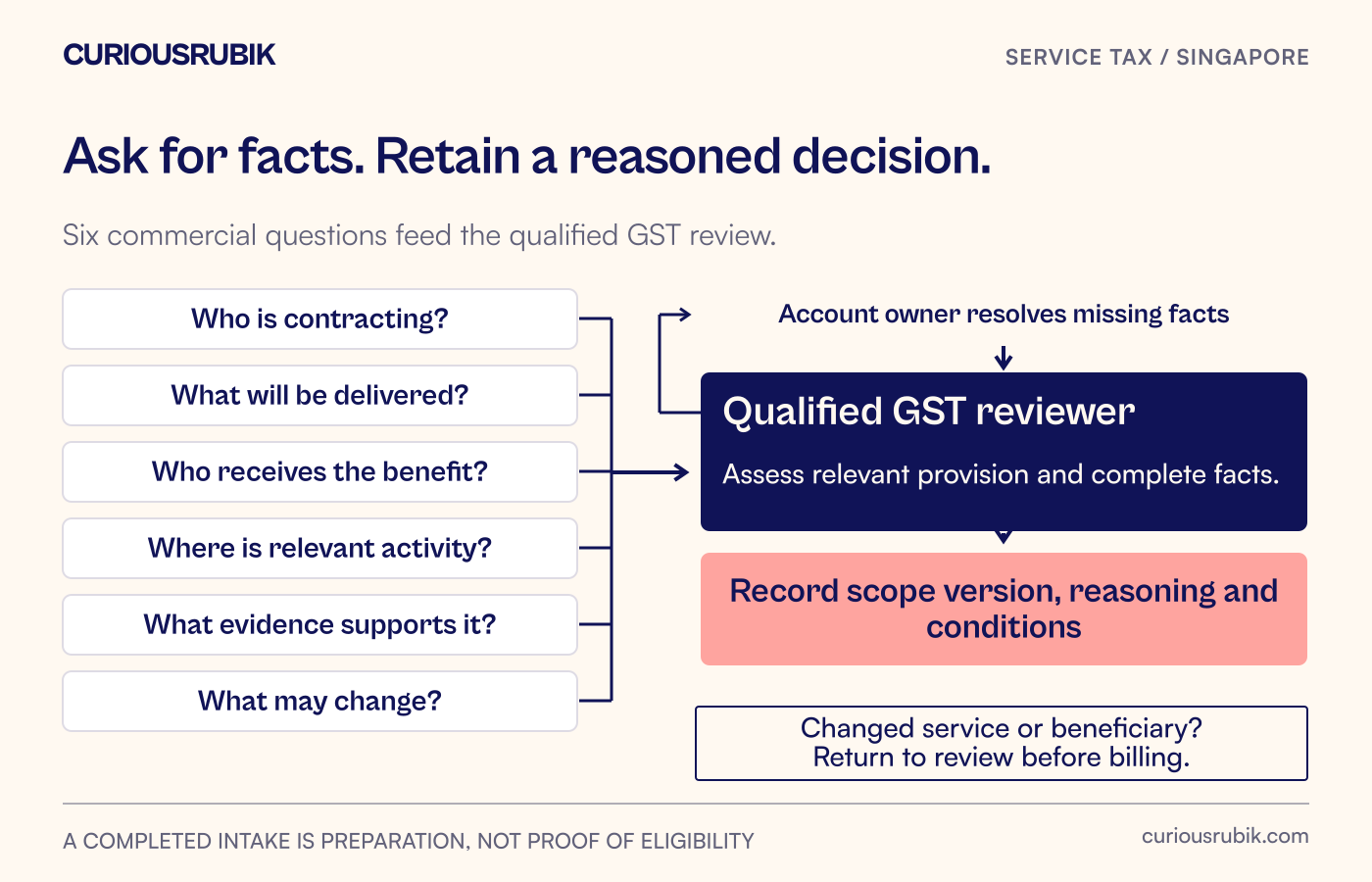
Move the fact-gathering earlier. The aim is to give the reviewer a coherent engagement description before billing, while avoiding an intake form that asks sales to interpret the legislation.
A short service-tax intake should collect observable facts, with evidence references where available.
Who is contracting? Record the full customer entity and the relevant agreement or accepted proposal. Distinguish the buyer from a group headquarters that processes invoices or pays centrally.
What will be delivered? Describe the actual work, outputs and any bundled activities. “Professional services” may be too broad to identify the relevant question.
Who will receive or use the benefit? Ask which entities, teams or people the work is intended to serve. Where several beneficiaries exist, record them rather than forcing one country into a dropdown.
Where does the relevant activity occur? Depending on the service, the locations of work, recipients, goods, land or buildings may be relevant. Collect the facts the reviewer asks for; do not assume the consultant's travel location alone determines treatment.
What evidence supports the description? Connect the statement of work, scope correspondence and other relevant records. Note anything still uncertain and the person who can confirm it.
What may change before delivery? A new participant group, different work location or changed asset can make an earlier assessment worth revisiting. Sales should know which changes must be sent back to finance.
CURIOUSRUBIK SERVICE TAX / SINGAPORE Ask for facts. Retain a reasoned decision. Six commercial questions feed the qualified GST review. Who is contracting? What will be delivered? Who receives the benefit? Where is relevant activity? What evidence supports it? What may change? Qualified GST reviewer Assess relevant provision and complete facts. Record scope version, reasoning and conditions Account owner resolves missing facts Changed service or beneficiary? Return to review before billing. A COMPLETED INTAKE IS PREPARATION, NOT PROOF OF ELIGIBILITY curiousrubik.com
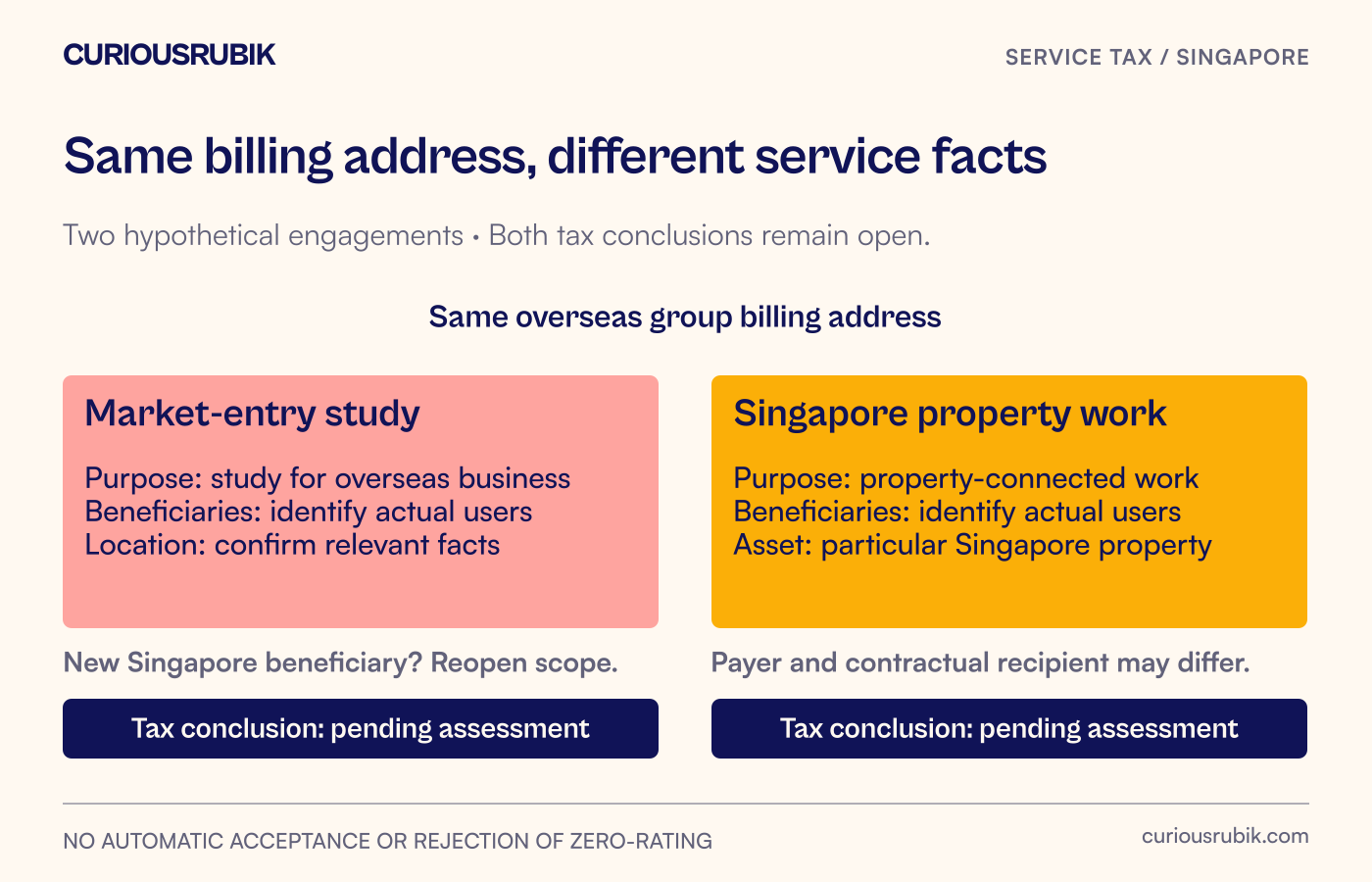
Imagine an overseas group asks a Singapore firm to perform two engagements. In the first hypothetical case, the work concerns a market-entry study for the overseas business. In the second, the scope concerns work directly connected with a particular property in Singapore. Both requests come from the same overseas procurement contact.
The billing address is identical, but the relevant service facts differ. The tax reviewer needs to identify the applicable provision for each engagement and assess its conditions. Copying the first engagement's treatment onto the second would skip that analysis.
Now vary the first case. The project expands to serve a Singapore group company as well. Sales should identify the additional beneficiary and the changed scope. The reviewer decides what that means under the relevant rules; the process should not automatically accept or reject zero-rating based on the new country label.
A further complication is a central payer. The entity making payment may differ from the contractual recipient. The intake should record both without substituting the payer's location for the customer's belonging-status analysis.
These examples intentionally leave the tax conclusion open. Their purpose is to show which differences the commercial handoff must surface. A real determination needs the complete facts and current applicable guidance.
CURIOUSRUBIK SERVICE TAX / SINGAPORE Same billing address, different service facts Two hypothetical engagements · Both tax conclusions remain open. Same overseas group billing address Market-entry study Purpose: study for overseas business Beneficiaries: identify actual users Location: confirm relevant facts Tax conclusion: pending assessment Singapore property work Purpose: property-connected work Beneficiaries: identify actual users Asset: particular Singapore property Tax conclusion: pending assessment New Singapore beneficiary? Reopen scope. Payer and contractual recipient may differ. NO AUTOMATIC ACCEPTANCE OR REJECTION OF ZERO-RATING curiousrubik.com
The approved record should state the service and entity covered, the applicable reasoning, the evidence reviewed and any conditions or limitations. Include the reviewer, date and version of the commercial scope.
A status saying only “zero-rated approved” invites overuse. Staff may apply it to every future order from that customer, even when the service changes. A better record explains the boundaries of the decision and the changes that trigger a fresh assessment.
For a repeat engagement with unchanged facts, the team may be able to reuse approved evidence under its controls. Confirm the relevant facts remain current and preserve that confirmation. Do not make every repeat order a new research project, but do not treat the original decision as a permanent customer attribute either.
If the reviewer needs more information, return a focused question to a named owner. “Please clarify the entity receiving the deliverable” is more useful than “please provide GST support”. The account owner can then obtain an answer the customer understands.
A customer may expect a particular tax treatment before the facts have been assessed. Sales should avoid presenting an unreviewed assumption as a final conclusion. The authorised commercial and tax owners should agree how quotations describe any unresolved treatment and who can approve changes.
Similarly, an urgent invoice deadline should trigger an escalation to the reviewer. It should not cause the process to default to zero-rating because an overseas address is present. Nor should staff invent a legal conclusion from a generic checklist just to complete a mandatory field.
Where the facts genuinely remain uncertain, the qualified reviewer determines the appropriate treatment or further advice required. Record the question and next action. This helps distinguish a documentation delay from a complex classification issue that needs specialist analysis.
Once decided, ensure billing receives the current conclusion and relevant document instructions. A well-supported review is wasted if the invoice is generated from an older customer default or an earlier version of the proposal.
Automation can prefill established entity facts, request service-specific questions and detect differences from a previously reviewed engagement. It can flag missing beneficiary information, conflicting scope versions or a location change after approval.
The suggested route should explain why the case needs review. Avoid a black-box score that labels an engagement “international” without showing the underlying facts. A complete questionnaire is useful preparation, not proof of eligibility.
Protect commercial confidentiality in the process. Give reviewers the relevant evidence, with access limited to their role. Do not collect unrelated personal histories or entire customer databases merely because a document upload is available.
Build a change checkpoint near billing for engagements where the facts can evolve. Ask the account owner whether the agreed service, customer and relevant beneficiaries remain as reviewed. If they changed, link the new facts to the original decision rather than silently replacing the old record.
Pilot the intake on one recurring service type. Compare the number of follow-up questions finance must ask, time to an approved treatment, invoices corrected after issue and cases reopened because the scope changed.
Review the questions themselves after the pilot. If a field never affects the analysis, ask whether it is necessary. If reviewers repeatedly request the same missing fact, add a plain-language prompt with an example. The form should become more precise as the team learns, not simply longer.
The useful result is a sales handoff that lets the reviewer understand the engagement without reconstructing it from scattered messages. Choose one recent invoice that stalled for a GST question and identify the earliest sales conversation in which the missing fact could have been obtained. Start the improvement there.