The most awkward time to discover a tax question is after a supplier has completed the work and expects the full invoice to be paid. By then, the service location may be poorly documented, the contract may promise a net amount and the buyer may have little room to clarify the commercial terms.
For a Singapore business buying overseas services, the purchasing process should collect the facts a tax reviewer needs before commitment. A foreign address on an invoice is an investigation cue. It is not a complete tax conclusion.
The proposed process is a foreign-service intake checklist linked to a named tax owner. Procurement gathers evidence, the specialist determines treatment and the commercial owner negotiates with that advice. Automation helps those handoffs occur early enough to matter.
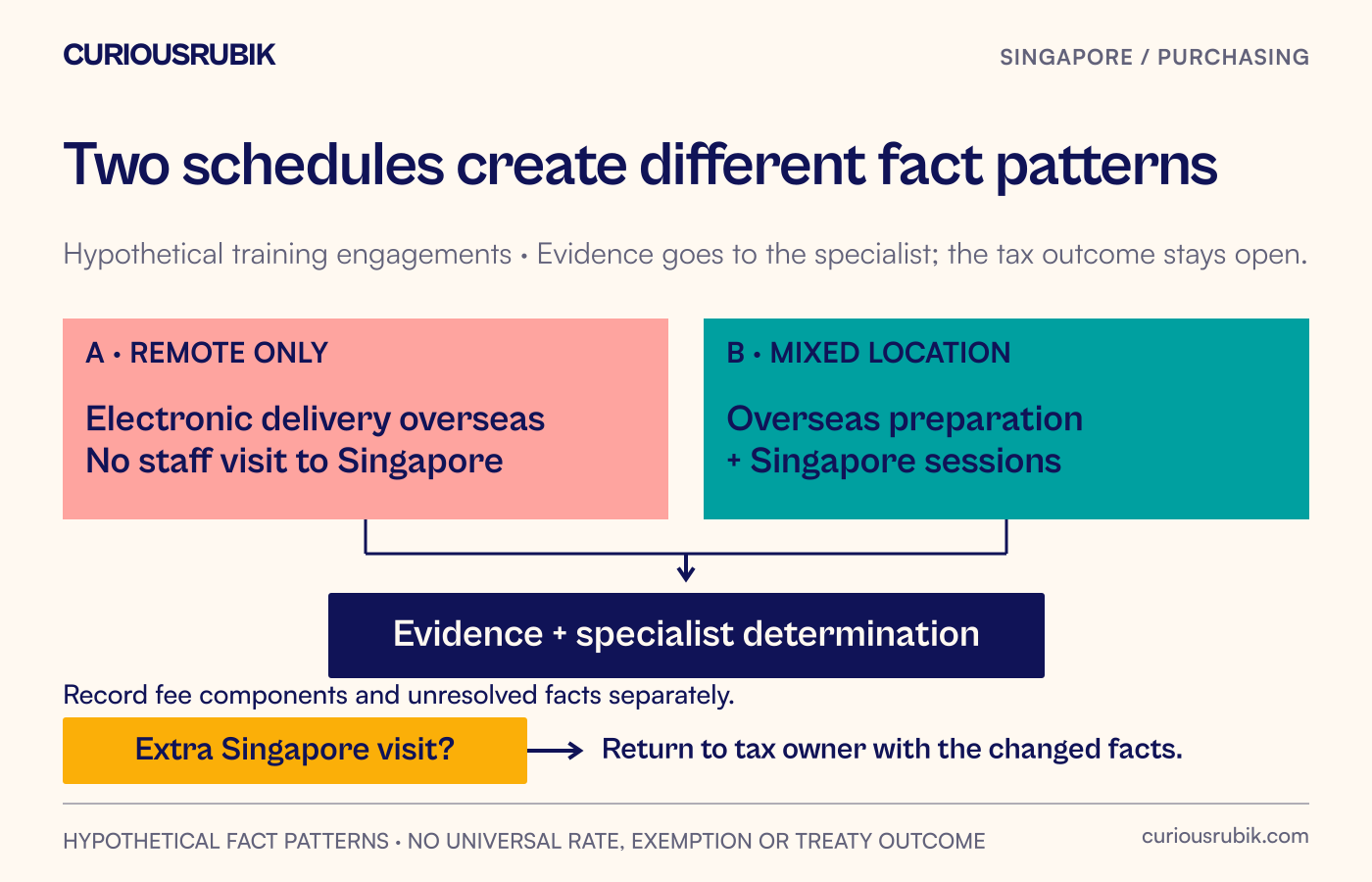
Consider two hypothetical training engagements. In the first, a non-resident company delivers technical training entirely from overseas through remote sessions and sends nobody to Singapore. In the second, its trainers come to the Singapore customer's premises, while preparation and follow-up take place overseas.
IRAS's guidance for specified services supplied by non-resident companies distinguishes work performed in Singapore from services delivered electronically from overseas without staff coming here. It also identifies treaty conditions that can affect treatment. The two engagements therefore need an accurate account of what is being supplied and where the work happens.
The buyer should not convert those examples into a rule that every overseas invoice is exempt, or every Singapore visit has the same tax result. Provider status, payment character and the applicable treaty need specialist review. An individual trainer also requires the appropriate individual-provider analysis rather than automatic use of the company rules.
Even a previously reviewed engagement can change. A remote workshop may gain an on-site session. A fixed training fee may acquire a licence component. The service owner needs a simple way to report such changes before the original tax conclusion is reused.
A purchasing form that asks “Does withholding tax apply?” gives the buyer a technical question they may be unqualified to answer. Replace it with factual prompts:
Record uncertainty explicitly. “Location not confirmed” is more useful than choosing “overseas” because that is the supplier's registered address. Ask for the statement of work and proposed terms instead of relying on a short purchase description such as “training package”.
Keep the intake proportionate. The requester should not be asked to obtain every conceivable document before anyone looks at the transaction. A tax owner can identify which facts are material, which supporting documents are needed and whether the proposed scope requires further advice.
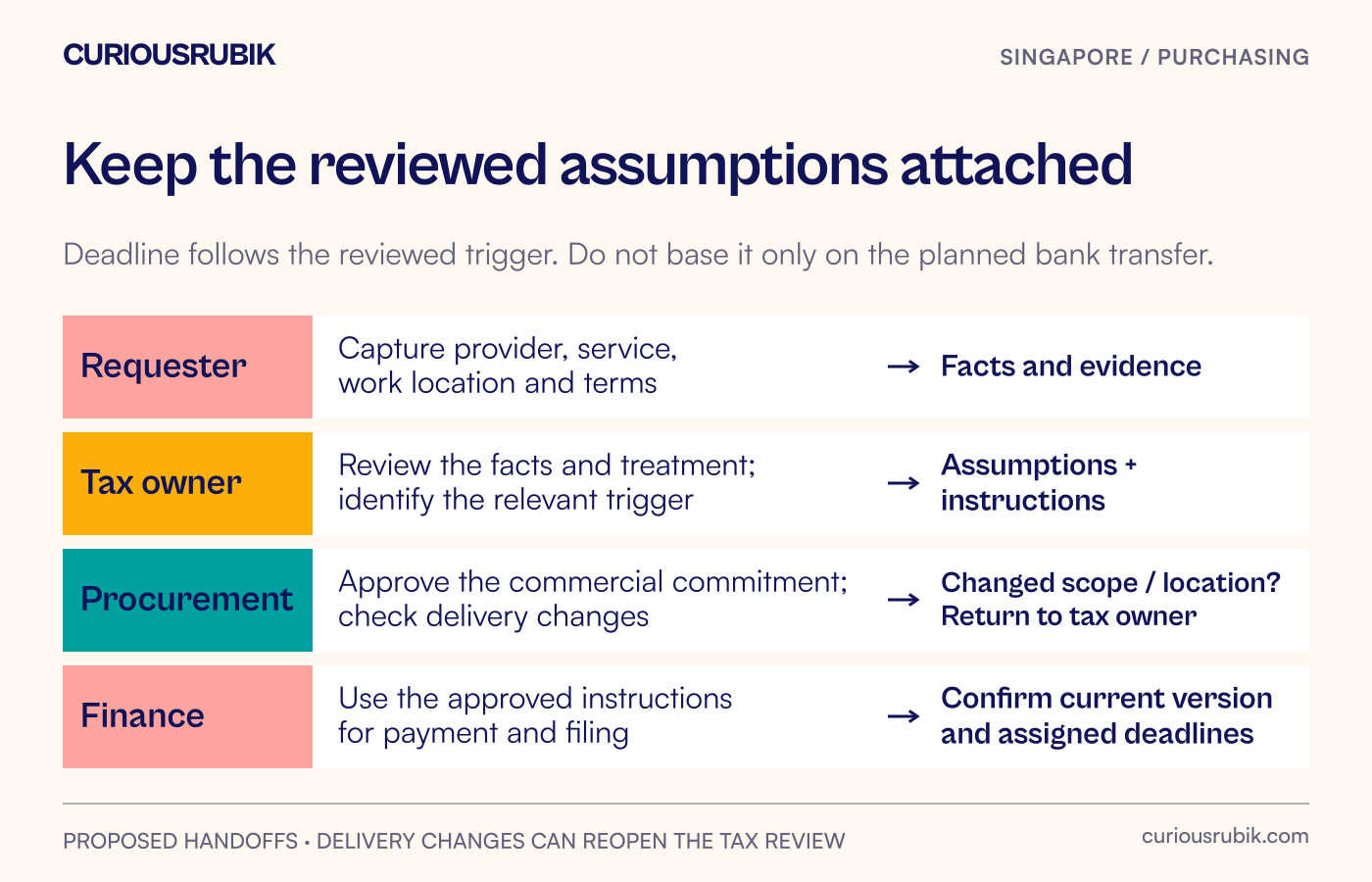
The tax review should produce a usable instruction, not a one-word status. A handoff record can identify the service components reviewed, factual assumptions, treatment determined, supporting evidence and conditions that would require another review.
For the mixed-location training example, procurement might establish the proposed schedule and fee breakdown but leave the tax conclusion open. The reviewer decides whether the information supports the appropriate treatment and what further evidence is needed. Do not allocate a bundled fee by counting calendar days unless the reviewer has approved a defensible basis for that engagement.
The commercial owner then checks the contract consequences. If the provider expects an agreed net receipt, a tax obligation may affect the payer's total cost. Procurement should resolve the relevant wording and pricing before approval, with tax and legal input where needed. Finance should not discover a gross-up question only when it prepares payment.
CURIOUSRUBIK SINGAPORE / PURCHASING Keep the reviewed assumptions attached Deadline follows the reviewed trigger. Do not base it only on the planned bank transfer. Requester Capture provider, service, work location and terms Facts and evidence Tax owner Review the facts and treatment; identify the relevant trigger Assumptions + instructions Procurement Approve the commercial commitment; check delivery changes Changed scope / location? Return to tax owner Finance Use the approved instructions for payment and filing Confirm current version and assigned deadlines PROPOSED HANDOFFS · DELIVERY CHANGES CAN REOPEN THE TAX REVIEW curiousrubik.com
Payment processing and withholding-tax timing need distinct fields. Under IRAS guidance, filing and payment are generally due by the fifteenth of the second month from the relevant payment date. For payments other than directors' fees, that date uses the earliest applicable event: contractual due-and-payable date, crediting to the non-resident’s account or another account they designate or actual payment. In the absence of an agreement, invoice-date rules apply; ordinary credit terms do not simply defer the clock.
Have the tax owner establish the trigger and calendar instruction for the specific transaction. A reminder based only on the planned bank-transfer date can be late even when the supplier payment itself is still awaiting approval. Special filing arrangements or transaction categories need their own assessment.
The workflow should therefore capture the contract event, invoice date, accounting information relevant to crediting and proposed payment date. It should preserve which event the reviewer used and why. If the facts change, route the deadline for recalculation rather than silently replacing it with the newest date entered.
Treat treaty relief as a documented conclusion with any necessary filing action. “No tax to pay” should not be used as an automatic instruction to remove the transaction from the compliance queue.
The service owner is often best placed to know what actually happened. Before the purchase reaches final payment preparation, ask them to confirm whether the provider, scope, location and fee components still match the reviewed version.
In the hypothetical example, the trainers may spend an additional day in Singapore to resolve follow-up questions. The event should create a review task linked to the original decision. It should not require finance to discover the visit from an expense attachment weeks later.
Likewise, a cancelled on-site session does not automatically prove that every fee is now for overseas work. The revised service and contractual entitlement need to be understood. Preserve the original plan, the actual change and the revised conclusion so that the transaction remains explainable.
CURIOUSRUBIK SINGAPORE / PURCHASING Two schedules create different fact patterns Hypothetical training engagements · Evidence goes to the specialist; the tax outcome stays open. A · REMOTE ONLY Electronic delivery overseas No staff visit to Singapore B · MIXED LOCATION Overseas preparation + Singapore sessions Evidence + specialist determination Extra Singapore visit? Return to tax owner with the changed facts. Record fee components and unresolved facts separately. HYPOTHETICAL FACT PATTERNS · NO UNIVERSAL RATE, EXEMPTION OR TREATY OUTCOME curiousrubik.com
Automation can identify purchases marked as overseas services, flag missing delivery-location information and route the request to the tax owner before commitment. It can retrieve the last approved review for a repeat engagement while asking whether its assumptions remain true.
It can also prevent incomplete instructions from reaching a payment run unnoticed. The exception message should state what is missing, who can supply it and whether a filing deadline needs urgent attention. “Tax hold” without an owner or next action encourages buyers to seek a workaround.
Do not use supplier country alone to calculate a rate. Do not infer a provider's tax residence from incorporation details. Do not reuse an earlier decision merely because the invoice description is similar. The value of the automation is in presenting the right evidence to the person accountable for the determination.
Start with a small set of recent overseas-service purchases. For each, compare the first commercial commitment with the date the tax owner received usable facts. Record missing-location cases, changed-scope cases and payments delayed because the contract or fee description was unclear.
The most useful measure is the proportion of relevant purchases reviewed before commitment with sufficient evidence. Pair it with late holds and repeated requests for the same missing fact. A fast review based on an incorrect delivery assumption is not a successful outcome.
This checklist is a recommended purchasing design, not a substitute for current tax advice. Before applying it, ask your tax owner to take one upcoming overseas engagement and specify the facts, trigger dates and change events they need. Build the intake around those requirements while procurement can still clarify the deal.