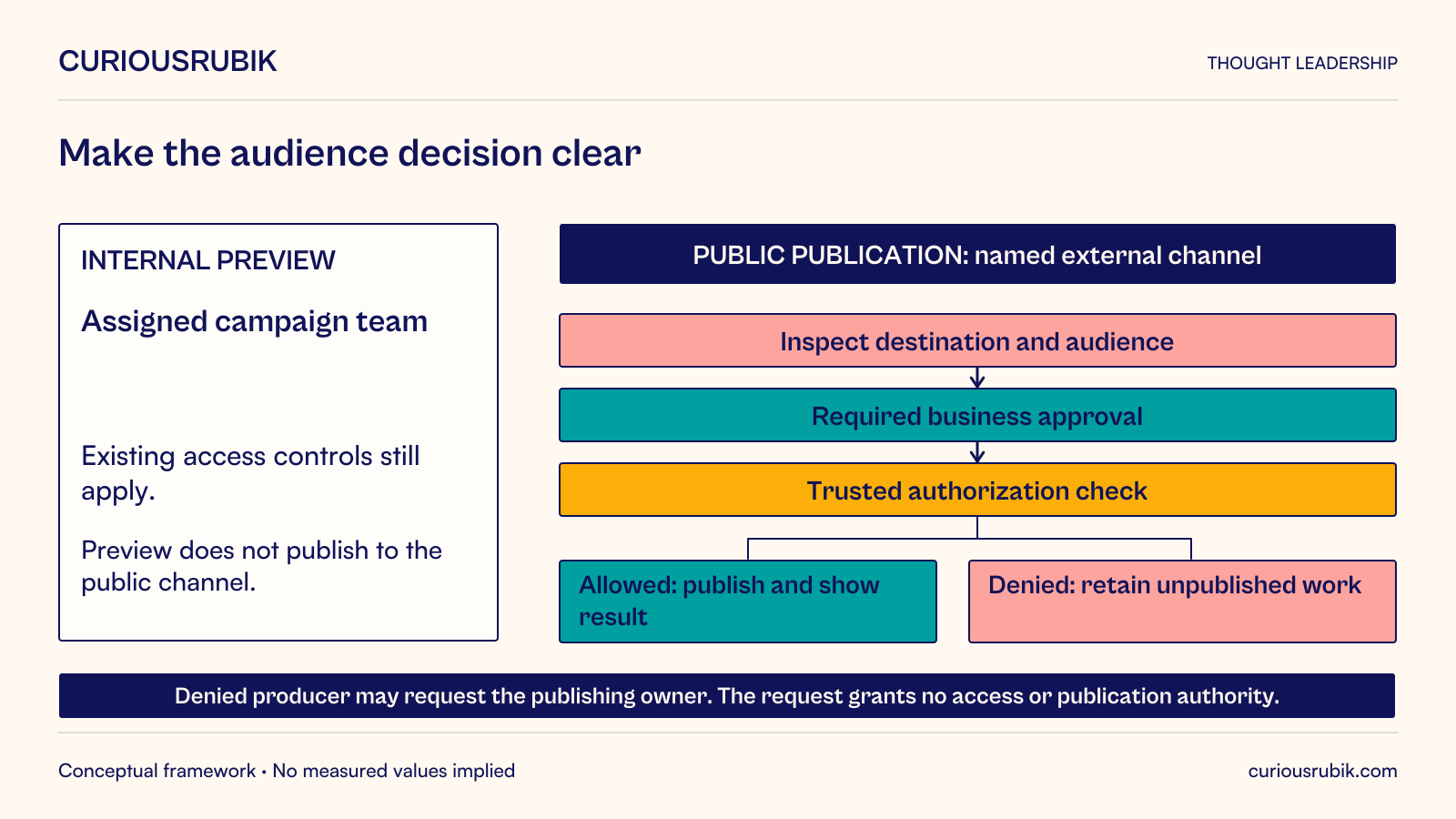
A video producer opens an internal preview and dismisses a warning. Later, the same warning appears before a video is published to a public channel. The messages look alike, even though the consequences differ. When publication is denied, the application provides an error code but no supported way to reach the person who can authorize the work.
This hypothetical studio has several controls, yet its staff must work hard to understand which decision each control protects. Adding another warning might increase effort without clarifying the consequential action. Removing every interruption would create a different problem: an important audience change could become too easy to miss.
The useful question is where a control helps someone complete an authorized task correctly, and where the surrounding design creates avoidable confusion. Security, product, and operations leaders need evidence about both. A shorter journey is valuable only when its permissions, outcomes, and recovery remain acceptable.
Observe a complete task, including preparation and blocked attempts. Ask what the person is trying to do, what information is exposed, what could change, and whose authority is required. Count more than clicks. Time spent finding an approver, reconstructing a lost draft, or determining whether a command succeeded belongs to the task too.
Then examine each interruption. Is it establishing identity, requesting a business decision, warning about a changed audience, or simply repeating information? Those purposes require different evidence. A user acknowledging a warning does not establish permission, and an authenticated account does not automatically have authority to publish.
Some friction is deliberate and useful. A consequential action may warrant a clear pause, stronger verification, or independent approval under the organization’s policy. The design problem is to make that moment meaningful and enforceable while avoiding unrelated obstacles around it.
Saltzer and Schroeder’s 1975 protection paper includes psychological acceptability: security mechanisms should be understandable and usable in relation to the person’s protection goals. It also discusses least privilege and complete mediation. These are design principles, not proof that a particular interface is secure. The Protection of Information in Computer Systems, Section I.A.3
Imagine a product-video studio preparing material for a brand’s campaign. Under its hypothetical operating policy, a producer can save work and preview it within the assigned internal campaign team. Public publication requires the publishing role and the campaign owner’s required business approval. The specific policy is illustrative; organizations must establish their own requirements.
The current interface labels several actions “Share.” An internal preview link and a public-channel action use similar dialogs. A generic security warning appears in both paths. Staff can complete the screens without gaining a clear view of the audience they selected.
The team proposes a narrower redesign. Internal preview explicitly names the internal campaign audience and stays within its existing access controls. Public publication has a separate action that names the destination channel and states that the material will be externally visible. The final confirmation asks the publisher to inspect those facts, rather than merely acknowledging that sharing can be risky.
The application still checks the acting account’s authority and the required business conditions in trusted service logic. A producer without publication rights cannot acquire them by pressing the confirmation button, altering a request, or using another interface. Clearer wording supports a legitimate person’s decision; it does not replace enforcement.
When publication is unavailable, the producer can retain the unpublished work and submit a request through the approved publishing-owner route. The request includes the intended campaign and destination so the owner does not have to reconstruct the task. It grants no temporary publication authority by itself.
This proposal has not produced a measured improvement. It gives the team a testable alternative: routine preparation should be easier to interpret, while the public-release decision becomes more explicit and unauthorized publication remains blocked.
The studio’s publication screen should answer concrete questions: which campaign, which destination, and who will be able to see the result? If the person has selected an unexpected public channel, the screen needs an obvious way to correct that choice before proceeding.
Avoid treating severity words as sufficient explanation. A prominent message saying “Important security action” may attract attention without revealing the actual consequence. The wording should describe the decision in the vocabulary of the work and distinguish a requested action from a completed one.
Use stable, accessible labels and controls. Test whether keyboard users and people using assistive technology can inspect the destination, change it, and understand the result. A confirmation that can be read visually but not navigated reliably excludes some authorized users from the intended protection.
There are limits to the information shown. The screen should provide enough context for the decision without exposing unrelated confidential campaign details. Help and support messages also need appropriate handling; a diagnostic screenshot should not become an uncontrolled copy of protected material.
Review the complete action path with the security team. The same publication policy should apply through the ordinary screen, another client, and supported automated interfaces. Tests should include attempts that omit the confirmation screen or present an account without the required authority.
The interface can explain a restriction without revealing information the requester is not entitled to see. A denial should identify an appropriate next step, such as contacting the assigned publishing owner, while protecting sensitive account or campaign details.
Define what happens when a task is interrupted. If a session ends during preparation, the person should be able to determine whether their work was saved and whether anything was published. Restoring access must use the approved recovery process; convenience is not a reason to share a privileged account.
Likewise, withdrawing future access is different from undoing an external disclosure. In the studio example, removing a published video may stop its continued availability through that channel, but the organization cannot assume that nobody copied or saw it. The design should prevent an accidental audience change where possible and provide an incident route when one occurs.
These controls need implementation review and security testing. A successful usability session demonstrates neither resistance to deliberate misuse nor complete coverage of all access paths.
Repeated prompts, unclear denials, and difficult recovery can create frustration, but a complaint alone does not establish which control should change. Observe where the task fails. The problem may be a missing entitlement, an unavailable decision maker, a confusing label, or a control that is correctly preventing an unauthorized action.
The 2016 qualitative study Security Fatigue identified resignation, loss of control, and decision avoidance among interviewed participants discussing online security. Its findings justify attention to people’s experience; they do not establish that every employee is fatigued or that removing controls improves security. Stanton and colleagues, Security Fatigue
Invite staff to report difficult cases without asking them to demonstrate unsafe workarounds in production. Use a controlled test environment and representative, non-sensitive materials. Distinguish an observed design failure from assumptions about a person’s motivation or competence.
If an authorized publisher is regularly unavailable, the remedy may be staffing, delegated coverage, or a revised service commitment. Rewording the denial cannot supply missing operational capacity. Any delegation still needs explicit scope and approval.
Build the evaluation around a small set of realistic tasks. For the studio, include an internal preview, an authorized public publication, a producer who lacks publication authority, and a publisher who initially selects the wrong destination. Add an interrupted session and a user who needs an accessible interaction path.
Record whether each person reaches the correct outcome and understands it. Did the preview stay internal? Did the publisher notice and correct the wrong channel? Did the denied producer find the authorized request route without believing that publication had occurred? Did a service-side test reject a prohibited command?
Measure effort alongside those outcomes. Observe completion time, correction time, help requests, abandoned legitimate tasks, and work transferred to the publishing owner. Keep difficult and denied cases visible rather than reporting only the fastest successful journeys.
Use comparable task conditions when evaluating alternatives. Familiarity with the system, campaign complexity, and available support can affect results. A small prototype study can reveal confusion, but it should not be presented as a measured reduction in security incidents.
Agree on unacceptable results before the trial. A faster design that causes users to misunderstand the audience, loses drafts, or permits a prohibited action needs revision. Security and operational owners should decide the release conditions together, with unresolved risks visible.
The studio should not approve a broad promise to “reduce security friction.” It should decide whether the specific preview and publication redesign provides clearer task boundaries, preserves enforced permissions, and supports the required publishing workload.
That decision may retain a deliberate confirmation for public release while removing or rewriting a repetitive warning elsewhere. It may also require investment in publishing-owner coverage or better error recovery. The appropriate result depends on observed tasks and the organization’s risk requirements.
Start with one costly point of confusion. Document the protected outcome, inspect the real task, prototype the alternative, and test allowed actions alongside mistaken and prohibited ones. Keep the control owner accountable after release, especially when audiences, roles, or channels change. Operational efficiency then becomes evidence about correctly completed work, rather than a count of how many safeguards have disappeared.