A workforce budget can be arithmetically correct and still rely on a stale eligibility assumption. The model carries forward a salary, assigns a start month and treats the role as available. HR later finds that the planned application or renewal falls under a different published schedule.
The budget needs a timing register alongside its cost assumptions. That register connects the intended workforce action, relevant pass dates and specialist review to the period in which finance expects capacity to be available. It should support responsible planning, without turning personal characteristics into an automated hiring or retention score.
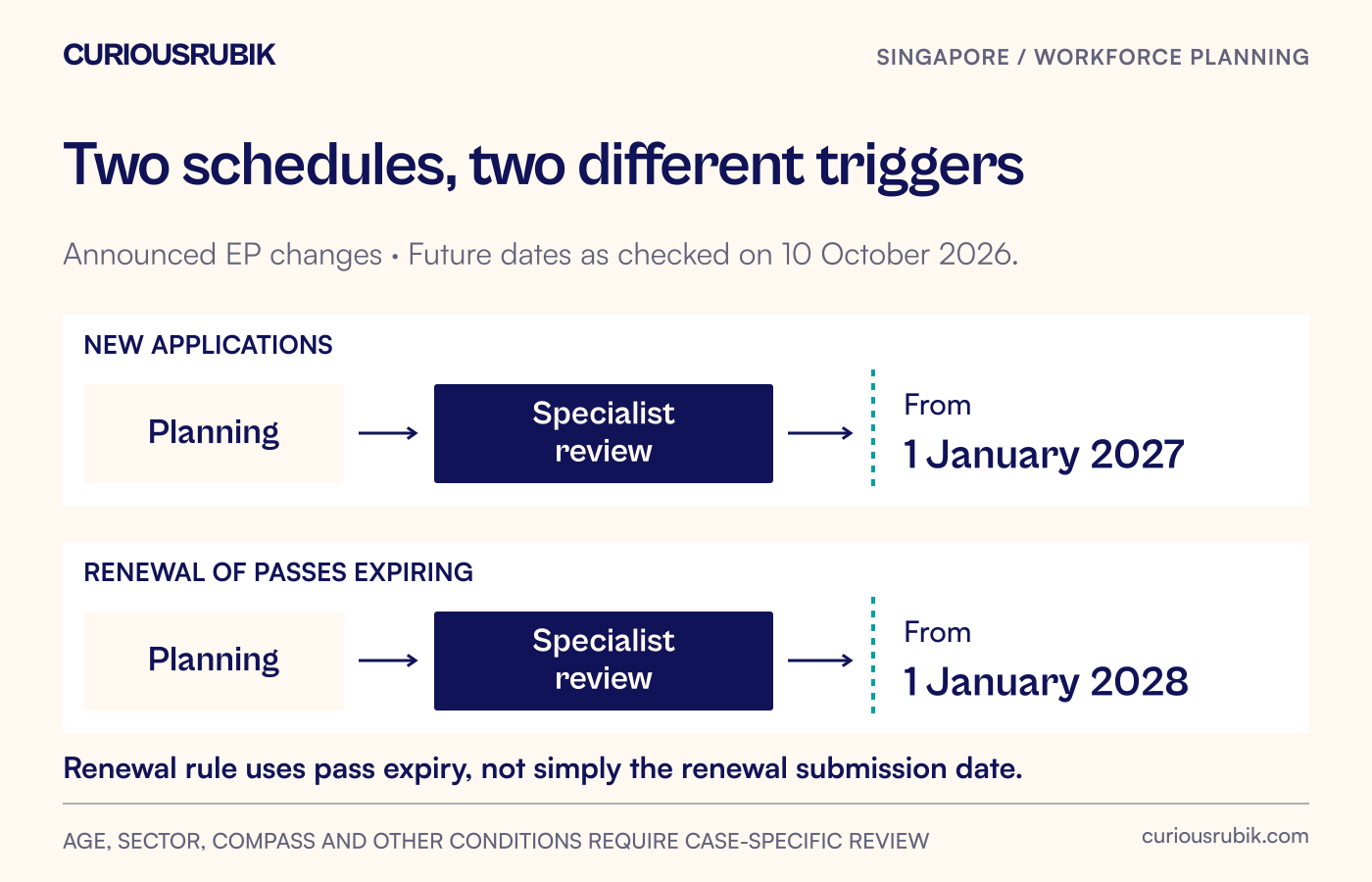
Singapore's announced Employment Pass changes make the distinction concrete. As at 10 October 2026, higher qualifying-salary schedules are due to apply to new applications from 1 January 2027 and renewals of passes expiring from 1 January 2028. Those are different triggers. A budget built around a single field called “renewal year” can select the wrong one.
Before approving headcount costs, separate three questions. What work does the business need performed? What is the proposed employment and timing plan? Has the responsible HR or work-pass specialist checked the applicable requirements and uncertainties?
The business manager owns the work requirement and realistic capacity assumption. HR owns the employment and eligibility review. Finance owns the cost scenario and the effect of timing changes. A green cell in the budget should not be interpreted as approval of a pass application, an employment offer or an individual outcome.
Ask each owner for an explicit statement. “Capacity needed from February” differs from “application intended in February”. “Renewal review underway” differs from “renewal approved”. These distinctions let management see the remaining uncertainty instead of assuming the role will be filled on the model's preferred date.
A useful meeting ends with a decision about the budget and a list of conditions that remain open. It should not force HR to make an unsupported eligibility assurance so finance can finalise the spreadsheet.
For a proposed new application, record the intended application period and the schedule the specialist expects to use. For an existing pass, record its verified expiry and the intended renewal action. Keep the source and check date for the applicable rule.
MOM's published EP qualifying salaries vary with age and sector, and COMPASS applies unless an exemption is relevant. Other application requirements also matter. Meeting a headline salary floor is therefore insufficient to establish approval. The specialist must apply the correct criteria to the actual case.
The general planning register does not need to expose every employee document. It can show a restricted case reference, the action type, relevant timing, reviewed cost assumption and unresolved condition. Access to personal details should be limited to the people who need them for their role.
Where the organisation uses age-specific published schedules for compliance review, keep that assessment in the appropriate HR process. Do not repurpose the information to rank people by a supposed “cost of eligibility”. Role requirements, fair employment practice and accountable human decisions remain central.
CURIOUSRUBIK SINGAPORE / WORKFORCE PLANNING Two schedules, two different triggers Announced EP changes · Future dates as checked on 10 October 2026. NEW APPLICATIONS Planning Specialist review From 1 January 2027 RENEWAL OF PASSES EXPIRING Planning Specialist review From 1 January 2028 Renewal rule uses pass expiry, not simply the renewal submission date. AGE, SECTOR, COMPASS AND OTHER CONDITIONS REQUIRE CASE-SPECIFIC REVIEW curiousrubik.com
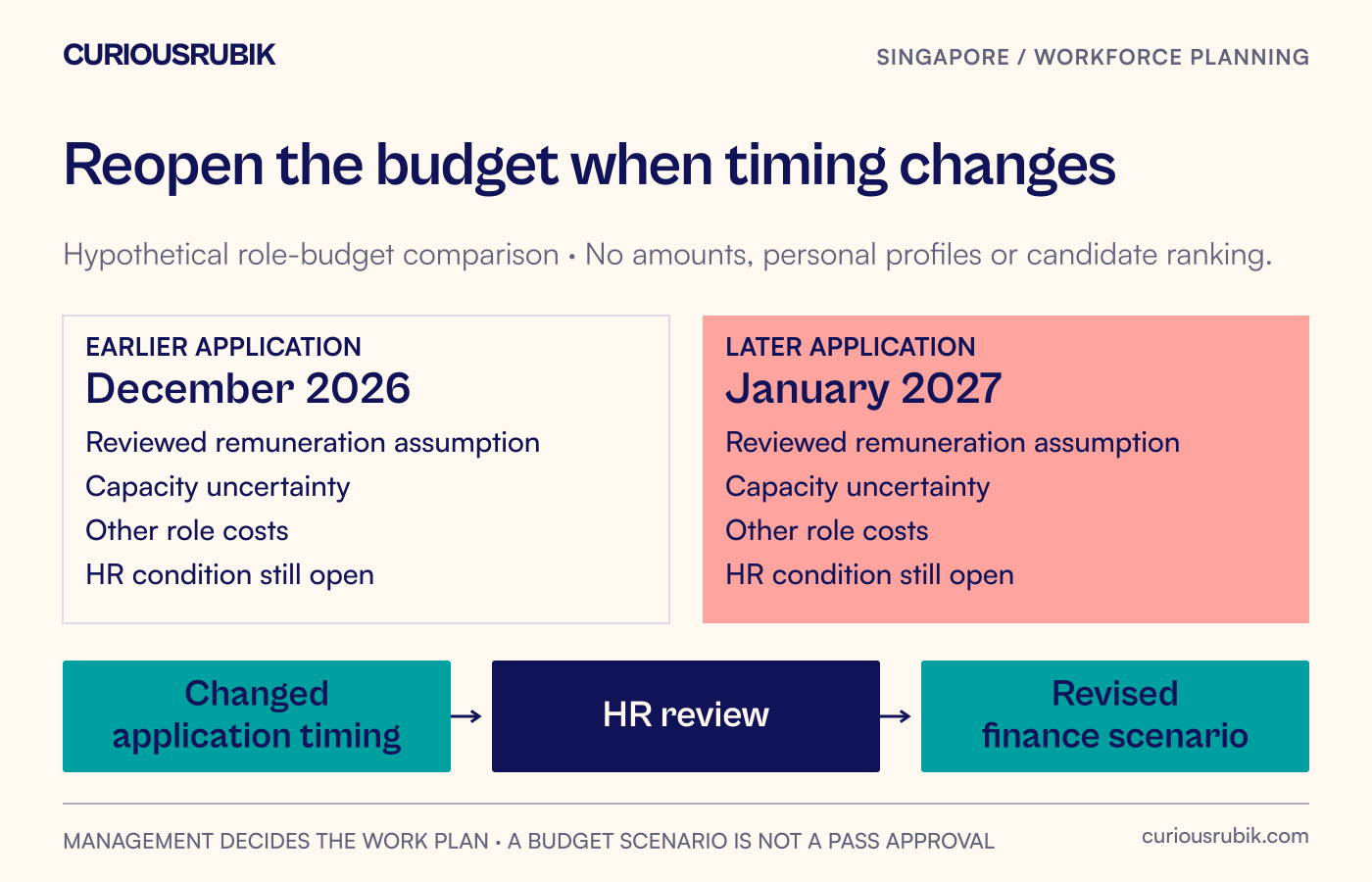
Imagine a hypothetical Singapore company planning an additional operational role. Its first scenario assumes a new EP application in December 2026. A revised project schedule moves the intended application into January 2027. The role's work may be unchanged, but the applicable published salary schedule needs a fresh check.
The finance response should be to reopen the assumption with HR. It should not be to move the date backward in the model while retaining a start date that the operation cannot support. Nor should it assume that increasing a salary to the lowest published figure resolves every eligibility condition.
Use two cost columns with explicit assumptions. One describes the earlier intended application, the reviewed remuneration assumption and realistic availability uncertainty. The other describes the later intended application and the revised specialist input. Include ordinary role-related costs and any temporary capacity arrangement separately, without disguising them as salary.
A third column can show what management must decide: whether to revise timing, adjust the work plan or approve a different lawful employment arrangement after proper review. It should not list preferred candidates or recommend adverse action based on age or nationality.
For an existing pass, carry out a separate exercise. Check the verified expiry against the renewal schedule's trigger, then examine the intended cost period. Copying the new-application rule into every renewal case can overstate or understate the planning issue.
A workforce timing register can remain compact. For each planning item, include:
Use statuses that describe evidence. “Facts incomplete” asks for missing information. “Specialist reviewed, conditions open” shows a usable but qualified assessment. “Application pending” is an external process status. None should be replaced with “approved” merely because the budget owner has accepted the expenditure.
If a key date or sector assumption changes, the review should reopen. Preserve the original assumption and the reason for the change so finance can explain why the budget moved. This is particularly useful where workforce planning runs months before an actual application.
CURIOUSRUBIK SINGAPORE / WORKFORCE PLANNING Reopen the budget when timing changes Hypothetical role-budget comparison · No amounts, personal profiles or candidate ranking. EARLIER APPLICATION December 2026 Reviewed remuneration assumption Capacity uncertainty Other role costs HR condition still open LATER APPLICATION January 2027 Reviewed remuneration assumption Capacity uncertainty Other role costs HR condition still open Changed application timing HR review Revised finance scenario MANAGEMENT DECIDES THE WORK PLAN · A BUDGET SCENARIO IS NOT A PASS APPROVAL curiousrubik.com
Automation can identify approaching expiry dates, detect a planned application crossing a published effective date and present the relevant source schedule. It can remind HR when a reviewed assumption is stale or notify finance when the timing basis changes.
The trigger should open a review, not reject a candidate or alter an employee's pay. Employment changes require the appropriate human decisions, communications and documentation. A budget adjustment alone does not amend agreed terms.
Test the reminders with cases either side of each effective-date boundary. Include a renewal whose planned submission occurs before the new rule but whose expiry is on the relevant side of the published trigger. This exposes whether the register uses the correct event rather than the most convenient date.
Assign exceptions to the HR or pass specialist, with finance owning the resulting budget update. If facts remain uncertain near a commercial commitment, show the uncertainty and its capacity consequence to the decision maker. Repeating an alert without identifying the decision will not improve the plan.
Measure how often relevant workforce plans receive specialist review before the business commits, how many assumptions are changed late and which missing facts cause repeated rework. Review the explanation behind a changed budget rather than treating every revision as planning failure. Some revisions reflect new information that the process should surface.
The first useful step is to annotate the next workforce budget with action type, relevant date and last specialist review. Ask HR and finance to inspect one new-application case and one renewal case together. If they can identify the rule trigger, the remaining uncertainty and who owns the next decision, the budget is describing a plan the business can responsibly act on.