A bank payment shows that money moved. Months later, it may say little about what the business bought, why the cost was incurred or how a later credit changed the amount. If the explanation sits only in a former employee's memory, a routine question can become a lengthy reconstruction exercise.
For a Singapore business, the practical answer is to connect the evidence while the transaction is active. A small, retrievable bundle with a named owner is more useful than a large folder of loosely related files. The aim is to explain the transaction without collecting everything anyone might conceivably ask for.
IRAS's company record-keeping guidance requires source records and an explanation of business transactions. It expressly says that keeping only bank statements is insufficient. A transaction index can help the business meet that evidence need, but the proposed index is an operating recommendation rather than an official form.
Start with the questions a reviewer would reasonably need to answer for the transaction type. What was purchased or supplied? Which entity was involved? What was the business purpose? Which period did it relate to? How was the amount agreed, and what changed later?
The evidence will vary. A goods purchase may need an order and receipt record alongside the invoice. A service may need scope and completion evidence. A reimbursement needs the employee's business context and relevant payment support. Do not impose a goods-received document on a transaction where no goods exist merely because the form expects an attachment.
Also separate what happened from the tax conclusion. For a GST-registered business, input-tax recovery remains subject to its own conditions and documentary requirements. A complete internal bundle does not guarantee that an expense is deductible or that GST is recoverable.
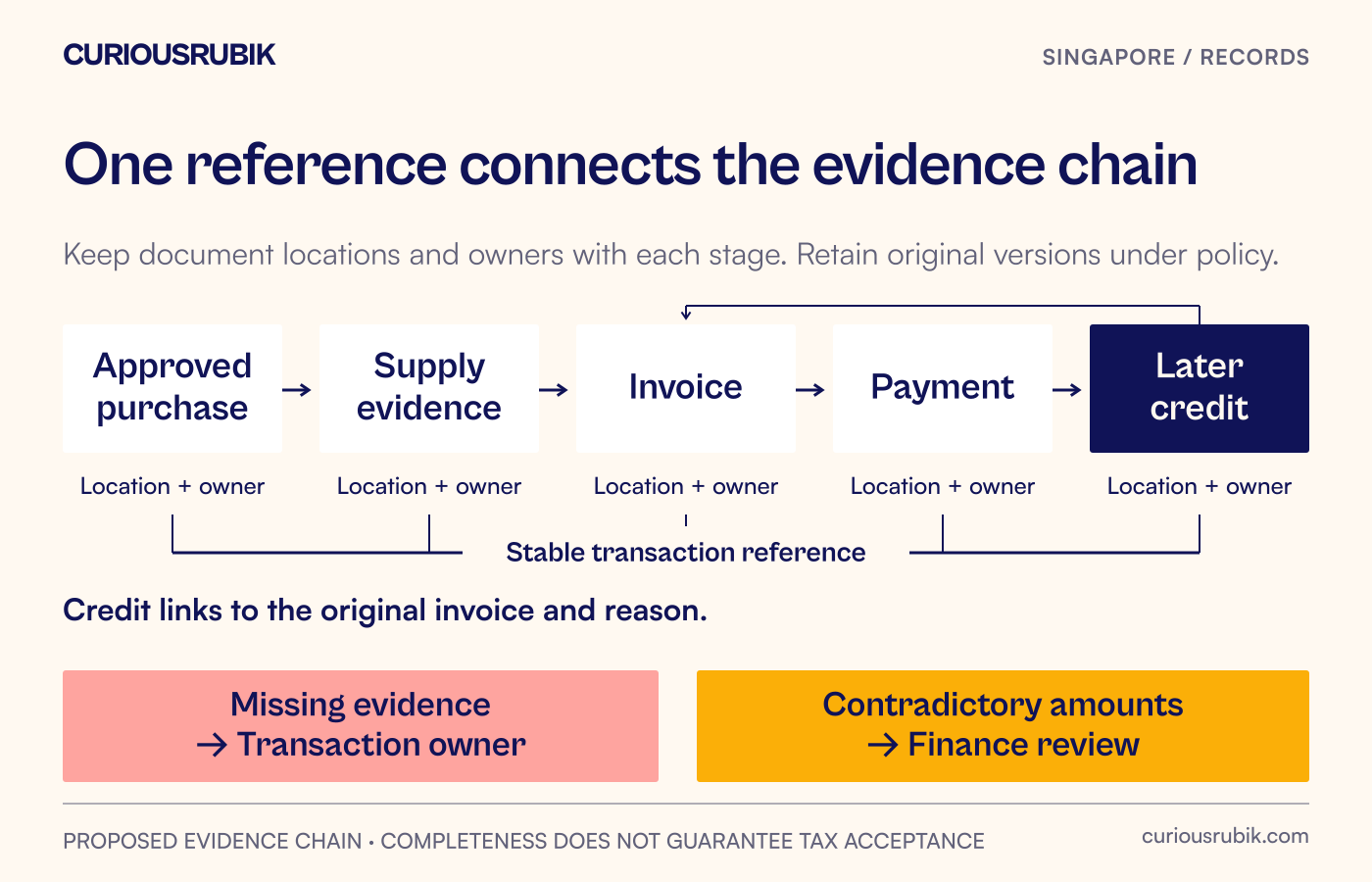
Give the transaction a stable reference and connect the records through that reference. The index should tell an authorised reviewer where the originals are and which version mattered to the decision.
A practical record contains:
Avoid copying the same document into multiple locations simply to make each department's folder look complete. Copies can diverge, especially when an invoice is corrected. A controlled reference to the original is often easier to maintain, provided the file remains accessible to the people entitled to review it.
If a copy must be preserved for the record, identify the original source and version. A screenshot of a partial email may omit the attachment, date or context that explains the decision. The evidence owner should judge whether the captured record is complete enough for the purpose.
CURIOUSRUBIK SINGAPORE / RECORDS One reference connects the evidence chain Keep document locations and owners with each stage. Retain original versions under policy. Approved purchase Location + owner Supply evidence Location + owner Invoice Location + owner Payment Location + owner Later credit Location + owner Stable transaction reference Credit links to the original invoice and reason. Missing evidence → Transaction owner Contradictory amounts → Finance review PROPOSED EVIDENCE CHAIN · COMPLETENESS DOES NOT GUARANTEE TAX ACCEPTANCE curiousrubik.com
A hypothetical business buys S$7,500 of specialist work. Finance receives the invoice and bank payment record. The project lead knows why the work was needed and which deliverable it covered, but that explanation never reaches the accounting record.
Instead of asking finance to reconstruct the project later, collect a short confirmation at the relevant handoff. The project lead identifies the work, period and supporting delivery record. Finance connects that explanation to the invoice and its review. The amount is illustrative; the same handoff problem can occur at any value.
Now suppose the supplier issues a partial credit. Keep the original invoice, credit and reason connected. Update the current status while preserving the earlier decision and accounting references. A reviewer should be able to understand both the original purchase and the change without searching separate inboxes.
If the project lead disagrees with the invoice description, mark the contradiction explicitly. A bundle containing every expected document can still be unreliable if those documents tell different stories. “All attachments present” is a completeness test, not a conclusion that the transaction is explained.
An evidence gap needs a person who can obtain or explain the fact. Finance operations can coordinate the queue, but it may not know whether a service happened or why a purchase was made.
Route a missing delivery confirmation to the receiving or project owner. Route a revised invoice to the person managing the supplier relationship. Route an accounting or tax interpretation to the qualified finance reviewer. Keep the coordinating owner responsible for ensuring the item does not disappear between these handoffs.
Give the request a precise question. “Please provide support” invites another unrelated attachment. “Please confirm which project deliverable this invoice covers and attach the completion record” is easier to answer and easier to evaluate.
Where original evidence cannot be recovered, record what is missing, the efforts made and the available alternatives. Ask the relevant reviewer to assess the consequences. Do not manufacture a retrospective approval or imply that an employee's later recollection is necessarily equivalent to a contemporaneous source document.
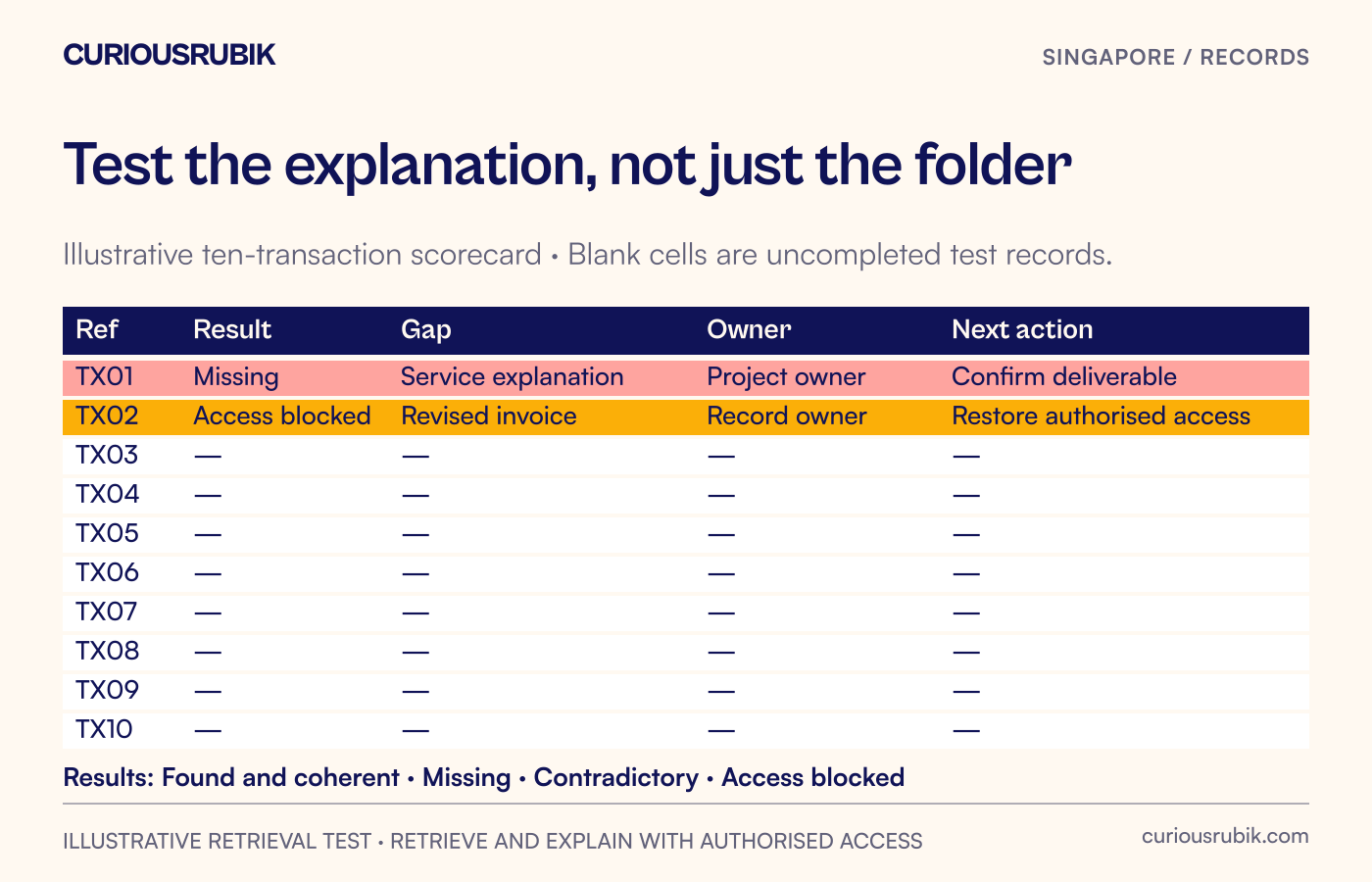
A retrieval exercise is a useful diagnostic because it tests the outcome rather than the appearance of the filing structure. Select ten recent transactions across several types. Include ordinary purchases, a service, a reimbursement, a credit or refund, and at least one transaction that required an exception.
Give the reviewer the transaction references and ask them to assemble the explanation using authorised access, without asking the original preparer where everything is. Record four possible findings:
Record the time required and what prevented a clear answer. Set a local target appropriate to the transaction types and reviewers; do not borrow a universal retrieval-time benchmark. A complex contract and a routine stationery purchase should not necessarily have identical evidence demands.
CURIOUSRUBIK SINGAPORE / RECORDS Test the explanation, not just the folder Illustrative ten-transaction scorecard · Blank cells are uncompleted test records. Ref Result Gap Owner Next action TX01 Missing Service explanation Project owner Confirm deliverable TX02 Access blocked Revised invoice Record owner Restore authorised access TX03 — — — — TX04 — — — — TX05 — — — — TX06 — — — — TX07 — — — — TX08 — — — — TX09 — — — — TX10 — — — — Results: Found and coherent · Missing · Contradictory · Access blocked ILLUSTRATIVE RETRIEVAL TEST · RETRIEVE AND EXPLAIN WITH AUTHORISED ACCESS curiousrubik.com
Review the failures by cause. Several missing business explanations may point to an intake problem. Repeated access blocks may indicate poorly assigned permissions or a dependency on one employee's account. Contradictory amounts may show that credits and revised invoices are not being connected properly.
Automation can check expected attachments by transaction type, flag payments with no linked invoice or claim, and detect broken document references. It can compare amounts across versions and notify the owner when a transaction remains unresolved.
Keep the limits clear. A file's existence does not prove its relevance. A similar invoice number does not prove that two records belong together. A generated summary should remain traceable to the original evidence, especially where descriptions or amounts conflict.
Ask for human review at the point where the evidence changes the conclusion. For example, an invoice and credit may be linked automatically, but the reason for a disputed service reduction needs an accountable assessment. The reviewer should be able to reject a proposed match without losing either source record.
Do not broaden collection just because automation makes it easy. Restrict sensitive material to the people who need it, and avoid attaching entire employee or customer histories when a specific transaction record is enough. Retention and lawful disposal need their own rules; this intake process should operate within them rather than creating an indefinite archive by default.
Measure retrieval success, unresolved evidence gaps and time spent answering repeated questions. Also ask how much effort transaction owners spend completing the bundle. A process that demands a long narrative for every small purchase can become so burdensome that people stop providing useful context.
Refine the matrix after the retrieval exercise. Keep fields that establish a necessary fact or change a review decision. Remove duplication, improve examples and fix access problems at their source. A short explanation supplied promptly is often more valuable than a lengthy reconstruction months later.
Choose ten transactions from the last month and test the evidence today. For each gap, identify the handoff at which the missing information was easiest to obtain. That is the best place to improve the process before the next transaction arrives.