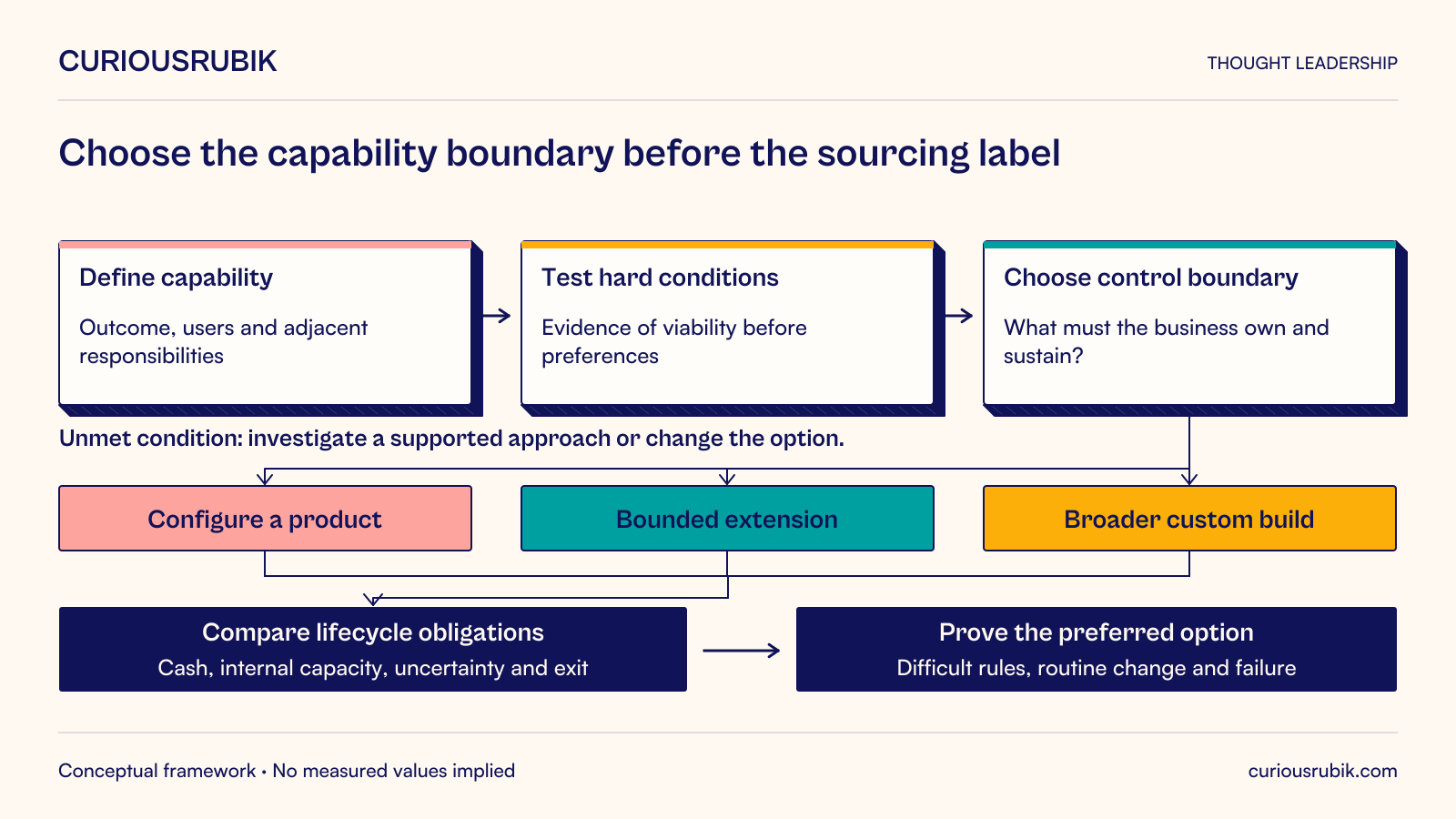
The first build-versus-buy decision is the boundary of the capability. A business may need control over a distinctive calculation or workflow without needing to own an entire application suite. Treating the choice as “buy everything” or “build everything” can turn a narrow requirement into an unnecessarily large commitment.
For a business leader, the useful question is which parts of the operating capability require control, which can be supplied reliably by a product and whether the organization can sustain the responsibilities it chooses to own. Cost matters, but a low estimate is not persuasive if the option cannot meet a critical condition or depends on capacity the business does not have.
The framework below is a proposed decision sequence, not a validated scoring model. It compares complete operating options and preserves non-negotiable constraints rather than hiding them inside a weighted feature score.
State the business outcome and the work that produces it. Identify the users, decisions, data and service expectations involved. Then distinguish the outcome from the current way of achieving it.
For example, a request for a custom quoting application might actually mean that the business needs consistent rule-based estimates, traceable exceptions and a proposal the customer can understand. Some parts may fit an existing product; another part may require a specialized calculation or review process.
Define the relevant boundary with adjacent capabilities. Will the proposed application own customer identity, pricing rules, accepted orders, documents or only the quotation decision? Each responsibility affects integration, support, controls and future change.
Include the option of changing the process without buying or building a new application. If the underlying problem is an unresolved approval policy or duplicate data entry between existing tools, a smaller intervention may meet the need. The burden of proof should apply to a new software commitment as well as to maintaining the current arrangement.
Identify conditions an option must satisfy to be viable. These might include a required operating environment, access boundary, recoverability requirement, data portability need or integration capability. The conditions should be supported by a business or specialist decision, not an unexamined preference.
Keep those conditions outside a compensating score. An option should not win because its attractive interface outweighs an inability to retrieve essential records or enforce required permissions. If the condition can be changed, the appropriate owner must explicitly accept that change.
For preferences, compare the actual tradeoffs. A familiar workflow may reduce transition effort but preserve an inefficient process. A highly configurable product may support variation while increasing administration. A custom interface may fit users closely but create continuing design and testing work.
Record the evidence for fit separately from the claimed fit. A demonstrated capability, a supported extension and a roadmap promise are different forms of assurance. The decision should not treat them as equivalent checkmarks.
Control has value when the business must change a rule, experience or operating behavior on its own terms. It also creates obligations: design, testing, security, support, documentation and continuity when people leave.
Ask which decisions truly require that control. A proprietary calculation may deserve a separately owned component. Standard identity administration or routine document handling may be better supplied through established services, depending on the context. The appropriate boundary is a business and architecture decision, not a slogan about building only what differentiates the company.
A capability can be strategically important without needing custom software. Equally, a seemingly ordinary process may have constraints that make available products unsuitable. Use evidence from the actual requirements and market options rather than assuming that importance determines the delivery model.
Consider a mixed approach deliberately. Buying a stable foundation and building a bounded extension can preserve useful control, but the integration and operating boundary need clear ownership. A poorly governed extension can become a second application that the original cost comparison ignored.
Consider a hypothetical equipment-refurbishment business preparing customer quotations. The example is illustrative. Its estimators combine inspection findings with rules for replacement parts, labor operations and permitted alternatives. The rules change as the company learns from completed work, and the business needs to explain which rule version produced a quotation.
The initial request is to build a complete customer-and-quoting platform. A capability review shows that customer records, proposal storage and routine approval routing can be supported by several existing products. The uncertain part is whether those products can represent the estimation rules, preserve historical versions and expose the required explanation.
The team evaluates three credible options: configure an existing product, add a bounded estimation service to a purchased foundation, or build the broader platform. It uses representative difficult estimates, including an amended inspection and a permitted alternative, rather than comparing feature lists alone.
Suppose one product can model the current rules but cannot reproduce an earlier quote after a rule change in the demonstrated configuration. That finding is material to the stated requirement. It should prompt investigation of a supported approach or a different option, not an immediate assumption that all products are unsuitable.
A bounded custom estimation service may be attractive if it can preserve the rule version and explanation while the purchased product handles the surrounding workflow. The architecture must then define ownership of inputs, identifiers, approved results and error recovery. Building the whole customer platform would need a separate justification; the distinctive estimation need does not automatically justify every additional custom responsibility.
The next commitment is a targeted proof of the difficult rule and versioning behavior, together with an operating-cost assessment. The business chooses based on the capability it can demonstrate and sustain, not on whether the final solution carries a build or buy label.
Use the same service boundary and planning horizon for every option. Include implementation, migration, integration, environments, training, administration, upgrades, security work, support and eventual transition. Record exclusions rather than treating them as zero cost.
The US Government Accountability Office’s 2020 cost-estimating guide emphasizes lifecycle coverage, documented assumptions, sensitivity analysis and updating estimates with actual costs. It is not a commercial application-pricing benchmark, but those disciplines help prevent an incomplete comparison. GAO Cost Estimating and Assessment Guide.
Separate cash expenditure from internal capacity. Existing employees’ time may not create an immediate additional payment, but their availability still constrains the option. A custom solution with low supplier fees can be infeasible if nobody can own releases or support incidents.
Include uncertainty explicitly. Product pricing may depend on usage or user categories. Custom development effort may depend on unresolved rules and data quality. A mixed option may depend on an interface whose behavior has not been tested. Identify which assumption could reverse the choice and investigate it before making an irreversible commitment.
Do not count every benefit as a cash saving. Faster preparation, better consistency and improved customer explanation are different outcomes. State how the business will realize and measure each one.
Ask who will own the application after launch. For a purchased product, the supplier may operate the platform while the customer still owns configuration, access, data and business exceptions. For custom software, an external development partner may write the code while the customer still needs an accountable product and operating owner.
Demonstrate a routine change and a failure scenario. How is a rule updated, tested, approved and released? What happens when an integration is unavailable? Who can investigate a disputed result? Can the organization recover without the one developer who understands the design?
Assess documentation and knowledge transfer as operating capabilities. Possession of source code is useful, but does not by itself establish maintainability. Likewise, a support subscription does not prove that the supplier will resolve every business-specific issue.
Match the option to the organization’s ability to govern it. If that capability is missing, include the cost and time to establish it or choose a less demanding boundary. Avoid approving an ownership model that exists only in the proposal.
Before committing, ask how the business could change direction. Can it retrieve the data and configuration it needs? Can a critical component be replaced without rebuilding unrelated capabilities? What work would remain if the supplier or development partner changed?
No option is free of dependency. Custom software can depend on specialist knowledge and libraries; purchased software can depend on commercial terms and platform behavior; a mixed model can depend on both. Compare the specific switching obligations rather than calling one option inherently independent.
Use staged commitment where uncertainty is material. A discovery exercise or bounded pilot can answer a decisive question without funding the entire implementation. Define the evidence that would justify proceeding, changing the boundary or stopping.
A sound build-versus-buy decision identifies the capability the business needs and the responsibilities it is prepared to own. Start with that boundary, prove the hard conditions and compare the full operating commitment. The best option is the one the organization can use, change and sustain with confidence, whether it is purchased, custom-built or deliberately combined.