A screen that displays every available customer field can still leave an employee unable to answer a simple question: is this the right customer, is the information current, and am I allowed to act on it?
The phrase “360-degree customer view” encourages completeness as the design goal. A more useful goal is a trustworthy view for a defined decision. A service agent, account manager, and credit analyst need overlapping but different context. Showing everyone everything can increase confusion and privacy risk without improving service.
For a CIO or customer-experience leader, the central decision is architectural and operational: which facts must be connected, under what identity, at what freshness, with what provenance and access, and who will resolve disagreement? The user interface is the final expression of those choices. It cannot compensate for their absence.
Choose a specific task for the first release. Examples include resolving a billing complaint, preparing a renewal, or determining service entitlement. Describe the action the employee must take and the consequences of an incorrect answer.
For a billing complaint, the employee may need the contracting party, relevant invoice, delivery or service evidence, dispute status, and authority to offer a correction. They may not need every marketing interaction or the customer’s entire contact network.
Define what “good enough” means for each fact. A historical invoice can be retrieved on demand. An unresolved dispute may need a recent status. An entitlement decision may require confirmation from an authoritative system at the moment of action. A single freshness target for the entire view rarely fits these differences.
This boundary creates a testable first release. It also prevents the program from postponing value until every source has been connected and every identity problem has been solved.
An email address is a useful contact attribute. It is usually a weak universal customer identifier. People change employers, shared mailboxes serve several users, and one organization can have many domains or trading names.
Model the entities the business actually serves. A legal organization may sign a contract; an account may define the commercial relationship; a site may receive service; a person may act for several organizations. The same person can have different permissions in different contexts.
Use stable internal identifiers and preserve source-system identifiers through an explicit mapping. Avoid forcing every source to adopt the same number before any integration can proceed. What matters is that the relationship is controlled and explainable.
Set matching rules according to consequence. An approximate name match may be suitable for suggesting a possible duplicate to a steward. It may be unsuitable for merging financial records or revealing another customer’s service history. The cost of a false merge can be substantially different from the cost of leaving two records separate temporarily.
A merge must also be reversible where the platform permits it. Preserve evidence, affected records, approver, and the ability to investigate downstream consequences. “Deduplicated” is not a sufficient quality claim if nobody can explain why two accounts became one.
Decide which system is authoritative for each important attribute or transaction. The contract system may own approved terms, the finance system may own invoice status, and the service system may own the operational case state.
Authority does not necessarily belong to one platform for the entire customer. Define it by business concept and, where needed, by lifecycle stage. A proposed address and a verified invoicing address can both exist if their meanings are clear.
A joined view should show the source and effective time for information that influences a consequential decision. If two systems disagree, the view needs a resolution rule or an explicit conflict, not a silent last-write-wins policy chosen for technical convenience.
W3C’s PROV-O Recommendation provides a model for expressing provenance through entities, activities, agents, and their relationships. A customer view need not implement that ontology to benefit from the underlying discipline of recording where information came from and how it changed. W3C PROV-O.
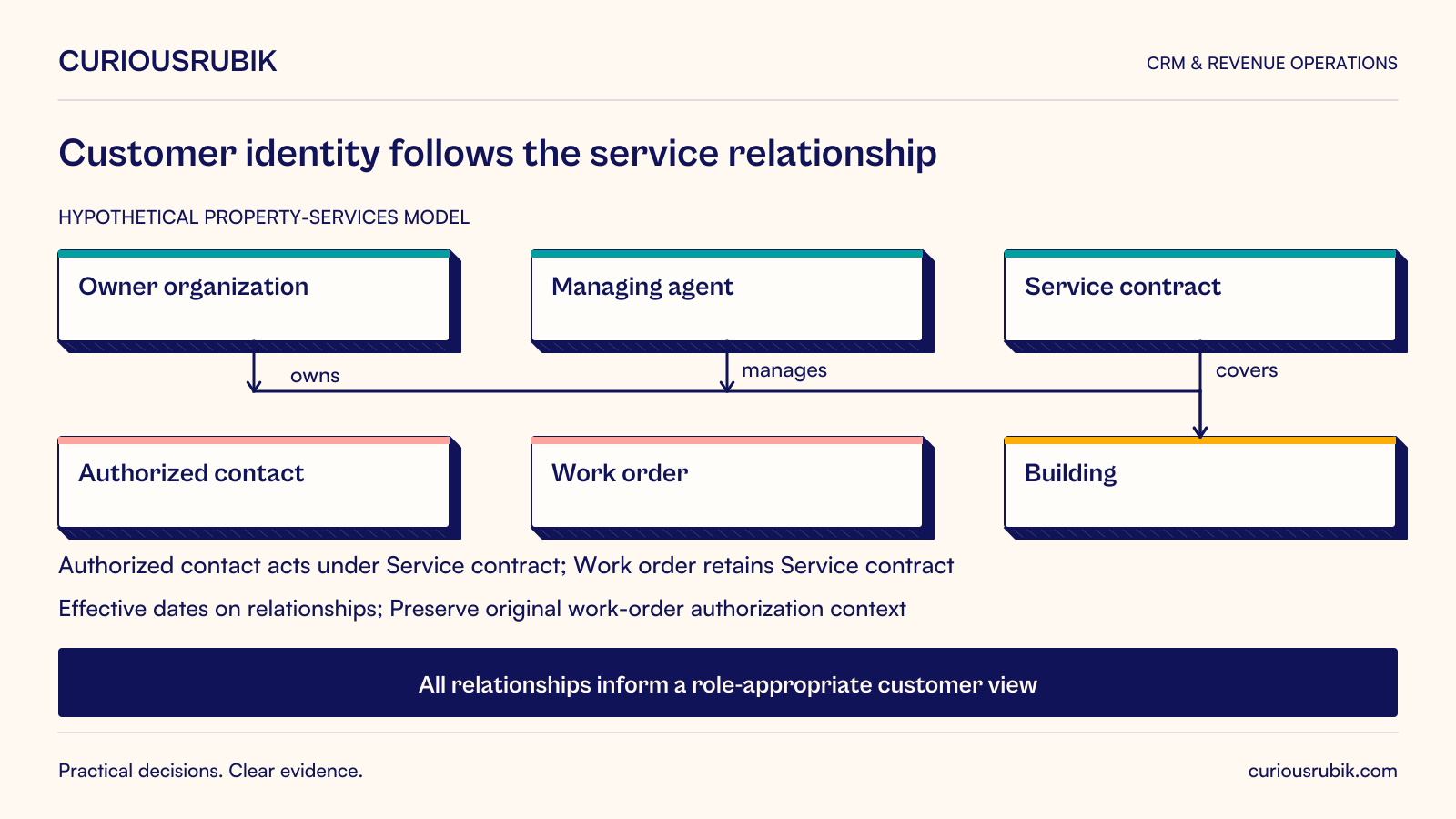
Consider a hypothetical company maintaining commercial buildings. A property investment group owns several buildings, a managing agent commissions work, and tenants report faults. In its existing systems, each party sometimes appears as “the customer.”
A service agent searching by building name can find work orders but may see the wrong billing contact. A salesperson viewing the property group can see consolidated revenue but cannot establish which managing agent is authorized to approve an additional visit.
The redesign introduces explicit relationships among owner organization, managing agent, building, service contract, and authorized contact. These relationships have effective dates because management arrangements change. A work order retains the contract and authorization context under which it was created rather than inheriting whatever relationship happens to be current today.
The first customer view supports fault resolution. It shows the building, active service coverage, open work, approved contacts, and unresolved billing disputes relevant to that contract. It does not expose unrelated tenant records or group-wide financial detail to every service agent.
The team tests a management-company change, two buildings with similar names, a shared contact, and a contract that has expired while a work order remains open. Those scenarios expose errors a clean demonstration dataset would miss.
Where identity is uncertain, the agent sees a warning and a controlled verification path. The business accepts some manual review because an incorrect disclosure or unauthorized service commitment would be more costly than a brief delay. The example illustrates an architectural decision; it does not assert a measured operational result.
There are several legitimate ways to assemble the view. Replicating selected data into a common store can support fast search and consistent reporting, but creates synchronization and deletion obligations. Fetching from source systems at the time of use can provide more current information, but increases dependence on their availability and response time.
A hybrid approach often deserves consideration. Stable reference data can be cached while a consequential status is confirmed on demand. This is a design option, not a universal best practice. The right balance depends on workload, outage tolerance, sensitivity, and the source systems’ capabilities.
Make stale behavior explicit. If the service source is unavailable, should the screen show a clearly dated cached status, suppress the field, or prevent the action? Different decisions may need different responses. A useful display should not quietly convert “unable to confirm” into “no open issues.”
Monitor the information path. A technically successful connection can still deliver unusable data if mappings are wrong or updates are delayed. Track unmatched identities, conflicts awaiting review, lag for critical fields, and correction completion. These measures describe the reliability of the view more directly than the number of connected applications.
A unified customer view can unintentionally broaden access. Users who previously saw only service records may now see commercial negotiations or personal details because they share an account identifier.
Design permissions around role, relationship, purpose, and record sensitivity where necessary. Test the permissions on linked records and search results, not only on the main screen. A hidden field can still leak through exports, notifications, summaries, or cached results.
The NIST Privacy Framework offers voluntary guidance for managing privacy risk across enterprise activities. For this design, it supports treating data use, exposure, and control as part of architecture rather than an approval step after consolidation. It does not itself determine the legal basis for a particular use. NIST Privacy Framework Version 1.0.
Avoid equating access with permission to reuse information for any purpose. A service record collected to resolve a fault may not be appropriate input for unrelated profiling. Establish purpose and retention rules with the relevant privacy and legal owners, especially when data crosses organizational or jurisdictional boundaries.
People will discover mistakes while serving customers. The view needs a way to report them without forcing the employee to understand the entire data architecture.
Let users identify the disputed fact, supporting evidence, and urgency. Route the issue to the source owner or data steward. Show whether the correction is pending, rejected with a reason, or completed. Update dependent copies and preserve the relevant audit trail.
Do not make every employee a master-data administrator. A service agent may be able to suggest a changed contact role but should not necessarily merge organizations or alter approved billing terms. Separate convenient reporting from authority to change the underlying fact.
Prioritize corrections by consequence. A misspelled display name and a cross-customer identity merge should not enter an undifferentiated queue. Define urgent containment steps for issues that could cause inappropriate disclosure or incorrect transactions.
A meaningful acceptance test asks a user to complete a task with realistic data complications. Include duplicate organizations, reused contact details, a stale source, a withdrawn permission, and a disputed relationship. Verify what the user sees and what actions remain available.
Measure successful task completion, time spent reconstructing context, incorrect account selection, and unresolved data conflicts. Set thresholds according to the process and observed baseline rather than borrowing a generic industry target.
Include negative tests. A user should be unable to view another account’s restricted information even when names are similar. A cached result should respect updated access rules. A failed synchronization should create an operational signal and a recoverable state.
Invite the source owners to sign off on meaning and correction behavior. A central analytics team can verify data movement, but only the relevant business owners can confirm that the assembled view supports the intended decision.
Ask vendors and implementation partners to demonstrate a difficult customer relationship model using representative scenarios. Request evidence of match review, merge recovery, field provenance, stale-data behavior, and permission enforcement across exports and notifications.
Inspect the operating model behind the product. Who maintains mappings when a source changes? Who resolves a disputed customer identity? Who pays for ongoing stewardship? What happens when the organization acquires a business with a different account model?
A credible proposal should explain what the first release will deliberately omit. Limited scope is reasonable when it produces a trustworthy decision view and a clear expansion path. An apparently complete view that conceals uncertainty is a poor substitute.
The strongest customer view earns trust through correct identity, understandable facts, appropriate access, and a workable correction loop. Its value is measured by the decisions people can make responsibly, not by how much information fits on the screen.