“Can you look at this now?” A designer interrupts a colleague for a quick review. The question is answered, but the same pattern returns throughout the day. If nobody examines the accumulated interruptions or the needs behind them, the studio has learned to absorb the friction without learning how to improve it.
That hypothetical design-studio problem is a useful starting point for continuous digital improvement. The issue is small enough to be familiar and large enough to consume attention repeatedly. A new platform may help, but the more important capability is a routine for turning observed friction into a tested change and maintaining the result.
An operations leader building that capability needs to decide how teams will raise problems, choose experiments, obtain permission, and incorporate what they learn. The objective is not an endless stream of suggestions or constant software change. It is a dependable way to make work better without making the operation unstable.
Start with problems employees can describe from actual work: repeated clarification, inconsistent information, avoidable re-entry, or an exception that has no owner. Ask for the task, the observed consequence, and a recent example. A suggestion such as “replace the system” may conceal several different needs.
Record the frequency and consequence proportionately. A minor irritation occurring many times can matter, while a rare problem may deserve attention because its impact is severe. Do not require an elaborate business case before anyone can report a small issue, but obtain enough evidence to choose responsibly.
Include workarounds in the discussion. A local spreadsheet or message thread may be compensating for a missing capability. Understand its function before removing it. The goal is to improve the work, not to eliminate unofficial artifacts for their own sake.
Keep observation separate from blame. An interruption may reflect an unclear review route, an urgent customer need, or a rushed handoff. The first inquiry should establish the mechanism. Individual conduct, where relevant, belongs in the organization’s appropriate management process rather than an improvised public diagnosis.
Use one visible intake for improvement opportunities, with clear ownership and a simple disposition. Teams should know whether an issue is being investigated, tested, deferred, or closed with an explanation. A suggestion box without a decision route teaches people that reporting is ceremonial.
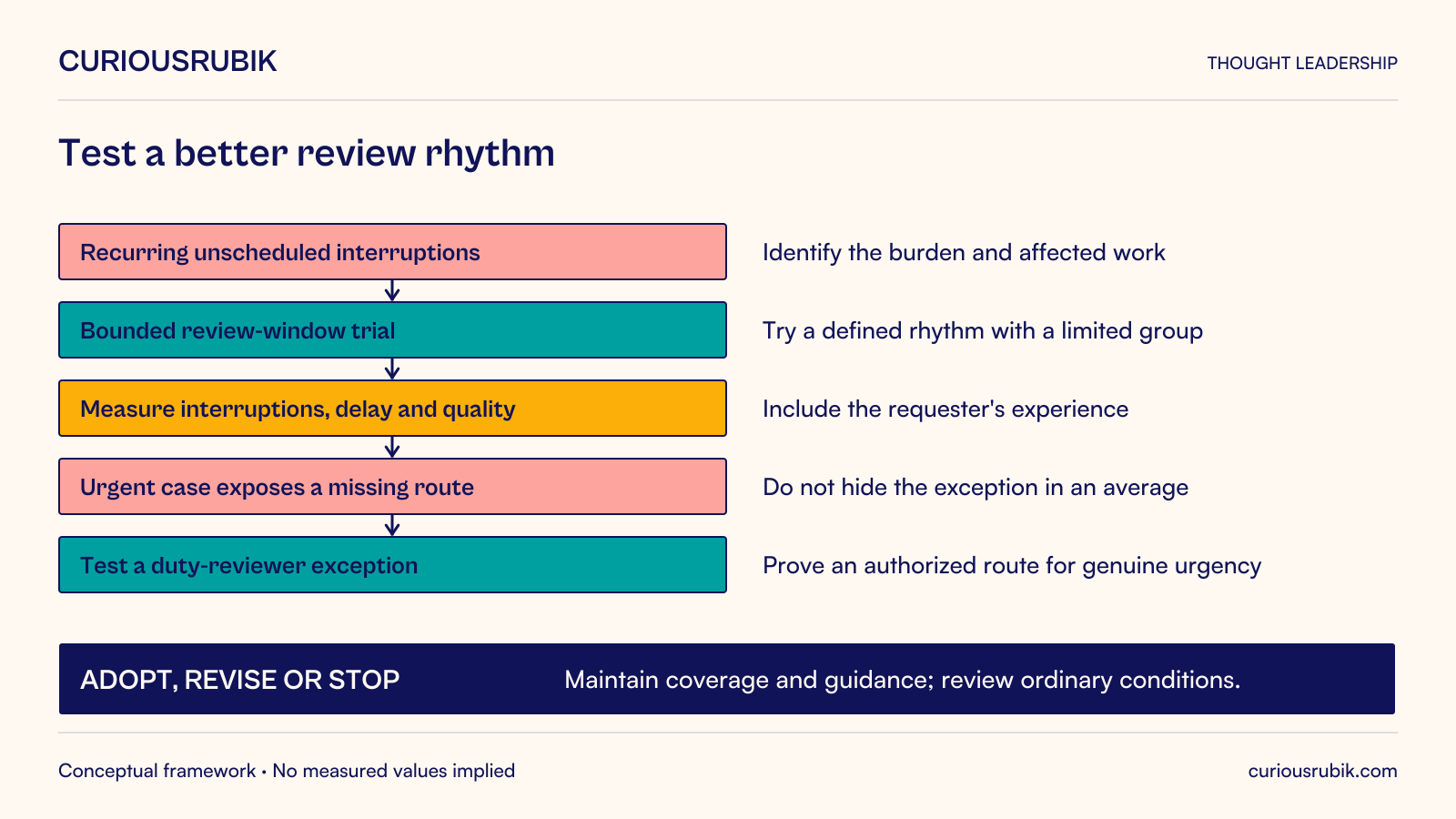
Choose a bounded change that addresses the suspected mechanism. In the studio example, the hypothesis might be that planned review windows and a defined urgent-request route will reduce avoidable interruptions without delaying important feedback. That is more testable than a broad ambition to improve collaboration.
Specify the population, duration or decision point, expected observation, and safeguards. An experiment is not permission to ignore access controls, customer commitments, or production-change procedures. Use the appropriate authorized route for any system modification.
Keep the test small enough to learn from but representative enough to expose the important conditions. A change tested only by its designer may miss how other roles interpret it. Include the people who receive the output as well as those who create it.
Imagine a hypothetical commercial design studio where colleagues request design feedback through unscheduled messages and desk-side questions. Reviewers repeatedly switch away from concentrated work, while some designers wait because they do not know who is available. The studio has no reliable picture of interruption burden or response delay.
The team proposes a limited trial for one project group: two planned review windows during the working day, with requests entered in a shared queue containing the question and relevant context. The process owner approves the trial and protects reviewer capacity. The number and timing of windows are hypothetical trial choices, not a universal scheduling recommendation.
The team observes interruptions, time to useful feedback, reviewer effort, and the quality of the resulting work. It also asks whether designers are delaying questions or proceeding on assumptions while waiting. Fewer interruptions would be a poor result if mistakes or customer delays increased.
During the trial, a genuinely time-sensitive customer issue cannot wait for the next window. The initial design has no workable exception route. The team adds a defined urgent-request path to a duty reviewer, with criteria based on the consequence of waiting. It also checks whether that route is becoming a way to bypass the ordinary queue for convenience.
The revised arrangement is reviewed with both requesters and reviewers. The owner can adopt it, change the windows or coverage, extend the trial, or stop it if the costs outweigh the benefit. The decision should reflect the whole work pattern, including people who experienced longer waits, rather than only the reviewer who preferred fewer messages.
No productivity gain is assumed in this fictional example. The useful result is a supported decision based on observed work and a tested exception. The organization has learned more than which colleague is most willing to be interrupted.
People need to be able to raise a problem, ask for help, or report an unsuccessful trial without automatically being treated as incompetent. Otherwise, the organization may see only polished success stories and discover failures after they become expensive.
Edmondson’s 1999 field study of manufacturing teams found an association between team psychological safety and learning behavior. It does not prove that one workshop or leadership phrase causes improvement everywhere. The relevant implication is to examine whether the local environment permits the interpersonal risks involved in learning. Psychological Safety and Learning Behavior in Work Teams
Safety to speak does not remove accountability. Teams still need truthful records, appropriate authorization, and attention to consequences. Distinguish a well-designed experiment that disproves a hypothesis from careless execution or an unauthorized change. Those situations call for different responses.
Leaders make the distinction credible through their reactions. When a trial fails, ask what was expected, what happened, what evidence supports the explanation, and what should change. If every unsuccessful result is punished, employees have an incentive to hide uncertainty or avoid testing anything meaningful.
Continuous improvement competes with immediate delivery. If teams can work on it only after every other task is complete, it may never happen. Allocate a realistic amount of time and make the tradeoff with operational work explicit.
Keep work in progress limited. A long list of active experiments can overwhelm the people needed to evaluate them and create interacting changes that are difficult to interpret. Finish, stop, or consolidate trials before starting more simply to demonstrate activity.
Use a short decision rhythm suited to the work. Review evidence, unblock ownership, and decide what happens next. Do not turn the forum into a status performance in which every team must invent a new improvement each week.
Provide access to the skills needed for safe change. A team may understand the problem but need help with data analysis, interface design, or a controlled release. A central enablement function can support those needs without taking ownership of every local decision.
A trial is not fully adopted when people agree that it worked. Update the relevant workflow, guidance, training, ownership, and support arrangements. Retire the superseded instruction so employees do not encounter competing versions.
Identify the conditions under which the change was useful. The studio’s review-window arrangement may work for one project type but need different timing or cover for another. Share the problem, mechanism, evidence, and limits rather than copying the visible solution without context.
Assign an owner to maintain the practice. Review arrangements, intake guidance, and coverage can become unsuitable as the business changes. An improvement that depends indefinitely on its original volunteer is fragile.
Review the result after ordinary operating conditions resume. A trial may benefit from unusual attention or extra help. Confirm that the change still works when the experiment team is no longer watching every case, and revise the adoption decision if necessary.
Make useful findings discoverable across teams. A concise record can describe the problem, tested intervention, outcome, limitations, and owner. Include stopped experiments when the lesson could prevent another team repeating the same mistake.
Look for shared causes. Several local problems may reveal a common data definition, platform limitation, or policy conflict that needs enterprise action. Conversely, similar symptoms can have different causes, so a central team should not force one solution without checking the context.
Give local teams authority within clear boundaries. They may adjust a template or improve guidance through the approved process, while changes to security, financial controls, or shared interfaces require the relevant owners. Clear boundaries encourage useful initiative without treating experimentation as a bypass.
Measure the improvement system by resolved problems and sustained outcomes, not the number of ideas submitted. A reduction in repeated rescue work, a better-supported decision, or a retired unnecessary step can be meaningful even when it does not produce an immediate cash saving.
The next time someone asks for an immediate review, the studio should have a workable way to determine whether the request can wait and who can respond. If the arrangement fails, that case becomes evidence for another focused improvement. That is what makes the capability continuous.
An operations leader can begin with one recurring problem, one accountable owner, and one bounded test. Make it safe to report what actually happens, keep the experiment authorized, and turn the result into a maintained decision. Over time, the culture becomes visible in those ordinary habits: people expose friction, test a plausible remedy, stop weak ideas, and preserve the changes that genuinely improve the work.