An outlet can be empty while its purchasing commitments remain active. Cleaning visits continue. A rented appliance has moved to another site without a recorded transfer. A standing consumables order is still scheduled. The final invoice arrives after the outlet manager has left, and nobody can explain whether the charge is expected.
The closure date should trigger a coordinated review of those commitments. It should not trigger blanket cancellation. Some services need to stop earlier, some must continue through reinstatement or handover, and some belong to a wider contract that covers other outlets.
For a Singapore multi-outlet business, the practical task is to give every site-linked commitment a documented disposition: terminate, transfer, return or retain. A closure coordinator owns the overall result, while the person with contractual or operational authority makes each decision.
A single closure date hides different events. The last trading day may precede stock removal, final cleaning, equipment collection and premises handover. Supplier notice deadlines can fall well before any of them.
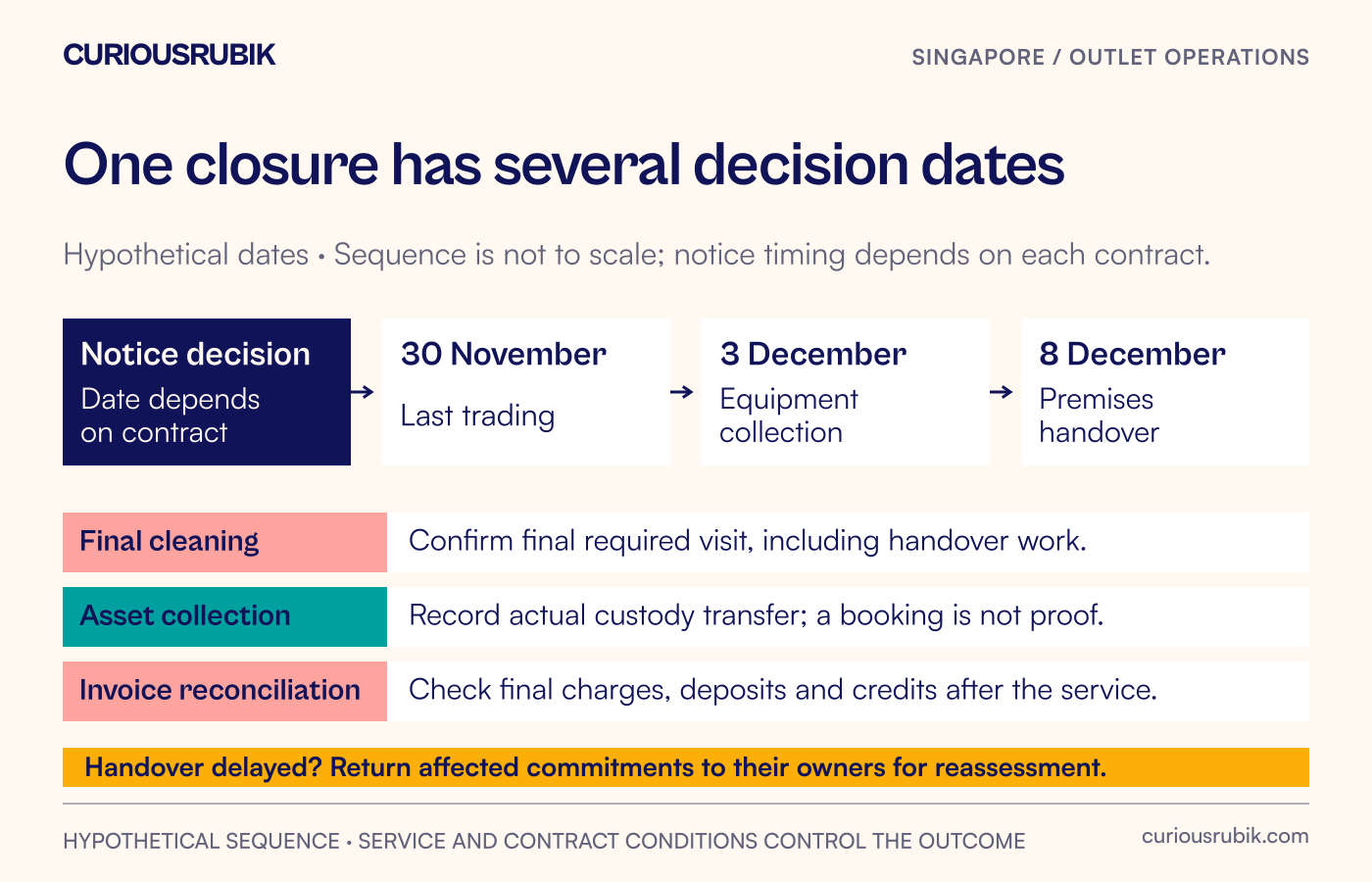
In a hypothetical example, an outlet stops trading on 30 November, equipment is collected on 3 December and the premises are handed back on 8 December. These dates are illustrative planning assumptions. The contracts and actual handover arrangements determine what must happen, and when.
A cleaning service may still be required during that interval. A consumables delivery intended for trading might be unnecessary. A rental charge may continue until a contractual return condition is satisfied. None of these conclusions follows from the trading date alone.
Record approved milestones and who can change them. If handover is delayed, the coordinator needs to know which termination decisions, access arrangements and final services must be revisited. Automating tasks against an obsolete date can create a service gap as easily as an unnecessary charge.
Begin with contracts, standing orders and recent supplier charges tagged to the outlet. Then reconcile that list to what people can see on site. A piece of hired equipment may reveal an agreement that finance records under a central cost centre. A supplier invoice may cover several locations without listing every site clearly.
Ask operations about regular visits, periodic replenishment and equipment held on loan. Ask finance about recurring debits, deposits, outstanding supplier balances and prepaid periods. Ask procurement about umbrella agreements and commitments placed by former employees. Each source finds a different kind of omission.
Do not assume the person who pays the invoice owns the service. Finance may know the amount and supplier but have no authority to decide whether a contract can end. Conversely, a site manager may know that a service is no longer used but not know the notice requirement.
Create one row per commitment and site relationship. For a shared contract, link the outlet-specific row to the master agreement. That lets the coordinator remove a site from the service schedule without treating the entire supplier relationship as cancelled.
A usable site-closure commitment register needs more than a cancellation checkbox. Include:
Keep the intended outcome separate from its evidence. “Termination approved” means someone has authorised action. “Notice sent” records communication. “Supplier confirmed effective date” records the response. “Final account reconciled” means finance has checked the financial end of the arrangement. These milestones may happen weeks apart.
If notice wording or termination consequences are uncertain, the contract owner obtains appropriate advice. The coordinator should flag that uncertainty rather than calculate an assumed penalty or promise that a charge will be waived. Closing an outlet does not itself remove contractual obligations.
CURIOUSRUBIK SINGAPORE / OUTLET OPERATIONS One closure has several decision dates Hypothetical dates · Sequence is not to scale; notice timing depends on each contract. Notice decision Date depends on contract 30 November Last trading 3 December Equipment collection 8 December Premises handover Final cleaning Confirm final required visit, including handover work. Asset collection Record actual custody transfer; a booking is not proof. Invoice reconciliation Check final charges, deposits and credits after the service. Handover delayed? Return affected commitments to their owners for reassessment. HYPOTHETICAL SEQUENCE · SERVICE AND CONTRACT CONDITIONS CONTROL THE OUTCOME curiousrubik.com
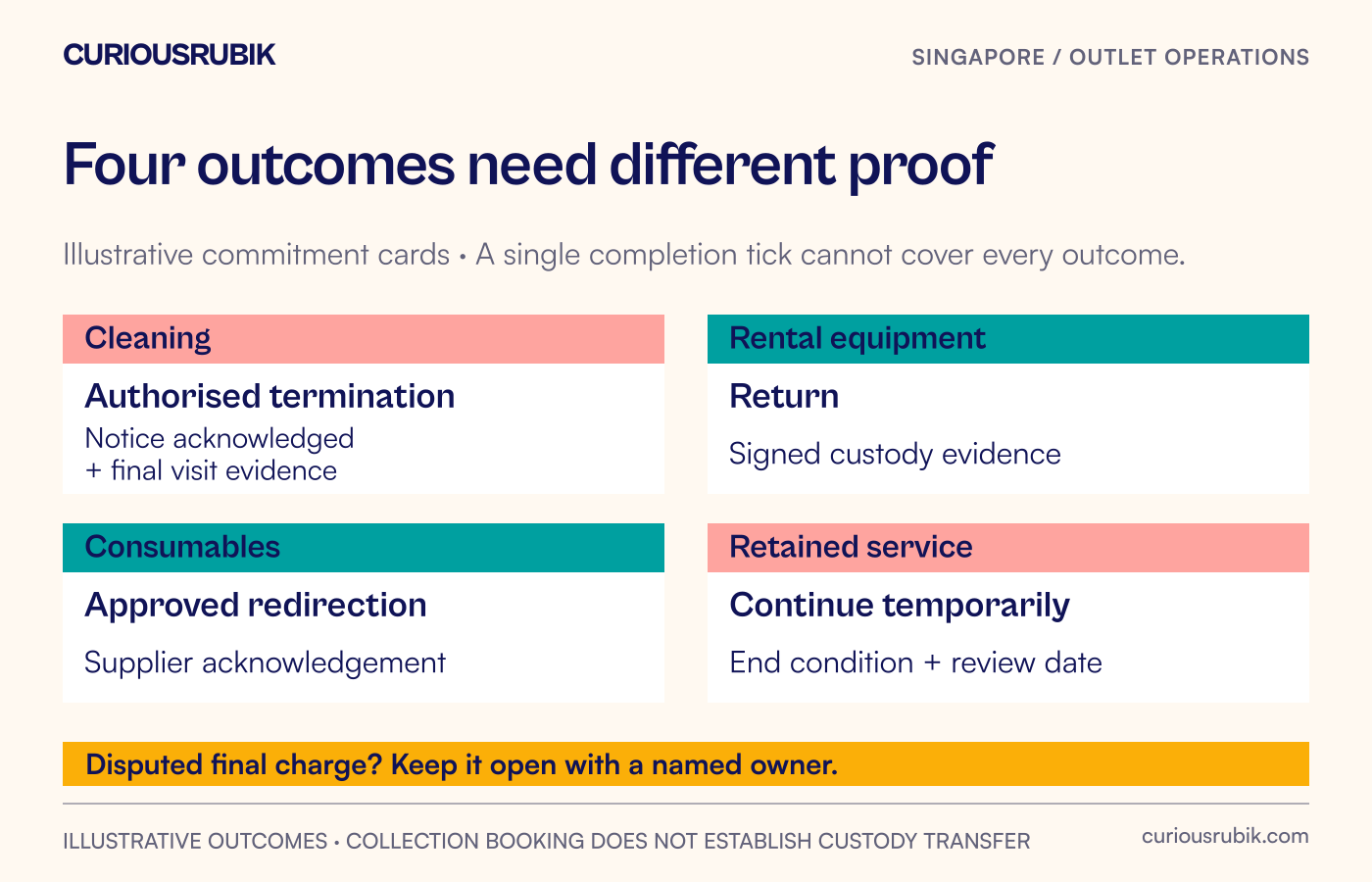
For the hypothetical outlet, take cleaning first. The operations owner confirms the final required visit, including any agreed work after trading stops. Procurement checks the notice and final-service terms. The register records the authorised notice, acknowledgement and completion evidence. If reinstatement runs late, the owner decides whether additional cleaning is needed and obtains approval for the extra commitment.
Next consider rented equipment. An internal move to another outlet does not necessarily constitute a supplier-approved transfer. Confirm asset identity, condition, destination and the applicable agreement. If it is returned, record collection evidence and any unresolved damage assessment. A collection booking alone is insufficient evidence that custody has changed.
For standing consumables, identify orders already released or in transit. Stop future schedules only after authorised review. Decide whether existing deliveries should be accepted at the original site, redirected with supplier agreement or otherwise resolved under the purchase terms. Do not let a closure flag silently delete an order that a supplier has already acted on.
Finally, consider retained services. A service supporting premises security or required records may need to continue after the last customer leaves. The owner records the reason, end condition and next review date. “Retain” without an end condition can become the same forgotten commitment under a new label.
CURIOUSRUBIK SINGAPORE / OUTLET OPERATIONS Four outcomes need different proof Illustrative commitment cards · A single completion tick cannot cover every outcome. Cleaning Authorised termination Notice acknowledged + final visit evidence Rental equipment Return Signed custody evidence Consumables Approved redirection Supplier acknowledgement Retained service Continue temporarily End condition + review date Disputed final charge? Keep it open with a named owner. ILLUSTRATIVE OUTCOMES · COLLECTION BOOKING DOES NOT ESTABLISH CUSTODY TRANSFER curiousrubik.com
Automation can assemble candidate commitments from site codes, supplier records and recurring charges. Treat that output as a starting list to reconcile, since an incomplete site code can hide an agreement and a shared code can overstate the scope.
Once the register is reviewed, automation can create tasks, remind owners before confirmed notice deadlines and flag purchases or charges after the approved closure milestones. A post-closure charge should enter a review queue with its agreement, expected final service and owner. It should not automatically be rejected as an error.
For example, an invoice received in December may properly relate to November services. Another might be an agreed final collection charge. A third could be an unexplained visit after termination. The dates and supporting evidence distinguish those cases; the fact that all three arrived after trading stopped does not.
Escalate ownerless items to the closure coordinator. If a former outlet manager held the knowledge, assign a successor before their access ends and obtain the necessary handover while they are available. Preserve the original decision history rather than overwriting their name with the successor's name.
Finance reconciles final invoices, deposits, credits and any prepaid amounts against the agreed disposition. Differences need a reason and a responsible reviewer. A supplier promise to issue a credit remains open until the relevant document is received and checked.
IRAS's GST invoicing guidance describes credit-note situations and the information needed to connect adjustments to the original transaction. Finance should apply the relevant requirements to actual credits; a closure register is supporting evidence, not a tax document or an automatic adjustment instruction.
Keep the records accessible after the outlet closes. The operating company's record-keeping responsibilities continue; shutting a location is different from dissolving the legal entity. Apply the organisation's retention rules to the contract, approvals and transaction evidence rather than deleting everything attached to an inactive site code.
Measure unexplained charges after closure, assets without confirmed disposition and commitments awaiting a supplier response. Count the age of open exceptions as well as their number. A small unresolved rental item can matter more than several completed low-value supply cancellations.
The closure coordinator can sign off the operational milestone while explicitly listing remaining commercial items, owners and review dates. This avoids holding every part of the closure hostage to a late invoice while keeping unfinished obligations visible.
For the next outlet closure, put the commitment register beside the physical handover checklist. Ask each owner to show the evidence that their service, asset or standing order has reached its approved outcome. The useful end point is an explainable final position, not an empty premises photograph.