A customer portal can reduce service workload when it removes the need for avoidable assistance. It can also increase workload by creating unclear statuses, rejected submissions and customers who contact support to check whether the digital action worked.
The difference is not the presence of self-service features. It is whether the portal helps customers complete a useful task correctly and gives the service team a coherent way to handle the cases that still need help.
For a customer-service leader, the practical objective is to reduce total handling effort while maintaining or improving the customer’s outcome. Contact deflection is only a possible consequence. It is not a sufficient measure of success.
Start by separating demand into useful categories. Some contacts exist because customers need a decision, reassurance or specialist help. Others exist because information is missing, a prior action failed or the customer cannot understand what happens next.
Look at the sequence around a contact, not only its label. A status enquiry may be routine curiosity, or it may be the third attempt to resolve an unacknowledged request. A password reset may be a straightforward identity issue, or evidence that infrequent users cannot return to the service reliably.
Review representative cases with frontline staff. Identify the information they consult, the authority they exercise and the exceptions they resolve. Those observations help distinguish tasks suitable for direct self-service from tasks that need better assisted service.
Avoid treating all human contact as waste. A conversation that resolves a complex problem can be valuable. The more useful target is unnecessary work: repeated explanations, avoidable corrections, duplicate requests and routine information retrieval that the customer could complete confidently.
A portal feature should have an observable end state. Downloading the correct statement is different from opening the document page. Rescheduling an appointment is different from sending a request for another time.
Choose a task whose rules and dependencies are understood. Define what information is needed, who is authorized to act and what conditions prevent immediate completion. The customer should not discover those conditions only after investing effort in a long form.
Decide how exceptions will enter assisted service. Preserve the information already supplied, show what remains unresolved and identify the next step. An escalation that asks the customer to start again can erase much of the benefit of the portal.
The initial scope can be narrow. A limited task that completes reliably often provides a stronger basis for learning than a broad menu of features that all end in manual follow-up.
Consider a hypothetical commercial pest-control provider whose business customers request changes to scheduled service visits. Some changes can be accepted within existing contractual and operational rules; others need a coordinator to review access arrangements, route capacity or a specific service requirement.
A useful portal would show the current appointment, the options actually available to that customer and the conditions for changing it. Selecting a new window should either produce an authoritative confirmation or clearly create a request awaiting review. The interface should not make those outcomes look identical.
When a coordinator must intervene, the case should carry the original appointment, requested alternative and relevant explanation. The customer should be able to see that the request exists and should not need to send a second email merely to establish receipt.
If the customer calls, the service team needs the same case history. If another user from the customer organization has already changed the visit, the portal should expose the current state before accepting another conflicting action.
These details determine whether the portal removes handling effort or creates a new reconciliation job. The task is not finished when the form is submitted; it is finished when the appointment outcome is clear and the operating schedule reflects it.
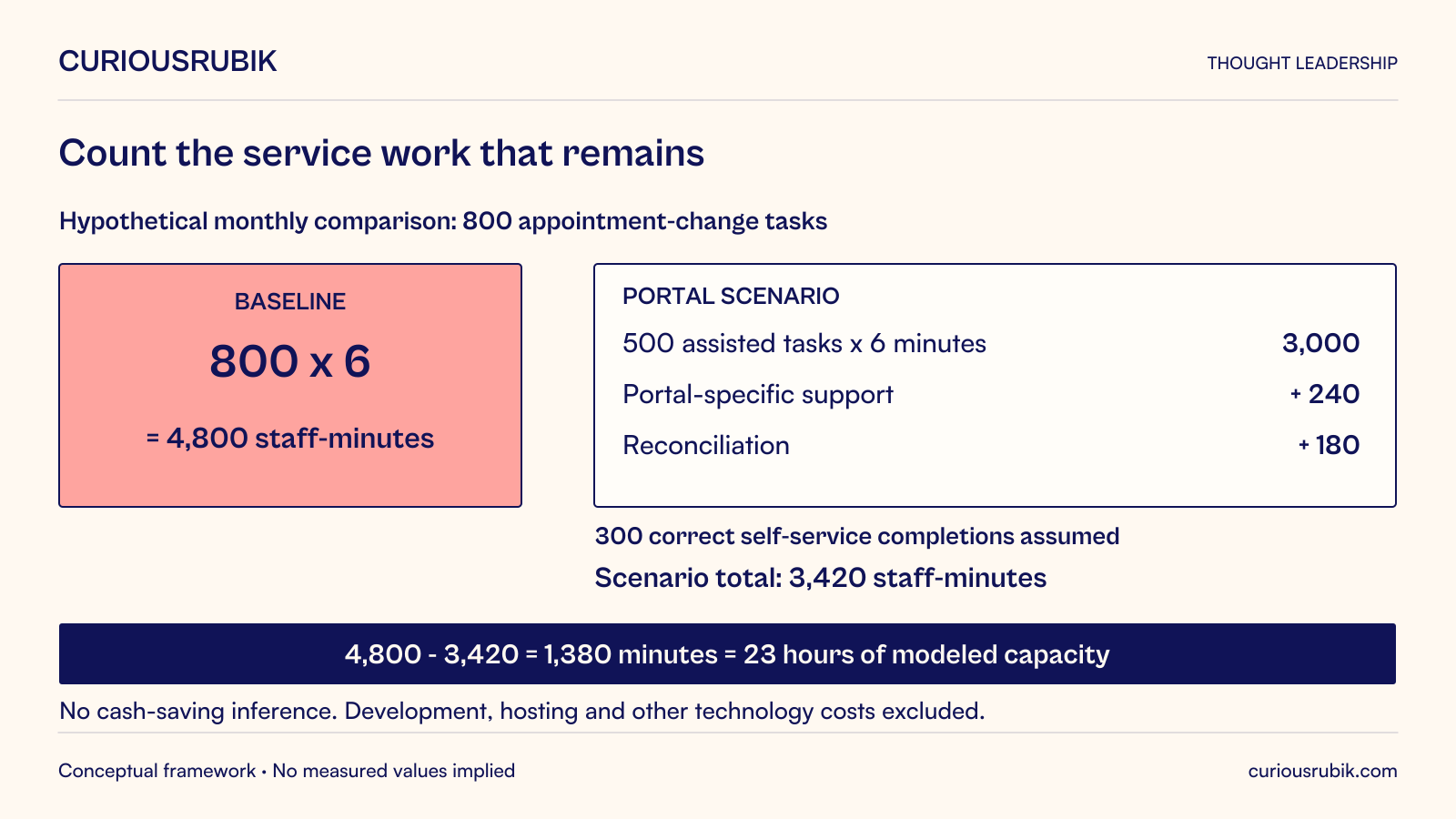
Suppose a hypothetical monthly workload contains 800 appointment-change tasks. The baseline requires six staff-minutes per task, for 4,800 staff-minutes. Assume these figures cover the same defined handling activities in both scenarios.
In an illustrative portal scenario, 300 tasks are completed without staff handling and 500 still require six minutes each. That produces 3,000 staff-minutes of assisted handling. Add 240 minutes of portal-specific support and 180 minutes of reconciliation, giving 3,420 staff-minutes in total.
The modeled reduction is 1,380 staff-minutes, or 23 hours, against the stated baseline. That is a capacity estimate, not a cash saving. It also excludes development, hosting and other operating costs, which belong in a full investment analysis.
The example assumes that the 300 self-service completions are correct and that customers do not create uncounted follow-up work elsewhere. If either assumption fails, the estimate overstates the benefit. Measure completed tasks and their related contacts together so that a portal submission and a later phone call do not become unrelated statistics.
A service-cost analysis should also examine customer effort. The business has not necessarily improved the experience if it reduces staff time by making customers perform a difficult administrative task that an employee previously handled quickly.
Customers often contact a business because they do not know whether an action succeeded, whether it needs attention or when to expect a response. Clear state and next-step information can address that uncertainty directly.
Use confirmations that describe the actual commitment. Appointment confirmed should mean the relevant scheduling decision has been accepted. Request received should explain the review path without implying a guaranteed outcome or response time that the business cannot support.
Notifications should be tied to meaningful events and appropriate preferences. Repeated messages that contain no new information can create noise. A useful message tells the customer what changed, whether they need to act and where to find the current record securely.
Keep portal information and assisted-service information aligned. If a coordinator sees a different status from the customer, investigate whether the difference is intentional, stale or incorrect. Conflicting answers can generate more contact than the original lack of information.
Measure repeat contact for the same task, including contacts through other channels. That helps distinguish genuine resolution from a channel shift.
A portal should offer a clear route to assistance when the customer cannot complete the task. The route needs to reflect the service’s risks and operating hours rather than promise universal immediate support.
Carry the relevant context into the handoff: task identity, submitted information, current state and the reason for escalation where known. Do not expose unnecessary personal or confidential information to a broader audience merely to make the handoff convenient.
Allow frontline staff to see what the customer sees and understand the available actions. Give them a process for reporting recurring portal problems and enough authority to resolve the cases within their role.
A rising assistance rate is useful diagnostic evidence. It may indicate confusing language, an overly narrow eligibility rule, missing data or a task that requires more human judgment than expected. Treat it as a reason to improve the service, not as evidence that customers are failing to adopt technology.
Use a balanced set of task-level measures. These can include correct completion, time to resolution, customer effort, repeat contact, correction rate and staff handling time. Select measures that fit the task and define them consistently.
Do not rely on a single average. Customers with complex accounts, accessibility needs or infrequent usage may experience a different service from frequent users. Review the distribution and investigate groups that need disproportionately more help.
The Government Digital Service’s guidance on defining success connects performance data with user research and ongoing service improvement. Its public-service context does not supply a universal portal ROI formula; the useful principle is to establish meaningful success measures and use them to improve the service. GDS, Define what success looks like and publish performance data.
Compare like with like during a pilot. Seasonal demand, changes in staffing and a different mix of appointment types can affect outcomes independently of the portal. Record those changes and avoid attributing every improvement to the technology.
Qualitative feedback helps explain the numbers. A task can have a high completion rate while leaving customers uncertain about what they agreed to. That uncertainty deserves attention before it becomes a complaint or service failure.
If the portal reduces handling effort, decide how the team will use the capacity. It may support faster resolution of complex cases, improved proactive communication or reduced overtime. Those outcomes require an operating plan; they do not happen automatically when a dashboard shows fewer contacts.
Consider how work is distributed. Small fragments of saved time across many employees may be useful without being fully redeployable. A concentrated reduction in a staffed queue may offer different options. Keep those distinctions visible in the business case.
Retain the support capability needed for exceptions and users who cannot use the portal independently. A cost target that removes assistance too early can damage outcomes and increase the cost of later recovery.
Review the ongoing burden of the portal itself: identity support, content accuracy, integrations, testing and incident handling. A service that is economical at launch can become expensive if its underlying rules change frequently and ownership is unclear.
After the first release, use failed and assisted journeys to prioritize improvements. Fix unclear states, missing context and repeated correction work before assuming that another feature will generate the next benefit.
Expand when a new task has a clear completion condition, an accountable owner and a credible measurement plan. Reuse proven patterns where they fit, while checking the new task’s permissions and consequences.
Customer portals reduce service costs sustainably when they make the work easier to complete correctly for both the customer and the service team. The strongest result is a clear outcome with less total effort, supported by help that remains available when the situation calls for it.