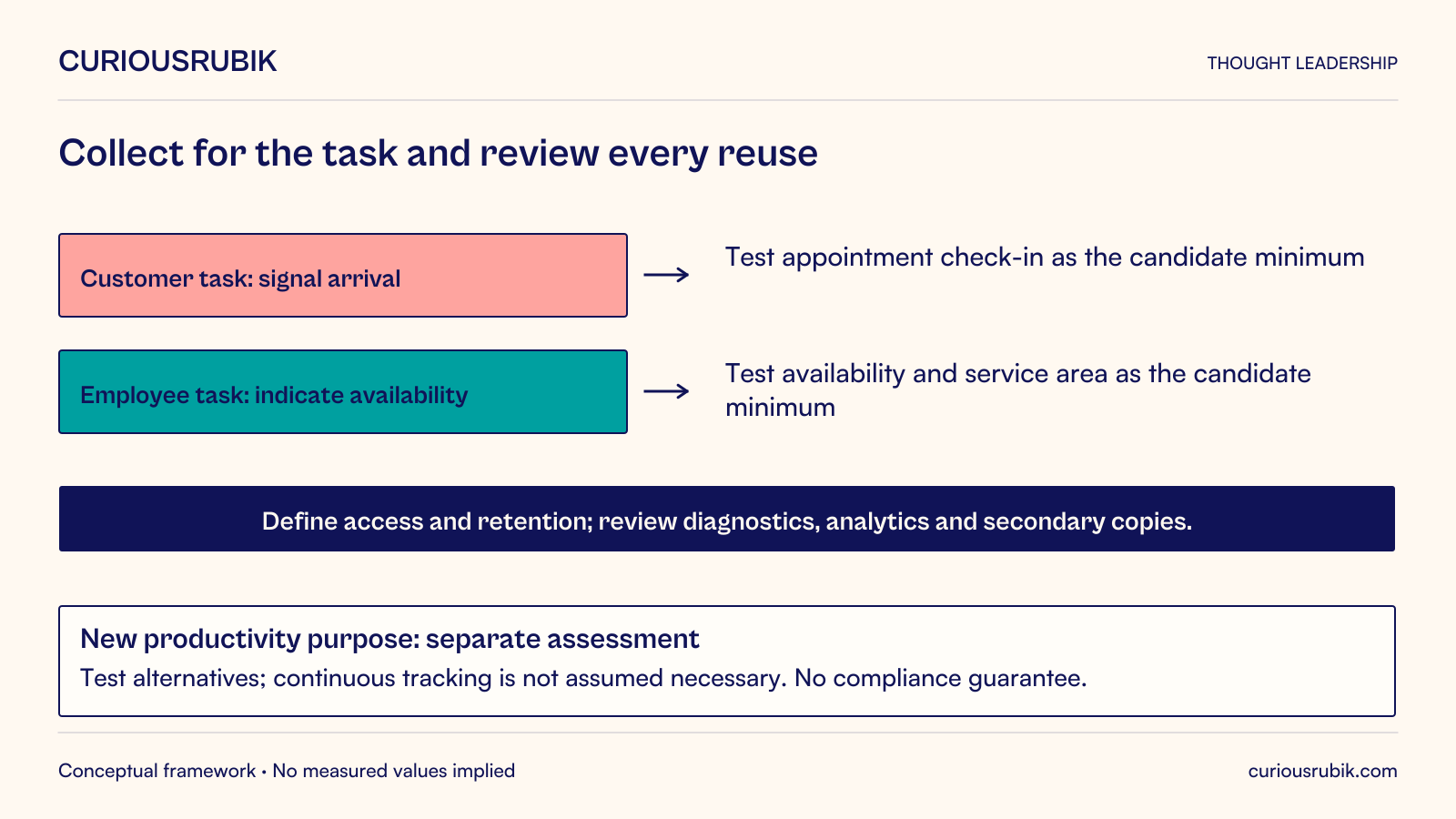
An appointment app needs to know that a customer has arrived. It requests continuous location access. A supervisor needs to know which employee can take the next task. The same application retains a detailed movement history. Both features may function securely while collecting more information than the immediate service requires.
In this hypothetical design, privacy depends on choices made before a notice is written: the purpose, precision, collection pattern, access, reuse, and retention of the data. Privacy by design means treating those choices as product and engineering requirements throughout the information lifecycle.
The product owner should be able to explain why each material data flow exists and demonstrate that the implementation follows that explanation. This article develops that review for a service-appointment application used by customers and employees. It provides design guidance; the applicable legal basis, notices, rights, retention obligations, and employment requirements need qualified review for the actual context.
Describe the decision the application must support. Knowing that a customer is ready for service differs from knowing their route to the location. Knowing that an employee is available differs from tracking their precise movements throughout a shift.
Ask what information is sufficient for that decision. A customer-initiated arrival event may satisfy one workflow. A coarse availability state may satisfy another. Other legitimate tasks may require more detail, but that need should be identified and assessed separately rather than inherited from a convenient device capability.
Consider collection frequency and duration as well as the field itself. One location reading, continuous tracking, and a retained history create different exposures. A design review that lists only “location data” can miss the most important differences.
NIST’s Privacy Framework distinguishes privacy risks arising from ordinary data processing from those associated with cybersecurity incidents. Preventing unauthorized access is important, but it does not settle whether the intended collection and use create problems for individuals. NIST Privacy Framework 1.0, Section 1.2.1
Imagine a service business introducing a shared application for customer arrival and employee task assignment. The customer can signal readiness for an appointment. Employees can indicate availability to receive the next permitted assignment. The service does not inherently require a continuous map of everyone using the application.
The initial proposal collects precise location frequently and retains it for future analytics. The product team revisits the purposes. For the arrival workflow, it tests a customer-initiated check-in linked to the appointment. For employee assignment, it tests an explicit availability state and the relevant service area.
These alternatives have limits. A check-in can be mistaken or submitted early, and an availability state can become stale. The team evaluates whether the service can handle those conditions through confirmation, expiry, or an appropriate exception route. It does not assume that less data automatically produces an adequate service.
A separate manager asks to use the retained events to rank employee productivity. That is a new purpose with different consequences and data-quality questions. The organization should assess it through the appropriate business, privacy, and people-management process rather than treat existing technical access as approval.
The team also follows the events into diagnostics, analytics, exports, and support tools. A reduced operational record can still become a detailed history if logging or an embedded analytics component copies more information than intended. The privacy design must cover those paths as well as the visible screen.
The proposed result is a service that collects enough information for defined tasks, with explicit limits and a review route for additional uses. It is not a claim that one check-in design suits every business or that the application is legally compliant because the diagram looks minimal.
For each material field or event, record its purpose, source, precision, recipients, storage locations, retention rule, and owner. Include derived information and identifiers used to link records. The record should explain actual processing rather than simply list database tables.
Follow the information beyond the application boundary. Identify processors, messaging services, diagnostic tools, analytics platforms, and support exports that receive it. Review the relevant contractual, security, and privacy arrangements before enabling the flow.
Distinguish required data from optional data. If the interface calls a field optional but the workflow effectively prevents service without it, the user’s understanding may be inaccurate. Test the actual experience, including denial of a device permission or refusal of an optional feature.
Give free-text fields and attachments particular attention. They can collect information the structured design did not anticipate. Provide clear guidance, limit access appropriately, and decide whether the field is necessary for the task instead of relying on users to avoid every unnecessary disclosure.
Explain important processing at the point where it matters. A short task-specific explanation can help users understand why information is requested and what happens if they decline where a choice is available. It should remain consistent with the fuller notice and actual system behavior.
Test understanding rather than treating the presence of a notice as sufficient. Can customers distinguish arrival signaling from tracking? Can employees understand who sees availability information and how long it remains? Ask people to explain the consequence in their own words.
NISTIR 8062 introduces predictability, manageability, and disassociability as privacy engineering objectives. They provide ways to consider understandable processing, controlled data handling, and limiting association where appropriate. They do not determine the application’s legal obligations. NISTIR 8062, Section 3.1.1
Provide the mechanisms needed to implement approved choices and applicable rights. Those may involve access, correction, restriction, or deletion through an authorized process. The design must account for legitimate retention and legal-hold conditions rather than promise an action the organization cannot consistently perform.
Employees may face different expectations and practical choices from customers. A worker may not feel able to decline a feature connected to job performance. Assess that context with the appropriate privacy, legal, HR, and representative functions instead of assuming that a consent screen resolves it.
Separate operational visibility from unrestricted individual monitoring. A manager may need assignment status without needing every historical event or personal detail. Define views around the actual role and purpose, with appropriate access enforcement.
Consider information that reveals more when combined. Arrival times, assignments, and location history can expose patterns beyond the original task. Assess linking and derived uses before enabling a broad analytics view. Do not assume that removing a name alone makes a dataset anonymous.
Use aggregated or less identifying information where it satisfies the analysis, while evaluating its limitations and re-identification risk. Privacy-enhancing choices still require sound design and testing; a label such as anonymized should not substitute for evidence.
Choose retention periods according to documented purposes and applicable obligations. Different records may need different treatment. A temporary availability state and a record needed to resolve a service dispute should not automatically inherit the same indefinite retention.
Implement expiry across relevant stores and derivatives. Operational databases, search indexes, analytics extracts, logs, caches, and backups may have different mechanisms. Document those differences and the limits of what a deletion or restriction action establishes.
Test the process with representative records. Can the organization locate the relevant copies, apply the approved action, and establish the outcome? A deletion button that affects only the main screen can leave the privacy promise unfulfilled elsewhere.
Assign ownership after launch. New features, processors, or analytical purposes can change the lifecycle. Require review of those changes before the original data begins serving a materially different purpose without assessment.
Use test cases that reflect the intended boundaries. Deny optional location access, change a user’s role, expire an availability event, correct a record, and exercise the approved retention action. Verify both the user-facing result and the relevant downstream behavior.
Inspect diagnostics and telemetry. Confirm that error reports and analytics do not capture more information than the approved design permits. Developers and support staff need useful evidence, but broad data collection should not become the default solution to every troubleshooting problem.
Evaluate failure behavior. If a privacy preference cannot be applied or a downstream processor is unavailable, the application needs a defined response and an accountable owner. It should not claim that a requested action completed when the outcome remains uncertain.
Review the design with both affected people and the roles responsible for operating it. Their observations can reveal confusing explanations, inaccessible controls, or a legitimate service need that the first design missed.
Before release, the product owner should be able to connect each important data flow to a defined task and show how access, reuse, retention, and user understanding are supported. Unresolved legal or employment questions should remain visible to the qualified decision-makers.
The appointment app’s success is not measured by how much it can learn about customers and employees. It is measured by whether it delivers the intended service with proportionate, understandable, and controlled processing. Privacy by design becomes practical when the organization can demonstrate that relationship and keep it true as the application changes.