The automation finishes routine cases quickly. Its exceptions arrive faster than qualified reviewers can resolve them. The team keeps the service indicator green by approving easier cases first, while a few consequential decisions become older and harder to understand.
At that point, the operating question is no longer whether the system can process more work. It is which actions the business can safely continue with the review capacity actually available. Define that limit before increasing throughput, and give someone authority to restrict the affected activity when the limit is reached.
Thirty cases needing a quick source comparison are different from thirty cases requiring a supplier investigation or a specialist's decision. Count the work by the skill and authority needed, its likely effort and the consequence of delay.
Track at least the oldest consequential case, cases approaching external deadlines and cases waiting for evidence outside the review team. A total backlog can fall while the most important cases remain untouched.
Also distinguish incoming exceptions from returned work. A case sent back for more information may re-enter tomorrow. If every return is counted as a fresh item and every referral as a completion, the dashboard can show a busy team without showing how many business decisions were resolved.
The process owner needs a view of unresolved decisions, not just movements between queues. Keep the original case identity and show who currently has the next action.
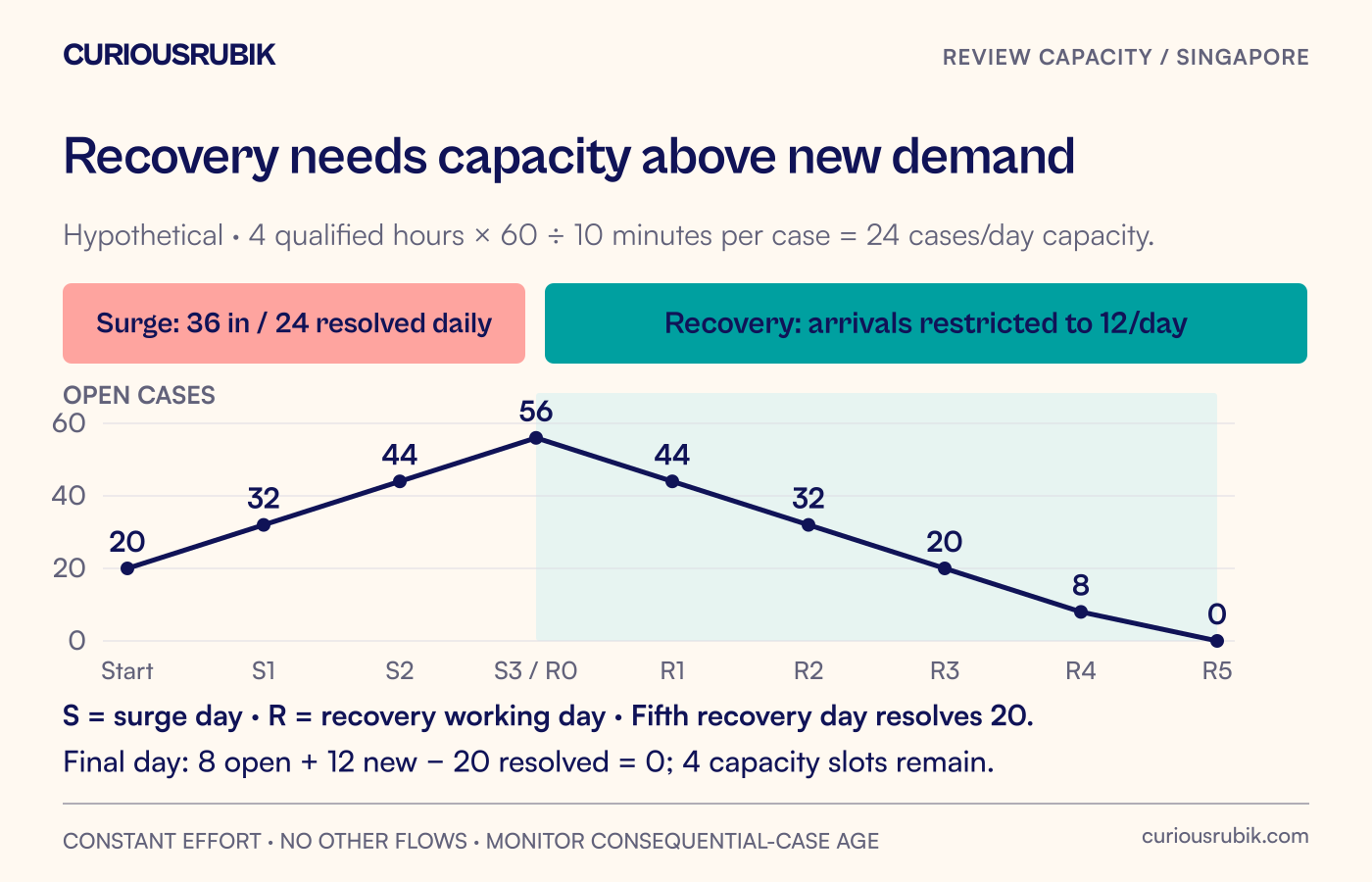
Take a hypothetical review team with four qualified hours available each day for one defined class of case. At an assumed ten minutes per case, that is capacity for 24 cases per day. The assumption includes the review work being modelled; actual complexity and other duties must be measured before using it operationally.
Suppose 36 cases arrive daily. The backlog grows by 12 per day if 24 are resolved and there are no other entries or exits. Starting with 20 open cases, it reaches 56 after three days: 20 plus three times 12.
Adding another reminder will not close that gap. Nor will a rule that releases every case older than two days. That would remove the very review on which the process depends.
Now suppose the owner restricts the activity creating new cases so arrivals fall to 12 a day, while the team can still resolve 24. The backlog reduces by 12 per day. Under these deliberately simplified assumptions, clearing the 56-case starting backlog requires five working days, with capacity left over on the fifth. If complexity rises or a reviewer is absent, recovery takes longer.
The point is the recovery condition: resolution capacity must exceed new demand for long enough. A one-day fall in the queue is not evidence that the process can return to full throughput.
CURIOUSRUBIK REVIEW CAPACITY / SINGAPORE Recovery needs capacity above new demand Hypothetical · 4 qualified hours × 60 ÷ 10 minutes per case = 24 cases/day capacity. Surge: 36 in / 24 resolved daily Recovery: arrivals restricted to 12/day 0 20 40 60 OPEN CASES 20 Start 32 S1 44 S2 56 S3 / R0 44 R1 32 R2 20 R3 8 R4 0 R5 S = surge day · R = recovery working day · Fifth recovery day resolves 20. Final day: 8 open + 12 new − 20 resolved = 0; 4 capacity slots remain. CONSTANT EFFORT · NO OTHER FLOWS · MONITOR CONSEQUENTIAL-CASE AGE curiousrubik.com
Avoid a single switch labelled “automation off” if the workflow contains actions with very different consequences. Capturing incoming requests may remain useful while automatically creating a payment proposal or external commitment needs restriction.
A practical mode table can state exactly what is permitted:
| Mode | Work that may continue | Work restricted | Accountable decision |
|---|---|---|---|
| Normal | Approved routine path and staffed exception review | Cases outside agreed scope | Process owner confirms conditions remain met |
| Restricted | Intake, evidence collection and selected low-risk preparation | Named actions that create review demand or commitments | Process owner activates scoped restriction |
| Paused for affected action | Preserve requests and communicate status appropriately | Specific consequential action until release criteria are met | Authorised owner accepts recovery plan |
These are proposed operating categories, not regulator-prescribed modes. Specify the actions in the real process. “Low risk” should have a defined basis, rather than mean whatever the system happens to handle confidently.
Keep legal and contractual obligations in view. Pausing an internal automated action does not suspend a payment deadline or a duty to respond. Where necessary, arrange a lawful, controlled alternative with the appropriate specialist and communicate realistic expectations.
A trigger can concern the age of a high-consequence case, projected workload beyond available qualified hours, loss of a necessary reviewer or a source fault creating a surge. A backlog count alone is rarely enough.
The owner should choose thresholds using the business's actual service requirements, reversal limits and evidence. If an action becomes difficult to reverse after dispatch, the restriction needs to take effect before that boundary. A daily check may be too slow for a fast-moving queue.
Singapore's IMDA agentic-AI guidance supports bounded risk and meaningful human accountability. It does not prescribe a universal queue size or review-time threshold for this business. The mode table and capacity calculations here are operating recommendations that need local testing.
Record who can activate the restriction, who must be told and who can authorise restart. If the primary owner is unavailable, an authorised deputy should be able to act. A control that depends on waiting for an absent executive can fail precisely when demand spikes.
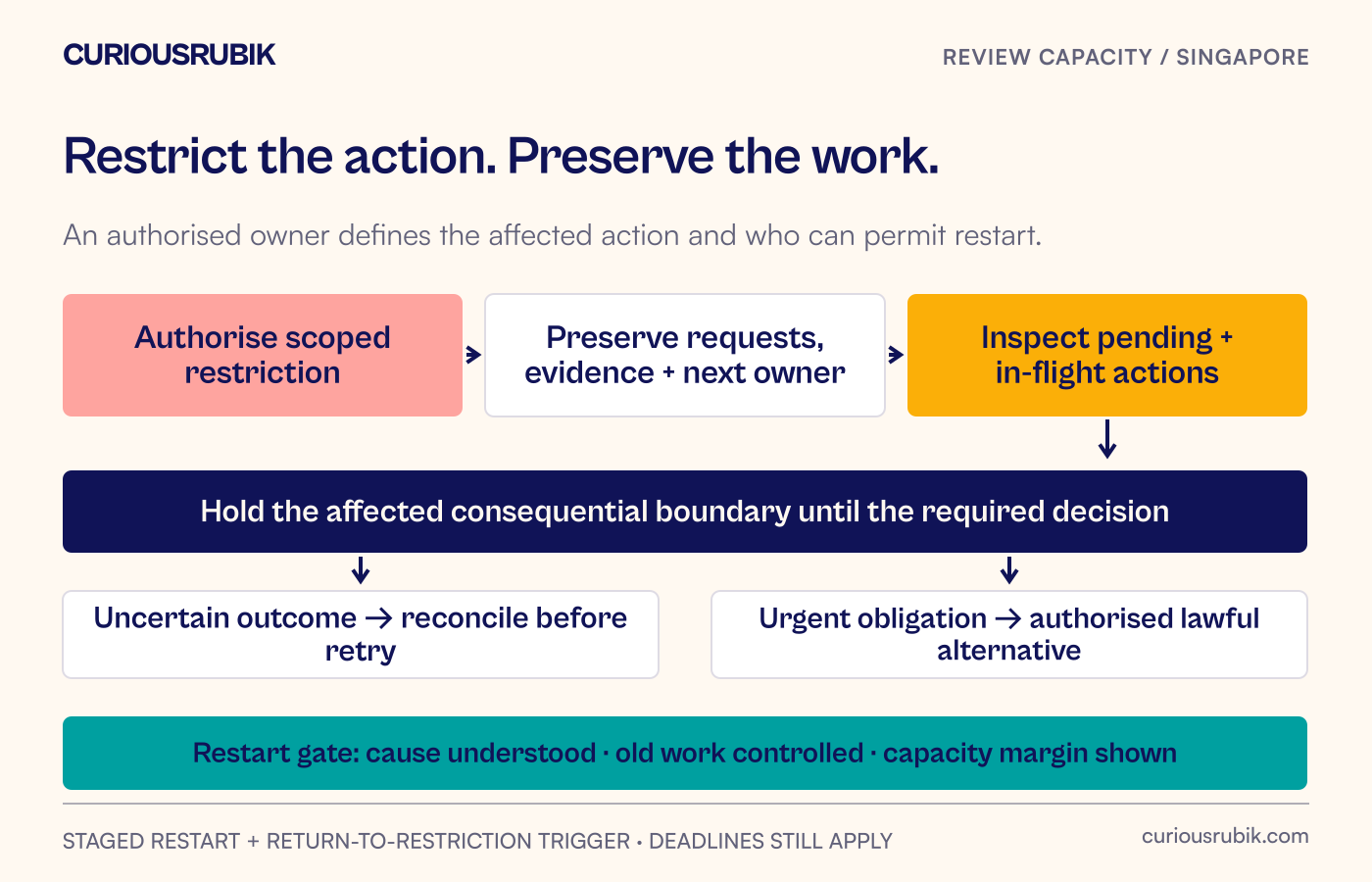
Restriction should not delete unresolved requests, mark them rejected or hide them from the service team. Keep the request, evidence, current status and next owner intact.
Check work already in flight. A stop instruction at intake may leave previously prepared actions waiting in a downstream queue. Identify which pending actions are affected and verify that they cannot pass the consequential boundary without the required decision.
Distinguish an action not started from one whose outcome is uncertain. Before retrying an uncertain action, reconcile what happened. Otherwise a recovery process can introduce duplicate messages, records or commitments while trying to clear the backlog.
Tell the people handling customers or suppliers what the changed mode means. They need an accurate description of what remains available and who can resolve urgent cases. They should not improvise promises based on an old service status.
CURIOUSRUBIK REVIEW CAPACITY / SINGAPORE Restrict the action. Preserve the work. An authorised owner defines the affected action and who can permit restart. Authorise scoped restriction Preserve requests, evidence + next owner Inspect pending + in-flight actions Hold the affected consequential boundary until the required decision Uncertain outcome → reconcile before retry Urgent obligation → authorised lawful alternative Restart gate: cause understood · old work controlled · capacity margin shown STAGED RESTART + RETURN-TO-RESTRICTION TRIGGER · DEADLINES STILL APPLY curiousrubik.com
Use consequence, deadline and dependencies to set review order. A quick case may be worth clearing, but speed alone can keep complex work at the bottom indefinitely.
Reserve appropriate capacity for specialist cases and track their age separately. If they are waiting on another team, escalation should reach the evidence owner rather than repeatedly remind a reviewer who cannot proceed.
Do not quietly lower the review standard to improve the completion count. A temporary change in controls is a risk decision requiring the appropriate authority, not an informal response to a busy afternoon. Where the required review cannot be performed, restrict the action or arrange qualified cover.
Check the burden on the reviewers. Additional nominal hours may not provide equivalent capacity if people are unfamiliar with the cases or taking on the work after a full day elsewhere. Recovery assumptions should reflect usable skill and attention.
Before returning to normal mode, establish that the cause of the surge is understood, the relevant old cases are resolved or controlled, and the expected incoming mix can be handled with available capacity. Test any repaired rule on the cases that caused the problem.
Use a staged restart where appropriate. The owner can increase permitted volume while watching arrivals, resolution effort and consequential-case age. Define what would cause a return to restriction. Avoid repeatedly switching modes around one fragile threshold by requiring a supported recovery margin.
Keep a record of the period in restricted mode, actions withheld, urgent alternatives used and any unauthorised releases. The business can then assess whether the limit protected the intended outcome and what should change before the next surge.
Start with the queue's oldest consequential case. Ask what prevents its resolution and how much similar work is arriving. Those answers reveal whether the next useful investment is more throughput, better source information, qualified review capacity or permission to stop a specific action sooner.