“Your data can be exported” sounds reassuring during a software selection. It becomes less reassuring when the export excludes attachments, omits relationships and cannot be produced without a supplier project whose timing and cost were never discussed.
An exit strategy prepared before commitment is a way to make those uncertainties visible while the business still has choices. It does not mean expecting the supplier relationship to fail. It means understanding what would be required to change the arrangement if the business, the service or the market changes.
The strategy should connect commercial questions, technical evidence and operating capacity. A contractual right that cannot be exercised within the available time is a weak practical option. A technically possible migration that nobody is funded or authorized to perform is similarly incomplete.
“Exit” can mean several things: moving to another supplier, bringing a service in-house, replacing one module, reducing scope or ending the capability altogether. These scenarios have different dependencies and should not be collapsed into a promise that the entire platform is portable.
For an important capability, identify a small set of plausible changes. A company buying a hosted service-management application might later want to replace its scheduling module while retaining customer history, or move the whole service to another platform. The first scenario tests separability; the second tests a broader transition.
Distinguish an orderly end-of-term transition from an urgent loss of service. A plan that depends on months of cooperative supplier assistance may be appropriate for the first and inadequate for the second. The business should understand that difference rather than assume one exit plan covers every disruption.
Set the required continuity conditions. Which work must continue, which historical evidence must remain usable, which service interruption could be tolerated and which decisions need specific approval? These are business requirements to agree with the relevant owners, not numbers the technology team should invent alone.
Proportion the investigation to consequence. A low-impact tool with easily reconstructed information may need a modest exit check. A service holding active customer obligations and unique operational history deserves a more substantial demonstration and funded plan.
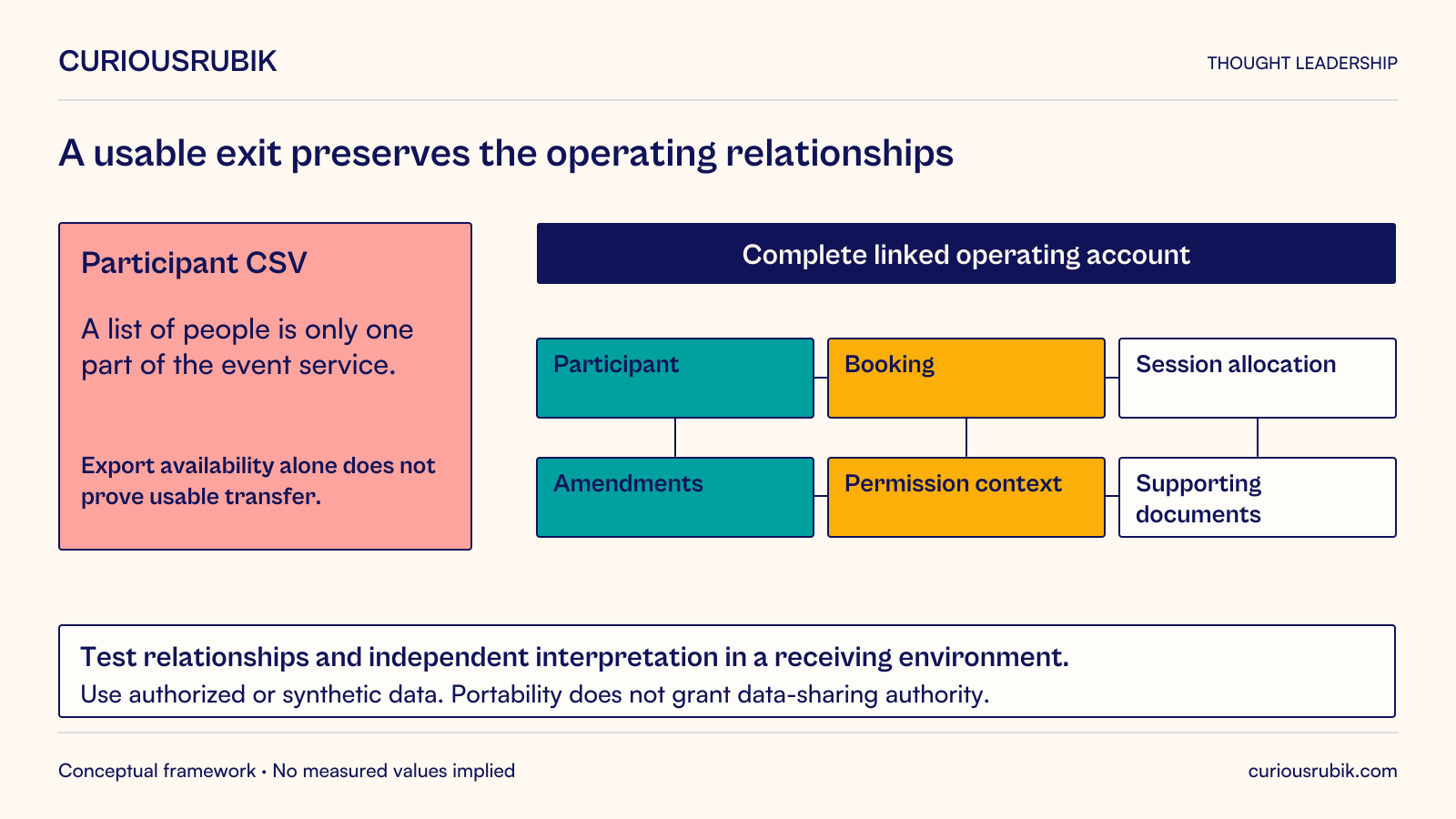
Consider a hypothetical association selecting an event-management service. It needs to preserve future bookings, participant permissions, session allocations, amendments and supporting documents if it changes provider. A demonstration exports participant names and email addresses to a spreadsheet.
That export may be accurate, but it does not establish that the association can continue the event operation elsewhere. The missing booking relationships and session allocations matter more than the fact that the file opens successfully.
Ask which objects, fields, identifiers, relationships, attachments and histories can be transferred, and which cannot. Establish how deleted, amended or restricted records are represented where their treatment matters. Include configuration and reference data needed to interpret the exported information.
Then test a small but meaningful transfer into an independent environment. Can a different team reconstruct an agreed booking, identify its session and relevant amendment, and understand the permissions attached to the record? The test should not secretly rely on the original supplier’s application to interpret every code or relationship.
An open format is useful, but it does not guarantee semantic completeness. A documented proprietary format may be usable with an agreed conversion, while an undocumented spreadsheet can still be difficult to migrate. Evaluate the information and the work required rather than treating the filename extension as the answer.
The example concerns operational portability only. It does not authorize disclosure of participant information to a new recipient. Any test and actual transfer must use appropriate data, permissions and handling arrangements, with synthetic or suitably protected test records where possible.
Before signing, ask how an export is requested, who can perform it, how often it can be obtained and how long production takes. Ask about volume limits, attachments, incremental changes and access to documentation. Request evidence for the relevant capability rather than accepting an unqualified assurance.
Clarify the assistance available during transition. Which activities are included, which require additional services and how will those services be scoped and priced? What happens if the business needs assistance near contract end when supplier resources are already committed elsewhere?
Discuss the period in which the old and receiving services may need to operate together. The business may require time to validate information, train staff and resolve discrepancies. That overlap can have licensing, support and resource implications that belong in the decision before the commitment is made.
Ask how notice dates, renewal decisions and transition milestones interact. A supplier’s commercial deadline and the organization’s implementation schedule are different constraints. Have procurement and legal advisers interpret the applicable terms and negotiate the arrangements; an operational checklist is not legal advice or a model contract.
The UK government’s June 2023 Sourcing Playbook emphasizes early planning for contract end and connecting the outgoing supplier’s exit with the incoming service’s mobilization. Its public-sector guidance also identifies activities, resources, responsibilities and dependencies as elements of the plan. Those are useful planning considerations here, not rules automatically applicable to every private enterprise. Sourcing Playbook, chapter 13.
A supplier may agree to provide data while the business remains dependent on a proprietary workflow, specialist knowledge or a chain of connected services. Document these dependencies separately from the data export.
For the event service, a custom seating rule or allocation process may need to be recreated elsewhere. The organization should know whether that logic is documented, who understands it and which rights or arrangements govern its reuse. Do not assume that access to a result includes ownership of all software or methods that produced it.
Integrations create another layer. Identify which partners and internal consumers depend on supplier-specific identifiers, interfaces or timing. A replacement may need changes in several places even if the main application can be switched. Estimate that coordination work and test the most consequential dependencies.
People are part of the exit capability. If only one external specialist knows how to interpret configuration or run a complete export, availability of that person becomes a dependency. Knowledge transfer and documented operating procedures can reduce it, but only if another qualified person can actually use them.
Not every dependency should be removed. A specialized service may provide enough value to justify a difficult transition. The decision becomes stronger when the business understands the tradeoff, funds the necessary precautions and can explain why the retained dependency is acceptable.
Include more than a possible termination charge when estimating exit effort. Relevant categories may include extraction, transformation, reconstruction of rules, replacement implementation, testing, staff training, parallel operation, supplier assistance and the final retirement of the old capability.
Keep cash costs, internal capacity and uncertainty separate. An estimate of employee time does not automatically become a cash payment or saving. A low quoted export fee may coexist with substantial internal work to make the output usable.
Use scenarios where the uncertainty is material. For an orderly transition, the supplier may provide planned assistance and the organization may have time to prepare. Under an urgent service disruption, the same assistance or access may be unavailable. The purpose is to expose the difference in preparation needs, not assign unsupported probabilities.
A cheap annual price should not be compared with another offer as though both provide the same exit capability. Equally, it may be wasteful to pay for extensive portability that the business is unlikely to need and can replace easily. Evaluate the additional option against the consequence and cost of being unable to change course.
Write down the assumptions that would change the choice. If the amount of unique history, number of integrations or importance of the service grows substantially, the original exit provision may no longer be proportionate. That gives the operating team a reason to revisit the decision later.
An exit plan can become obsolete as the application changes. New modules, custom fields, attachments, integrations and service partners can alter what must be transferred and how difficult it will be. Review the plan when those changes materially affect the option.
Retain evidence from the initial transfer test and repeat a proportionate test when needed. Confirm that the current export still contains the important relationships and that the organization can interpret it independently. An old demonstration should not be treated as permanent proof.
Assign ownership for the commercial timeline and the operational preparation. Renewal should be an informed choice made with enough time to consider alternatives, not the automatic result of discovering too late that a transition cannot be completed.
The eventual decision may be to remain with the supplier. A credible exit option can support that decision by making the alternatives and dependencies explicit. It should not be used as a threat that ignores the value of a productive relationship.
Before signing, aim to know what would move, what would need rebuilding, what help would be available, what it would take and who would own the work. That is a practical exit strategy: a maintained ability to make a future choice with evidence, rather than a reassuring sentence that nobody has tested.