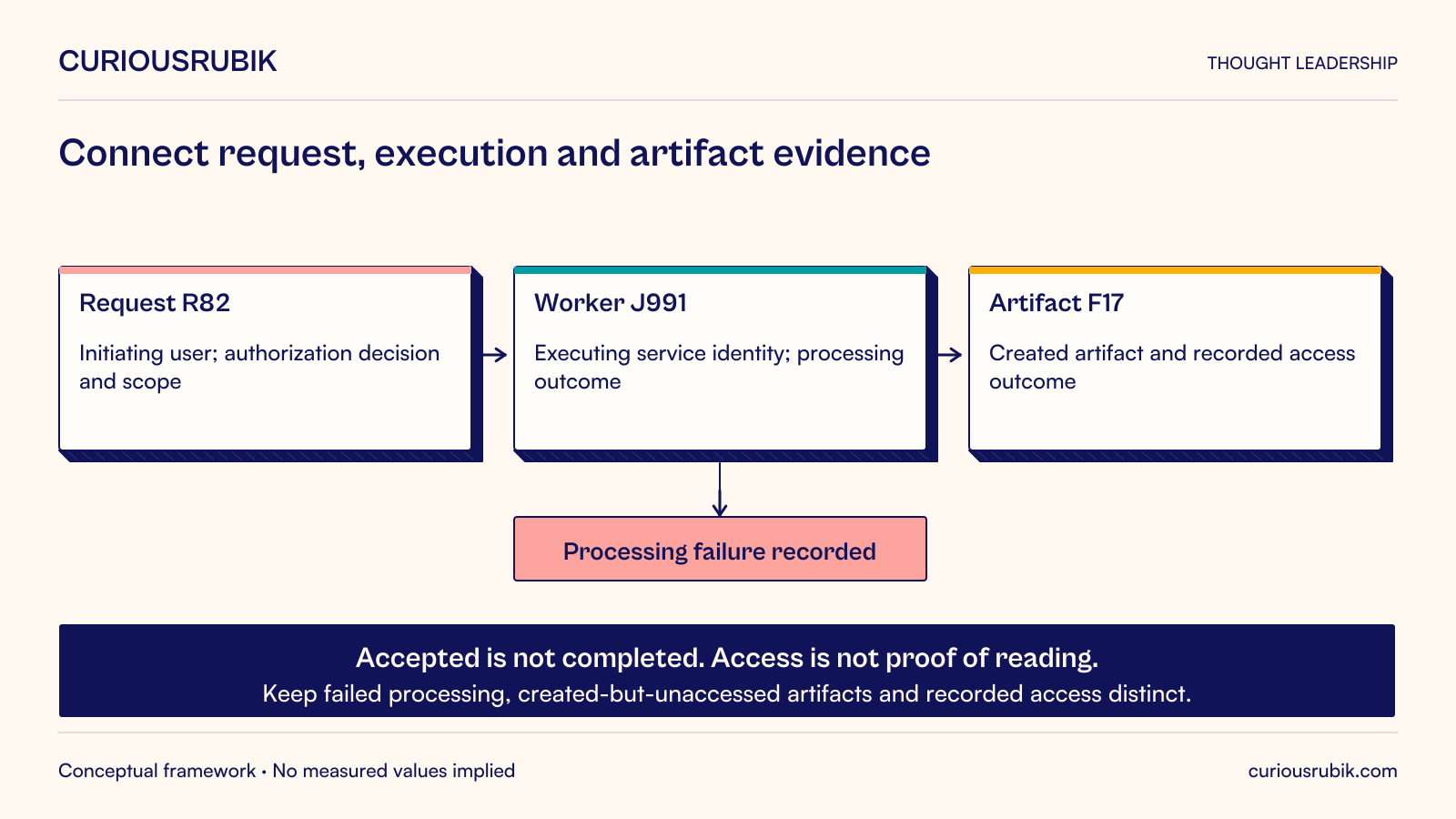
In a hypothetical investigation, an administrator is asked who exported a customer dataset. The web log shows a successful request, the background worker log names a service account, and the file store records a download. None of the three records links reliably to the others. The organization has plenty of logs and still cannot explain the business action.
An audit trail should be designed backward from the questions it must answer: what was requested, under whose authority, which resource was affected, what actually happened, and whether the evidence is complete enough to support a conclusion. Collecting more events is useful only when the events preserve those relationships.
The goal is defensible reconstruction, with appropriate limits. An audit record can associate an action with an authenticated account; it does not automatically prove which person controlled that account or what they intended. Supporting compliance also requires identifying the applicable obligations. No universal event list or retention period makes every application compliant.
Choose the consequential actions in the application: access grants, sensitive exports, changes to protected records, approvals, administrative configuration, and failed attempts relevant to the risk. For each, write the questions a reviewer would need to answer after an incident or control assessment.
An export may require the initiating account, effective authority, selected data scope, purpose or request reference where appropriate, processing job, produced artifact, and delivery outcome. A configuration change may require the prior and new setting, approver, deployment reference, and effective time. The appropriate evidence differs by action.
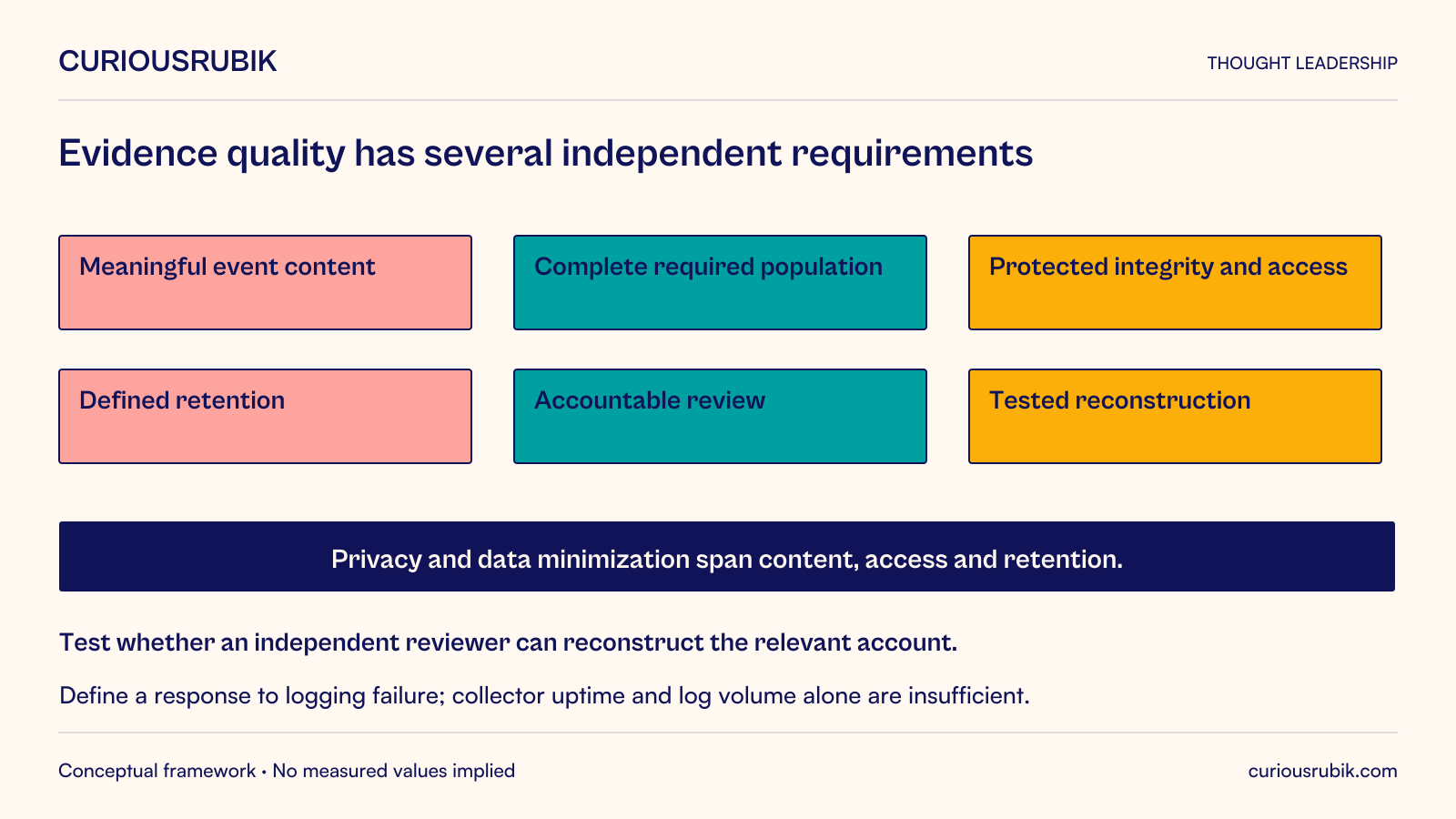
NIST SP 800-53 Revision 5’s audit controls distinguish event selection, record content, generation, protection, review, and retention. That separation is useful: deciding what to record is different from ensuring the records survive and are examined. The catalogue is tailored to organizational requirements, not a universal compliance checklist. NIST SP 800-53 Revision 5, Audit and Accountability family
Define the event’s meaning before its format. “Export succeeded” could mean that a request was accepted, a file was created, or a recipient obtained it. Use distinct events for materially different stages rather than one ambiguous success label.
Suppose an authorized user requests a report of a defined customer population. The application creates request R82 and records the initiating account, requested scope, relevant authorization decision, and policy version. The actual customer data is not copied into this general audit event.
A background job J991 processes R82 using its service identity. Its records retain both identities in their proper roles: the initiating user and the executing workload. The service account should not erase the user context, and the user name should not conceal which technical component performed the work.
The job produces artifact F17 with a recorded scope and version or other integrity reference appropriate to the design. The file service records the subsequent access event against F17. The relationships R82 to J991 to F17 allow an authorized investigator to reconstruct the chain.
Now suppose the worker fails before creating the artifact. The trail should show an accepted request and failed processing, not a completed export. If a file is created but never accessed, that is different from evidence of access. Even a recorded download does not prove that a human read or understood the contents.
If the user leaves the organization later, a stable account identifier should still support historical interpretation. A changed display name or deleted directory entry should not turn the event into an unresolvable string. Retain the necessary identity context through a controlled records policy rather than preserving unrelated personal information indefinitely.
All identifiers and events are hypothetical. The example illustrates evidence relationships, not a required logging schema for every export system.
A practical event model usually needs an event identifier, action type, resource reference, actor and workload context, time, outcome, correlation references, and the information needed to interpret the decision. The exact fields should follow the investigation questions and risk assessment.
Record authorization outcomes where they matter, but protect the supporting context. A log should not contain passwords, access tokens, private keys, or unrestricted copies of sensitive request bodies. Masking a screen does not help if the same values are written to a broad-access diagnostic stream.
For before-and-after evidence, consider whether a full value is necessary. A protected reference, selected changed fields, or a separate access-controlled evidence store may support the requirement with less exposure. The design should preserve enough information to investigate without making every log reader a privileged data user.
NIST’s AU-3 discussion explicitly recognizes privacy risk in audit content, and AU-3(3) addresses limiting personally identifiable information elements. This supports deliberate selection of evidence rather than assuming that maximum collection is always safer. NIST SP 800-53 Revision 5, AU-3
Treat incoming text as data when it enters a log. Use a structured event format and appropriate handling so unexpected characters do not corrupt the record structure or create misleading entries. Preserve a clear distinction between system-generated fields and user-supplied descriptions.
Time also needs context. Record a consistent time representation, monitor clock behavior, and distinguish event time from collection time where delays matter. Timestamps alone may be insufficient to establish order across components; correlation and sequence evidence can be necessary. Do not present clock precision as certainty about causation.
Restrict who can generate, read, alter, export, and delete audit information. Administrative access to the application should not automatically include unrestricted power over the evidence of that administration. The separation must reflect actual infrastructure privileges, not merely different role names in the interface.
Use integrity and storage protections appropriate to the risk, such as restricted append-oriented collection, separate storage administration, protected transport, and monitored changes. These controls can make tampering harder or more detectable; they should not be described as making all evidence impossible to alter.
NIST AU-9 addresses protecting audit information, while AU-5 addresses responses to logging failures. Both matter because a protected log is still incomplete if events stop arriving unnoticed. NIST SP 800-53 Revision 5, AU-5 and AU-9
Define the application’s response when logging is unavailable. Some actions may continue with a bounded local buffer; others may need to pause because the missing evidence would create unacceptable risk. Evaluate storage exhaustion, collector outages, and delayed transmission before production. A policy to block everything can also create availability consequences, so the decision belongs in the risk design.
Check completeness using independent expectations where feasible. Compare initiated jobs with recorded terminal outcomes, or privileged configuration changes with deployment records. A dashboard showing that the collector is running does not establish that every required application path emits the intended events.
Sampling can be useful for some diagnostic telemetry, but it may be inappropriate for evidence required to reconstruct every occurrence of a consequential action. Define the distinction explicitly. A sampled activity stream should not later be represented as a complete audit population.
Retention should follow identified business, security, contractual, legal, and records-management needs, with qualified input where required. Separate rapid investigation access from longer-term preservation if the architecture supports it. The existence of inexpensive storage does not justify keeping every event forever.
Account for copies and exports. An analyst’s downloaded log file, a support bundle, and a backup may preserve information after the primary store’s retention period ends. Their access, use, and disposal need an appropriate policy too.
Assign review responsibilities. Some events need near-term investigation, some support periodic control review, and others are retained for later reconstruction. Sending every event to an urgent alert channel creates noise and can obscure the events that deserve attention.
An alert is the start of assessment, not a verdict. A failed access attempt may be a user mistake, an integration defect, or suspicious activity. The record should provide enough context for the responsible team to investigate without automatically treating the event as proof of misconduct.
Document the decision made after review and link it to the relevant evidence. This creates accountability for the response as well as the original action. It also helps identify recurring configuration or workflow problems that should be prevented rather than investigated repeatedly.
Choose a small set of scenarios and ask an independent, authorized reviewer to reconstruct them from the available evidence. Include an allowed export, a denied request, a failed background job, a privileged configuration change, and an interruption in collection.
The reviewer should identify what can be concluded and what remains unknown. If reconstruction depends on asking the original developer to interpret undocumented log strings, the trail is not yet sufficiently operable.
Repeat the exercise when the workflow or architecture changes. A new background service, file store, or identity model can break correlation even when each component continues to emit logs. Preserve event definitions and version changes as part of the application contract.
There are tradeoffs between detailed evidence, storage cost, privacy, and investigator usability. Resolve them through the questions the trail must answer and the consequences of missing evidence. A concise, protected, well-linked event can be more useful than a large unstructured payload.
Start with the next consequential action a reviewer might challenge. Design the evidence chain, protect it, simulate a failure, and verify what another person can establish. An audit trail earns trust through reconstructable facts and explicit limitations, not through the volume of events collected.