An external user can prove control of an email address without proving that they should represent a customer, supplier or project partner. That distinction is central to portal security. A successful sign-in answers only part of the business question: why is this person entitled to this information or action, and who remains accountable for that entitlement?
External access is harder to manage when the organization does not control the user’s employment lifecycle, device or internal role changes. The portal needs a deliberate process for establishing the relationship, granting bounded access and recognizing when the basis for access has changed.
For a business owner and security lead, the goal is a usable service with evidence behind its permissions. This requires application controls and an operating model; a login feature alone cannot provide either.
Define the external audiences and the work each needs to perform. A customer employee, a supplier representative and a subcontractor may all belong outside the organization, but their access should not be designed as one undifferentiated external role.
Identify the business relationship that supports each permission. That might be a specific account, contract, project, location or transaction. Record who can approve access to that scope and what evidence they must consider.
Email-domain matching can help route a request for review, but it should not automatically grant broad access. Shared domains, consultants and corporate groups can make that shortcut misleading. Likewise, knowing an account number or project name does not establish authority to act for it.
Make the sponsorship responsibility explicit. An internal owner or appropriately delegated external administrator should know which relationships they are authorized to approve and when those relationships require review.
Identity establishes which account is acting. Membership connects that account to a business context. Permission determines what the account may do within that context. Keeping these concepts separate makes exceptions and changes easier to reason about.
A person may legitimately represent two organizations but have different roles in each. A project participant may be allowed to read released drawings without approving a design change. A customer administrator may invite colleagues without gaining permission to alter commercially sensitive settings.
Enforce those distinctions in trusted application logic. The user interface can help people understand their role, but hiding a button does not prevent an unauthorized request through another route.
OWASP’s 2021 Broken Access Control guidance calls for trusted server-side enforcement, default denial for nonpublic resources and checks that enforce record ownership and business limits. These principles support a portal design in which successful authentication does not confer unrestricted access. OWASP Top 10:2021, Broken Access Control.
Use a consistent authorization mechanism across the service, while preserving the specific business rules required for different actions.
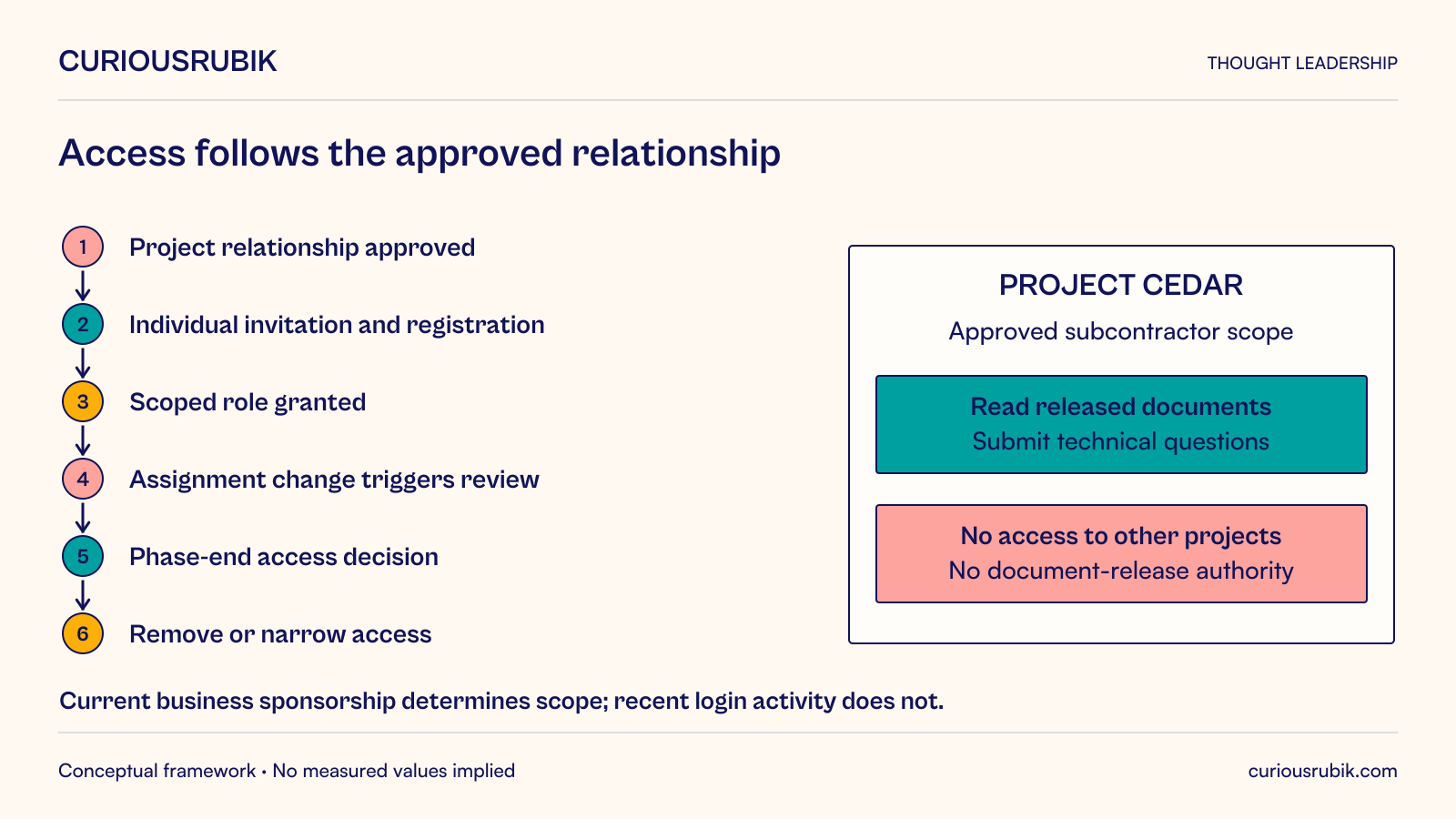
Consider a hypothetical engineering consultancy sharing project documents with a specialist subcontractor. The subcontractor needs access to released documents for Project Cedar and permission to submit technical questions. It does not need access to other client projects or authority to release revised documents.
An invitation should be tied to that approved project relationship and role. The invitation’s recipient completing registration establishes the intended account connection under the chosen enrollment process; it should not silently expand the project scope.
Suppose the subcontractor changes the person assigned to the work. The replacement person needs a new or updated authorization decision, while the previous person’s access must be reviewed and removed when no longer justified. Forwarding the original invitation or sharing an account would undermine individual accountability.
When the project phase ends, the business owner should decide what access remains necessary. Some users may need continued read access to a defined released set, while submission privileges end. That policy should be recorded and enforced rather than inferred from whether the account has recently logged in.
This is an operating example, not a universal retention or project-access policy. The appropriate decisions depend on the organization’s agreements, risks and information responsibilities.
Design how an external access request reaches an authorized reviewer. Provide enough context to verify the relationship without unnecessarily collecting sensitive information. The level of assurance should reflect the information and actions being exposed.
Protect invitation and registration flows against unintended reuse or reassignment. Define their validity, completion state and treatment when the original relationship changes. A pending invitation should not remain an unexplained permanent route into the service.
If external administrators can invite colleagues, limit their authority to the agreed organization or project scope. Decide which roles they may grant and which require internal approval. Test attempts to invite users into unrelated accounts or to grant privileges above the administrator’s own delegated authority.
Make unusual cases visible to support. A legitimate user who cannot complete enrollment needs an approved resolution path, not an informal bypass that grants broad access because a deadline is approaching.
Authentication controls should reflect the risks of account compromise and the actions available through the portal. Use qualified security guidance and the organization’s requirements to select and configure appropriate mechanisms, including stronger authentication where warranted.
A more demanding sign-in does not correct an overly broad permission model. An attacker using a compromised authorized account can still exercise whatever the application allows that account to do. Limit the available actions and consider additional confirmation or review for consequential changes.
Federation with a partner’s identity provider can improve lifecycle management in some relationships, but it creates dependencies on the partner’s identity processes and the agreed claims. Establish what the portal trusts and which business authorization decisions remain its own responsibility.
Account recovery deserves the same care as ordinary sign-in. A recovery process that relies on easily obtained business information can weaken the stronger controls used during login. Define how support verifies a recovery request and how the user is informed of relevant account changes.
The design should be reviewed against current authentication standards and the actual threat model. This article does not prescribe a universal authentication configuration.
Evaluate permissions for each protected action and resource. A user authorized for one project should not gain another project’s files by changing an identifier or following a copied link.
Apply the same rules to search, previews, exports, notifications and downloads. Sensitive information can leak through filenames, result counts or message content even when the main record page is protected.
Decide how access changes affect active sessions, pending jobs and previously issued download mechanisms. A removed user should not continue to obtain new protected information through an overlooked asynchronous path. The exact invalidation and retrieval behavior should be tested against the service’s policy.
Be honest about the limits of revocation. Removing portal access cannot reliably erase a file that a user has already downloaded to an external device. The business needs appropriate sharing practices and agreements as well as technical controls for future access.
That distinction should influence what information the portal exposes and which delivery methods are suitable for it.
Some portal actions change more than information on a screen. They can alter delivery instructions, delegate authority, approve a commercial proposal or request changes to a payment destination. Treat these as distinct business decisions.
Define what evidence and approval each action requires. Additional authentication may help establish that the account holder is present, but it does not establish that the requested change is legitimate or within their business authority.
Show the exact subject and consequences of an approval. If the underlying request changes, determine whether prior approval remains valid or a new decision is required. Preserve a record of the version and scope that were actually approved.
Use independent verification and separation of responsibilities where required by the organization’s policies. A portal should support those controls rather than replace them with a convenient submit button.
External access should have a lifecycle owner. Establish triggers for review, such as project completion, contract changes, delegated-administrator replacement or notification that a person no longer represents the partner.
Periodic review can supplement those triggers, but it should not become a ritual of approving a list nobody understands. Give reviewers the relationship, role, scope and recent relevant activity needed to make a decision. Inactivity can prompt investigation; it does not alone prove that access is unnecessary or safe.
Provide a way for partners and internal teams to report changes promptly. Record who acted on the report and verify the resulting access change across the relevant systems.
Include emergency suspension and reinstatement procedures. Support staff should know how to contain a suspected account problem without losing the evidence needed to investigate or granting access back without an authorized decision.
Security testing should cover enrollment, normal use, delegated administration, recovery, role changes and removal. Use authorized test accounts representing different organizations and scopes.
Verify both permitted and prohibited outcomes. Test a former project participant, an external administrator with limited delegation and a user who belongs to two legitimate customer contexts. Include direct resource requests and background results, not just navigation through the visible screens.
Review operational readiness alongside technical findings. Can support identify the business owner of a disputed permission? Can the team explain how a particular user obtained access? Can it confirm that a removal took effect?
A secure external portal is a maintained relationship between identity, business authority and enforced permissions. It becomes dependable when those decisions are understandable, testable and owned throughout the user’s time with the service.