A project can be busy, well staffed and steadily invoiced while its expected contribution is deteriorating. The warning often sits between systems: the commercial agreement contains the fee, the delivery plan contains the remaining work and the finance system contains costs that arrive after the work has happened.
Connecting those views is one of the most useful purposes of digital transformation in professional services. It gives the business a chance to act while the outcome can still be influenced, rather than discover the full effect at project close.
The aim is not simply more detailed time recording. It is a reliable relationship among what was promised, the resources needed to deliver it, the evidence of progress and the financial consequences.
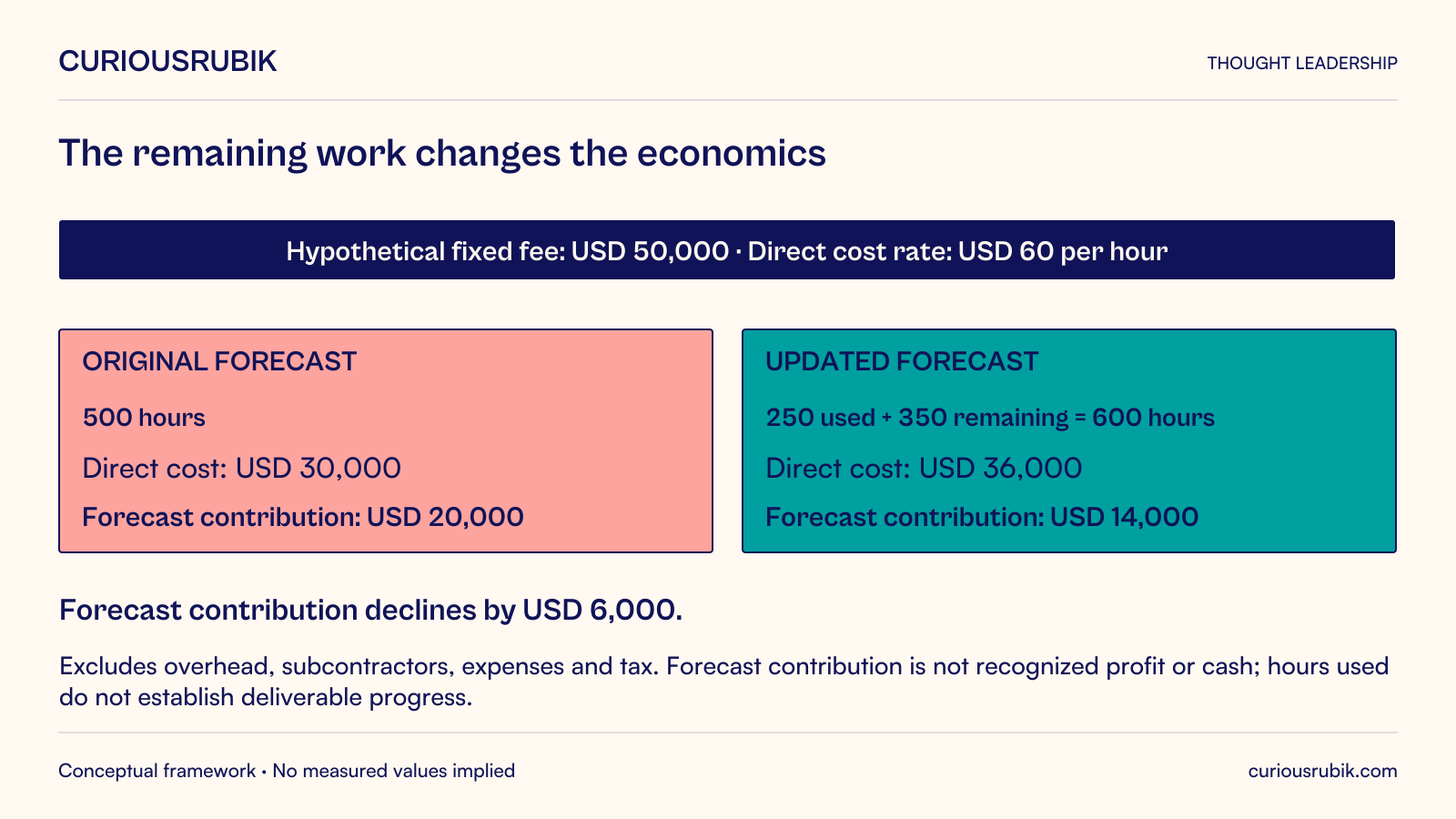
Consider a hypothetical fixed-fee project with an agreed fee of USD 50,000. The original plan assumes 500 delivery hours at a simplified direct labor cost of USD 60 per hour, giving USD 30,000 of forecast delivery cost and USD 20,000 of forecast contribution before overhead and other excluded costs.
At a review point, 250 hours have been used. The delivery team now estimates 350 additional hours to complete the agreed scope. The forecast becomes 600 hours in total, or USD 36,000 at the same assumed rate. Forecast contribution falls to USD 14,000, a USD 6,000 reduction from the original plan.
The project has used half its original hour budget, but that does not establish that half the deliverable is complete. The remaining-work estimate is what exposes the changed economics. It should be supported by the tasks, assumptions and risks still ahead.
These figures are illustrative, not a benchmark or an accounting result. They assume a constant direct cost rate and exclude overhead, subcontractors, expenses, tax and other factors. The contribution forecast is not recognized profit or cash collected.
A connected system should make this change visible to the people who can respond. It should not wait until every hour is posted and the project is already finished.
The project record needs a clear relationship to the accepted scope, assumptions, exclusions and fee arrangement. A sales description or proposal total alone may not provide enough information for the delivery team to plan the work.
Translate the agreement into inspectable deliverables and responsibilities. Identify customer inputs, review cycles and dependencies that can affect effort or timing. The purpose is not to remove every uncertainty before starting, but to make significant assumptions visible and owned.
When the scope changes, distinguish a request from an authorized change. A proposed additional fee should not be used to repair the margin forecast as though it were already agreed. Likewise, additional work should not disappear into the original baseline simply because the team has begun performing it.
Maintain the original and current views. Leaders need to know whether the project changed because the estimate was weak, the customer requested more, a dependency failed or the team discovered necessary work. Those causes lead to different commercial and operating responses.
The technology should support that conversation with linked evidence. It cannot decide contractual interpretation or entitlement on its own; the responsible commercial and finance owners need to apply the actual agreement and applicable policies.
A portfolio can appear to have enough capacity while lacking the specific expertise needed during a critical period. A hundred available hours spread across unrelated roles are not equivalent to a hundred hours of the required specialist skill.
Connect project forecasts to a time-phased resource view. Include committed work, expected changes and the confidence attached to future demand. Separate confirmed assignments from tentative opportunities so that the same person is not implicitly promised several times.
Review the consequences of moving resources. Assigning a specialist to rescue one project may delay another. The decision needs visibility into both effects and an owner able to resolve the tradeoff.
Do not treat maximum utilization as the universal objective. Teams may need capacity for quality review, learning, support and uncertainty. The appropriate balance depends on the service and operating model.
Use resource information responsibly. A low recorded utilization figure can reflect missing data, internal work or a planning gap; it should not automatically become a judgment about an individual’s performance. The system should help managers investigate and improve the work rather than turn an incomplete measure into a conclusion.
Timesheets can show effort, but they do not prove that a deliverable is usable or accepted. A project may consume many hours while waiting for a decision, correcting rework or exploring an approach that does not succeed.
Define the evidence of progress for the work involved. It may include a reviewed design, an accepted analysis, a tested configuration or another agreed outcome. Avoid reducing every professional service to a generic percentage-complete field with no stated basis.
Connect that evidence to the estimate to complete. If a major review remains unresolved, the forecast should reflect the associated work and uncertainty rather than assume that all remaining tasks will follow the original plan.
Make rework visible without creating incentives to hide it. The business needs to understand whether effort came from changed scope, avoidable defects or legitimate exploration. A single nonbillable category can conceal those different causes.
Review the forecast with the people who understand the remaining work. An automated calculation based only on elapsed time or historical averages may miss a newly discovered constraint. Technology can organize the evidence and identify anomalies, while qualified delivery judgment remains necessary.
A project can have several financial states at once. Work may be performed before an invoice is issued; an invoice may be issued before cash is collected; revenue recognition depends on the applicable accounting requirements and the contract’s substance.
The IFRS Foundation’s overview of IFRS 15 describes recognition when a performance obligation is satisfied by transferring the promised good or service, with appropriate progress measurement for obligations satisfied over time. An invoice or timesheet alone does not settle that assessment. Organizations should apply their relevant accounting framework with qualified finance oversight. IFRS Foundation, IFRS 15 Revenue from Contracts with Customers.
The project view should show the relevant states without substituting one for another. A large invoice total does not prove strong project contribution, and a positive contribution forecast does not establish that cash will arrive on time.
Link billing prerequisites and supporting evidence to the agreement. Missing customer acceptance or an unclear milestone can create avoidable delay even when the delivery work is sound. Route the issue to the person able to resolve it rather than leaving finance to reconstruct the project history.
Keep collection status visible to authorized owners, with the context needed to understand a dispute or delay. Do not infer a customer’s intent from an unpaid balance alone. The operating response should follow the facts and the organization’s approved process.
In the hypothetical project, the updated forecast creates several possible responses. The team might remove avoidable rework, change the delivery approach, resolve a blocking decision or discuss a genuine scope change. It should not simply reduce the estimate until the margin looks acceptable.
Assign thresholds for review that fit the business. A material change in remaining effort, an unresolved customer dependency or repeated unapproved scope requests can trigger a discussion. The threshold is a management choice, not a universal formula.
Give the reviewer the current baseline, forecast, evidence and options. A red margin indicator without an explanation can lead to pressure rather than a useful decision.
Record the action and revisit its effect. If the team changes the approach, does the remaining-work estimate improve with evidence? If a commercial change is proposed, is it actually accepted? If a resource is reassigned, what happens to the other affected projects?
This is where integration creates value: the business can connect an emerging delivery condition to an authorized response before the project outcome is fixed.
After completion, compare the accepted scope, forecast revisions, actual effort and relevant financial outcomes. Retain the reasons for material changes so that the next estimate can use the learning.
Look for patterns across comparable work. Repeated underestimation of review cycles may justify a different planning assumption. A service that consistently requires scarce specialist intervention may need a changed delivery model or commercial approach.
Avoid comparing unlike projects through one margin or utilization ranking. Contract type, scope uncertainty, strategic purpose and cost allocation can change the meaning of the number. Define the comparison before drawing conclusions.
Maintain the connected records as part of normal work, rather than asking teams to rebuild the evidence at month-end. Keep data collection proportionate and useful to delivery as well as finance.
Professional-services transformation becomes valuable when it improves the firm’s ability to make and fulfill profitable commitments. The technology provides the connection, but the result depends on honest forecasts, clear scope, meaningful progress evidence and people empowered to act on what the combined view reveals.