A group controller should treat consolidation as a controlled transformation of entity information into a group view. Adding trial balances is only the starting point. The difficult work is establishing the reporting perimeter, aligning meaning, resolving intercompany differences, applying approved adjustments, and preserving an explanation of every material change.
The operating-model decision is how much to standardize at entity level and how much to perform centrally. A common ledger can simplify some dependencies, but it does not resolve accounting judgments or guarantee complete information. Different local systems can support a reliable consolidation when submission rules, mappings, responsibilities, and evidence are explicit.
This article focuses on those operating requirements. IFRS 10 provides the identified accounting reference: it uses control as the basis for consolidation, with provisions and exceptions that require assessment. Its objective is a view of the parent and subsidiaries as a single economic entity. The appropriate framework, perimeter, and treatment for a real group require qualified accounting judgment. IFRS Foundation, IFRS 10 overview
Maintain an approved entity register that records the reporting treatment, relevant ownership and control information, effective dates, reporting currency information, and responsible local and group contacts. An ownership percentage alone should not become an automatic substitute for the applicable control analysis.
Changes need a route into consolidation before the next submission. Acquisitions, disposals, changes in rights, and restructurings may affect the perimeter or treatment. The controller needs timely information from legal, corporate development, and local management, with documentation of the accounting conclusion.
Keep management structures separate from the formal reporting perimeter. A regional executive may manage several operations that sit inside different legal entities. The group may want both views, but the transformations and reconciliations must be defined. Using the sales organization as the consolidation hierarchy can create a view that is convenient and technically wrong for its stated purpose.
Freeze the applicable perimeter for each reporting version while retaining the ability to produce a revised version if an approved correction is needed. Otherwise, changing a master record can silently alter historical reports and make comparisons difficult to explain.
A submission should contain the agreed trial balance, required supporting schedules, intercompany detail, approved local-to-group adjustments, and explanations of relevant changes. The exact package depends on the group’s accounting and disclosure requirements. Its design should begin with what the consolidation team must establish, rather than with the fields an application happens to offer.
Use validation at the point of submission. Check the reporting period, currency, entity identifier, required accounts, balance consistency, and expected supporting populations. Reject an invalid submission with a clear reason and owner. Accepting a file and discovering fundamental defects during final review moves preventable work to the most constrained stage.
Define which local manager or controller confirms the package and what that confirmation covers. A declaration that “the numbers are complete” is weak if it does not identify the version, required schedules, unresolved items, and approved exceptions. Preserve the evidence of submission and subsequent changes.
There is a tradeoff between a uniform package and local effort. Requiring every entity to provide the same extensive schedule can waste work where the underlying activity does not exist. Use a common core with explicitly scoped additional schedules, while making absence distinguishable from missing data.
A mapping connects local account meaning to group account meaning. It does not, by itself, align accounting policy. If local records apply a different treatment, a separate, approved adjustment may be needed under the applicable framework.
The Australian Accounting Standards Board’s published AASB 10 text, which incorporates IFRS 10, addresses uniform policies for comparable transactions and the elimination of intragroup activity. These are accounting requirements within that framework, not a requirement that every entity operate identical software. AASB 10, paragraphs 19, B86 and B87, December 2021 compilation
Keep account mappings, policy adjustments, currency-conversion rules, and elimination rules as separate controlled objects. They may interact, but they answer different questions. When a number changes, the group should be able to establish whether the source changed, the mapping changed, the accounting treatment changed, or the consolidation rule changed.
For currency conversion, preserve original amounts and the approved rate references and methods. Currency treatment can be technically complex and depends on the facts and applicable standards. The operating requirement is traceability and controlled application, not a universal instruction to apply one rate to every balance.
Intercompany records need consistent counterparty identifiers and sufficient transaction detail. A group account called “intercompany receivable” is not enough if the consolidation team cannot determine which entity owes the balance or which transaction it represents.
Match the parties’ records and classify differences. Timing, currency, missing documents, different classifications, and genuine disputes require different resolutions. An automated tolerance can help prioritize investigation, but it should not silently erase unexplained differences. Small differences may accumulate or reveal a larger process defect.
Assign both a transaction owner and an escalation route. If one entity says it delivered a service and another disputes receipt, the consolidation team cannot resolve the business facts by posting an unexplained group adjustment. The facts should be settled or their reporting consequence assessed and documented by the responsible professionals.
A working intercompany timetable can require counterparties to exchange relevant balances before final submission, identify disagreements, and confirm approved resolutions. Earlier matching is useful when the data is sufficiently complete; it still needs a controlled update for later activity.
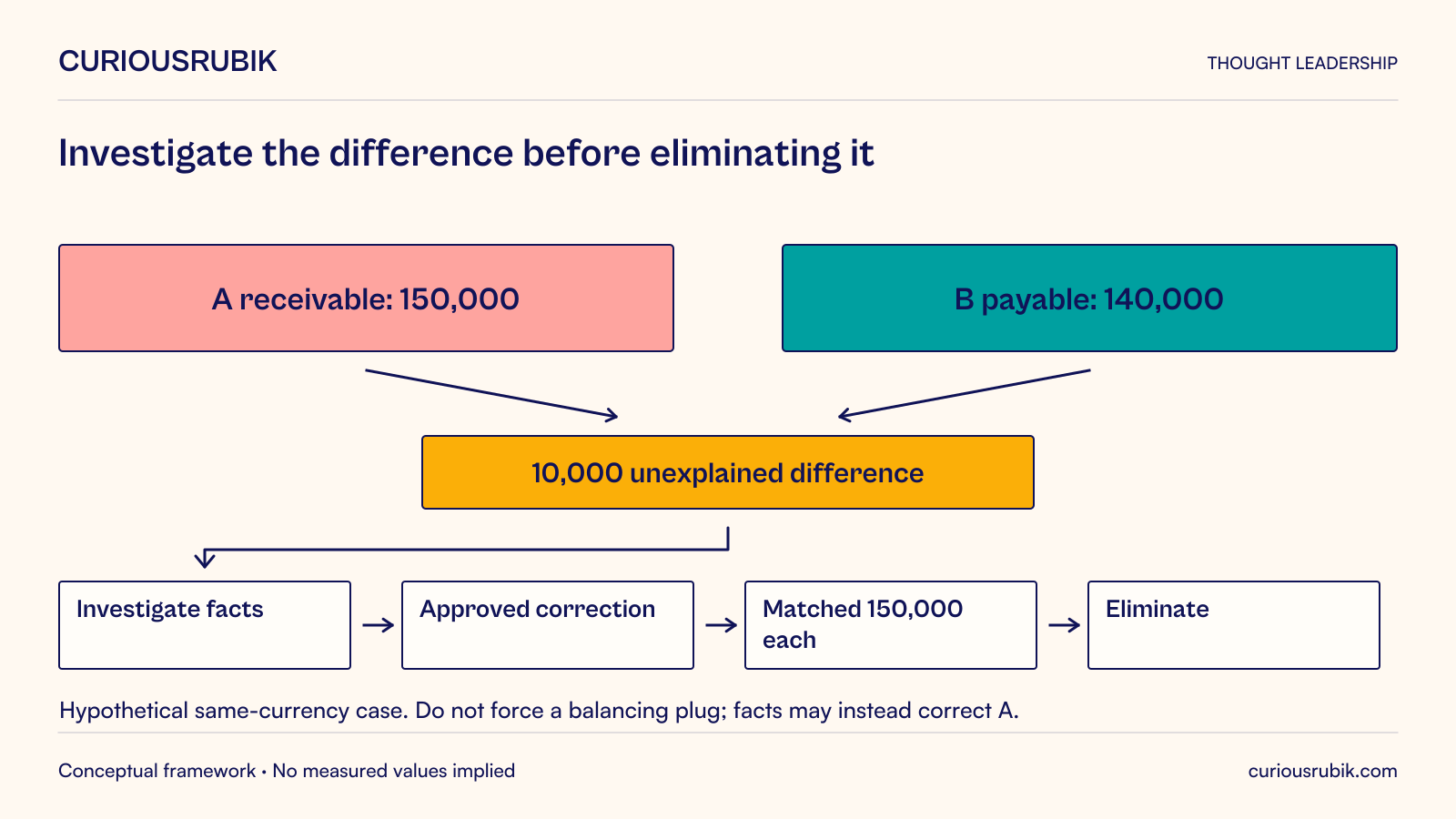
Suppose Entity A records a USD 150,000 receivable from Entity B for shared services, while B records a USD 140,000 payable. Both entities are assumed to be fully consolidated, use the same currency for this simplified example, and have no other differences relevant to the illustration.
The USD 10,000 mismatch cannot be explained by the fact that the parties are in the same group. If the consolidation process simply removes USD 150,000 from both sides, it would create an unsupported USD 10,000 adjustment to B’s reported liability. If it removes only USD 140,000, an unexplained internal balance remains. Neither mechanical response establishes the correct result.
Investigation finds that A’s charge includes a USD 10,000 service item that B has not recorded. Assume the responsible teams establish that the service was provided in the relevant period and that qualified accounting review approves the corresponding correction. The entity submission or separately controlled group adjustment is updated through the approved route. The two recognized balances can then be reconciled at USD 150,000 before the elimination is processed.
If the facts instead show that A billed an unsupported amount, the correction may belong on A’s side. If a genuine dispute remains, its treatment needs assessment under the applicable policies. The useful lesson is that matching identifies a question; it does not authorize a balancing entry.
This example deliberately omits tax, foreign currency, unrealized profit, ownership changes, and other consolidation matters. Those can require additional work. The operating design must allow the applicable adjustments to be added transparently rather than hiding them inside a generic “consolidation difference.”
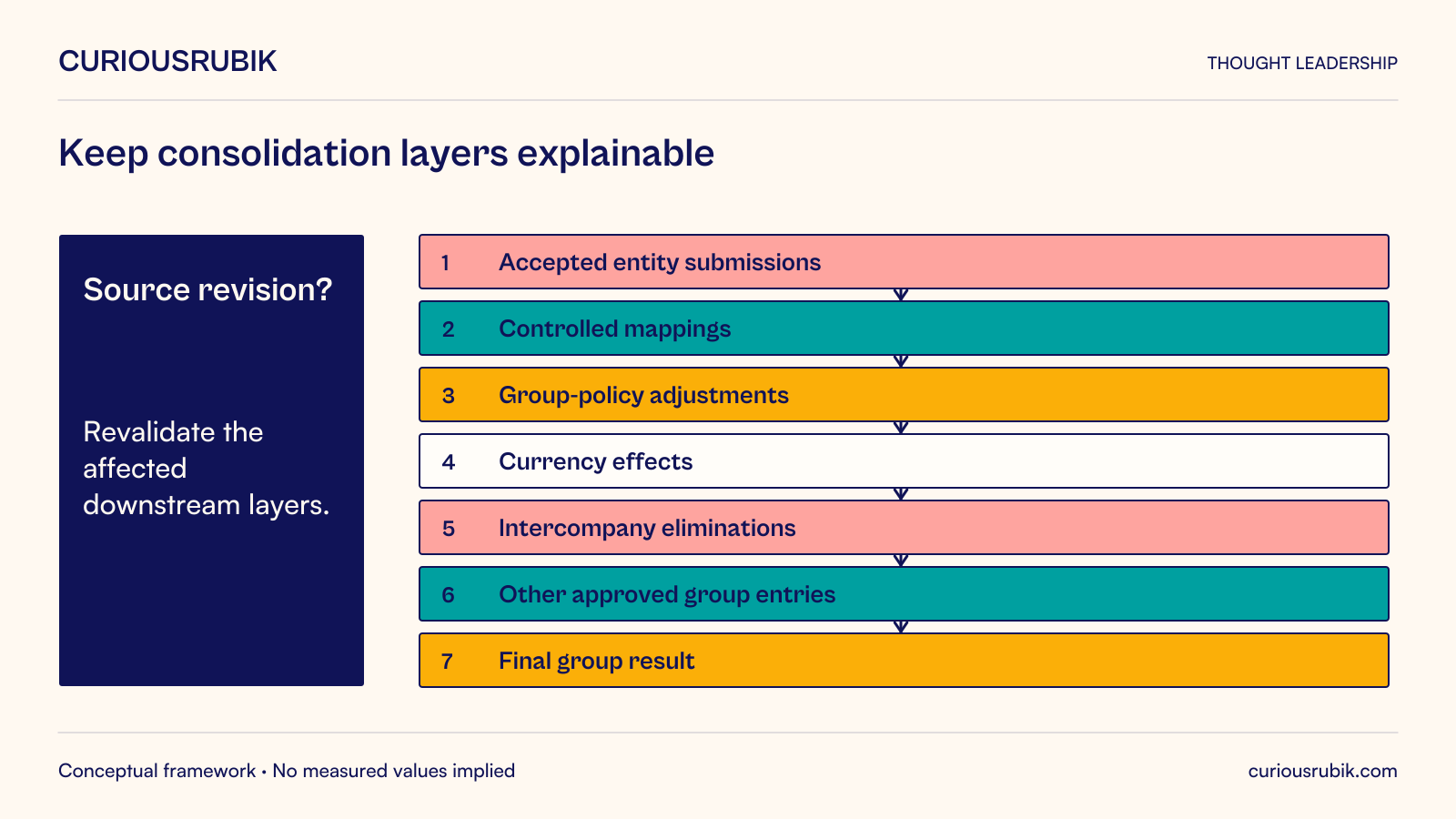
Maintain a bridge from local reported balances to the final group result. Separate source submissions, mapping effects, group-policy adjustments, currency effects, intercompany eliminations, and other approved consolidation entries. The grouping should fit the system and accounting model, but each layer needs an identifiable purpose.
For manual group entries, record the rationale, supporting evidence, preparer, approver, affected period, and whether the entry recurs or reverses. A copied prior-month adjustment can become wrong when the underlying entity data changes. Recurrence should trigger review of the continuing basis, not indefinite automatic repetition.
When an entity resubmits, determine which downstream calculations and approvals are invalidated. Version control should prevent a final group report from combining a new entity balance with an elimination derived from the old one. Reconcile the final output to the accepted inputs and approved adjustment layers.
The same discipline helps management understand movements. A change in group performance should be distinguishable from an acquisition-perimeter change, mapping correction, or amended accounting treatment. Without that bridge, executives can attribute a reporting change to operating performance and make the wrong response.
Centralize activities where common expertise and consistency matter: group policies, consolidation rules, reporting definitions, and difficult technical assessments. Keep local ownership of facts that local teams are best placed to verify. A central team can coordinate receipt evidence; it cannot manufacture knowledge of whether a local service was actually delivered.
Evaluate technology against the required operating model. Ask whether it supports controlled submissions, counterparty detail, versioned mappings, traceable adjustments, recoverable processing, and meaningful reviews. A polished consolidated dashboard cannot compensate for missing submission evidence.
For the next cycle, choose one recurring intercompany difference or unexplained adjustment and trace it from entity records to the final report. Establish the underlying fact, assign the preventive owner, and preserve the correction through the consolidation layers. Removing that uncertainty is a more defensible first improvement than demanding a faster group total from the same unresolved inputs.