“Job complete” can describe the engineer's work without answering finance's next question. Has the customer accepted the deliverable? Was extra work authorised? Is the billing entity correct? Has an invoice or payment already created a GST timing issue that needs attention?
A single unbilled queue mixes these problems together. Finance sends a general reminder to the service team, the service team repeats that the job is finished, and the oldest items remain unresolved.
The practical improvement is to give each blocked job a specific reason, a person who can resolve it and a next action. For a Singapore service business, keep contractual billing readiness, accounting treatment and GST timing as separate decisions. An operational status cannot settle all three.
Trace one job from work order to completion record. The engineer may confirm that the specified task was performed, equipment tested or a report delivered. That evidence is valuable, but the billing milestone depends on the agreement and the facts.
Customer acceptance might require a signed service sheet, approval by a specified contact or another agreed method. In some arrangements, a signature may not be the contractual trigger at all. Read the relevant terms rather than imposing the same sign-off requirement on every service.
Extra work introduces a different question. A technically necessary task may have been completed without agreement on price or scope. Asking the engineer to obtain a signature on the original service sheet will not necessarily resolve that commercial issue.
An administrative omission is different again. The work and billing entitlement may be clear, but finance lacks a purchase-order reference or has conflicting billing-entity information. These cases need targeted correction, not a new debate about whether the service happened.
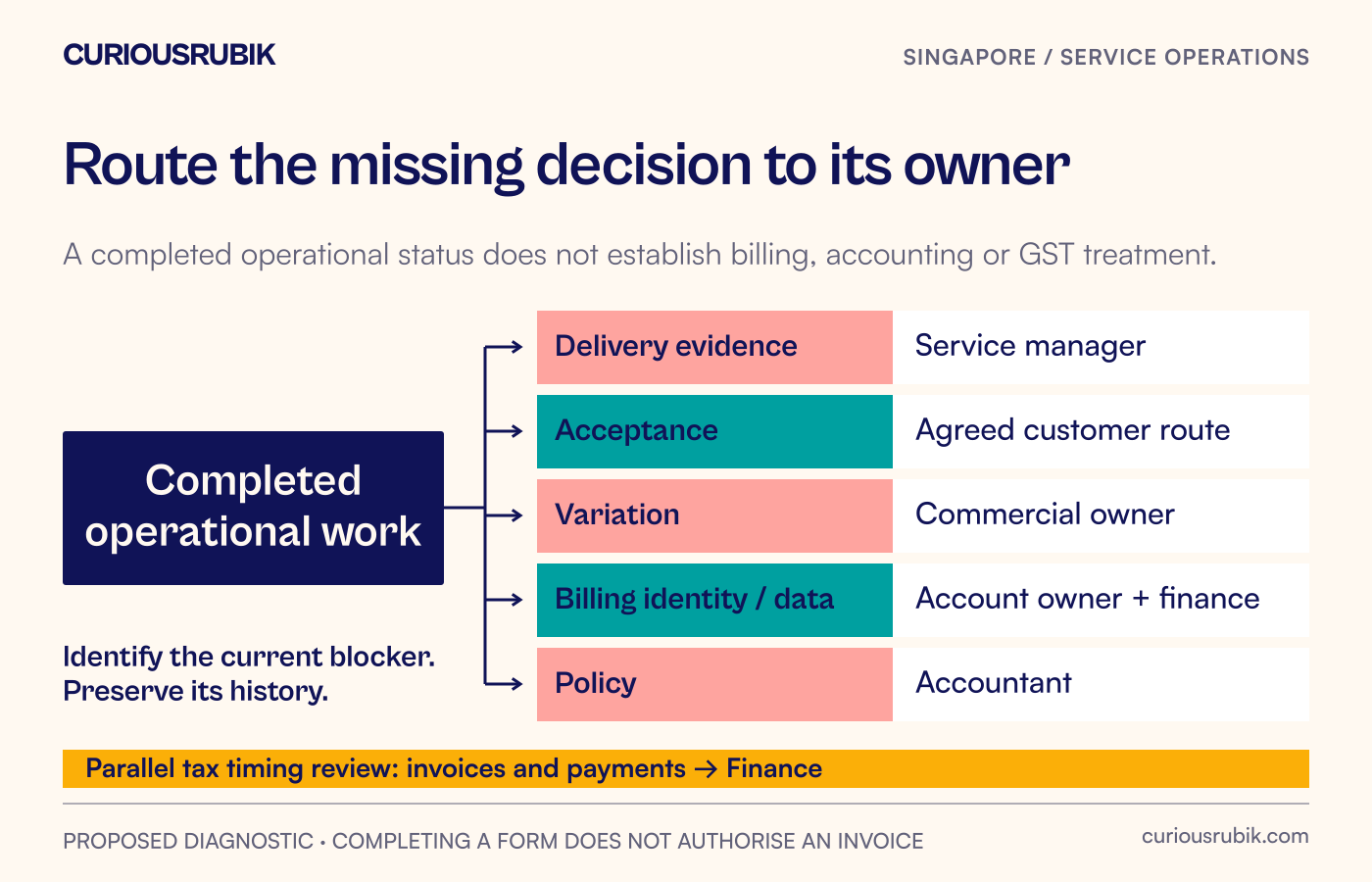
Use a primary blocked reason and allow secondary reasons where necessary. Useful categories include delivery evidence incomplete, acceptance unresolved, variation under commercial review, billing information missing and finance-policy review required.
For every case, capture the job and customer, relevant contract or order, completion event, proposed billing amount, blocker, owner, evidence requested, next action and promised review date. Where the amount itself is uncertain, mark it as an estimate with its basis rather than presenting it as settled revenue.
The primary reason should identify the current constraint on the next decision. A job may begin with missing delivery evidence and later move to a variation dispute. Preserve that history. Otherwise the team may conclude that finance delayed the job when the underlying commercial facts were unsettled for most of the period.
Avoid an unrestricted “other” category. It can be useful temporarily, but assign an owner to clarify the reason and review repeated uses. A growing pile of “other” items usually means the diagnostic categories no longer describe the work.
CURIOUSRUBIK SINGAPORE / SERVICE OPERATIONS Route the missing decision to its owner A completed operational status does not establish billing, accounting or GST treatment. Completed operational work Delivery evidence Service manager Acceptance Agreed customer route Variation Commercial owner Billing identity / data Account owner + finance Policy Accountant Identify the current blocker. Preserve its history. Parallel tax timing review: invoices and payments → Finance PROPOSED DIAGNOSTIC · COMPLETING A FORM DOES NOT AUTHORISE AN INVOICE curiousrubik.com
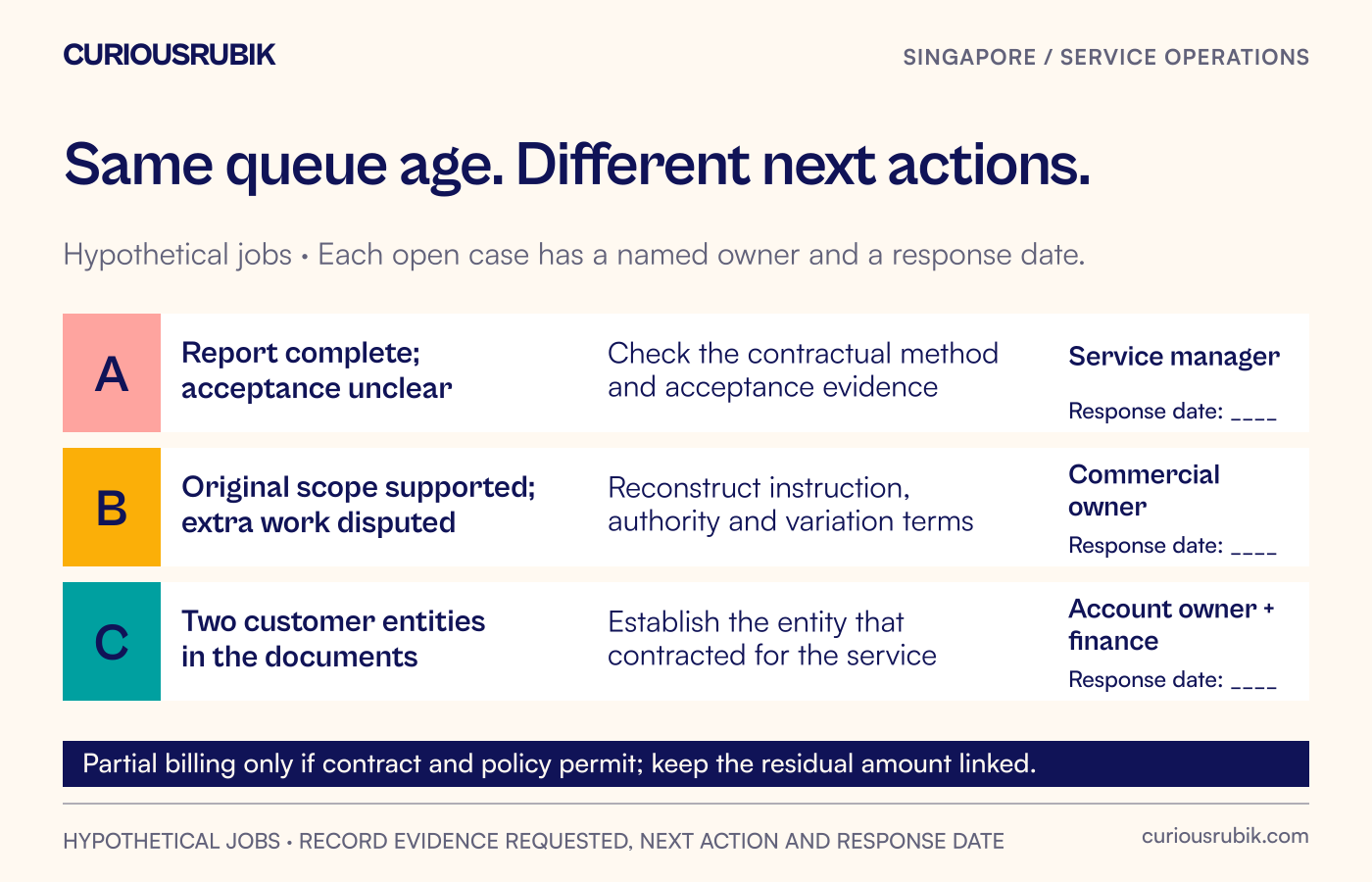
Consider three hypothetical jobs completed by the same service team during one week. They are examples of workflow design, not reported client cases.
Job A has a completed service report but no evidence that the agreed acceptance step occurred. The service manager checks what the contract requires and obtains the appropriate evidence from the customer contact. The next action is specific: establish acceptance under the actual arrangement. It is not simply “chase billing”.
Job B includes extra work requested on site. The original scope is supported, but the additional amount is disputed. The commercial owner reconstructs the instruction, the authority of the person who requested it and any applicable variation terms. They decide the authorised commercial response. Finance should not resolve the issue by quietly removing the extra amount or treating the engineer's completion status as customer agreement.
Job C has the delivery and commercial support needed for billing, but two customer entities appear in the documents. The account owner confirms which entity contracted for the service, and finance checks the appropriate invoice details. Copying the most recent address into the invoice could send a valid charge to the wrong company.
Each job can have an agreed review date, but the evidence and decision maker differ. A generic daily reminder cannot make those distinctions. The service manager remains responsible for completion evidence; the commercial owner resolves scope and price questions; finance applies the relevant billing and accounting policies.
CURIOUSRUBIK SINGAPORE / SERVICE OPERATIONS Same queue age. Different next actions. Hypothetical jobs · Each open case has a named owner and a response date. A Report complete; acceptance unclear Check the contractual method and acceptance evidence Service manager Response date: ____ B Original scope supported; extra work disputed Reconstruct instruction, authority and variation terms Commercial owner Response date: ____ C Two customer entities in the documents Establish the entity that contracted for the service Account owner + finance Response date: ____ Partial billing only if contract and policy permit; keep the residual amount linked. HYPOTHETICAL JOBS · RECORD EVIDENCE REQUESTED, NEXT ACTION AND RESPONSE DATE curiousrubik.com
A mixed job may contain a clearly supported element and a disputed variation. Check whether the contract and applicable policies permit separate billing. If they do, an authorised decision can release the supported portion while preserving the open amount and reason. Do not assume every job can be divided simply because the records have separate lines.
The queue should show the relationship between any released invoice and the remaining candidate amount. Otherwise partial billing can create a duplicate later, when the whole job reappears as “ready”. Recalculate the remaining amount using the accepted commercial position and billing history, with review where needed.
Where the customer rejects acceptance, record the substance of the issue. Is work incomplete, is evidence missing, or is there a disagreement about quality? The appropriate next step could be remedial service rather than another request for a signature. A status that treats every rejection as paperwork will keep sending the case to the wrong person.
For GST-registered businesses, IRAS states that, for most transactions, GST time of supply is the earlier of invoice issuance and receipt of payment. Documents that function as bills can matter even if they carry another label. The treatment of particular arrangements and payment types still needs the relevant review.
That means an item marked “unbilled” internally is not proof that no GST obligation has arisen. Finance should check invoices or billing documents already issued and payments already received, alongside the commercial blocker. Waiting for an operational status to turn green is not a substitute for determining the applicable tax period.
Revenue recognition is also a separate accounting assessment under the Singapore reporting framework applicable to the entity. Neither completion, billing nor cash receipt should be treated as an automatic answer for every arrangement. Escalate the actual facts to the responsible accountant instead of embedding an unsupported recognition rule in the job workflow.
The diagnostic recommended here is a management tool. It does not certify revenue or tax treatment. ACRA's financial-reporting guidance emphasises appropriate accounting policies, controls and records; those responsibilities remain with the relevant people when an automated queue prepares billing candidates.
Automation can bring completed jobs into a review queue, identify missing fields and request evidence from the relevant owner. It can show the age of each blocker and alert a manager when a promised response date passes.
The outgoing request should identify the job, missing fact and usable evidence. “Please upload the agreed acceptance record” is more useful than “job overdue”. For a variation, route the commercial question to the account owner rather than asking the engineer to approve their own additional charge.
Preserve the documents and decision history. When someone changes a blocked reason, record why and what remains unresolved. Prevent automation from issuing an invoice merely because all form fields are filled; a complete form can still contain a disputed or unsupported assertion.
Report age and value by blocked reason, with uncertain amounts identified. Track time from completion to a valid invoice, repeated blockers and the time between a promised action and its completion. Separate service remediation from administrative data correction so management does not prescribe the same remedy for both.
Review how often a “ready” job is returned by finance or rejected by the customer. Faster queue clearance is a poor result if it creates avoidable credit notes or disputed invoices. Include the quality of the released work in the pilot.
Take the oldest five completed, unbilled jobs and give each one a specific blocked reason. Assign the next action to somebody who can supply the evidence or make the decision. The pattern will show whether the business needs better completion records, earlier commercial agreement or a cleaner billing handoff.