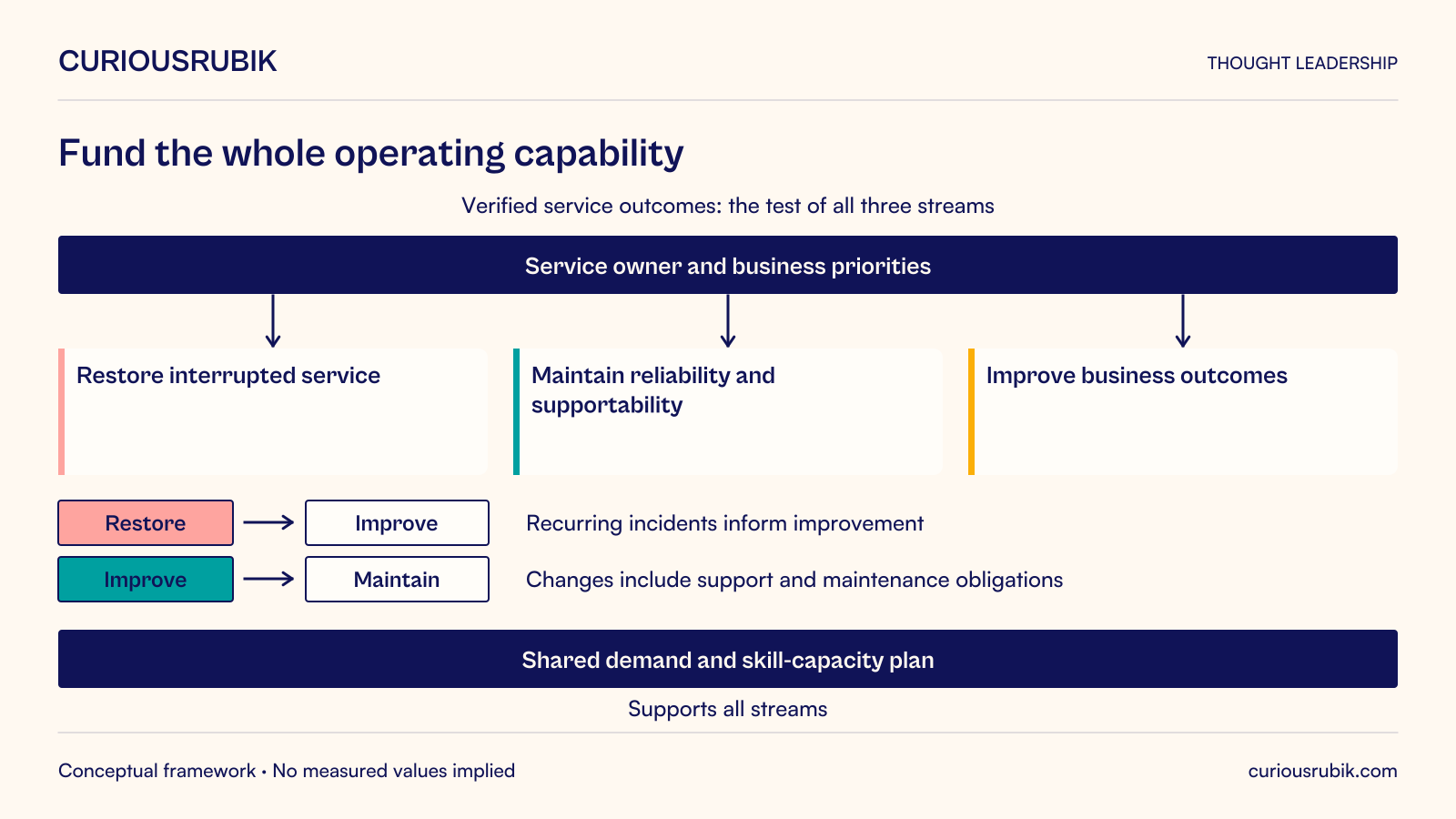
After implementation, application work does not disappear. It changes shape. Incidents interrupt the day, updates require testing, users request improvements, business rules evolve, and integrations need attention. If all of that work enters one undifferentiated queue, urgent requests consume the capacity needed to prevent the next problem.
A sustainable support model makes deliberate choices about ownership, funding, service expectations, and improvement. It should keep the application dependable while allowing the business to change without launching a new project for every adjustment.
For a CIO or COO, the central decision is how to maintain a continuing capability rather than purchase an indefinite supply of ticket responses. The right model may combine internal staff and external providers, but accountability for business outcomes and priorities must remain clear.
Start with the business capability and its users, operating hours, critical cycles, dependencies, and expected outcomes. An application name alone is an incomplete service definition.
A finance platform, for example, may support daily transactions, periodic close, management reporting, and interfaces to other systems. Each has different support needs and decision owners. The operating model should show those distinctions without fragmenting accountability.
Define the support boundary: incidents, routine requests, data correction, access administration, maintenance, minor changes, and larger enhancements. Explain how work moves when it falls outside the agreed scope.
Avoid promising broad availability without understanding the coverage required. A service used across time zones may need different arrangements from one used during a local working day. Response expectations should reflect business consequence and feasible staffing.
A practical working model distinguishes restore, maintain, and improve work. This is a proposed management structure, not a formal service-management taxonomy.
Restore work addresses interrupted or degraded service. Maintain work preserves reliability, security, compatibility, and supportability through updates, testing, housekeeping, and knowledge maintenance. Improve work changes the service to produce a better business outcome.
The streams interact, but they should not compete invisibly. A recurring incident may create an improvement item. A maintenance release may need operational testing. A new feature may increase future support demand.
Record enough information to understand the demand and its cause. The aim is to make capacity decisions visible, not to create elaborate classification that delays response to a real problem.
The service owner is accountable for the overall operating result and support arrangement. Business process owners decide policy and process priorities. Technical owners maintain the application and integrations. Data and control owners retain their specialist responsibilities.
A product or improvement owner should prioritize changes against business value, risk, and capacity. Without that role, the backlog tends to reflect whoever is most persistent rather than the service’s needs.
External providers can perform important work, but they should not become the default authority for unresolved business decisions. Nor should internal staff assume a provider will coordinate a cross-system issue unless that responsibility is explicit.
The UK Service Manual’s live-phase guidance emphasizes sustainable operation and continued improvement. Its relevance here is that the ongoing team and roadmap need deliberate design rather than being whatever remains after the implementation budget ends. GOV.UK, How the live phase works.
Consider a hypothetical group producing commercial video and digital content. Its enterprise application supports project setup, resource scheduling, purchasing, and job-cost reporting. An application partner handles faults, an integration supplier maintains interfaces, and internal operations staff answer process questions.
After launch, every issue enters a shared mailbox. The application partner closes tickets when its component behaves as designed. Operations then discovers that a mapping or business rule still prevents the project from completing correctly. Meanwhile, planned updates are deferred because the same specialists are handling urgent requests.
The group defines one service owner and a coordinating incident role. Component teams retain their responsibilities, but a cross-system incident remains open until the agreed business outcome is verified. Policy questions route to the relevant process owner rather than being passed between suppliers.
The contract distinguishes restoration from routine maintenance and approved improvement work. The group reserves explicit capacity for tested updates and recurring-cause removal, with a review mechanism if incident demand consumes that capacity. It does not assume a universal percentage allocation; the plan follows observed demand and service risk.
A recurring job-cost discrepancy becomes a defined improvement item with a business owner, source-data analysis, acceptance evidence, and release plan. It is no longer treated as a series of unrelated user corrections.
The pilot operating period reviews unresolved business effects, repeated causes, maintenance completion, and the effort required to deliver a small change. The example illustrates a support-model redesign and claims no measured savings or service improvement.
Updates, regression testing, access reviews, dependency management, recovery exercises, and documentation need planned capacity. When these activities are funded only after failure, the organization accumulates avoidable operating risk.
Create a forward view of known obligations and their dependencies. Identify release windows, supplier deadlines, business-calendar constraints, and the people needed for testing.
Keep maintenance visible in business terms. Explain which capability or risk the work protects. “Upgrade required” is less useful to a sponsor than a clear account of supportability, compatibility, or security consequences and the available options.
Do not use maintenance as a label for every desired enhancement. Preserve a transparent distinction so leaders can make informed tradeoffs rather than treating the entire backlog as mandatory.
Some support work repeats without creating lasting improvement: manual resets, recurring report corrections, repeated data transfers, or routine intervention in an unstable job.
The SRE discussion of toil describes operational work that is manual, repetitive, automatable, and scales with service growth, among other characteristics. The useful lesson is to identify recurring effort that can be reduced through engineering or process change rather than accepting it as a permanent support cost. Site Reliability Engineering, Eliminating Toil.
Not all operational work is waste. A necessary review or customer conversation may involve judgment that should remain human. Investigate the purpose before automating it.
Track the recurring burden and the intervention intended to reduce it. Verify whether the change removes work or moves it elsewhere. A new automation that generates a complex exception queue may offer little net relief.
Small changes can have large effects when applications are integrated. Use a proportionate path from problem evidence to design, approval, testing, release, and outcome review.
Define which changes can be handled within the ordinary support model and which require a separate project or higher authority. Consider consequence and dependency, not only estimated development hours.
Preserve versioned process and configuration decisions. A minor routing change can alter who has authority or when an external action occurs. Business owners should review those consequences rather than treating every configuration change as purely technical.
Schedule improvement around the service’s operating calendar. Avoid adding discretionary risk during critical periods unless the benefit or urgency justifies it. The model should make such decisions explicit and traceable.
A contract focused entirely on ticket response can reward fast acknowledgment while leaving recurring causes unresolved. A contract focused only on ticket reduction can discourage reporting or reclassify problems.
Use a balanced account of service outcomes, response, resolution, recurrence, maintenance, and improvement. Define what counts as resolution and how business verification occurs.
Clarify collaboration across providers. Specify who coordinates, what evidence each party supplies, and how disagreements are escalated. The business should not become the technical translator between suppliers during every incident.
Keep commercial boundaries understandable. If an issue requires out-of-scope work, the operating team still needs a safe containment path while the appropriate approval is obtained. Urgency should not become a standing excuse for unreviewed scope or cost.
Analyze incident arrival, routine request volume, maintenance obligations, and improvement effort by skill and timing. Include interruptions, handovers, and the concentration of expertise.
Averages can conceal peaks around close, seasonal demand, or releases. Plan coverage for the business calendar and provide a route for exceptional demand.
Reserve improvement capacity deliberately, then review whether it is actually used. If urgent work repeatedly consumes it, investigate root causes, service scope, or staffing. Simply moving the same improvement work to the next month does not create a sustainable model.
Avoid relying on one expert to approve every change and solve every difficult incident. Develop deputies and usable knowledge so the service can continue through ordinary absence and turnover.
Track whether important business outcomes remain dependable, how often problems recur, how much manual intervention is required, and whether planned maintenance occurs.
Measure change lead time with quality and consequence in view. Faster delivery is useful only if changes work and remain supportable. Include failed changes, rollback or repair effort, and user impact where relevant.
Use costs with a meaningful denominator, such as the supported scope or workload, while preserving the effect of complexity. A lower cost per ticket can be misleading if the ticket mix changes or users stop reporting issues.
Review the support model periodically with business owners. Decide whether to change service levels, staffing, supplier roles, or priorities based on evidence. A monthly report should support those decisions rather than exist as a contractual ritual.
A sustainable model should survive a supplier change or internal reorganization. Maintain current documentation, approved access processes, configuration history, source ownership where applicable, and an intelligible backlog.
Clarify exit assistance and knowledge-transfer obligations in the commercial arrangement. The organization should be able to understand its service without depending entirely on one provider’s private knowledge.
Test internal capability through representative scenarios and reviews. Full self-sufficiency may not be economical, but the business needs enough understanding to govern the service and assess supplier performance.
Implementation creates the initial capability. Sustainable support keeps it dependable, maintains its foundations, and changes it deliberately as the business evolves. The strongest model funds all three responsibilities and gives each a clear owner, so continuous improvement becomes part of ordinary operation rather than a promise deferred until the queue is empty.