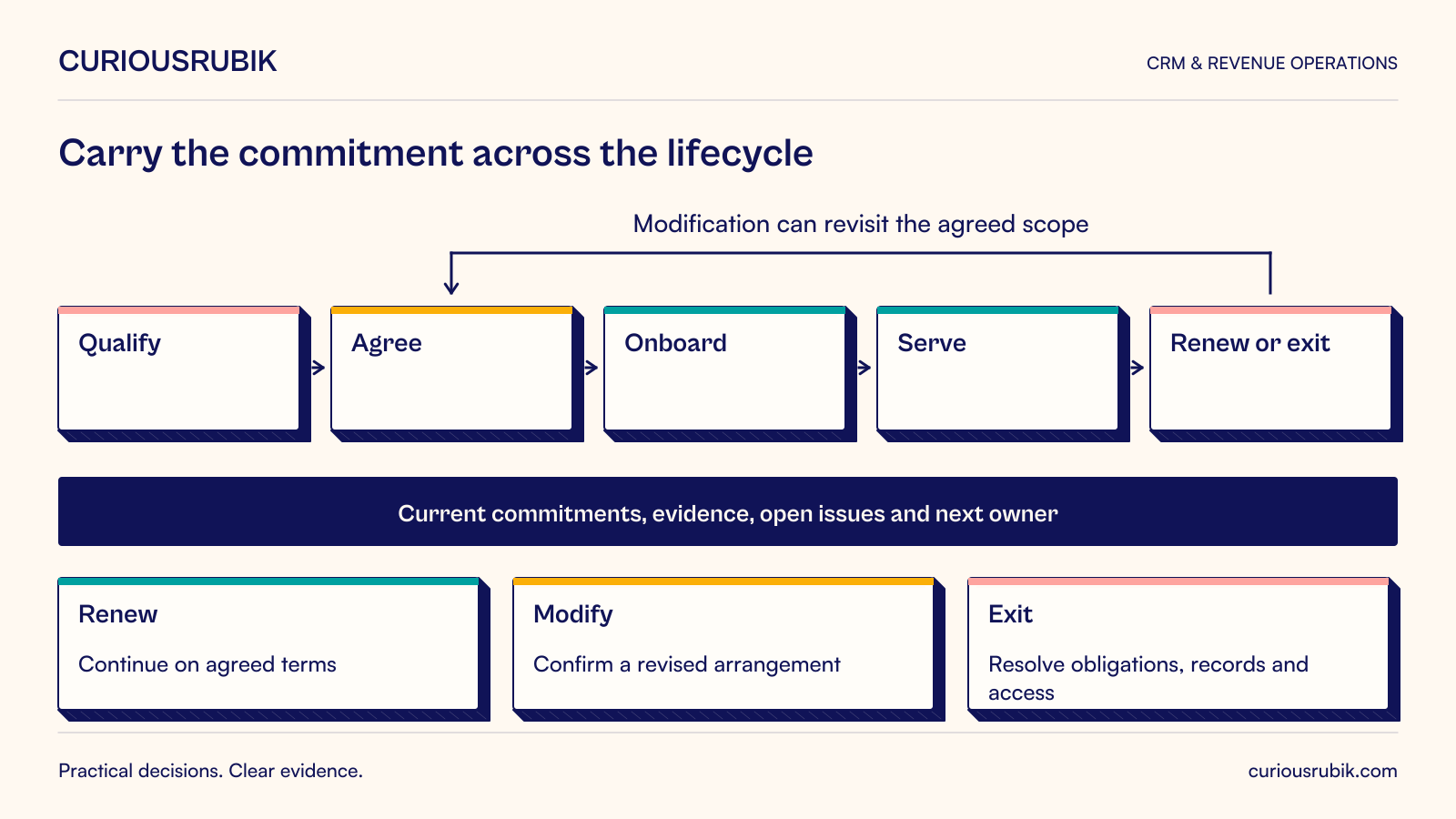
A customer can experience one relationship while the supplier manages six disconnected records: an inquiry, an opportunity, an order, an onboarding project, a support account and a renewal. The breaks become visible when the customer repeats a requirement, receives an irrelevant expansion message or discovers that the renewal team does not know what was difficult during delivery.
A connected revenue lifecycle preserves the customer’s commitments, context and decision history as responsibility changes. It should also make room for outcomes other than expansion: a pause, a smaller scope, a change of contact or an orderly exit. For a revenue leader and customer-success leader, the design task is to decide what must survive each transition and who is accountable for using it.
The goal is not to store every interaction in one giant record. It is to carry the right evidence to the next consequential decision, with appropriate access and a reliable correction path.
A lead expresses possible interest; an accepted contract creates a different kind of obligation. An onboarding plan translates that obligation into work. A service record shows what happened. A renewal discussion considers whether the arrangement should continue or change. These records are related, but they should not be collapsed into one status field.
Identify the commitments that must persist across them: agreed outcomes, scope, relevant customer responsibilities, commercial terms, acceptance conditions and promises made during resolution of an issue. Preserve their source and current version.
Also preserve uncertainty. A seller’s hypothesis about an expansion opportunity should not become a confirmed customer objective simply because it was copied into a success plan. A customer preference may change. A service concern may be unresolved. The receiving team needs those distinctions to act appropriately.
Keep the relationship model clear. The organization paying the invoice may differ from the site receiving service or the business unit evaluating renewal. Contacts can hold different roles and can leave. A connected lifecycle depends on these relationships being understandable without exposing unrelated information to every participant.
At lead qualification, preserve the stated need, source, permitted contact context and next useful question. At opportunity development, add evidence about the decision process and proposed solution. At contract acceptance, establish the authoritative scope and unresolved prerequisites. At onboarding, identify the first usable outcome and who must contribute to it.
During service, connect issues and changes to the affected commitments. At renewal, review the current arrangement, evidence of delivery, unresolved concerns and the customer’s present priorities. A renewal should not rely solely on the original sales story.
This continuity package is a working design aid rather than a universal data model. The exact contents should follow the offering and the next team’s decisions. A high-volume standardized service needs a different package from a multi-site engineering engagement.
For each transition, name the sender, receiving owner, acceptance condition and exception route. Some information can flow automatically. Important uncertainty or unusual commitments may require a conversation with a traceable outcome. Sending more data is not the same as transferring understanding.
Consider a hypothetical provider of business training subscriptions. The example is illustrative, with no claimed client outcome. A corporate buyer initially wants a course library for one department. During qualification, the buyer explains that managers need evidence of completion for a particular internal program.
The accepted arrangement includes the library access and an agreed reporting method. Onboarding should preserve that reporting commitment, the relevant user groups and the customer’s responsibility for supplying accurate enrollment information. If onboarding treats the account as a generic library subscription, it may activate access while missing the reason the customer bought it.
During service, the customer reorganizes. Several managers change, and the original program owner leaves. A connected lifecycle updates role relationships and confirms the new owner rather than continuing to send decision requests to the old contact. Access changes should follow the organization’s security process, separately from the commercial relationship record.
Near renewal, usage appears lower. The team should investigate what changed: perhaps the initial program ended, the new owner does not know how to obtain reports, or the offering no longer fits the customer’s priorities. A low activity measure alone cannot distinguish these explanations.
The renewal discussion may lead to a smaller subscription, a revised reporting process, another program or termination. The useful outcome is a decision based on current needs and evidence. Automatically treating every low-usage account as an upsell target would bypass the question the customer is actually facing.
A shared event can tell another team that something important changed: a contract amendment was approved, onboarding was accepted, a material service issue remains open or the renewal owner changed. The event should contain or reference the information needed for the receiving action.
Avoid broadcasting complete notes to every application. A billing team may need the approved amendment and effective date, while a service team needs the changed scope. Neither necessarily needs all negotiation commentary. Define access according to role and purpose, and apply the relevant privacy and retention requirements through the responsible specialists.
Account lifecycle is also a security concern. NIST SP 800-53 Revision 5 provides a configurable catalog of security and privacy controls, including access-control and account-management responsibilities. Its use does not make a private business automatically compliant with a particular law. The practical point is that customer or employee role changes should trigger a deliberate access review, rather than relying on a commercial-status update to remove permissions. NIST SP 800-53 Revision 5.
Maintain enough history to explain changes without keeping unnecessary information indefinitely. The operational design needs both continuity and disciplined limits.
Customer-success teams often hold information that sales and finance need, but the value depends on how it is interpreted. A support ticket count can reflect product difficulty, a newly engaged customer or a reporting change. A high usage figure can coexist with dissatisfaction. Do not turn every operational signal into a commercial conclusion automatically.
Define the question each signal helps answer. Completion of an agreed onboarding outcome may support a transition into ongoing service. Repeated unresolved issues may justify account-owner review before a renewal message. A request for a new use case may justify a discovery conversation, not an immediate assumption of additional budget.
Record evidence and interpretation separately. This allows a later owner to challenge the conclusion without losing the underlying facts. It also helps teams learn which signals are useful and which generate unnecessary work.
Create a feedback route to the offering itself. If the same promise repeatedly causes onboarding difficulty, the remedy may be changing qualification, scope or packaging. A connected lifecycle should improve future selling, not only rescue existing accounts.
Cross-functional continuity needs governance, but not one manager approving every interaction. Assign an accountable owner for the end-to-end design and keep domain decisions with the teams qualified to make them.
Sales owns qualification and commercial discovery within its authority. Delivery owns feasibility and execution. Finance owns financial definitions and accounting decisions. Customer success owns agreed adoption or relationship responsibilities. Security and privacy teams govern relevant access and information controls. The lifecycle owner resolves gaps between those responsibilities and maintains the shared measures.
Use an exception review focused on broken transitions and repeated ambiguity. Which accounts have no confirmed next owner? Which amendments have not reached delivery? Which renewals lack current customer context? Which exits have unresolved records or access tasks?
The review should produce specific changes to the process or record. If it only adds another meeting where teams report status, it has not created continuity.
Choose measures linked to the intended transitions: time to the first agreed usable outcome, handoffs reopened for missing information, amendments not reflected in operations and renewals requiring rediscovery of basic context. Pair these with customer feedback and business outcomes rather than treating them as complete measures of relationship quality.
Use comparable populations and clear definitions. New customers, established accounts and complex expansions may require different timelines. A blended average can conceal the cases that need attention or make a changing customer mix look like a process improvement.
Design exit with the same care as onboarding. Confirm the authorized end of service, outstanding obligations, appropriate record handling and access changes. The exact actions depend on the arrangement and applicable requirements. Do not confuse a lost opportunity with a terminated contract or an inactive contact with an account that should be deleted.
A connected revenue lifecycle earns its value when a new owner can understand the current commitment without asking the customer to retell the relationship. Start by following a few accounts across qualification, onboarding, service and renewal. Identify what was lost at each transition, decide what truly needs to persist and give that information an owner. The resulting continuity makes growth, renewal and responsible exit easier to manage with evidence.