A renewal reminder is only useful if somebody is able to decide. An email sent to a former employee, a calendar alert with no contract attached or a task assigned to finance because it pays the bill can all arrive on time and still produce an unwanted renewal.
The recurring commitment needs a current business owner, an evidence-based decision date and a realistic exit path. Record those elements when the agreement begins, then revisit them when people or operating needs change.
This is a practical control for a Singapore SME whose managers combine purchasing and administration. It applies to maintenance, hired equipment, outsourced services and other recurring agreements. The objective is a deliberate continue, reduce or exit decision, rather than treating every recurring charge as waste.
The renewal date is often the wrong date for the first reminder. An owner may need time to gather usage evidence, discuss pricing, test an alternative and obtain approval. The contract may require notice before any of those activities can be completed.
Consider a hypothetical maintenance agreement that renews on 1 January and requires notice by 1 November. Suppose the business also needs a month to assess replacement coverage. These are illustrative terms and planning assumptions, not a standard Singapore notice period. A reminder in December offers little practical choice.
Record the verified notice deadline first. Then choose an internal decision date early enough to evaluate the options and carry out the selected action. If notice wording, delivery method or the meaning of “received” matters, procurement or legal advisers should confirm the relevant requirement from the contract.
Avoid calculating every deadline from a field labelled “notice days” without reviewing the wording. A clause can refer to calendar months, a defined anniversary or a particular notice method. The register should point to the source and identify who checked the interpretation.
The business owner answers whether the service is still needed and whether the proposed level is appropriate. Procurement manages commercial terms and notice evidence. Finance confirms costs, charges and the approved financial treatment. A privacy or technical owner may need to assess an exit dependency.
In a small company, one person may hold several of these responsibilities. Still record which decision they made in which capacity. Otherwise an approval to pay the current invoice can be mistaken for approval to renew the whole agreement.
Name a successor when the original requester leaves or changes roles. A recurring agreement should not remain assigned to an inactive account until its next renewal alert. The cost-centre manager can accept temporary ownership while a permanent service owner is identified.
An owner is more than a mailbox. They need authority to make or recommend the value decision, access to the contract and enough knowledge to challenge the evidence. Where that combination is missing, assign the unresolved question to a named decision maker rather than widening the distribution list.
A useful renewal-decision register includes the supplier and agreement, scope, current owner, recurring amount, minimum commitment, notice requirement and next decision date. Add four short sections that support a real choice.
First, what business activity does the service support? A contract description can be too broad. Identify the team, assets or customer commitments that depend on it and the consequence of interruption.
Second, what evidence shows the current need? Usage may be one input, but it should reflect the service. Maintenance readiness cannot be assessed only by counting call-outs. A low-use service can still protect an essential capability. Conversely, a service used frequently may duplicate work already available elsewhere.
Third, what changes if the agreement is reduced or ended? Include switching work, replacement capability, equipment return, data handling and any charges that the terms make relevant. Record uncertainties rather than burying them in a general “risk” score.
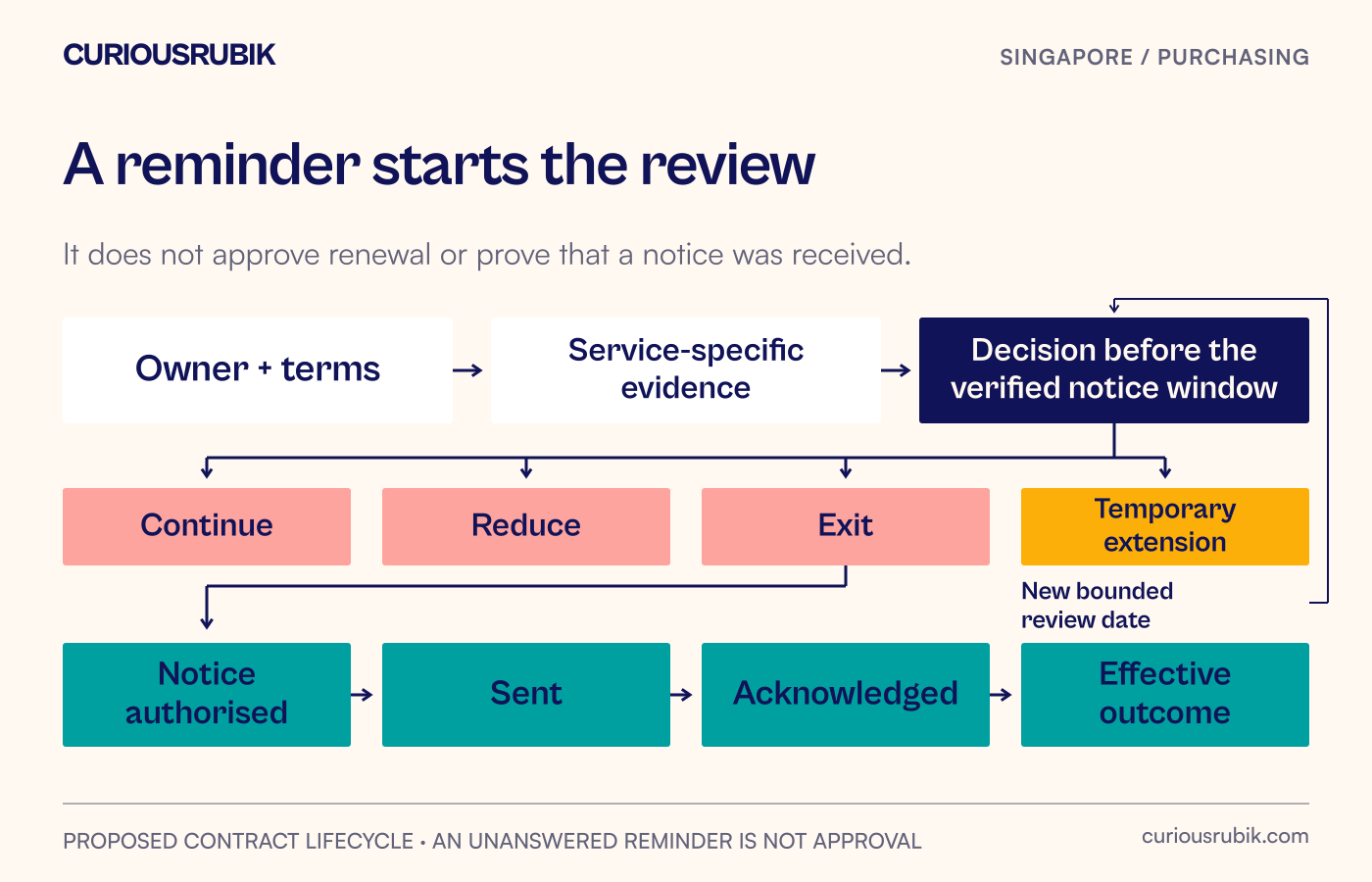
Fourth, which option is approved, by whom and on what evidence? Distinguish continuing the current scope, negotiating a change, exiting and temporarily extending while an unresolved dependency is addressed. A temporary extension needs its own reason and next decision point.
CURIOUSRUBIK SINGAPORE / PURCHASING A reminder starts the review It does not approve renewal or prove that a notice was received. Owner + terms Service-specific evidence Decision before the verified notice window Continue Reduce Exit Temporary extension New bounded review date Notice authorised Sent Acknowledged Effective outcome PROPOSED CONTRACT LIFECYCLE · AN UNANSWERED REMINDER IS NOT APPROVAL curiousrubik.com
Take the hypothetical maintenance agreement. The owner initially proposes cancellation because there were few service visits. The facilities lead then identifies equipment still dependent on specialist support. Procurement finds that the current agreement covers more units than remain in use.
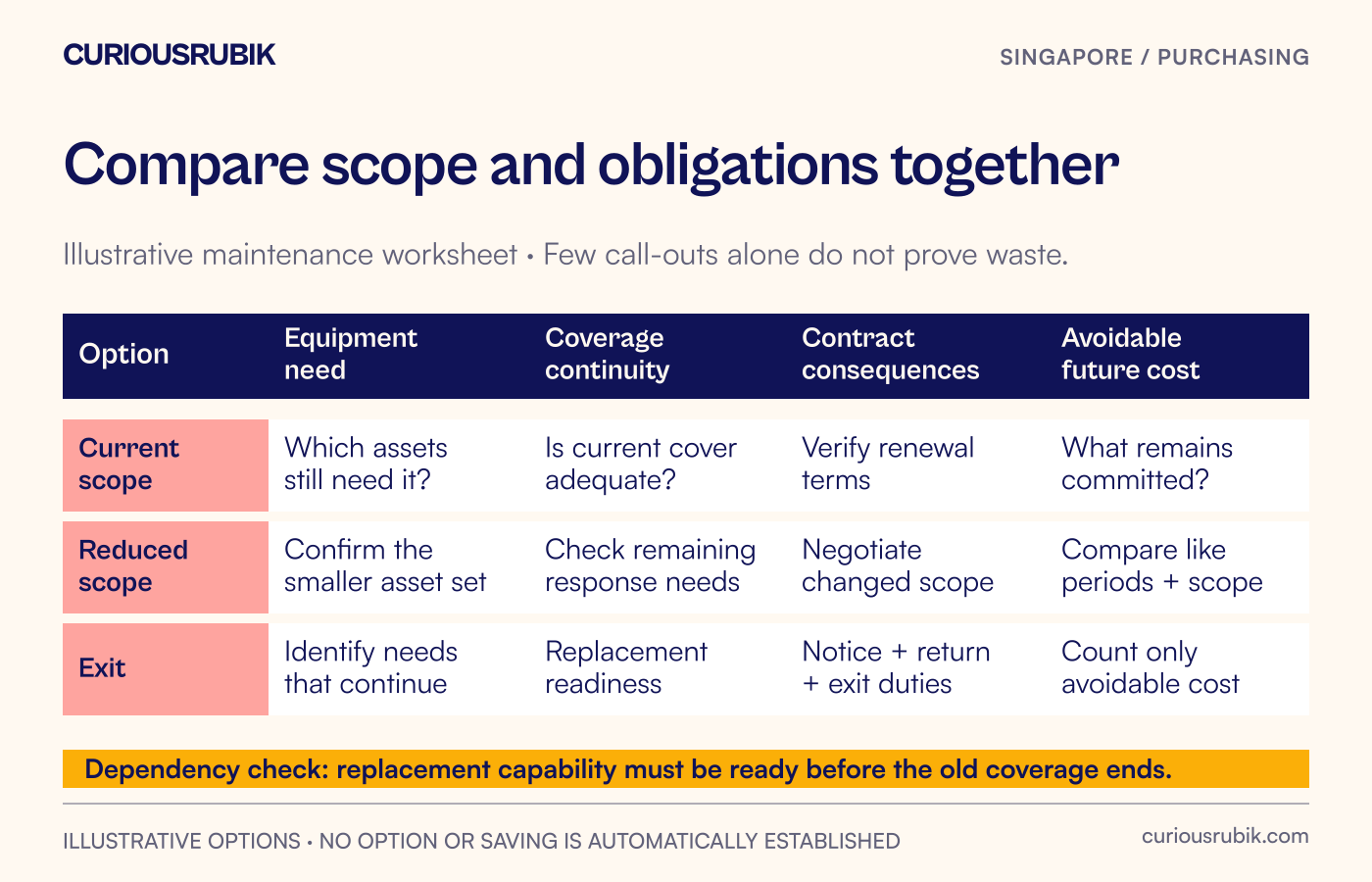
The useful option may be a reduced scope, subject to negotiation, rather than either unchanged renewal or immediate exit. The worksheet should show which assets remain, the proposed coverage, the required response arrangements and the evidence behind the recommendation.
When comparing cost, use the same period and scope. An annual price cannot be compared directly with a monthly quote without considering the commitment. A lower fee may exclude work included in the existing agreement. A proposed exit may involve a period of overlapping services.
Separate cash that can actually be avoided from amounts already committed. Do not call the full current annual fee a saving just because a cancellation request has been sent. Confirm the effective outcome and any remaining charges before reporting a financial result.
CURIOUSRUBIK SINGAPORE / PURCHASING Compare scope and obligations together Illustrative maintenance worksheet · Few call-outs alone do not prove waste. Option Equipment need Coverage continuity Contract consequences Avoidable future cost Current scope Which assets still need it? Is current cover adequate? Verify renewal terms What remains committed? Reduced scope Confirm the smaller asset set Check remaining response needs Negotiate changed scope Compare like periods + scope Exit Identify needs that continue Replacement readiness Notice + return + exit duties Count only avoidable cost Dependency check: replacement capability must be ready before the old coverage ends. ILLUSTRATIVE OPTIONS · NO OPTION OR SAVING IS AUTOMATICALLY ESTABLISHED curiousrubik.com
Some recurring suppliers hold operational records, personal data or equipment. Ending the payment does not establish that information has been returned, access has ended or retained data has been handled appropriately.
PDPC's guidance on managing data intermediaries includes exit management as part of the supplier lifecycle. Where a provider processes personal data, involve the organisation's responsible privacy owner in the exit plan. They should assess the relevant obligations, contractual arrangements and evidence needed; the renewal register is not a substitute for that assessment.
Similarly, a replacement service may need to be working before the old arrangement ends. The business owner should identify the minimum readiness evidence for a transition. Enterprise Singapore's continuity guidance supports planning contingency arrangements and testing them. Apply that principle to the actual service dependency rather than assuming a signed replacement contract means the transition is complete.
Keep tax questions separate. If the renewed agreement adds overseas services or changes the rights purchased, route the changed facts for appropriate review. A commercial renewal decision does not establish the tax treatment.
Automation can flag agreements with no active owner, remind the owner before the internal decision date and assemble recent charges or usage records. It can highlight changes between the expiring and proposed terms for review.
The workflow should also track notice preparation, authorised sending, acknowledgement and effective outcome as separate events. Marking “exit” on a worksheet should not automatically terminate a supplier relationship. Nor should an unanswered reminder count as approval to continue.
For overdue decisions, escalate with a short explanation of what choice remains. If the notice window has already passed, the owner needs the verified contractual position and available options. Repeating an alert labelled “urgent cancellation” may encourage an unsupported promise to the supplier.
Preserve previous decisions and the facts on which they relied. That history helps a new owner distinguish a forgotten contract from an agreement deliberately retained because exit would disrupt a critical activity.
Pilot the register with agreements whose decision windows are approaching. Check how many have a current owner, a verified notice requirement and evidence appropriate to the service. Track missed windows and cases where a reminder arrived but nobody could decide.
Also review the quality of completed decisions. Was a reduction implemented at the agreed scope? Did an exit leave unreturned equipment or unresolved data handling? Did an unchanged renewal have a documented reason? These questions prevent the process from rewarding cancellation alone.
Start with one recurring charge requested by someone who has left. Find the agreement, identify the current business need and name the person who can decide its future. A useful renewal process begins when responsibility becomes explicit, well before the next invoice appears.