AI can change sales operations by making complex customer requirements easier to organize and answer. In request-for-proposal work, it may help identify obligations, locate approved evidence, and prepare a coherent response. The commercial value depends on whether the response accurately represents what the business can deliver, including the requirements it cannot yet satisfy.
For a proposal operations leader, the key decision is how to use AI to improve requirement coverage without creating unsupported commitments. A fluent answer to every question can be worse than an incomplete draft if it quietly turns a response target into a resolution guarantee or presents a planned capability as available.
The recommended approach is a requirement-by-requirement evidence and resolution workflow. Keep the customer’s wording, the proposed answer, supporting sources, gaps, and accountable owner connected. This article uses a hypothetical business-support provider to explain that design. It concerns proposal preparation and commercial review, not legal interpretation of a particular tender or contract.
A long RFP question may contain several distinct requirements. It might ask for continuous service coverage, a two-hour response, named escalation contacts, and reporting by location. A single yes/no answer can hide partial compliance with that bundle.
Assign stable identifiers to the requirement units while preserving their relationship to the original question. Record the source document, section, wording, and any relevant amendment. The purpose is to make omissions visible and allow reviewers to trace an answer back to what the customer actually requested.
Separate requirements from preferences and background information where the source permits that distinction. If the customer has not made the status clear, retain the ambiguity and raise a clarification through the authorized process. The model should not invent a mandatory classification simply because the language sounds strong.
Identify dependencies between questions. An answer about service coverage may change the meaning of a response-time statement elsewhere. Treating each question as an independent text-generation task can produce a proposal whose individual answers look plausible but contradict one another.
For each requirement, locate approved sources that actually support an answer. Relevant material may include the current service description, authorized commercial terms, product documentation, staffing arrangements, and previously approved exceptions that remain applicable. A past proposal is not automatically authoritative for a new customer.
Record the scope of the evidence. A capability available in one region, product tier, or service window should not become an unqualified enterprise-wide statement. The answer needs to preserve those conditions unless an authorized owner approves a broader commitment.
Use explicit coverage states. A requirement can be supported, partially supported, unsupported, conflicting, or awaiting clarification. These are working review categories rather than a validated standard. They help the team direct attention toward unresolved substance before polishing prose.
Keep absence of evidence distinct from evidence of absence. If the repository lacks a current statement about weekend support, the team may need to ask the service owner. It should neither assert that coverage exists nor conclude definitively that it does not without the appropriate evidence.
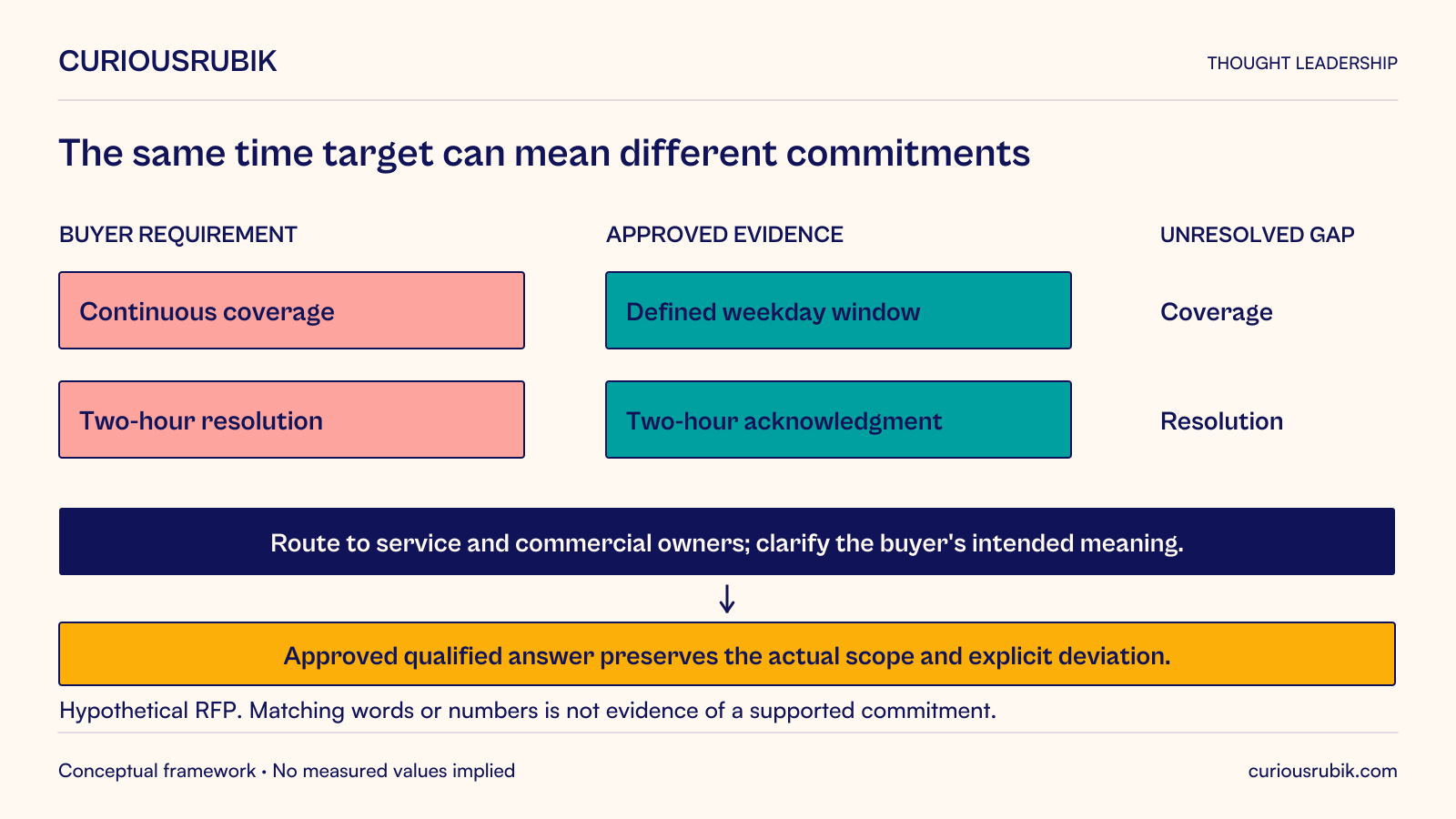
Imagine a hypothetical provider responding to an enterprise request for business-application support. The RFP asks for round-the-clock coverage and “resolution within two hours” for a specified incident category. The provider’s approved service description offers two-hour acknowledgment during a defined weekday service window.
A weak drafting assistant finds the phrase “two hours” and produces a confident statement that the provider meets the requirement. The numerical match conceals two important differences: acknowledgment is not resolution, and a weekday window is not continuous coverage.
The proposed evidence workflow splits the request into separate obligations. The two-hour resolution requirement is marked unsupported by the current acknowledgment statement. The continuous-coverage requirement is marked as a gap against the approved weekday scope. Both remain visible rather than being merged into an apparently compliant answer.
The proposal owner then routes the questions. The service leader determines whether a broader coverage arrangement is feasible. The commercial owner assesses the proposed exception and its consequences. Qualified contract reviewers handle any legal interpretation required by the actual procurement process. AI can prepare the issue summary, but it cannot establish that the business has accepted the obligation.
The buyer may also need to clarify what “resolution” means for incidents dependent on third-party systems. The team prepares a precise clarification identifying the ambiguous requirement and the operational distinction. Any communication follows the organization’s authorized proposal process; a draft question is not permission to send it.
Suppose the approved response ultimately offers two-hour acknowledgment within the stated coverage window and explicitly identifies the deviation from the requested term. The final proposal should preserve that qualification wherever the commitment appears, including summaries and pricing assumptions. A persuasive executive summary must not silently restore the broader promise that detailed review rejected.
The hypothetical outcome is an accurate, accountable response with a visible exception. It does not claim that the provider wins the bid or that AI reduces proposal effort by a particular amount. The benefit is a workflow that makes a consequential mismatch easier to find and resolve before submission.
Retrieval can help locate potentially relevant material, but relevance is only the start of verification. A document containing the same product name or time target may describe a different service, customer, or effective period. Review whether the source entails the proposed claim under the actual conditions.
Require the draft to distinguish supported statements from unresolved questions. A source citation should point to the specific evidence, with the applicable version and scope. Attaching a credible document title to an unsupported interpretation does not make the answer reliable.
NIST’s explainable-AI principles distinguish meaningful explanation from explanation accuracy and knowledge limits. Applied to proposal work, a readable rationale must still faithfully represent what the cited evidence establishes and where it stops. NISTIR 8312, Section 2
Test contradiction handling deliberately. Include old and new service descriptions, conditional statements, draft policies, and prior customer-specific concessions. The application should surface the conflict or use the approved authority rule, rather than average incompatible statements into a new promise.
An unresolved requirement should identify the decision needed, the evidence missing, the owner, and the deadline within the bid process. “Needs review” is insufficient when different functions must determine feasibility, pricing, delivery, or contract implications.
Keep technical capability and commercial willingness separate. A service may be feasible but not included in the offered price or operating model. Conversely, a sales team may want to promise something that the delivery organization cannot support. The proposal workflow needs an explicit resolution of that disagreement.
Use approved exceptions with their scope intact. Record the affected requirement, accepted wording, assumptions, and authorizing role. An exception approved for one customer, location, or term should not automatically become a reusable standard answer for future proposals.
Escalate unresolved dependencies before the final response is assembled. If staffing approval is still pending, the coverage statement and associated price assumption may both remain provisional. A final-document deadline should not convert provisional content into an approved commitment by default.
After drafting, compare the requirement map with the proposal sections, commercial schedules, summaries, and attachments. Verify that every material requirement has a disposition and that qualifications appear wherever needed. This is a coverage and consistency check, not merely a grammar review.
Track amendments from the buyer. A revised service window or definition may invalidate earlier evidence matching and approvals. Identify affected answers and reopen their review rather than regenerating the whole proposal without a clear change record.
Control versions of both source evidence and submitted content. The team should be able to establish which approved response was sent and which requirements it addressed. Keep the final submission accountable to a named proposal owner under the organization’s review process.
Protect confidential information in reusable libraries. A past customer’s pricing, architecture, or negotiated terms should not be exposed in a new proposal simply because they are useful examples. Retrieval and drafting must respect access and permitted reuse, with appropriate review of external processing.
Measure uncovered requirements, unsupported claims, inconsistent qualifications, correction effort, and late commercial escalations. Establish definitions and inspect representative cases. A high percentage of filled answer cells may indicate only that the assistant produces text readily.
Time the full process from intake through accepted response, including evidence review, clarification, approvals, and revision. Faster initial drafting can be offset by searching for invented claims or correcting scope throughout the document. Compare with a well-organized non-AI response library and workflow.
Review customer-facing usefulness. Did the response answer the actual question? Were deviations clear enough for the buyer to evaluate? Did clarifications resolve ambiguity rather than merely delay the bid? Those outcomes connect sales efficiency with credible customer engagement.
Begin with one proposal section containing several interdependent requirements. Build the evidence map, seed a meaningful contradiction, and test whether the workflow preserves the gap through final review. Expand AI assistance when it helps the team deliver accurate, complete, and accountable answers. In complex sales, the most valuable response is the one the business can stand behind after the deal is won.