Technology investment aligns with business strategy when it strengthens a capability required by a deliberate competitive choice. The connection should explain how the organization will work differently and what tradeoff it accepts. Attaching strategic language to a preferred platform does not establish that relationship.
For a manufacturer shifting toward engineered short-run products, the decision is whether its technology portfolio supports that service promise or continues optimizing the previous high-volume model. A technically impressive investment can improve a local measure while making the chosen strategy harder to deliver.
The practical approach is to test each proposal against a specific strategic choice, the capability gap it addresses, and the operating change required to realize value. This article uses a hypothetical industrial-fastener manufacturer to show how two reasonable investments can serve different business models. It does not recommend a particular product or assume that one competitive strategy is universally better.
A strategy should identify whom the business serves, the problem it solves particularly well, and what it will prioritize when objectives conflict. “Grow through digital innovation” is too broad to evaluate an investment. Reliable short-run customization and lowest-cost standard volume imply different capability needs.
Describe the customer promise in operational terms. For engineered short runs, the business may need to establish requirements, assess feasibility, prepare a dependable quotation, and manage changes without excessive delay. The actual targets should come from the company’s market and economics.
State what the business will not optimize at all costs. A strategy emphasizing responsiveness may accept some additional setup effort. That does not make cost irrelevant; it means cost is assessed within a chosen service model rather than treated as the only objective.
If leaders disagree about those tradeoffs, resolve the strategic choice before ranking technology. A portfolio review cannot create coherence by giving every proposal a high score for growth, efficiency, and customer experience simultaneously.
Examine recent opportunities or service failures that matter to the chosen market. Where does the organization lose time, confidence, or value? The constraint may be engineering knowledge, commercial coordination, production flexibility, or reliable information about prior designs.
Distinguish a capability gap from a product request. “We need a new configurator” is a proposed solution. “We cannot establish which prior design is applicable before quoting a modified part” describes a problem that several interventions might address.
Map the required people, process, information, and technology. A knowledge tool may help only if engineering owns the applicability rules and maintains approved records. A scheduling tool may help only if the company has agreed how to balance setup efficiency against promised response.
Choose the level of evidence appropriate to the decision. A small exploratory investment can test the constraint and solution options. A large commitment needs a more credible account of the operating change, dependencies, and expected value.
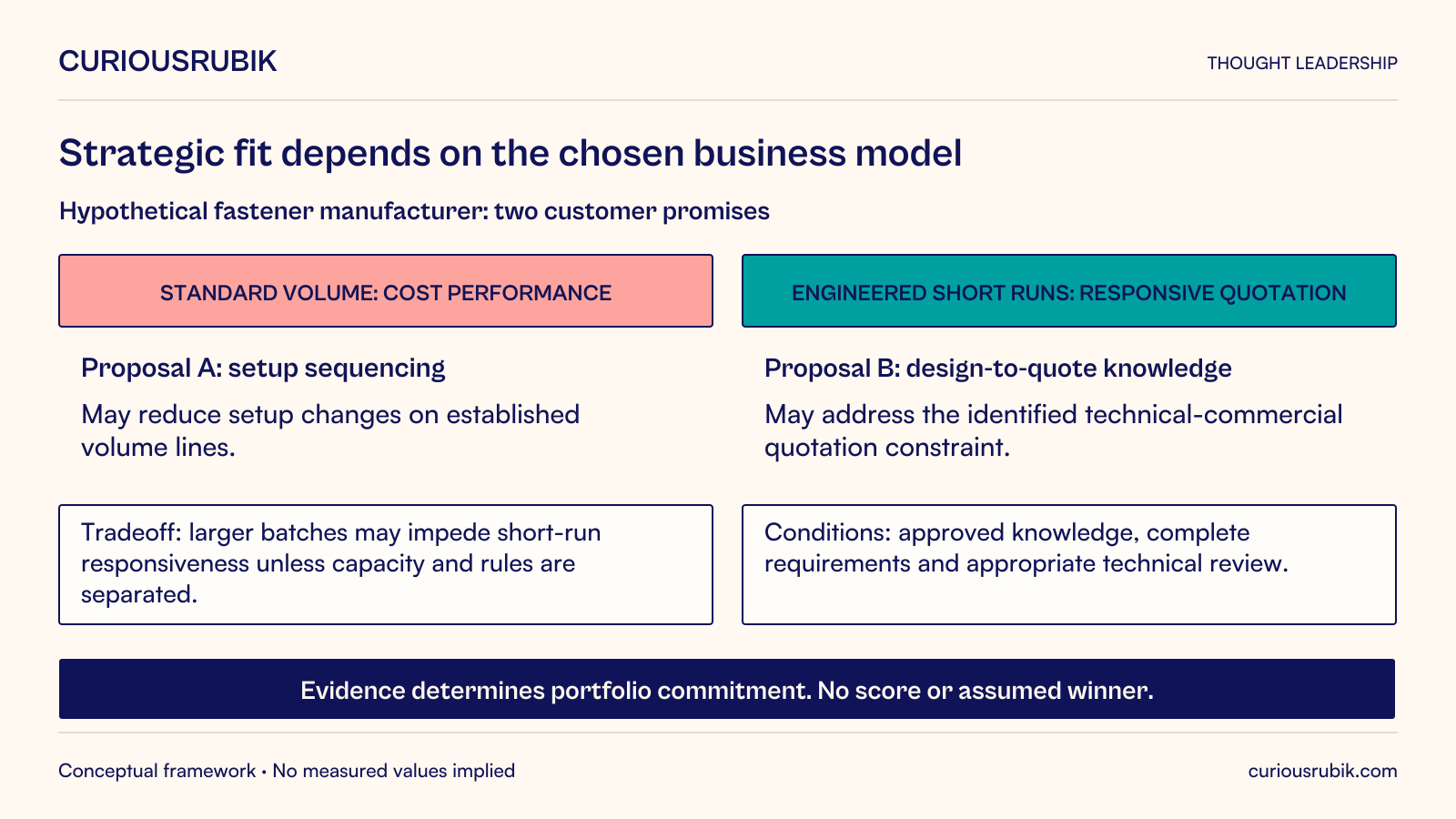
Imagine a hypothetical manufacturer that historically competes on standard high-volume fasteners but now wants to grow engineered short-run work. Customers value a dependable answer about feasibility and delivery before placing an order. The business has identified slow technical-commercial quotation as a constraint.
Two proposals compete for funding. Proposal A improves production sequencing to reduce setup changes on established volume lines. Proposal B makes approved design knowledge easier to find and connects engineering review with quotation preparation. Both can be legitimate investments, but they contribute differently to the stated growth strategy.
Proposal A may improve cost performance in the existing business. If its scheduling policy aggressively groups work into larger batches, it could also make short-run responsiveness harder unless the relevant capacity and rules are separated. The proposal should disclose that interaction rather than claim universal alignment through efficiency.
Proposal B addresses the identified quotation constraint, but its value depends on more than search software. Engineers must distinguish approved reusable knowledge from historical examples, commercial teams must supply complete requirements, and the business must retain appropriate technical review. Faster retrieval alone does not establish a valid design or delivery commitment.
The executive team may fund B for the growth capability while retaining a bounded version of A for stable volume operations. Alternatively, evidence may show that production flexibility is the actual bottleneck and that knowledge retrieval is only a visible irritation. The strategy defines the question; investigation determines the investment.
The decision record should explain which customer promise each proposal serves, which operating measures may trade off, and what evidence would justify further funding. The example does not claim a return from either proposal. It shows why a feature comparison or a generic efficiency score cannot settle strategic fit.
Connect the strategic choice to a capability gap, proposed intervention, changed behavior, and expected outcome. For Proposal B, the hypothesis is that reliable access to approved design knowledge will reduce avoidable engineering rediscovery and improve quotation readiness for eligible short-run requests.
Identify the evidence that could disprove the hypothesis. If most quotation delay comes from missing customer requirements or unavailable engineering capacity, a search improvement alone may have little effect. Testing that possibility protects the business from funding the most visible tool rather than the relevant change.
Name the benefit owner and the actions they must take. Retiring duplicate reference stores, maintaining applicability rules, or changing quotation handoffs may be essential. If those actions are unfunded or outside the owner’s authority, the proposal is incomplete.
Define a bounded first commitment. A pilot on one product family can establish whether the capability works before extending it across the entire catalog. The purpose is to test a material uncertainty, not to avoid making a decision indefinitely.
Consider process, staffing, information, and commercial alternatives alongside software. A standardized requirement brief or a dedicated technical-commercial review window may address part of the constraint at lower cost. Technology can then support the remaining need.
Include the option to improve or reuse an existing capability. A new system may be justified, but novelty is not evidence of strategic contribution. Assess integration, maintenance, migration, and the effort required from the people expected to use it.
GAO’s IT investment-management guidance connects investment selection, control, evaluation, and portfolio management. Its public-sector framework offers a useful discipline for comparing contributions and dependencies, without providing a universal private-sector scoring formula. GAO-04-394G, IT Investment Management, 2004
Make uncertainty visible in the comparison. Use ranges or scenarios where evidence is weak, and show the assumptions that change the preferred option. Precise-looking benefit scores can conceal unresolved judgment about the strategy itself.
Some investments maintain essential service, address a verified risk, or replace unsupported technology. They may deserve funding even when they do not directly differentiate the business. Explain their purpose honestly rather than attaching speculative revenue benefits.
Distinguish mandatory constraints from discretionary opportunities. The organization should obtain the appropriate specialist assessment of any legal, security, or contractual requirement. A broad label such as compliance should not exempt a proposal from explaining scope, alternatives, and cost.
A necessary foundation can support several strategic outcomes, but avoid counting the same benefit repeatedly across projects. Show the dependency and allocate benefit ownership clearly. An enabling platform does not independently generate every downstream improvement it helps make possible.
Keep resilience and operating continuity in the portfolio discussion. A strategy depends on a functioning business while new capabilities are developed. Deferring all maintenance to fund visible innovation can undermine both the current operation and the intended transformation.
Strategic fit is not a permanent label. Customer demand, competitive conditions, acquisitions, and operating evidence can change the case for an investment. Reassess future commitments when material assumptions move.
Separate past expenditure from the next decision. Money already spent explains the current position but does not prove that further funding is justified. Ask what value remains achievable, what additional cost is required, and what alternative use of scarce capacity is available.
Use operational results to test the contribution. For the fastener example, examine quotation readiness and accepted customer commitments for comparable short-run work, alongside cost and quality. A rise in tool usage does not establish that the strategic constraint has been relieved.
Retain a clear record of why priorities changed. Teams need to understand whether the strategy changed, the evidence contradicted an assumption, or another dependency became more urgent. That clarity supports disciplined adaptation rather than arbitrary reprioritization.
Before approving a major proposal, ask its owner to explain the customer promise it supports, the current limiting capability, the work that must change, and the tradeoff it creates. Ask what evidence would cause the business to choose another approach.
The executive team should be able to compare proposals using those answers without relying on product language. Where the strategic connection is weak, narrow the investigation or defer the commitment. Where the connection is strong, fund the operating changes as well as the software.
Technology alignment becomes practical when the business can explain why this capability matters for this strategy now. Begin with one contested investment and trace that connection all the way to an observable operating outcome. A coherent portfolio will contain different kinds of work, but each should have a clear reason to exist and a deliberate relationship to the business the organization is trying to build.