Sales teams are more likely to support a CRM strategy when they can see how it improves the work of selling and how management will change its own behavior in return. A promise of better visibility is insufficient if visibility mainly benefits headquarters while sellers inherit more fields, alerts, and reporting obligations.
The strategy should establish a practical operating agreement: which selling decisions the CRM will support, what evidence salespeople will maintain, what help other teams will provide, and which duplicate demands leadership will remove.
This is different from an adoption campaign after implementation. It shapes the scope, data model, management cadence, and investment priorities before configuration becomes difficult to change. For a sales leader, the important first decision is what kind of selling organization the CRM should enable, not which feature list the organization should purchase.
Start with decisions that affect seller effectiveness: which account to prioritize, what to prepare before a meeting, when an opportunity is ready for specialist help, and what evidence justifies a forecast commitment.
Different sales motions need different support. A high-volume inbound team may need reliable routing and fast qualification. An enterprise account team may need stakeholder relationships, commercial assumptions, and long-running commitments. A channel team may need clear ownership between partners and direct sales.
Avoid importing one team’s process into another without testing the underlying economics. A mandatory next meeting date can be sensible for an active opportunity and meaningless for a long-cycle account-development relationship. A universal stage model may hide differences rather than create comparability.
Write a short decision brief for each priority: the role making the decision, when it occurs, what information is required, what action follows, and how improvement will be recognized. Rank these briefs before discussing modules. A strategy with twenty equal priorities leaves the implementation team to make the real tradeoffs.
Salespeople should know what information the organization expects and why. The minimum useful record is the smallest reliable set of facts that supports the agreed decisions and downstream commitments.
For an active opportunity, it may include the customer objective, current evidence, next action, responsible owner, key commercial assumptions, and relevant dates. Exact fields should reflect the sales motion rather than a generic template.
Separate facts, estimates, and judgments. A customer-confirmed procurement date differs from a seller’s expected close date. An estimated value differs from an approved commercial offer. Keeping these distinctions visible improves the conversation about uncertainty and reduces pressure to enter confident-looking answers prematurely.
Every field needs a consumer. Ask the manager or downstream team that requested it to explain the decision it supports. If there is no current use, remove it or defer collection. A possible future analysis does not justify unlimited present-day effort.
The operating agreement should bind managers as well as sellers. Leaders should use the agreed record in reviews, avoid requesting parallel updates without a clear reason, and respond to the issues the system surfaces.
If sellers record that a specialist estimate is overdue, someone must own the response. If a manager asks for early risk disclosure, that disclosure should lead to useful discussion rather than automatic blame. A CRM can expose an issue; leadership determines whether reporting it is worthwhile.
Create a clear policy for overrides. Managers sometimes have information that does not fit the standard process. Let them record an exception and its rationale instead of encouraging unofficial workarounds. Preserve the original evidence when a forecast or priority is adjusted so later review can distinguish seller input from management judgment.
The UK Service Standard combines performance measures with user research. Applied to CRM strategy, this supports evaluating both the operational result and the experience of the people expected to maintain it. It does not establish a specific sales-management method. GOV.UK, Define what success looks like.
A useful working heuristic is to express each CRM requirement as a reciprocal commitment. The salesperson supplies a defined piece of evidence; the organization returns a useful service or decision; both have an owner and a reasonable timing expectation. This is a proposed design method, not a published standard.
For example, sales records the customer’s technical question and relevant context. A specialist team accepts the request, asks for missing information, or explains why it cannot help. The CRM makes the status visible so the seller does not have to chase through private messages.
For forecasting, sellers maintain agreed evidence and uncertainty. Managers use that evidence consistently and distinguish pipeline discussion from performance evaluation. Finance receives a defined view rather than requesting a separate spreadsheet with slightly different categories.
Not every requirement offers a direct personal return. Some records are needed for legitimate control or contractual reasons. State that honestly and minimize the burden. Reciprocity means an equitable and workable operating arrangement, not a promise that every field will delight its author.
Consider a hypothetical manufacturer of industrial sensors that sells through distributors while maintaining a direct team for strategic accounts. The CRM records one owner per account. That looks tidy in a report but creates conflict when a distributor introduces a project at an organization already assigned to a direct salesperson.
Partners hesitate to register opportunities because they fear losing the work. Direct sellers keep separate notes because the account hierarchy does not distinguish an existing corporate relationship from a partner-originated project at a particular site. Leadership proposes better CRM compliance, but the underlying strategy has not settled whose contribution receives protection.
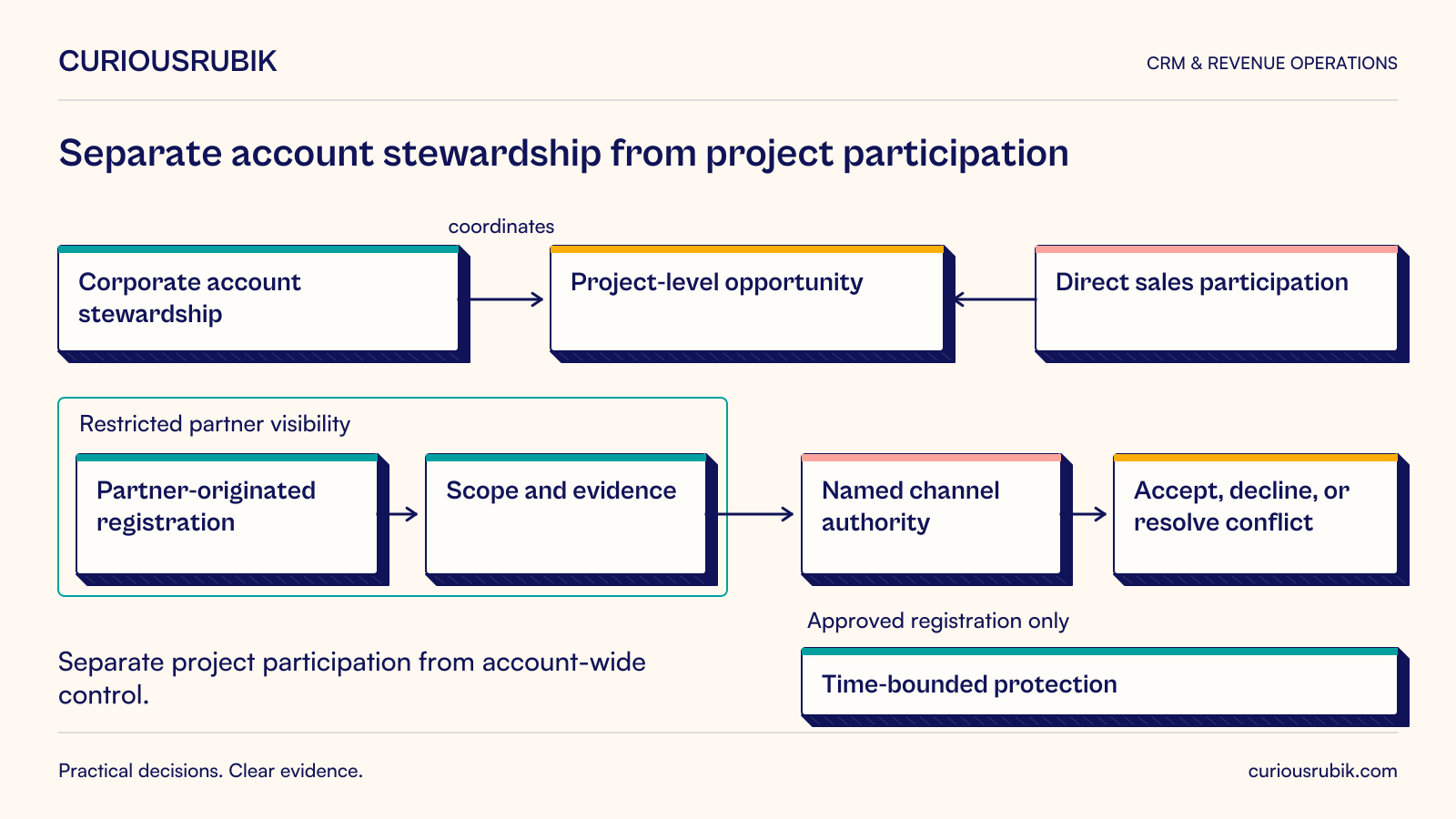
The redesigned strategy separates account stewardship from opportunity participation. A corporate account owner coordinates the broader relationship; a registered project has its own scope, origin, participating parties, and time-bounded protection under an approved channel policy. Registration does not confer unrestricted ownership of every future opportunity at that customer.
The reciprocal agreement is specific. Partners provide enough information to establish a genuine project and keep material progress current. Direct sellers disclose relevant overlapping activity. Management commits to resolving conflicts through a named channel authority using published criteria, rather than quietly awarding each contested deal to whichever team has more influence.
The company must choose a tradeoff. Broad protection may encourage partner investment but can obstruct legitimate direct work. Narrow protection may preserve flexibility while making registration unattractive. The CRM cannot choose that balance; commercial leadership must define it, test it with representative cases, and align incentives and agreements accordingly.
The first release covers one product line and a defined partner group. It records project-level participation, restricted partner visibility, registration decisions, and expiry or extension reasons. Partners see only information they are authorized to receive. The design does not expose another partner’s pricing or the direct team’s unrelated opportunities.
The pilot tests two partners claiming the same project, a direct opportunity that predates registration, an acquisition that changes the customer hierarchy, and a genuine project delayed beyond the protection period. It measures unresolved ownership conflicts, time to a reasoned decision, duplicate pursuit, and whether qualified partners are willing to register useful opportunities. Registration volume alone could reward speculative claims.
Leadership also changes performance reviews so approved shared participation is recognized rather than treated as an exception to a single-owner dashboard. Any compensation or contractual changes require the organization’s proper approval process. This hypothetical example illustrates a strategic choice about selling through an ecosystem; it does not claim an observed improvement in partner revenue.
The roadmap should explain what must be learned before the next investment. Begin with a bounded process, prove that the information is useful, verify that ownership works, and then extend the approach to adjacent decisions.
A gate can lead to expansion, redesign, or a smaller scope. Avoid treating it as a ceremonial approval once a calendar date arrives. If the pilot reveals an unresolved conflict in channel policy, further rollout may need to wait until commercial leadership settles it.
Select pilot participants to expose variation. A team of enthusiastic experts may identify possibilities but conceal training and usability problems. Include representative workloads and users who are willing to explain why the current process is difficult.
GOV.UK guidance on understanding user needs emphasizes direct research and testing assumptions. In a sales setting, this supports observing actual selling work and involving the roles affected by a proposed change. It does not mean allowing every user preference to become a requirement. GOV.UK, Understand users and their needs.
Incentives shape what enters the CRM. If managers reward apparent pipeline growth, staff may create weak opportunities. If forecast misses are punished regardless of evidence, uncertainty may be hidden until late. If activity volume becomes the target, records can grow while customer progress stalls.
Review how metrics are used before adding new ones. Separate coaching indicators from formal performance measures where appropriate, and explain the distinction. Use evidence-based stage criteria rather than relying entirely on a seller-selected probability.
Do not solve every data problem through compensation. Some issues arise from poor definitions, unusable workflows, or information the seller cannot reasonably know. A financial penalty can make those issues less visible without making the data better.
Managers should review a sample of records for decision usefulness. Can they explain why an opportunity is where it is and what would change the next action? This is a more meaningful quality test than whether every optional field contains text.
A vendor demonstration should use the company’s important selling scenarios, including incomplete information, a reassigned account, and a cross-team dependency. Ask the vendor to show how the system handles uncertainty and exceptions, not only how quickly a polished opportunity can be created.
Evaluate administrative burden and ongoing ownership. Who can alter a stage definition? How will changes affect historical reporting? Can the organization retire fields and workflows without breaking integrations? How are permissions managed when territories or partner relationships change?
Assess the partner’s ability to challenge requirements. A supplier who configures every requested field without asking who uses it may satisfy a specification while weakening the strategy. The buyer should remain accountable for priorities rather than outsourcing them to product demonstrations.
Assign a business product owner with authority to maintain the CRM’s purpose and a forum for resolving competing requests. Review new fields, automations, and reports against the priority selling decisions. Otherwise, a focused first release can gradually become an accumulation of departmental demands.
Track which duplicate processes were actually retired and which promised services are being delivered. If the organization asks sellers for better records but does not honor its own commitments, adoption work will become progressively harder.
A CRM strategy that sales teams embrace is clear about the work it will improve and the effort it will require. It creates a credible exchange, tests that exchange in real selling conditions, and gives leadership responsibilities beyond purchasing the software. That is a more durable basis for support than enthusiasm generated at a launch meeting.