People are more likely to follow data governance when the approved route helps them obtain a reliable decision, resolve a conflict, or make a change without unnecessary delay. A policy library and a committee calendar do not provide that route by themselves. Governance needs clear authority, usable workflows, proportionate evidence, and a way to see whether the decision was implemented.
For a data leader rebuilding a stalled governance program, the immediate decision is which requests can be handled by accountable domain owners, which require cross-domain resolution, and which need specialist review. Sending everything to one council creates a queue; delegating everything without boundaries creates inconsistent decisions.
Begin with the requests people already make: a new field, a changed metric definition, access to a dataset, a quality exception, or a change to a shared classification. Design the governance service around those recurring interactions before expanding the policy catalogue.
List the decisions that cannot safely remain informal. Examples include changing a shared definition, accepting a consequential quality limitation, resolving competing source authority, or granting access under the organization’s established policies. These are different decision classes and should not share one generic approval form.
For each class, name the accountable decision-maker, the evidence required, the people who must be consulted, and the route for disagreement. Consultation should not automatically mean veto power. Equally, a data owner should not override a specialist responsibility that belongs to security, privacy, legal, or another authorized function.
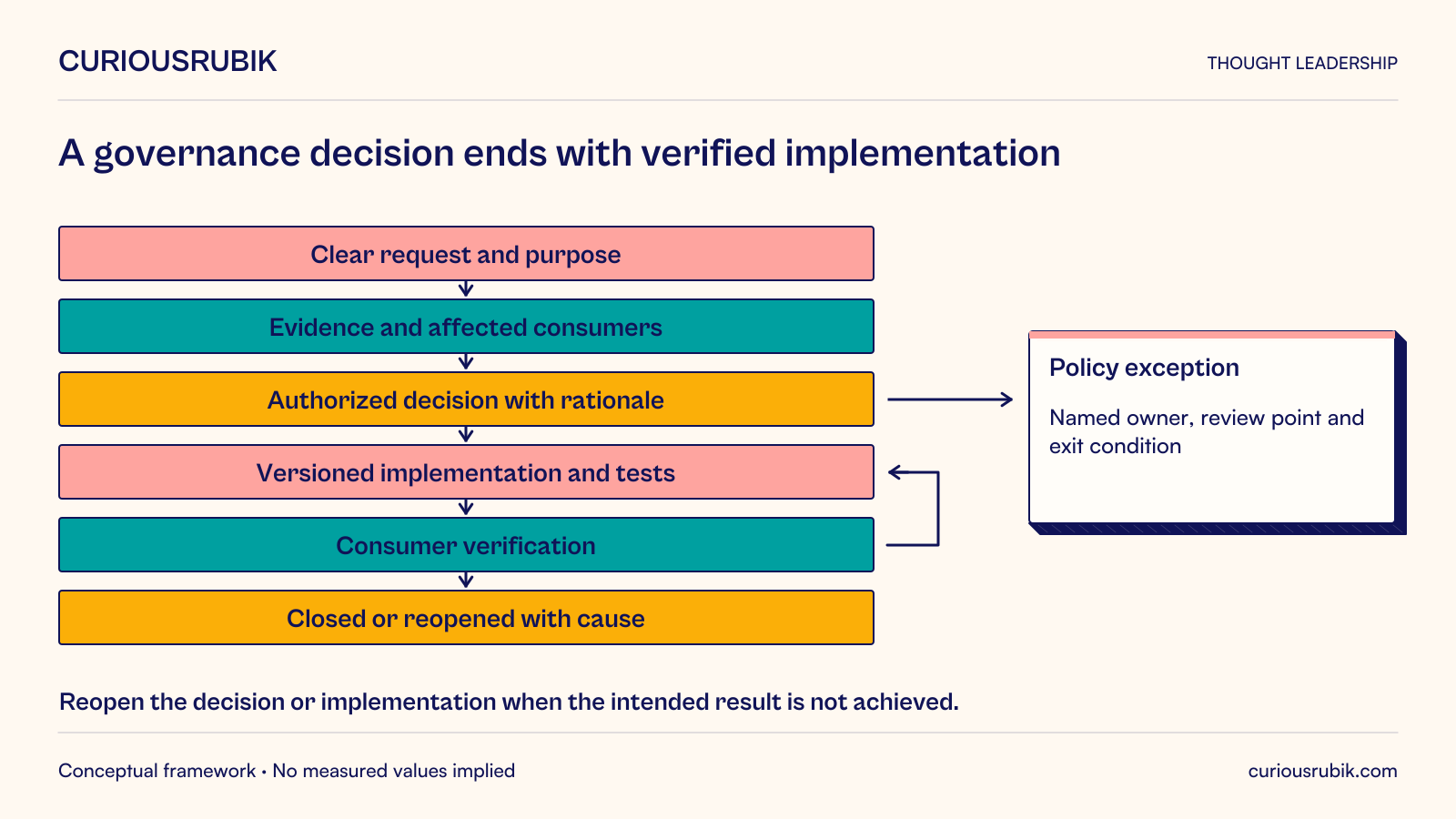
Distinguish policy from execution. The governance decision may approve a definition change; a delivery team still needs to implement, test, communicate, and release it. A meeting minute should not be treated as proof that every downstream report now uses the approved meaning.
The UK Government Data Quality Framework emphasizes accountability, capability, source-level improvement, and communication of quality. Those principles are useful here, but the proposed request-routing model is an operating design for the organization, not a prescribed government structure. The Government Data Quality Framework, Commit to data quality
Some changes can follow a standard pattern because their scope, evidence, and approving authority are already understood. A domain owner may be able to approve a descriptive correction that does not change identity, access, historical interpretation, or a shared calculation.
Define the boundaries of that path explicitly. If a supposedly descriptive change alters a classification used in financial reporting or customer eligibility, it may need broader review. The workflow should ask about downstream use rather than relying only on the name of the field.
Provide a short intake that captures the purpose, proposed change, affected data, consumers, urgency, and supporting evidence. Reuse information already available in the catalogue or change system instead of asking users to recreate it. Show the request’s status and next owner so people do not need to chase several teams privately.
A standard path still requires an authorized decision. It should not convert missing information, an unanswered request, or elapsed time into automatic permission. Where automation enforces an already approved rule, preserve evidence of which rule and version applied.
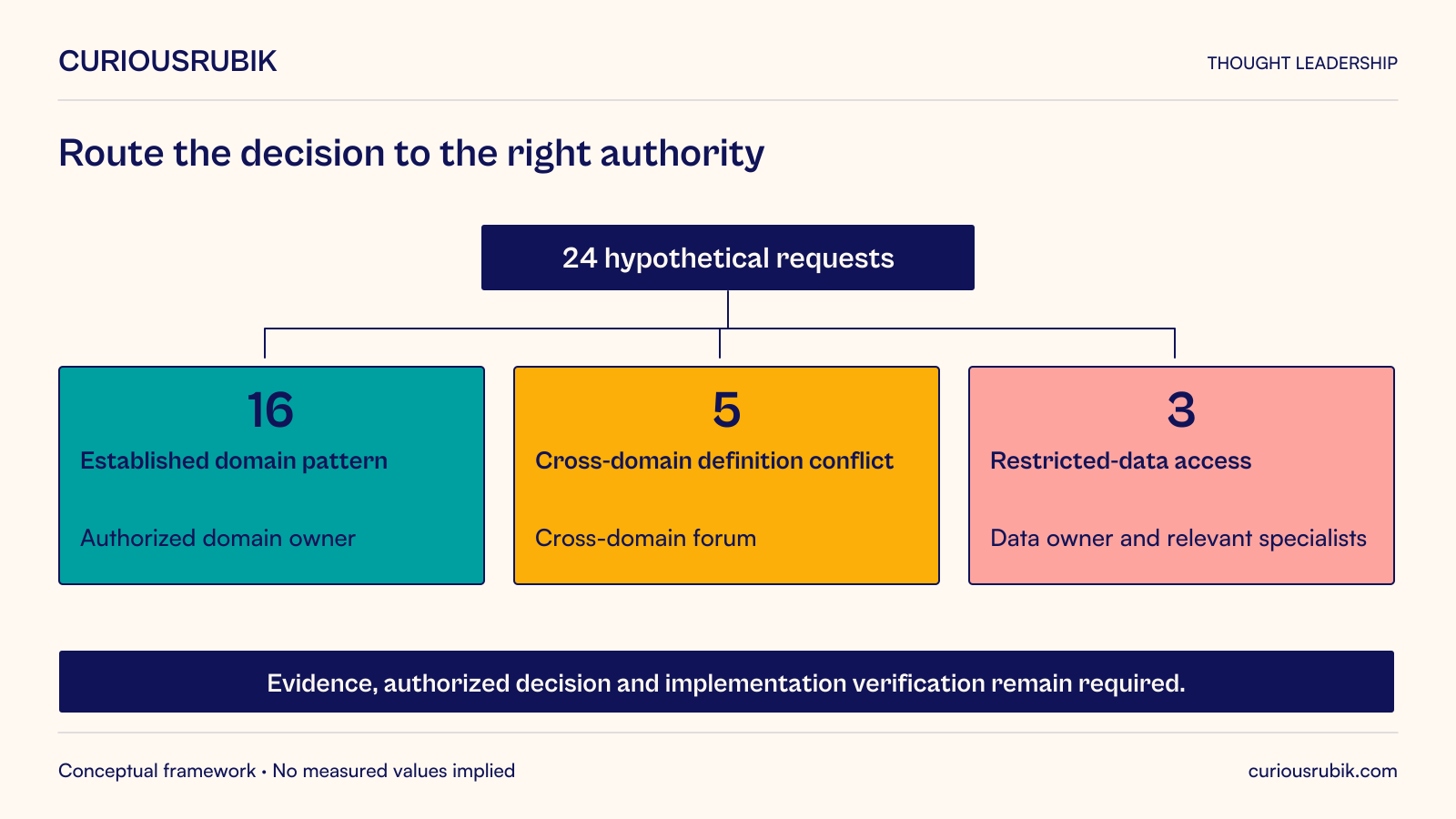
Suppose a hypothetical organization receives twenty-four data-change requests in a month. Sixteen fit an established domain pattern with a clear owner and sufficient evidence. Five involve conflicting definitions used by several departments. Three concern access to restricted information and need the appropriate data-owner and specialist review.
A model that places all twenty-four requests on a monthly council agenda makes unrelated work compete for the same meeting. A more proportionate design routes the sixteen through their authorized domain owners, the five to a cross-domain decision forum, and the three through the established access-review process.
This routing does not mean the sixteen are automatically approved, the five will be resolved quickly, or the three can bypass security requirements. It identifies the authority and evidence needed for each request. The council can oversee patterns and unresolved conflicts without personally deciding every routine correction.
Now consider one of the five definition disputes: a regional classification is being split into two new regions. Sales wants the new grouping immediately; the performance-review team needs comparable historical reporting. A workable decision may preserve stable location identities, introduce an effective-dated regional mapping, and provide clearly labeled current-structure and historical-structure views.
That outcome requires implementation details: the mapping owner, affected reports, effective date, treatment of prior periods, tests, communication, and the condition for retiring the old view. Merely agreeing that the regions will change leaves the difficult work unresolved.
All request counts and organizational details are hypothetical. The example illustrates proportionate routing and executable decisions, not a measured improvement in governance speed.
A cross-domain forum should receive a decision brief rather than a general presentation. State the disputed meaning, affected decisions, alternatives, consequences, and the authority needed to choose. Identify whether the conflict concerns a fact, a policy, or a legitimate difference in purpose.
Some disputes do not need one universal definition. A current commercial territory and a historical reporting region can both be valid if their relationship is documented. Forcing them into one field may create more confusion than preserving two clearly named concepts.
Other conflicts require a single authoritative decision. Two applications cannot independently define the same packaging quantity for the same identified case without risking inconsistent transactions. In that situation, the forum should establish the evidence source and accountable owner rather than compromise on an average value.
Record the rationale and unresolved limitations. Future teams need to know why a choice was made and what change would justify revisiting it. A short explanation beside the decision is more useful than a large archive of meeting slides with no clear disposition.
Real operations sometimes cannot meet a data standard immediately. An exception process should identify the affected use, consequence, compensating measure, owner, review point, and exit condition. It should also state which uses remain prohibited while the limitation exists.
Avoid treating an exception as a hidden waiver that lasts forever. If a dataset lacks a required field, a temporary manual check might support one bounded use while a source fix is delivered. It should not automatically authorize unrelated uses with different risks.
Escalate exceptions that cannot be contained within the authorized tolerance. The governance team should be able to say that a proposed use must wait or change when the evidence is insufficient. A service-oriented model makes that decision understandable; it does not guarantee a yes.
Review recurring exceptions as design feedback. If many teams request the same workaround, the standard may be impractical, the source process may be broken, or training may be inadequate. Investigate the cause instead of repeatedly approving the same exception under different names.
Link governance decisions to implementation artifacts: a versioned definition, mapping change, quality check, access configuration, or publication rule. Require the relevant tests and responsible sign-offs before release. Where practical, automate checks that are deterministic and well understood.
Do not confuse automated enforcement with policy completeness. A schema check can reject an invalid format while accepting the wrong meaning. A required-owner field can be populated with a person who lacks authority or capacity. The governance process needs occasional evidence that the assigned responsibilities actually function.
Verify closure with consumers. After the regional mapping change, confirm that affected reports use the intended version and that historical comparisons are labeled correctly. A request should not be marked complete solely because the central record was updated.
Make documentation available where people work. A field definition should be discoverable from the report or data product using it. The relevant owner and correction route should be nearby. Requiring users to search a separate policy portal for every routine question encourages local interpretations.
Track time to a clear owner, time waiting for missing evidence, decision time, implementation time, and reopening caused by an incomplete decision. These measures explain where requests stall. A single average approval time can hide both avoidable delay and rushed review.
Also track repeated quality incidents, unresolved definition conflicts, and exceptions that outlive their intended scope. Faster approvals are not a success if consumers receive inconsistent meanings or inappropriate access.
Build capability in the roles doing the work. Domain owners need time and training to understand downstream consequences. Stewards need access to evidence and an escalation route. Delivery teams need clear tests. Assigning titles without capacity makes governance appear established while leaving decisions informal.
There are limits to decentralization. Highly shared concepts and consequential access decisions may need central coordination. There are also limits to central control: a forum distant from local operations may lack the facts needed for routine decisions. Choose the level of authority from the decision’s reach and consequence, then review whether it works.
Start with one recurring request class that currently produces workarounds. Define its authorized path, evidence, response expectations, and implementation check. Make that path easier to use than a private spreadsheet or an informal message chain. Governance becomes credible when people can obtain a defensible decision and see it carried through into the systems they use.