A readiness dashboard can be mostly green while the release remains unsafe to launch. Training may be complete, data migration may have passed, and minor defects may be closing quickly, yet one unresolved issue prevents the business from completing a critical transaction.
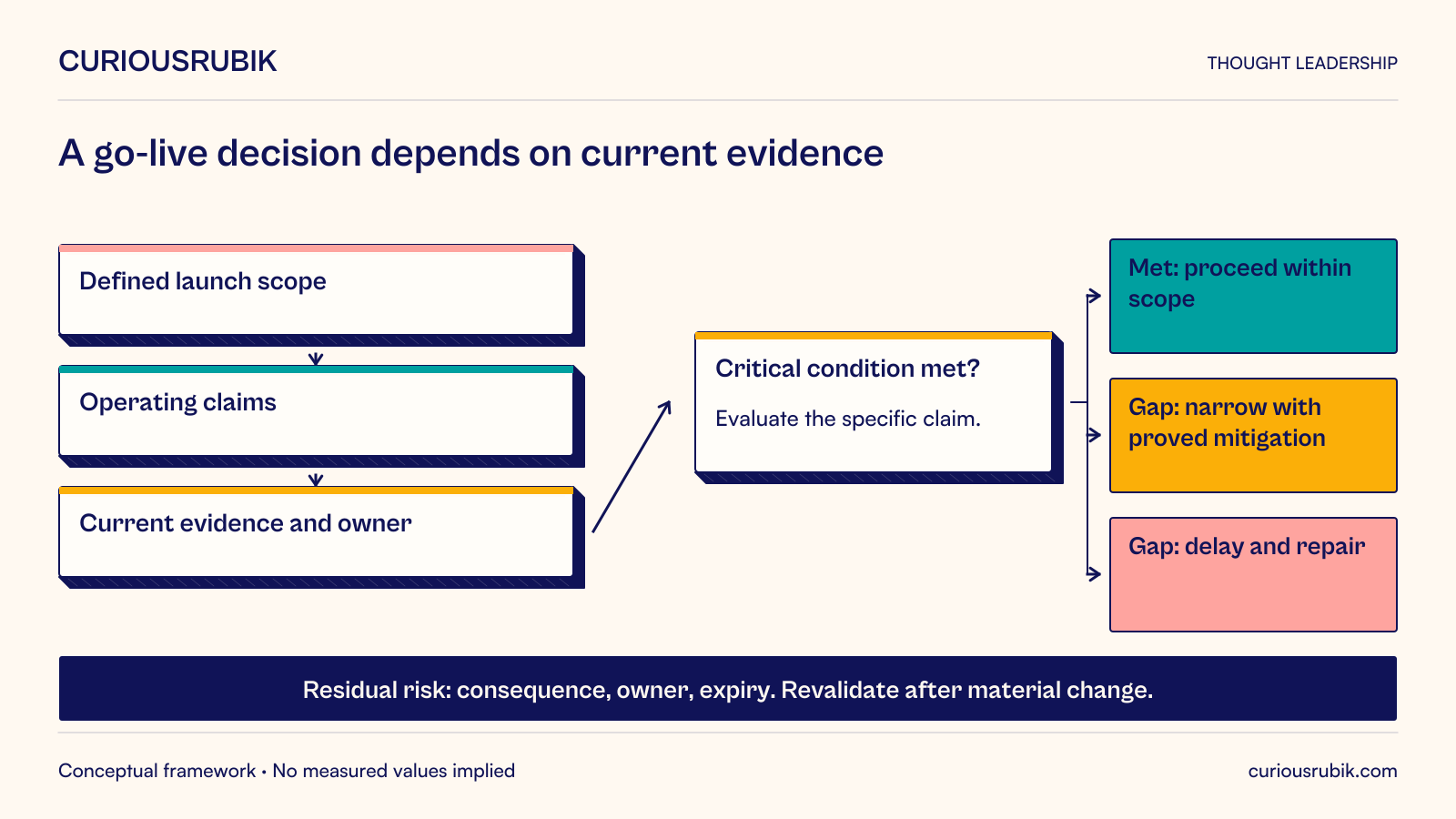
A useful readiness framework supports a decision. It identifies the operating claims that must be true, the evidence supporting them, the risks that remain, and the conditions under which the business should proceed, narrow the release, or delay.
The framework should be built early enough to influence delivery. If readiness is first discussed in the final week, the organization is likely to negotiate around whatever evidence happens to exist. For a sponsor, the essential discipline is to agree launch conditions before schedule pressure makes every unresolved issue appear manageable.
A release is ready for a defined population, workload, and set of processes. It is not universally ready in the abstract.
State which entities, locations, user roles, transaction types, and integrations are included. Identify relevant volumes and business-calendar events. A release for one office and a limited transaction set can require different evidence from a simultaneous enterprise launch.
Define the consequences of failure. An unavailable internal report, an incorrect payment instruction, and an inability to dispatch goods have different risk profiles. Readiness criteria should reflect the actual business exposure.
NASA’s Systems Engineering Handbook describes operational readiness in terms of the deployed system and its supporting personnel, procedures, and documentation. Its aerospace setting differs from enterprise software, but it usefully broadens readiness beyond the code itself. NASA Systems Engineering Handbook, Revision 2.
“Testing complete” is an activity statement. “Authorized users can complete the priority booking scenarios with reconciled records and a usable recovery path” is an operating claim.
For each claim, define the evidence, accountable owner, acceptance condition, applicable scope, and expiry or revalidation trigger. A test result should identify the release, configuration, data, and environment it covered.
Use evidence from realistic scenarios. A collection of isolated component tests may not demonstrate that the full business transaction works across systems and roles. Equally, one successful end-to-end case does not establish coverage of important exceptions.
Do not require every criterion to be numerical. Some decisions depend on a documented authority, a rehearsed procedure, or a verified support arrangement. The important quality is that the claim can be challenged and its evidence inspected.
Some conditions are necessary for the approved scope. If they are not met, the release must change or the decision must be revisited. Other issues can be accepted temporarily with a workable mitigation and a responsible owner.
Agree the distinction before the final readiness meeting. Otherwise, the team may relabel a failed gate as a minor risk because delaying launch is inconvenient.
A managed residual risk needs a specific consequence, affected cases, mitigation, owner, review point, and expiry condition. “Business accepts the risk” is not meaningful when nobody has described what the business is accepting.
Avoid weighted readiness scores that allow many small successes to offset one critical failure. A score can summarize progress within a category, but it should not override a launch condition or conceal missing evidence.
The following working heuristic organizes the decision: scope, claims, evidence, residual risk, and decision options. It is a proposed management framework, not a formal readiness standard.
Consider a hypothetical company operating conference venues. Its new system connects room availability, event bookings, customer deposits, and operational preparation. The first launch covers two venues before a busy booking period.
The project reports that most test cases have passed. A readiness review asks a more specific question: can the business accept and modify bookings without creating conflicting room allocations or inconsistent financial records?
The team defines scenarios for a straightforward booking, a date change, a partial cancellation, a transferred deposit, and a booking entered while a connected service is unavailable. Qualified finance and commercial owners determine the required treatment of deposits and contract changes; the readiness framework does not substitute for those policies.
Testing reveals that a date change updates the customer record before the room reservation is confirmed. The issue affects a critical operating claim. The launch decision cannot be rescued by the high overall test-pass percentage.
The team considers three options: repair and retest, exclude date changes from the initial automated scope with a controlled manual route, or delay launch. The manual route is credible only if staff capacity, authorization, duplicate prevention, and reconciliation are demonstrated for the expected volume.
A separate reporting defect affects a low-frequency internal analysis and has a verified workaround. That issue can be considered as a residual risk with an owner and review date. The two defects are not treated identically merely because both appear on the same defect list.
The hypothetical example illustrates a decision process. It does not establish that a manual workaround is always acceptable or that a particular defect severity automatically determines the answer.
Functional evidence should show that priority business scenarios work. Data evidence should establish that opening records are complete enough for the intended use and reconcile at meaningful boundaries.
People evidence should show that users and support roles can perform their tasks, including exceptions and absence cover. Attendance at training is useful information but is not the same as demonstrated capability.
Technical evidence should address access, interfaces, monitoring, performance, and recovery appropriate to the scope. Operational evidence should show how failures will be recognized and handled when the implementation team is no longer standing beside every user.
Treat these as connected claims. A recovery test may restore the application while leaving business transactions inconsistent. A trained user may still be unable to act because a permission was not provisioned. The readiness review should examine the whole dependency, not only each team’s completion percentage.
Evidence can become stale when code, configuration, data, or operating scope changes. Define what requires retesting or renewed acceptance.
A minor text correction may not invalidate a performance test. A changed integration mapping may invalidate reconciliation evidence. A new user population may require additional training and access checks. Make these judgments explicitly rather than repeating all tests or assuming none are affected.
Record the final baseline covered by the readiness decision. If a material change arrives after approval, identify who can accept it and what evidence is required. An informal late fix can undermine the conditions under which the original go decision was made.
Preserve unresolved assumptions. If expected transaction volume is uncertain, show that uncertainty and the contingency for higher demand. Do not convert an optimistic forecast into an unquestioned test requirement.
Risk assessment should distinguish the failure scenario, its likelihood or uncertainty, and its consequence. NIST’s risk-assessment guidance provides that discipline in an information-security context; applying it to launch decisions requires business-specific judgment. NIST SP 800-30 Revision 1.
For a residual issue, explain what users will do differently and how the organization will know the mitigation is failing. A workaround that requires an unavailable expert is not an operating control.
Check cumulative burden. Several individually manageable workarounds can overwhelm the same team during launch. Review their combined volume, required skills, and timing rather than approving each in isolation.
Define an expiry or trigger for reconsideration. A workaround might remain acceptable until a specific business cycle, a volume limit, or a scheduled repair. Open-ended acceptance can turn a temporary launch decision into permanent unmanaged operation.
The final readiness meeting should resolve a prepared decision, not discover the evidence for the first time. Circulate the claims, gaps, residual risks, and recommended options beforehand.
Include people with authority over the affected business and technical commitments. A project manager can coordinate the review but may not have authority to accept a material commercial or operational risk.
Present alternatives honestly. Narrowing scope may protect a useful launch; delaying may be less costly than operating through an inadequate workaround. Proceeding may be reasonable when the evidence supports the defined boundary.
Record the decision, conditions, owners, and next review point. Avoid a vague collective signoff in which nobody can later explain which risks were accepted and by whom.
A readiness decision should state which conditions must remain true during cutover. If a migration reconciliation fails or a dependency becomes unavailable, the cutover lead needs a clear escalation and stop rule.
Likewise, define the early operating signals that could require containment or a scope reduction after launch. Approval to start is not permission to ignore new evidence.
Keep readiness evidence available to support teams. Known limitations, accepted workarounds, and the scenarios already tested help them interpret early incidents without reconstructing the project’s history.
Review the framework after launch. Identify which criteria proved useful, which missed an important dependency, and which created effort without improving the decision. The framework should become a better management tool with experience.
Ask implementation partners to provide traceable evidence for business claims, not merely a completed checklist. Require clarity about the scope and release version covered by testing and about the assumptions behind the launch recommendation.
Test whether the framework can produce a no-go or reduced-scope decision. If every path ends in approval, it is a reporting ritual rather than a readiness control.
A useful readiness framework makes uncertainty visible early, distinguishes critical conditions from manageable residual issues, and leaves decision authority with the people who carry the consequences. That is how it protects a launch without turning every imperfection into a reason to stop.