A milestone date becomes credible when the team can explain the work, dependencies, decisions and available people that lead to it. A date agreed in a steering meeting is a target; it is not yet a delivery model.
For an implementation sponsor, the most useful schedule is one that reveals what can delay the next business outcome and which intervention could actually help. It should distinguish necessary sequence from habit, effort from elapsed time and a desired deadline from a forecast supported by evidence.
This requires more than adding detail to a plan. A thousand loosely connected tasks can conceal the same uncertainty as a single go-live bar. The aim is a maintainable model of the work that changes decisions when reality changes.
Define the milestone in operational terms. “Testing complete” should identify which scenarios, environments, data and approval evidence are required. “Ready for migration” should identify the source population, transformation rules, reconciliation method and responsible owners.
Work backward to the activities that produce that evidence. Include business decisions, external approvals, environment readiness, data preparation, testing, training and support preparation where they constrain the outcome. Omitting nontechnical work does not remove it from the real sequence.
Use tasks with observable completion conditions. “Data migration 50%complete” is difficult to interpret without knowing which population and evidence are included. “Representative migration rehearsal reconciled and discrepancies assigned” is a more useful checkpoint.
Keep the level of detail proportionate. Near-term work needs enough definition to coordinate people and dependencies. Distant work may remain at a higher level until discovery supports a more precise estimate. Explain that difference rather than displaying every future task with artificial certainty.
For each activity, ask what must be true before it can start and what it enables when finished. Distinguish technical dependencies, business decisions, external availability and resource constraints.
Do not connect tasks merely because they appeared in that order in a previous project plan. Some work can proceed in parallel; other work has a genuine dependency that a template missed. The people performing and receiving the work should validate the logic.
The US Government Accountability Office’s 2015 Schedule Assessment Guide treats an integrated schedule as a model that connects activities to major events and supports assessment of realism and change impacts. Its detailed practices were developed for program oversight; the principle applies usefully to enterprise implementations without supplying a standard duration for them. GAO Schedule Assessment Guide.
Make external assumptions visible. An interface test window, a supplier response or a business-owner decision should not appear as guaranteed simply because the project needs it. Record who confirmed the dependency and what happens if it is not available.
Effort measures work, often in person-hours or person-days. Duration measures the time an activity occupies in the schedule. Availability determines when qualified people can perform it. These are related but different quantities.
A task requiring five person-days may take more than a week if the required expert is available only part-time. Adding another person may help if the work can be divided, but may add coordination or fail to address the scarce skill. A waiting period for an external decision can have little internal effort and still determine the finish date.
Build calendars that reflect the actual business. Include peak operating periods, close cycles, leave, support coverage and restricted change windows. Avoid assuming the same business experts can work full-time on normal operations and the implementation simultaneously.
When several workstreams need the same person, model the conflict. Separate plans can each look feasible while the combined demand is impossible. Resolve the resource decision or expose its effect on the forecast.
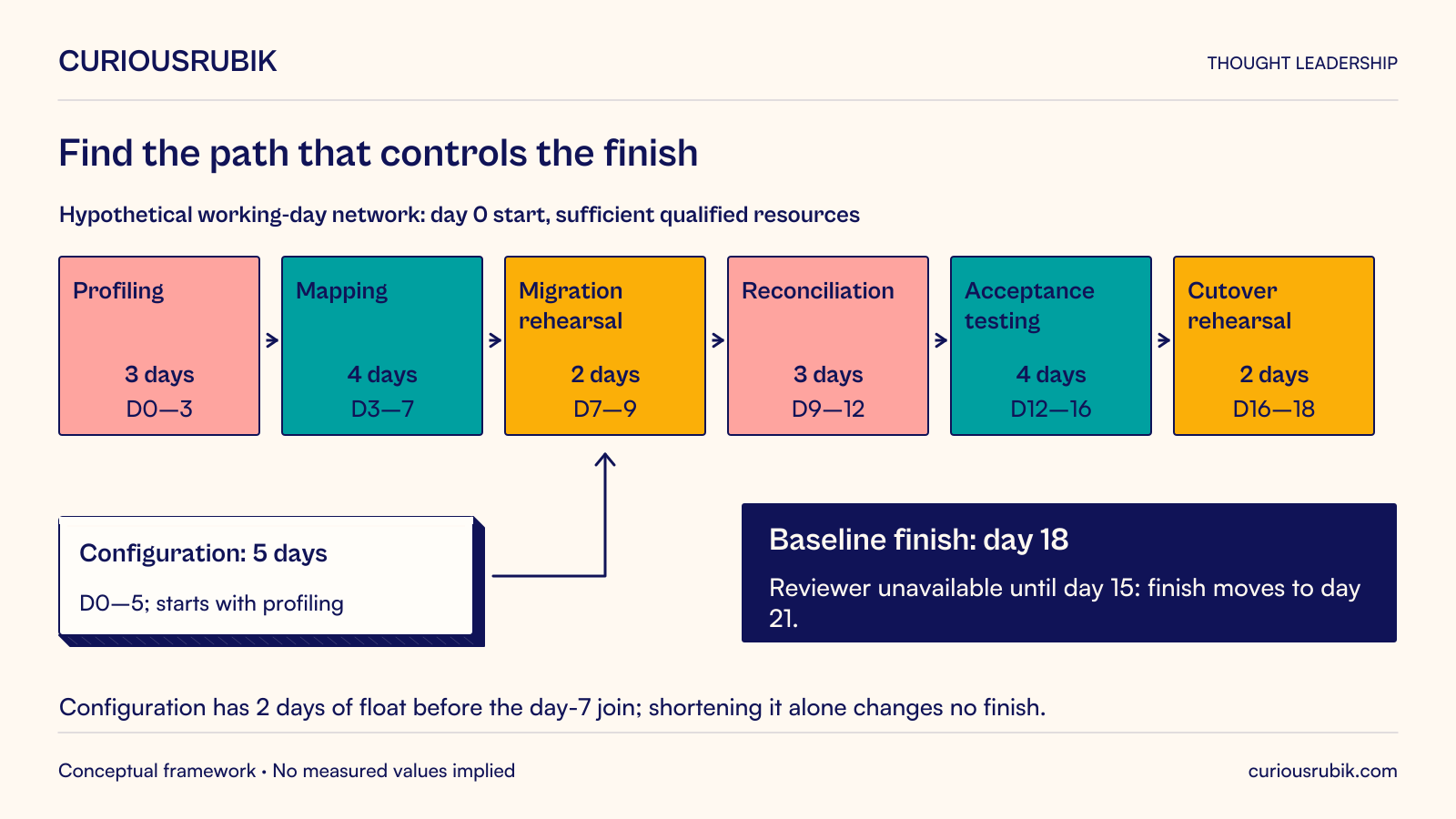
Consider a hypothetical implementation slice with durations expressed in working days. The figures are invented to illustrate dependency analysis, not benchmarks. Day 0 is the start, there are no holidays or waiting periods, and sufficient qualified resources are assumed unless a dependency is stated.
Data profiling takes 3 days, followed by 4 days of mapping decisions. Configuration takes 5 days and starts at the same time as profiling. A 2-day migration rehearsal can begin only when both mapping and configuration are complete. It is followed by 3 days of reconciliation, 4 days of business acceptance testing and 2 days of cutover rehearsal.
Under these assumptions, profiling finishes at day 3, mapping at day 7 and configuration at day 5. Migration rehearsal runs from day 7 to day 9, reconciliation to day 12, acceptance testing to day 16 and cutover rehearsal to day 18. The longest dependency path totals 18 working days.
Shortening configuration from 5 days to 3 does not change that finish, because mapping still prevents migration rehearsal from starting before day 7. Configuration originally had 2 days of schedule flexibility relative to that dependency. Improving profiling or mapping could affect the finish, provided the remaining assumptions hold.
Now suppose the business reviewer required for acceptance testing is unavailable until day 15. Testing cannot start at day 12 as originally modeled, so the final rehearsal finishes at day 21 if all other durations remain unchanged. The model has revealed a capacity-calendar constraint that a list of technical tasks would miss.
The example is deliberately simplified. A real program needs additional dependencies, resource checks and uncertainty analysis. Its lesson is that acceleration should target the condition controlling the outcome, rather than the task that is easiest to make faster.
Early durations are often estimates based on incomplete information. Record the basis: observed rehearsal effort, a supplier commitment, a comparable internal task or a planning assumption. The confidence in those inputs should affect how firmly the program commits to the resulting date.
Investigate uncertainties that could change the critical sequence. A data-quality problem may affect migration duration, design and testing together. Treating those effects as independent small contingencies can understate their combined impact.
Use scenarios to explain consequential changes. What if the supplier test window moves? What if a rehearsal exposes another conversion cycle? What if a key decision is delayed? State the assumptions and resulting management choices rather than presenting a precise confidence percentage without a defensible model.
Keep contingency visible enough to govern. Hidden padding in every task can distort priorities, while no allowance for uncertainty can turn the first ordinary setback into a crisis. The appropriate approach depends on the program’s risk and estimating maturity; it should not be a universal percentage applied without explanation.
A schedule is useful only if it is maintained. Record actual starts and finishes, current remaining duration and newly discovered dependencies. Preserve the approved baseline separately from the latest forecast so the organization can understand both its original commitment and its current expectation.
Avoid using percentage complete as the sole update. A task can be nearly finished by effort while a small unresolved decision blocks its usable output. Ask what remains, who must act and what evidence will establish completion.
Validate changes in logic. Removing a dependency to restore the desired date does not make the underlying constraint disappear. If the team proposes overlap, explain how incomplete inputs will be managed and what rework or risk may result.
Keep an audit trail for material revisions. The purpose is to learn why the forecast changed and what decision followed, not to punish honest updates. A schedule that never moves because bad news is suppressed is less reliable than one that exposes changing reality promptly.
When the forecast misses the target, examine scope, sequence, resources and operating options. A smaller usable release may remove work from the controlling path. Additional qualified capacity may help a divisible task. Earlier access to a decision-maker may remove waiting time. A different rollout approach may change the dependency structure.
Each intervention has limits. Parallel work can increase rework. Extra staff need onboarding. A deferred feature may carry a benefit the business case depends on. Skipping reconciliation or acceptance evidence can turn a schedule recovery into an operational failure.
Ask the team to show the before-and-after schedule logic for the proposed intervention. Which constraint changes? What new assumption is introduced? Who has committed the resources? What evidence will confirm that the intervention worked?
The sponsor should choose among credible options rather than asking the team to make the chart fit a date. A realistic timeline makes the path to delivery understandable, including the point at which a target becomes infeasible under current commitments. Begin with one major milestone, trace its dependencies and test the availability of the people who control them. That exercise often improves the plan more than adding another layer of reporting detail.