The most credible ten-year ERP strategy does not predict which features the business will need in year ten. It identifies the decisions that should remain stable, the parts that should be easy to change, and the evidence that will trigger a change of direction.
This distinction changes the CIO’s investment question. Instead of asking whether a platform is future-proof, ask what it would take to add an entity, change a fulfillment model, replace an adjacent application, or leave the platform. A system can support today’s operations extremely well while making those moves prohibitively difficult.
Long-lived ERP strategy therefore requires two kinds of discipline: consistency where shared operations depend on it, and affordable reversibility where the future is uncertain. Buying every conceivable feature does not provide either. Nor does distributing every capability across separate applications. The practical objective is to keep the cost and risk of necessary change within the business’s capacity to act.
Begin with obligations that are likely to outlast a technology generation. The business needs reliable accounting, clear ownership of transactions, controlled access, recoverable operations, and meaningful records. The exact implementation will change, but abandoning these obligations is rarely a sensible strategic option.
Then identify choices that depend on the business model: centralized or local purchasing, manufacturing or outsourcing, direct sales or channel partners, regional or global inventory pools. These choices can materially alter ERP requirements. Treating them as settled technical assumptions creates expensive commitments before executives have made the corresponding business decisions.
Finally, identify areas where experimentation is plausible: pricing analysis, customer interfaces, planning tools, or new service offerings. These often benefit from shorter delivery cycles than the transaction core. The appropriate boundary depends on transaction integrity, operational dependencies, and team capability, rather than a fashion for either monolithic or composable architecture.
Write these distinctions into the strategy. “Stable,” “reviewable,” and “experimental” are useful working labels, not permanent properties of a software module. An invoicing process may be stable until the business changes its commercial model. The classification must describe the business assumption and what would invalidate it.
A ten-year feature inventory becomes obsolete quickly. A scenario set can remain useful because it tests how the architecture responds to change.
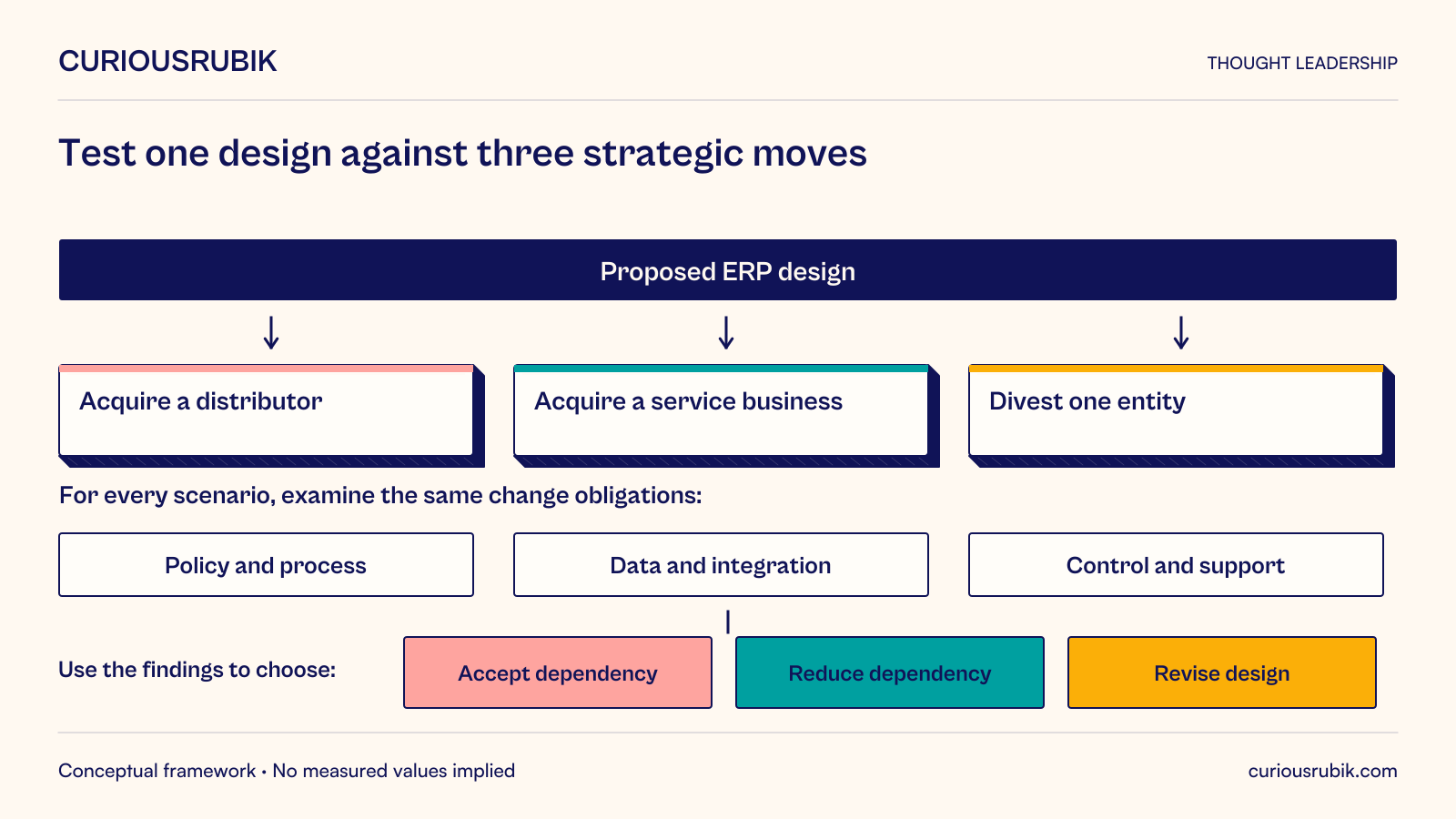
Select scenarios from the company’s actual strategic possibilities. An acquisitive business should test onboarding an entity with a different chart of accounts. A distributor entering services should test mixed goods-and-service contracts. A manufacturer expanding internationally should assess relevant entity, tax, currency, and reporting needs with appropriately qualified specialists.
Include a contraction scenario as well. Divesting a subsidiary, closing a warehouse, or retiring a product line can reveal data separation and dependency problems that growth scenarios miss. A platform that makes expansion straightforward but makes separation nearly impossible constrains strategy in a different direction.
For each scenario, ask what must change in policy, master data, integrations, reporting, controls, and support. Estimate the work using ranges and explicit assumptions. Do not turn an early workshop estimate into a precise financial forecast. The purpose is to compare exposure and uncover dependencies, not to claim certainty about future project costs.
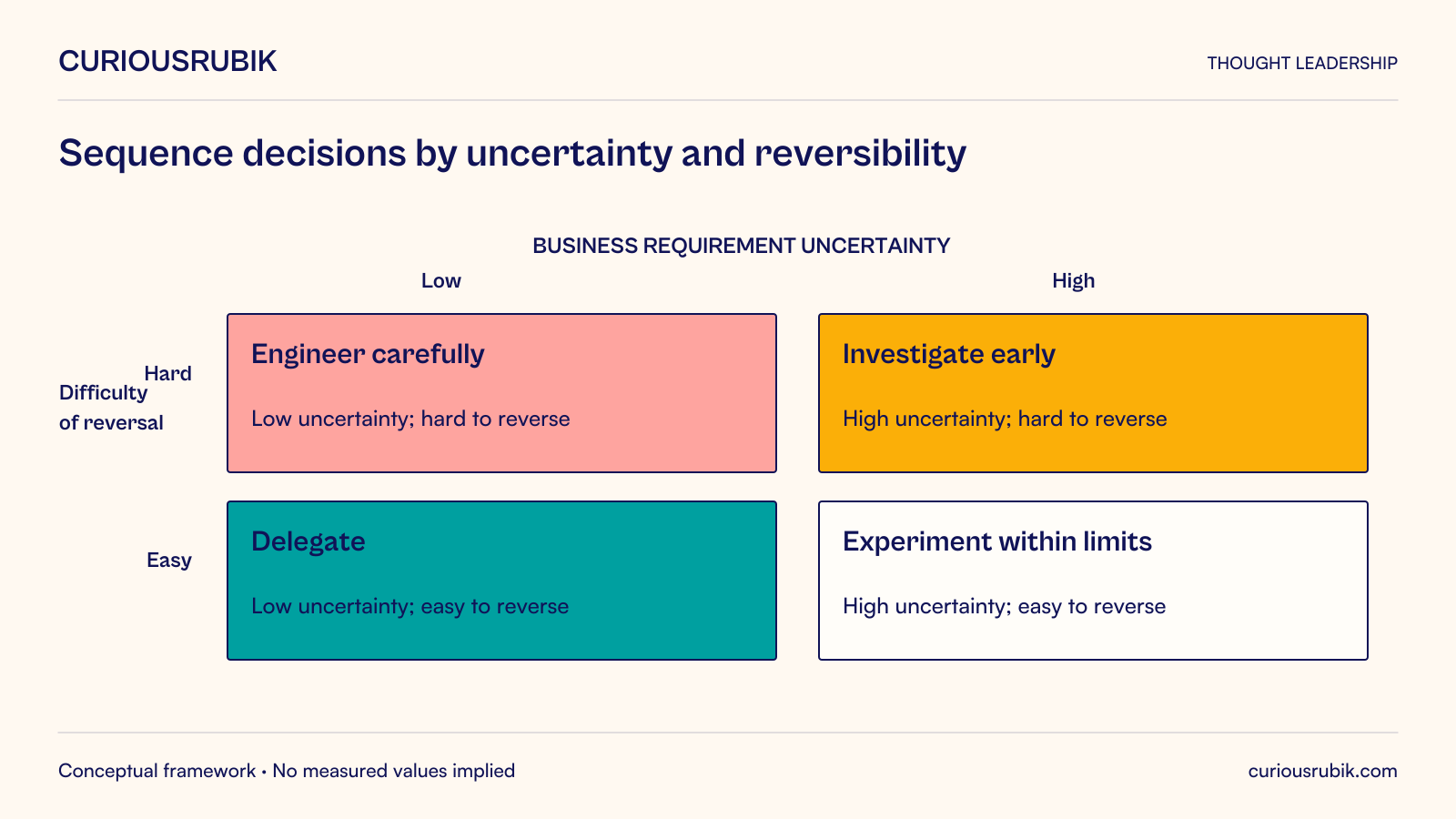
A practical working heuristic is to classify important decisions along two dimensions: how uncertain the business requirement is, and how difficult the decision would be to reverse. This is an author-proposed planning aid, not an established standard.
High-uncertainty, hard-to-reverse decisions deserve early investigation. Examples include embedding a new revenue model directly into the core or accepting a data design that makes entity separation difficult. Reduce uncertainty through a bounded proof of concept, commercial clarification, or a scenario rehearsal before committing.
Low-uncertainty, hard-to-reverse decisions deserve careful engineering. Stable transaction identifiers, audit evidence, and entity boundaries can be costly to repair after years of operation. Their durability does not remove the need for testing; it strengthens the case for getting the semantics right.
High-uncertainty, easy-to-reverse decisions are candidates for controlled experimentation. A planning dashboard can often be trialed with a limited audience if it does not become an ungoverned source of operational instructions. Define the experiment’s limits and its retirement conditions.
Low-uncertainty, easy-to-reverse decisions should not consume disproportionate executive attention. Standardize the selection method and delegate them within clear constraints. This leaves scarce decision time for commitments that could narrow future strategic options.
The map improves the sequence of work. It does not produce a universal architecture score. Two organizations can rationally choose different solutions because their uncertainty, bargaining power, and operating capability differ.
Consider a hypothetical equipment distributor planning to acquire smaller regional businesses. Its initial ERP proposal places every entity in one tightly standardized operating model. That promises straightforward group reporting, but an acquired company may have service contracts and serialized repair stock that the existing business does not manage.
The strategy team runs three scenarios: onboard a conventional distributor, onboard a service-heavy company, and sell one existing subsidiary. It discovers that the proposed shared customer numbering convention conflates legal customers with delivery sites. It also finds that entity-specific documents are stored without a reliable entity reference.
The company does not abandon common systems. It establishes separate identifiers for legal parties, locations, and accounts; documents how local identifiers map to group identifiers; and makes entity ownership mandatory for relevant records. It standardizes consolidation inputs while allowing a reviewed local service workflow where the economics justify it.
Next, it rehearses the exit scenario with synthetic data. Can it extract one entity’s transactions, attachments, open obligations, and reference data without handing over unrelated group information? Can a receiving system understand the relationships? A technically successful export is insufficient if invoice lines cannot be connected to their contracts or if the extract omits reversal history.
The exercise may reveal additional cost. That does not automatically invalidate the shared platform. It gives the board a clearer choice: accept the dependency, pay to reduce it, or change the design. The important result is a deliberate commitment supported by evidence, rather than a vague promise that the platform supports acquisitions.
Open interfaces can reduce some switching and integration constraints, but the phrase “open API” says little about actual portability. An API may omit attachments, limit historical extraction, lack stable identifiers, or expose transactions without the business meaning required to use them safely.
The UK Cabinet Office’s Open Standards principles connect interoperability, data exchange, flexibility, and exit-cost planning. They apply to government procurement; they are a useful reference for commercial buyers considering similar dependencies, not a mandatory private-sector architecture prescription. Cabinet Office, Open Standards principles.
Translate these concerns into acceptance tests. Require representative bulk extraction, documented identifiers and relationships, versioning behavior, error handling, and evidence that a replacement component can consume the output. Include attachments and configuration where they are necessary to interpret the business record.
Commercial review should cover access after termination, assistance obligations, extraction charges, renewal mechanics, and the time needed to transition. Have qualified advisers assess contractual terms. A technically portable platform can remain commercially difficult to leave; an attractive termination clause does not make incomplete data usable.
Avoid assuming that more interfaces automatically create flexibility. Each interface requires monitoring, change management, security, and an owner. An organization with a small support team may be better served by an integrated suite with a few carefully chosen boundaries than a large portfolio of individually replaceable components.
A durable ERP strategy needs data conventions that remain understandable when applications change. Establish ownership for core entities and define their identifiers, lifecycle states, and relationships. Distinguish a customer organization from a contact, a product from a stocked item, and a legal entity from a management reporting unit where the business requires those distinctions.
Document the rules that derive management measures. If margin excludes certain freight charges in one report but includes them in another, a new analytics platform will not solve the disagreement. Preserve versioned definitions and their effective dates so historical comparisons remain interpretable.
Keep the scope proportionate. Attempting to harmonize every attribute across the enterprise before delivering any useful capability can stall the program. Prioritize shared data that crosses a significant operational or reporting boundary. Let local attributes remain local when their meaning and ownership are genuinely local.
Data portability also has privacy and retention limits. A strategy should not promise permanent retention or universal replication. Decide which records are needed for which purposes, who can access them, and how deletion or retention obligations will be honored across copies. Obtain jurisdiction-specific advice where needed.
A ten-year strategy without a permanent ownership model is a purchase plan. Define who maintains process rules, evaluates releases, tests integrations, manages data quality, and reviews whether local extensions still justify their cost.
Separate spending required to keep the service dependable from discretionary improvements. Security work, supported versions, recovery testing, and essential interface maintenance should not repeatedly compete with new functionality as if they were optional enhancements.
Create a small decision record for significant extensions: the need, alternatives considered, expected benefit, owner, dependencies, and conditions for retirement. Revisit it when the platform gains equivalent capability or the business process changes. Otherwise, extensions accumulate after the reasons for them have disappeared.
GAO’s IT investment guidance emphasizes the processes, supporting cost-benefit-risk information, and decisions used to select and manage technology investments. Applied here, the useful lesson is to review the ERP investment throughout its life rather than only at purchase. The article’s proposed review cadence remains a management recommendation. GAO, Assessing Risks and Returns.
An annual review is useful, but material events should reopen assumptions sooner. Triggers may include a planned acquisition, a new commercial model, a support deadline, repeated integration failures, or a significant change in transaction volume.
For each trigger, name the evidence and the decision it initiates. “Growing complexity” is difficult to act on. “The next acquisition requires a process variant the current template cannot support without core modification” points to a specific architectural and commercial review.
Keep a short set of indicators: time to onboard an entity, effort to change a shared process, age of unsupported dependencies, concentration of critical knowledge, and results of recovery and extraction tests. Interpret them in context. A faster change process that weakens controls is not an improvement, and a larger extension inventory may reflect a justified new business rather than poor discipline.
Before approving an ERP roadmap, require a clear account of what the business intends to standardize, where variation remains legitimate, and which uncertainties need testing. Ask for scenario evidence, an ownership model, and a credible explanation of exit and transition costs.
The strongest strategy will contain fewer predictions and more explicit options. It will acknowledge that no platform removes the need for difficult organizational choices. Its durability will come from making those choices visible, preserving reliable records, and keeping necessary changes achievable.
An ERP strategy survives a decade when the business can revise it without first escaping a decade of undocumented assumptions.