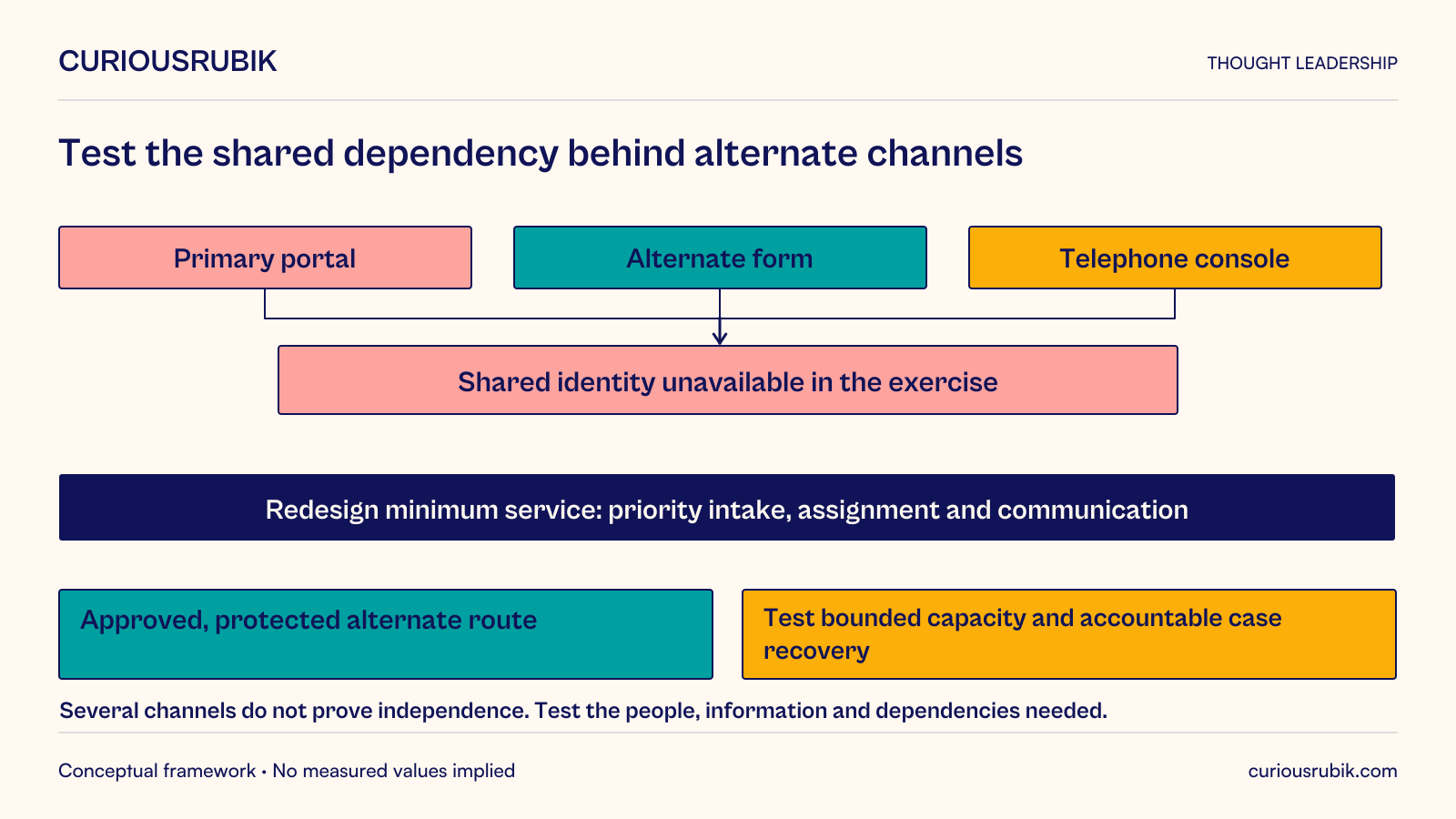
The primary service-desk portal is unavailable, so employees are directed to the backup form. During an exercise, the team discovers that both routes require the same unavailable sign-in service. The alternate channel exists, but it does not provide an alternate way to keep the business service operating under that failure.
This hypothetical example captures the distinction between having recovery components and sustaining useful work. Business continuity begins with the service the organization needs to preserve, the impact of interruption, and the dependencies required to operate at a reduced but acceptable level. Technology recovery supports that objective; it does not define it alone.
The discussion below uses a routine office-services desk, covering tasks such as equipment moves and meeting-room support. It does not prescribe emergency-response procedures. The practical decision is which work must continue, through which genuinely usable path, and for how long before the organization must change its commitments.
Identify the outcomes whose interruption matters most. The service desk may need to receive a request, identify its business priority, assign a responsible owner, and keep the requester informed. Rich reporting and every self-service feature may be less urgent during a disruption.
Describe what can be deferred and the consequence of delay. A routine furniture move may tolerate postponement, while support for a time-sensitive customer presentation may need earlier attention. The categories and priorities must come from the organization’s actual operating needs.
Define the minimum information and authority required to perform the retained work. A fallback that receives messages but cannot identify the location or reach an authorized service owner may not provide a usable service. Equally, copying the entire customer or employee database may create unnecessary exposure.
State the limits of reduced operation. The alternate process may handle less volume, fewer task types, or a shorter period. Those constraints should be visible so the business can adjust expectations rather than silently accumulate an unmanageable backlog.
Assess how consequences change over time. Consider service disruption, contractual commitments, financial exposure, information integrity, people, and dependencies on other operations. The analysis should involve business owners who understand the consequences, not only the team responsible for restoring systems.
NIST SP 800-34 Revision 1 connects business-impact analysis with recovery priorities and objectives. It distinguishes tolerable business interruption, system recovery time, and recoverable data points. Those are planning inputs that require evidence; they are not guarantees that a recovery will meet them. NIST SP 800-34 Revision 1, Section 3.2
Set objectives for the relevant service and supporting resources. The business may need a basic intake capability before the full portal returns. That can imply different priorities for identity, communications, current contact information, and the application itself.
Include the time needed to resume coherent work. Restoring a system may leave queued requests, incomplete assignments, and records created through the fallback. The operating plan must account for that work before declaring the service normal again.
Imagine a company whose office-services portal handles routine requests across several buildings. Its continuity plan names an alternate web form and a support telephone route. The initial review counts these as separate channels.
A realistic exercise removes access to the primary identity service. The team discovers that the alternate form uses the same sign-in dependency and that the telephone console also requires a new session through it in the tested conditions. Staff cannot use either route as planned.
The business and technical owners redesign the fallback around the minimum service. They establish an approved, protected way for designated staff to receive essential requests, reach current duty contacts, record minimal case information, and communicate limitations. The access and information-protection arrangements are reviewed before use; the fallback is not a permission to bypass controls informally.
The plan also narrows scope. Less urgent requests are deferred with clear communication, while the available team handles the defined priority population. The organization tests whether that staffing and channel capacity can sustain the reduced service for the intended period.
When normal access returns, the team accounts for requests received during the outage and confirms who owns each unresolved case. It checks for duplicate or conflicting assignments before returning to ordinary operation. This is necessary follow-through, but the central design question remains whether useful service could continue during the dependency failure.
The exercise does not prove resilience against every disruption. It establishes a specific weakness, a supported alternative, and the evidence needed to test that alternative. A different failure, such as loss of the designated operating location or key staff, needs its own assessment.
For each minimum service step, identify systems, information, people, suppliers, facilities, and communication channels. Include the dependencies of the alternate route, not only those of the primary application.
Look for shared causes of failure. Two applications may rely on one identity provider, network path, administrative team, or data source. Redundancy at one layer does not establish independence across the whole service. Verify the actual arrangements rather than inferring resilience from different product names.
Check how staff obtain the plan and required contacts during disruption. A continuity document stored only in the unavailable environment may not be usable. Provide an approved protected access arrangement suited to the risk and keep it current.
Assess suppliers as operating dependencies. Understand the support route, restoration information, contractual commitments, and alternatives relevant to the service. Do not assume a supplier’s availability claim covers the enterprise’s complete recovery and reduced-operation needs.
Specify who invokes the alternate process and on what evidence. Staff should not have to improvise the threshold during an incident, and an unavailable executive should not become an unplanned single point of decision failure.
Give the receiving team a clear task boundary. Define eligible requests, required information, permitted decisions, escalation, and the method for tracking unresolved work. A fallback that depends on everyone’s personal messages can quickly lose accountability.
Preserve appropriate security and privacy. Minimize copied information, restrict access, and define retention and reconciliation for temporary records. Urgency changes the operating conditions but does not remove the need for authorized handling.
Test the effort and throughput of the alternate process. A route that works for three demonstration requests may fail under ordinary demand. Establish what volume can be handled and what communication or prioritization is required beyond that boundary.
Prepare communication for the reduced service before disruption. Requesters need to know which work is being accepted, which is deferred, and where to find reliable updates. Verify that the update channel remains usable under the same failure scenario. A fallback can lose much of its value if employees continue submitting urgent work to an unavailable route because the organization cannot reach them with the change.
A restoration test can demonstrate that a component returns. A continuity exercise should also establish whether people can perform the minimum business tasks with the information and authority available under the simulated conditions.
Include a realistic dependency failure, an absent key participant, an information gap, and demand that challenges the fallback. Choose scenarios from the business-impact assessment and known concentrations rather than treating one dramatic event as representative of every risk.
Observe actual actions and results. Did the team reach the alternate channel? Could it identify and assign a request? Did the requester receive an accurate explanation? Were unresolved cases retained? Record where the exercise relied on help or access that would not be available in the real situation.
NIST’s contingency-planning guidance includes testing, training, exercises, and plan maintenance. Those activities support continued readiness; a successful document review alone is not equivalent to a demonstrated operating capability. NIST SP 800-34 Revision 1, Sections 3.6–3.7
Review continuity when the service changes its identity platform, supplier, data source, operating location, or staffing model. A replacement component may introduce a shared dependency that the earlier exercise did not contain.
Update the impact assessment when the business promise changes. A once-optional portal may become the only practical route for a critical service. The continuity design and funding should reflect that increased dependence rather than inherit old objectives without review.
Assign owners to findings from exercises and incidents. Each material gap needs a corrective action and evidence of completion. A lessons-learned list that is never retested can create an appearance of progress while the same weakness remains.
Include continuity requirements in procurement and architecture decisions. Ask how the proposed service can fail, what reduced operation is possible, and which dependencies must remain available. This is more effective than discovering the fallback requirements after the business has committed to a tightly coupled design.
A tested alternate intake route establishes a bounded capability under defined conditions. It does not prove that every customer request can continue unchanged or that every system will meet its target. Report the scope and remaining limitations honestly.
The office-services team can now distinguish a backup channel on a diagram from a service it can actually operate. Its next review should verify the minimum tasks, the shared dependencies, and the capacity of the authorized alternative. Business continuity is built into enterprise technology when those operating requirements shape the design and remain tested as the business evolves.