Procurement says the return is closed. The warehouse says the goods have left. Finance says the supplier balance has not changed. Those statements may describe three different events rather than three conflicting versions of one fact.
Connecting these functions requires a shared chain of evidence, not a single status that forces every team to agree prematurely. Each function needs to preserve the meaning of its own decisions while understanding how they relate to the others.
The practical design problem is to identify the events that change commitments, physical stock, availability and financial records, then make those events traceable across the process. A supplier return is a useful place to test whether that connection really exists.
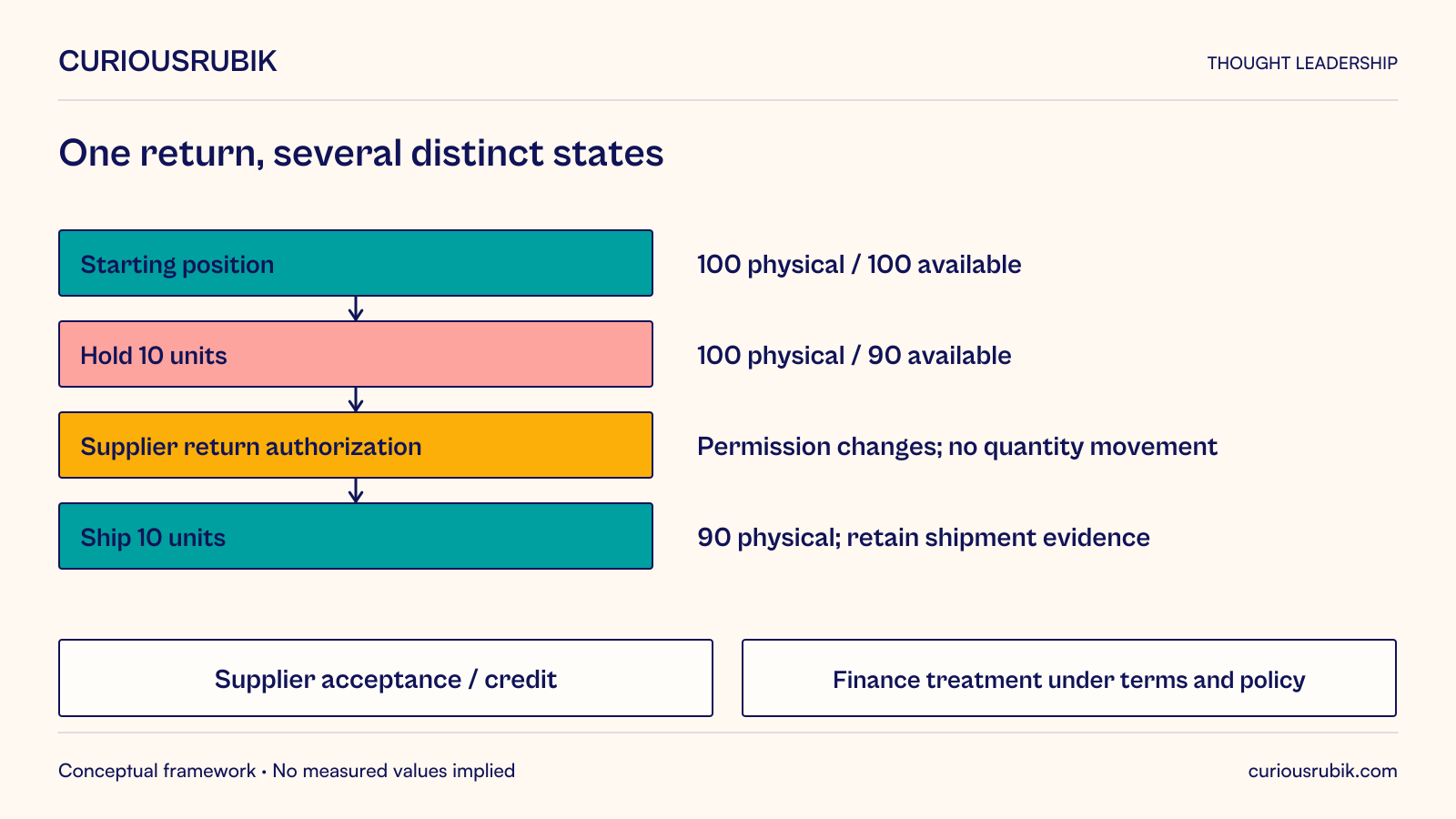
In a hypothetical distributor, 100 units of an item are physically present and initially available for allocation. A quality review places 10 units on hold. Physical stock remains 100, but available stock becomes 90 under the simplified assumption that there are no other allocations or restrictions.
Procurement then obtains the supplier’s authorization to return the 10 units. That authorization does not move the goods. When the warehouse ships them back, physical stock at the distributor falls to 90. The supplier’s receipt, acceptance of the claim, credit documentation and settlement may follow through separate steps.
The financial treatment must follow the applicable agreement and accounting policy, supported by the relevant evidence. It should not be inferred mechanically from a warehouse status or postponed automatically until a credit note arrives. A qualified finance owner needs to define which events support which financial conclusions.
A system that uses one returned flag for all these stages can mislead each team. Planning may treat held stock as usable. Procurement may assume shipping completed because authorization was received. Finance may lack the references needed to connect a later credit to the original purchase and return.
This example intentionally separates operational quantities from accounting conclusions. It is not a journal-entry prescription or a determination of ownership under any particular contract.
Create an event map with the people responsible for procurement, warehouse operations and finance. For each meaningful event, identify the object, responsible source, effective time, evidence and permitted downstream effect.
A quality hold changes the stock’s operational status. A return authorization establishes permission under the agreed process. A despatch records a movement. Supplier acceptance and financial documentation provide different evidence. The map should expose these distinctions in terms all three functions can understand.
Do not assume that the team originating an event owns every conclusion drawn from it. Warehouse staff can record a verified quantity movement without deciding the accounting treatment. Finance can interpret the evidence without silently rewriting the physical event.
The IFRS Foundation’s IAS 2 overview describes guidance for inventory cost and subsequent recognition as an expense. That illustrates why inventory’s financial meaning is not determined by quantity alone. The applicable reporting framework and specific treatment still require the organization’s qualified accounting judgment. IFRS Foundation, IAS 2 Inventories.
Record the rules that connect events to decisions. When a rule changes, identify which processes and integrations need review. Otherwise, teams can continue using different interpretations even while exchanging data successfully.
The map is a working design artifact, not a universal standard. Its value lies in making the organization’s actual assumptions and responsibilities inspectable.
A return needs references that connect it to the original item, relevant receipt or purchase, supplier relationship and the units or lot involved where applicable. The level of detail should match the operation and the evidence required.
Preserve the distinction between a return request and the individual movements or documents that fulfill it. One request may involve several shipments or a partial supplier acceptance. A credit may cover only part of the claim. Those relationships should not depend on a human recognizing similar free-text descriptions.
Use stable identifiers and versioned changes where material. If the return quantity changes after authorization, the team needs to know which version the warehouse acted on and which version the supplier accepted.
Avoid making a new record appear unrelated simply because it entered through another channel. An emailed credit document, portal response and integrated message may concern the same return. The intake process needs appropriate duplicate detection and linkage without merging genuinely different transactions.
Units and item definitions must remain consistent. A quantity expressed in cases cannot be compared safely with a quantity expressed in individual units unless the applicable conversion and packaging identity are known. The shared record should preserve that context rather than overwrite history with a later definition.
Reliable identity makes reconciliation possible. It does not remove the need to investigate differences in meaning or quantity.
For each interface, define what a successful exchange establishes. A message reaching the destination is different from passing validation, updating the intended record or completing the business action.
Expose rejected and pending transactions to an accountable owner. Include the reason, relevant references and what is needed to resolve the issue. A technical error queue that nobody in operations can interpret is not an adequate exception process.
Design repeated delivery and uncertain outcomes deliberately. If a movement message is retried, the receiving system should not create another movement simply because it arrived again. If a response is lost, the integration should determine the recorded outcome before repeating a consequential action.
Corrections need their own rules. An incorrect quantity may require an authorized reversal or adjustment that preserves history, rather than direct editing that makes the original event disappear. The appropriate mechanism depends on the systems and controls in use.
Keep the current operating view understandable while retaining evidence of what changed. Users should not have to read every message to determine whether a return is awaiting shipment, supplier response or financial review.
Test the whole chain with a deliberately incomplete case. For example, ship an authorized partial return in a test environment, delay the supplier response and submit the related financial document. Confirm that each function sees the correct unresolved condition rather than a false global completion.
Some differences arise because the functions observe different events at different times. They can be legitimate and still need monitoring. Others indicate missing, duplicated or incorrect information.
Define reconciliation populations and cutoffs. A comparison should state which returns, movements and financial documents it includes and which effective dates it uses. Comparing all current warehouse records with a prior-period financial extract can create misleading exceptions.
Distinguish an expected timing difference from an aged unresolved issue. The organization needs an agreed review process and evidence for that classification, not a permanent timing explanation attached to every mismatch.
Assign different exception types to the right owners. A missing shipment reference may belong to warehouse or integration support. A disputed claim may require procurement. A financial interpretation belongs with the qualified finance owner. Some cases need joint resolution with one person responsible for coordinating it.
Make the business consequence visible. An unresolved credit may affect supplier-account review; a hold that was not propagated may affect availability promises; a duplicate movement may distort replenishment. The exception priority should reflect those consequences rather than only the size of a technical error log.
Closing an exception should establish what was corrected, who authorized it and whether related records now reconcile. A comment saying handled is not the same as evidence that the connected process is consistent.
Connecting functions does not mean giving every participant permission to change every record. Define who can initiate a return, authorize a supplier commitment, record physical movement, release a hold and approve a financial action.
Separate viewing and acting permissions where appropriate. A procurement user may need to see shipment progress without being able to alter warehouse quantities. A warehouse user may need the authorized return details without access to unrelated supplier financial information.
Protect sensitive changes, including supplier identity and payment information, through the organization’s approved controls. A trusted integration should carry only the authority needed for its purpose, and its activity should remain attributable.
Include delegated and emergency work in the design. An absent owner should not lead to an informal expansion of administrator privileges. Provide a supported way to route the task to another authorized person and record the basis of the decision.
Govern changes jointly when they affect the shared meaning. A warehouse status redesign or a procurement policy change can alter finance’s evidence path even if no financial screen changes. The responsible teams need a way to identify that dependency before release.
A bounded reverse-flow test can reveal weaknesses that ordinary purchase processing conceals: partial outcomes, changed quantities, delayed evidence and different completion conditions. Use those findings to improve the shared event model and exception process.
Measure outcomes that matter across functions. Examples include unresolved return age, manual reconciliation effort, incorrectly available stock and the time to a supported financial resolution. Define the measures carefully and avoid treating every reduction in handling time as a cash saving.
Include operating staff in the review. They can identify where the system asks them to confirm something they do not know, where a necessary reference is missing and where work continues outside the recorded process.
Then apply the same discipline to receipts, transfers, consumption and other flows that need connection. Each has its own events and evidence; the return model should inform the design without becoming a rigid template for everything.
Procurement, inventory and finance are connected when each can explain its state through the same underlying chain of events while retaining the authority to interpret and act within its role. That creates a stronger operating foundation than a common dashboard whose single status hides what remains unresolved.