A signed agreement creates several different responsibilities. Sales must preserve what was promised. Service must deliver within the agreed scope. Finance must apply the correct commercial terms. Customer success must understand whether the customer is achieving the intended outcome.
Connecting these teams requires more than synchronizing an account record. They need a shared account of commitments, authoritative business events, and clear rules for what happens when their records disagree.
The practical design challenge is to preserve one coherent customer relationship while allowing each function to maintain its specialist controls. A finance system should remain authoritative for posted financial transactions; a service system should retain operational detail. The connection should make those facts usable across teams without encouraging everybody to edit everything.
Terms such as “closed,” “active,” and “complete” are dangerously ambiguous across departments. A closed opportunity may mean an accepted commercial proposal, a signed agreement, or a seller’s expectation that paperwork will arrive. An active customer may mean provisioned service, current billing, or recent usage.
Define the events that matter to the shared lifecycle. Examples include agreement approved, onboarding accepted, service activated, invoice issued, dispute opened, scope changed, and renewal confirmed. Each event needs a business definition and an authoritative producer.
Separate an event from a request. “Service activated” asserts that something happened. “Activate service” asks an authorized team or system to do something. Treating the request as proof of completion can cause premature billing, inaccurate reporting, or misleading customer communication.
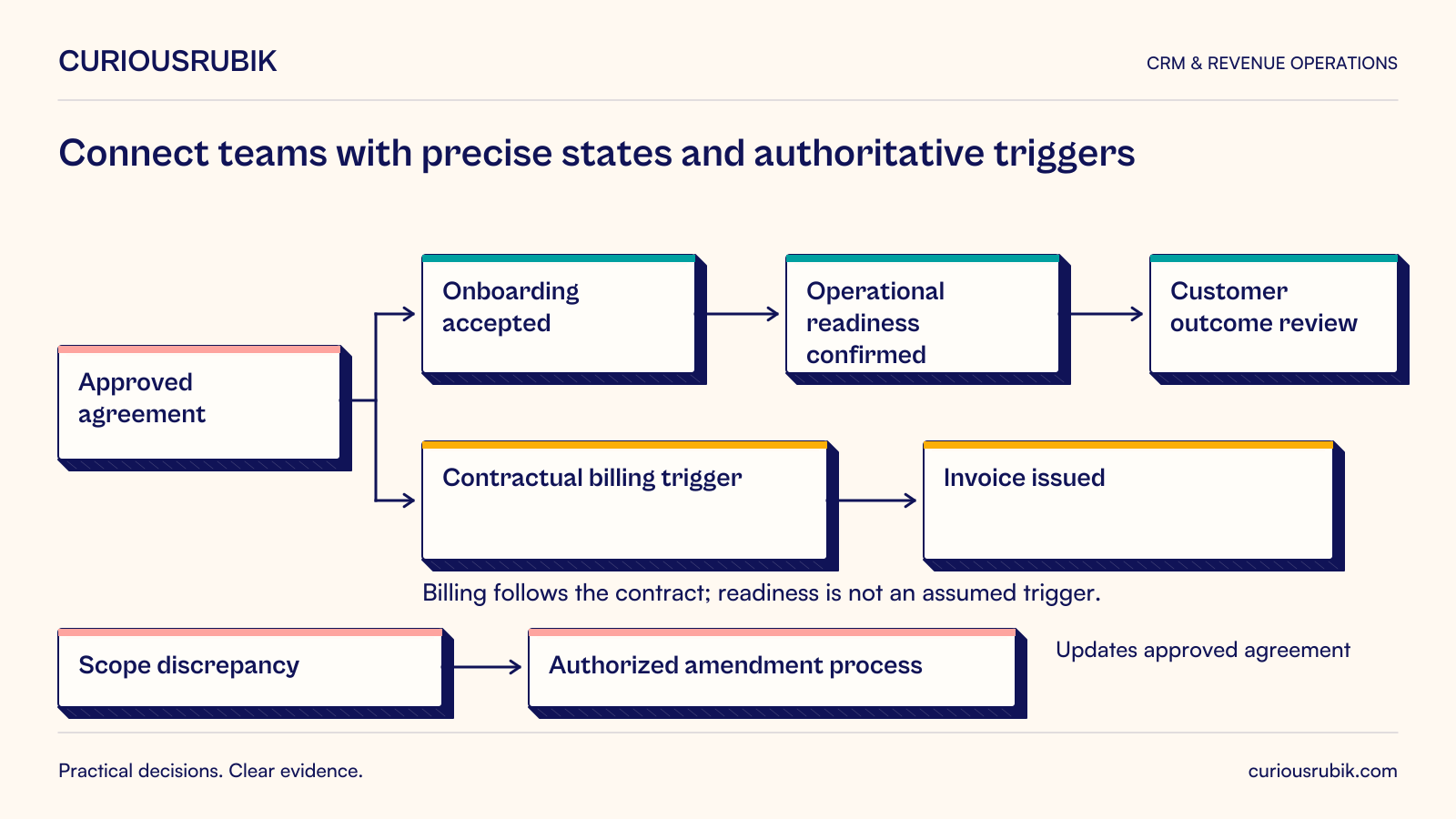
Not every event should trigger every downstream action. A signed agreement may initiate onboarding while billing waits for a different contractual condition. Make those relationships explicit rather than assuming that one sales stage can govern the entire customer lifecycle.
The shared record should describe what the company owes the customer, not duplicate every departmental record. It can contain the customer and contract identifiers, agreed scope, relevant effective dates, key obligations, responsible owners, and references to authoritative evidence.
Maintain amendments as changes with timing and provenance. Overwriting a scope field can erase the reason an earlier invoice or service decision was correct at the time. Preserve enough history to explain what applied when an action occurred.
Separate customer health from contractual status. A customer may be dissatisfied while fully entitled to service, or highly engaged while an invoice is disputed. A single red or green account flag cannot safely substitute for these different facts.
Likewise, distinguish customer success recommendations from authorized commercial changes. A success manager’s proposed service extension does not amend the contract until the appropriate approval and agreement process occurs.
Use a working handoff heuristic with six parts: trigger, meaning, evidence, accepting owner, response expectation, and exception route. This is an author-proposed design method rather than a formal standard.
The trigger states what initiates the handoff. Meaning defines what the event asserts. Evidence links to the authoritative record. The accepting owner takes responsibility for the next action. The response expectation describes when acceptance or rejection should become visible. The exception route addresses incomplete, disputed, or technically failed handoffs.
For example, an agreement-approved event can create an onboarding request with the approved scope and contact. Onboarding must accept it or return a specific reason. A technical acknowledgment from the integration layer confirms receipt of a message, not business acceptance of responsibility.
Keep rejection constructive. The receiving team should identify the missing condition and the owner who can resolve it. A generic “invalid request” forces the sender to reconstruct the process and often leads to private messages outside the system.
Consider a hypothetical company maintaining industrial refrigeration equipment. Sales agrees a new contract effective at the start of the next month. Service must first verify the installed equipment and confirm emergency coverage. Finance applies the billing terms in the approved contract. Customer success schedules a review after the customer has experienced the service.
The current integration sends “deal won” to every system. Service creates a task, finance assumes the account is ready to bill, and customer success sends a welcome message that implies coverage is already active.
The redesign separates the commercial effective date, operational readiness, and customer-outcome review. The agreement-approved event starts onboarding. Service publishes readiness only when the defined conditions are met. Finance uses the actual contractual billing trigger, which may or may not depend on readiness. Customer success sees both states and communicates accurately about what is available.
A site inspection reveals equipment outside the agreed scope. Service creates a scope discrepancy rather than silently adding it to coverage. Sales and the authorized commercial owner resolve the change. The shared record preserves the original agreement and any approved amendment, including its effective date.
The team tests a delayed inspection, a customer requesting an earlier start, a duplicate agreement event, and an amendment received after an invoice has been issued. Each scenario has a named decision owner. No application is allowed to resolve a commercial disagreement merely by copying the newest field value.
The hypothetical design illustrates why connected teams need multiple well-defined states. It makes no claim that a particular platform or integration pattern produces a guaranteed improvement.
A common event envelope helps systems exchange recognizable metadata. CloudEvents 1.0.2 defines attributes including event identifier, source, specification version, and type. It also describes how source and identifier distinguish events and duplicates. It does not define the meaning of a company’s “service activated” event. CloudEvents 1.0.2 specification.
The business still needs event definitions, payload schemas, versioning rules, access controls, and consumer responsibilities. A standard envelope cannot decide whether a contract amendment authorizes a billing change or whether service readiness includes a completed safety check.
Use stable identifiers across the lifecycle. An account name is a display label; it should not be the only way to connect an opportunity, agreement, invoice, and service case. Preserve the relevant entity and contract context so similarly named customers do not become accidentally linked.
Document compatibility expectations. A new field can be optional technically but essential to a new business rule. Coordinate producer and consumer changes, and test old and new versions during transition.
Connected systems need more than one timestamp. The event may have occurred at one time, been recorded later, and reached another system later still. A contract change can also have an effective date different from all three.
RFC 3339 defines a date-time representation for internet timestamps, including an offset. Consistent representation reduces ambiguity, but it does not establish event ordering, clock accuracy, or the business meaning of a date. RFC 3339, Date and Time on the Internet.
Choose which time governs each decision. Billing may depend on a contractual effective date; operational monitoring may depend on event occurrence; integration support may need receipt time. Do not silently replace one with another because it is easier to obtain.
Late events need defined handling. A delayed cancellation should not automatically delete a legitimate historical service record. It may require stopping future work and creating an adjustment process. Preserve the distinction between correcting history and recording a later change.
A successful interface run proves that messages moved. It does not prove that every eligible agreement became an accepted onboarding case or that every billable event produced the appropriate invoice.
Build business reconciliations around the lifecycle. Compare approved agreements with accepted onboarding requests, activated services with relevant contractual status, and issued invoices with their supporting records. Explain legitimate differences such as future effective dates or approved exceptions.
Define who investigates unmatched items and how urgent they are. An orphaned service activation may create an immediate customer or commercial risk. A missing optional enrichment field may not. A single integration-error queue obscures these differences.
Recovery must avoid duplicate effects. If a message is replayed, the receiving process should recognize work already completed or route the ambiguity for review. Preserve enough evidence to determine whether the business action occurred even when an acknowledgment was lost.
Some disagreements are data defects; others are genuine policy decisions. A misspelled contract identifier needs correction. A dispute about whether a service is in scope needs an authorized commercial judgment. Route them differently.
Establish ownership by concept. Finance owns posted invoice status; service owns completion evidence; the authorized contract process owns approved terms. Shared visibility does not transfer authority to whichever team notices the problem first.
Create a cross-functional review for recurring lifecycle failures. Focus on unresolved commitments, repeated rejection reasons, and reconciliation gaps. Give the forum authority to propose process changes and a clear escalation route for decisions outside its remit.
Control access according to role and purpose. Customer success may need to know that an invoice dispute affects the relationship without receiving unrestricted access to all financial or personal information. Integration design should expose the minimum useful context rather than copying complete records everywhere.
Choose a bounded contract or customer segment. Map the authoritative events and test the full sequence from agreement through service and billing to review. Include cancellations, amendments, disputes, and failed handoffs before widening scope.
Measure business acceptance, unresolved exceptions, reconciliation completeness, and time spent reconstructing customer context. Keep departmental measures, but add evidence that the shared lifecycle is coherent.
Buyers should ask suppliers to demonstrate an amendment arriving late, a duplicate event, and a receiving team rejecting a handoff. Ask which system is authoritative and who resolves the issue. A demonstration that merely shows the same customer name on four screens has not established operational connection.
Connected teams can specialize without leaving gaps between their responsibilities. The foundation is a shared account of commitments, precise events, and recoverable handoffs. Once those are in place, integration technology can support coordination rather than simply moving ambiguity faster.