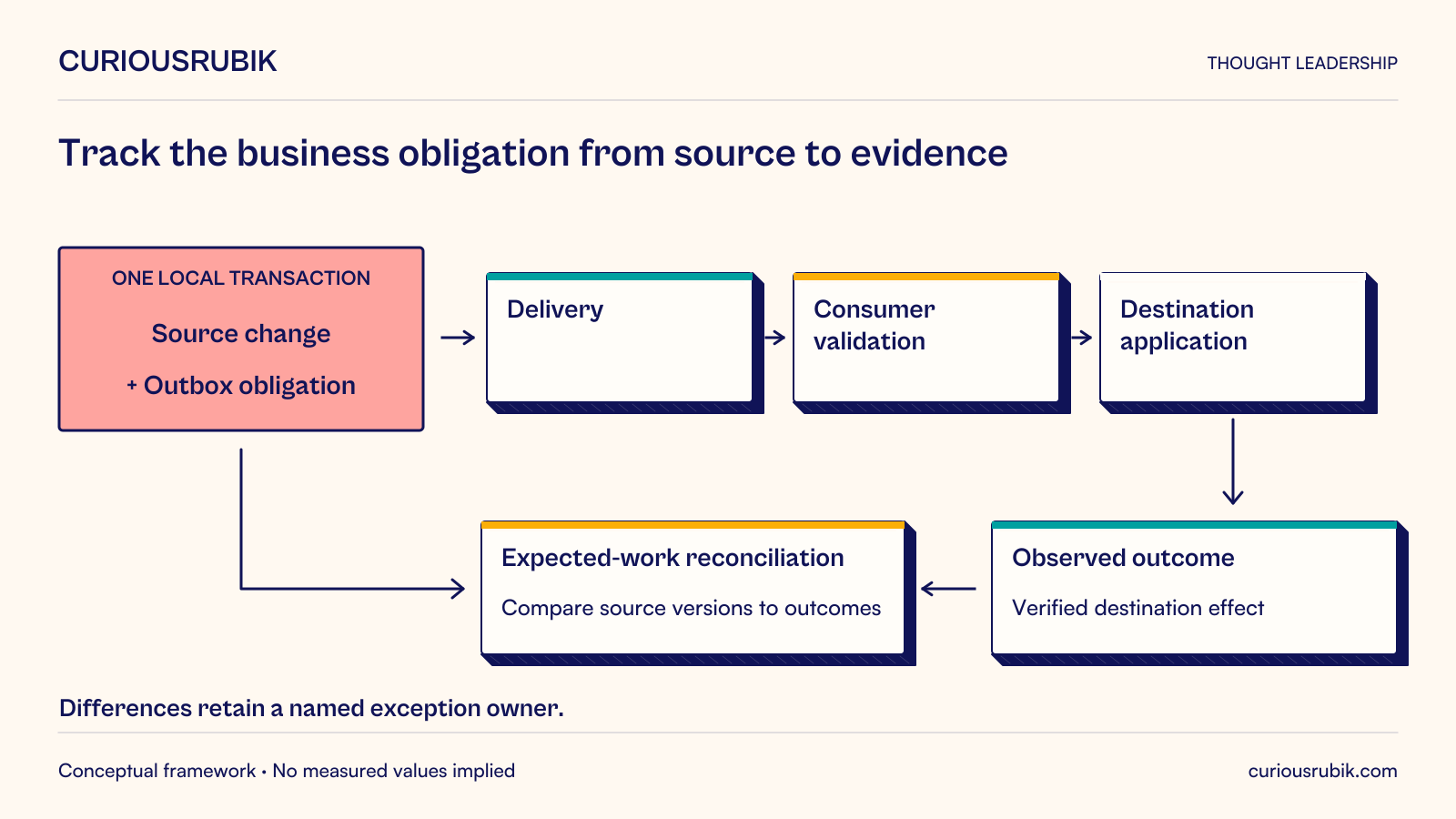
A reliable integration must establish that the intended business effect occurred, not merely that a message was sent. Transport acknowledgment, consumer processing, and verified destination state are separate milestones. The architecture should make those milestones visible and assign ownership when they disagree.
For a platform leader publishing product-catalog changes to a storefront and search index, the key decision is how to define and verify completion across systems. A successful source update is not enough if customers still see an old description or a removed product remains searchable. Conversely, a delayed analytics copy may not need to block the customer-facing release. Reliability begins with deciding which outcomes are required and when.
Define the business operation, its required destinations, its acceptable delay, and its failure response. Then design capture, delivery, application, and reconciliation around that definition. Infrastructure availability is useful evidence, but it cannot replace an end-to-end completion test.
For each flow, identify the source event or command, the durable business identifier, the expected destination effect, and the evidence that proves it. In the catalog example, completion might mean that a specified product version is active in the storefront and indexed under the correct visibility rules.
Do not make every downstream system part of one undifferentiated success condition. Classify destinations according to the business promise. The storefront and search service may be required for a coordinated release; analytics may have a separate freshness objective. These classifications are local business choices and should be approved by the relevant owners.
The completion record should identify versions, not merely product IDs. A search entry for a product can exist while containing an older version. A status saying “processed” is ambiguous unless it explains what was processed and which state is now visible.
Include rejection as a valid observable outcome. A destination may correctly reject a product update that violates its contract. The source team needs that reason and an assigned resolution path. Calling every rejection a transient technical failure can cause endless retries without fixing the data or business rule.
The source should not commit a business change and then rely on an unrecorded attempt to notify other systems. A failure between those actions can leave the source changed with no durable evidence that downstream work remains.
A transactional outbox is one way to address this local dual-write problem: record the source change and an outbound work record within the same database transaction, then have a separate process deliver the work. AWS’s description of the pattern explicitly identifies the dual-write issue and the need to handle possible duplicates. This is a pattern example, not a claim that all systems expose the necessary transaction boundary. AWS Prescriptive Guidance, Transactional outbox pattern
The boundary must be real. If a product image is stored in an object service while metadata is stored in a database, declaring an outbox does not make both stores one transaction. A possible design prepares an immutable asset, verifies its availability, then commits the metadata reference and outbox record together. It also needs cleanup for unused prepared assets and handling for later asset failures. Other designs may be appropriate depending on the systems.
Where the source cannot support an outbox or reliable change feed, use its supported export or event mechanism and add a reconciliation that detects missed obligations. Document the residual risk. A connector claiming “automatic synchronization” does not eliminate the need to understand what happens around a source commit.
Consumers should validate identity, version, schema, authority, and the business constraints relevant to their effect. A well-formed message can still request an invalid state. Preserve a reasoned distinction between accepted, rejected, waiting, and applied work.
Use duplicate-safe processing appropriate to the operation. For a catalog projection, applying the same approved version again may be harmless if version and deletion rules are correct. Sending a customer notification twice is a different effect and needs its own handling. The same event can therefore require different controls at different consumers.
When the destination state and a processed-event record share a transactional store, commit them consistently so a crash does not leave contradictory evidence. If application involves an external service, preserve the operation reference and establish its actual outcome through the supported mechanism. Do not equate an HTTP success response from an intermediary with verified customer-facing state.
Apache Kafka’s version-3.4 documentation explicitly distinguishes its transactional processing guarantees from effects in external destination systems, which require cooperation from those systems. This is an important limit on any claim of end-to-end “exactly once.” Apache Kafka 3.4, Message Delivery Semantics
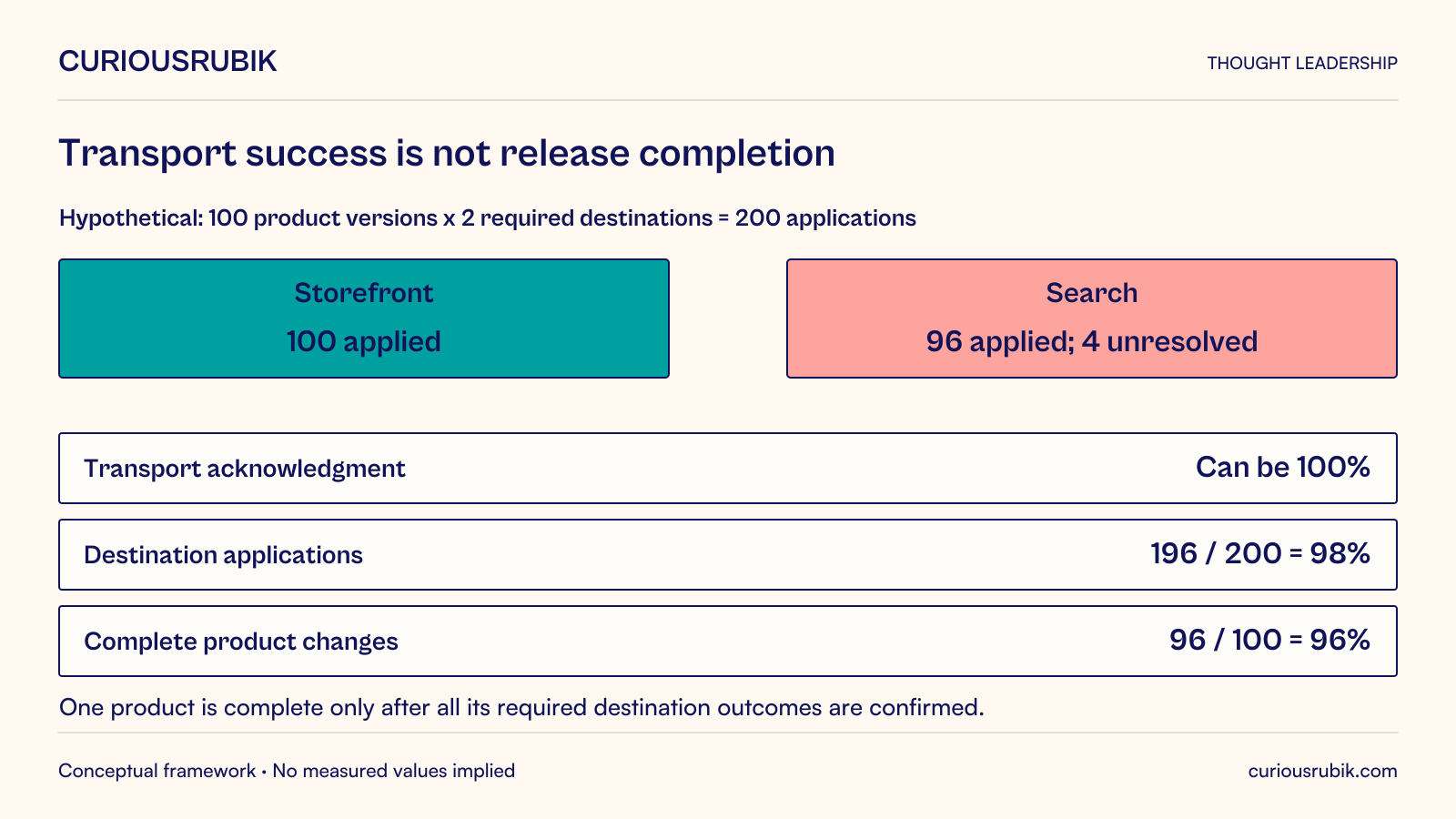
Suppose a hypothetical catalog release contains one hundred product-version changes. Each requires application to both the storefront and search index. The intended result therefore includes two hundred required destination applications, with completion assessed per product version.
The storefront reports all one hundred versions applied. Search reports ninety-six applied and four awaiting investigation. There are one hundred ninety-six applied destination outcomes, but only ninety-six fully completed product changes, assuming the four unresolved search items correspond to four distinct products.
A dashboard showing 98 percent destination application could be mathematically correct: 196 divided by 200. It answers a different question from the 96 percent product-completion measure. Neither percentage alone shows whether the four affected products are especially consequential, so the exception list must remain visible.
Now suppose all messages were acknowledged by the transport. A transport-success measure could show 100 percent while the business release remains incomplete. The missing distinction is between accepting work into the delivery system and establishing the required destination effect.
The platform owner should decide how to handle the four products. They might remain on the prior coordinated version, be withheld from publication, or be released with an explicitly accepted limitation, depending on the business rules and technical design. The integration should support the chosen policy rather than silently publishing an inconsistent result.
These figures are hypothetical. They illustrate why completion must be measured at the unit of business meaning, not inferred from a convenient infrastructure counter.
Maintain an expected-work population from the authoritative source and compare it with observed destination outcomes. Use stable identifiers and versions so missing, duplicate, rejected, and outdated records can be distinguished. Totals can supplement this comparison but should not be the only evidence.
Reconciliation should have a cadence and owner appropriate to the consequence. A customer-facing catalog update may need rapid exception detection; a secondary analytical copy may support a longer interval. The team should know which decisions are restricted while a difference remains unresolved.
Separate completeness checks from semantic checks. A destination may contain every expected record but map visibility incorrectly. Test representative business rules and meaningful edge cases as well as the population. For a discontinued item, verifying that a record exists is the opposite of verifying that it is no longer offered for sale.
Preserve evidence of corrections. If an operator repairs a record directly in the destination, the next source update may overwrite the fix. Prefer correction at the authoritative source or a controlled repair procedure whose relationship to source state is understood. Record any temporary divergence and its resolution condition.
Carry a correlation reference across source capture, delivery, consumer processing, and destination verification. Logs and traces should let an authorized operator reconstruct one operation without searching unrelated personal data. Record stage, version, outcome, time, and safe diagnostic context.
Monitor age as well as count. Queue depth can be small while one important update is stuck indefinitely. The age of the oldest unresolved business operation, the number of rejected items, and the gap between expected and applied versions often reveal problems that CPU or connection metrics do not.
Define alert ownership before production. A schema rejection may belong to the producer team; a destination outage to the service owner; a disputed business state to the domain owner. One integration support team can coordinate the incident without being expected to decide every business question.
Test alerts with deliberate failures. Confirm that the right owner receives enough information, can access the evidence, and knows which corrective actions are authorized. A monitoring rule that sends an unreadable payload to an unstaffed channel is not an operational control.
Before rollout, test lost acknowledgments, duplicate messages, a stopped consumer, invalid data, an unavailable destination, and a source correction during processing. Verify both expected state and expected exception evidence. Include a representative reconciliation after recovery.
Set sustainable operating objectives for the whole flow, including peak load and backlog recovery. A service that can process normal arrivals but cannot catch up after interruption will accumulate delay. The required capacity margin must follow measured workload and recovery needs.
There are costs to stronger completion tracking. Additional state, reconciliation jobs, and operational dashboards require maintenance. Apply depth proportionate to the business effect rather than building a distributed transaction framework for every low-consequence feed. The minimum remains the ability to explain what was intended, what occurred, and who resolves the difference.
Start with one flow whose failures are currently discovered by users. Define its business completion state and build an expected-versus-observed reconciliation around it. Then test a partial failure. Reliability becomes credible when the organization can identify the unfinished business operation even while every individual connection appears healthy.