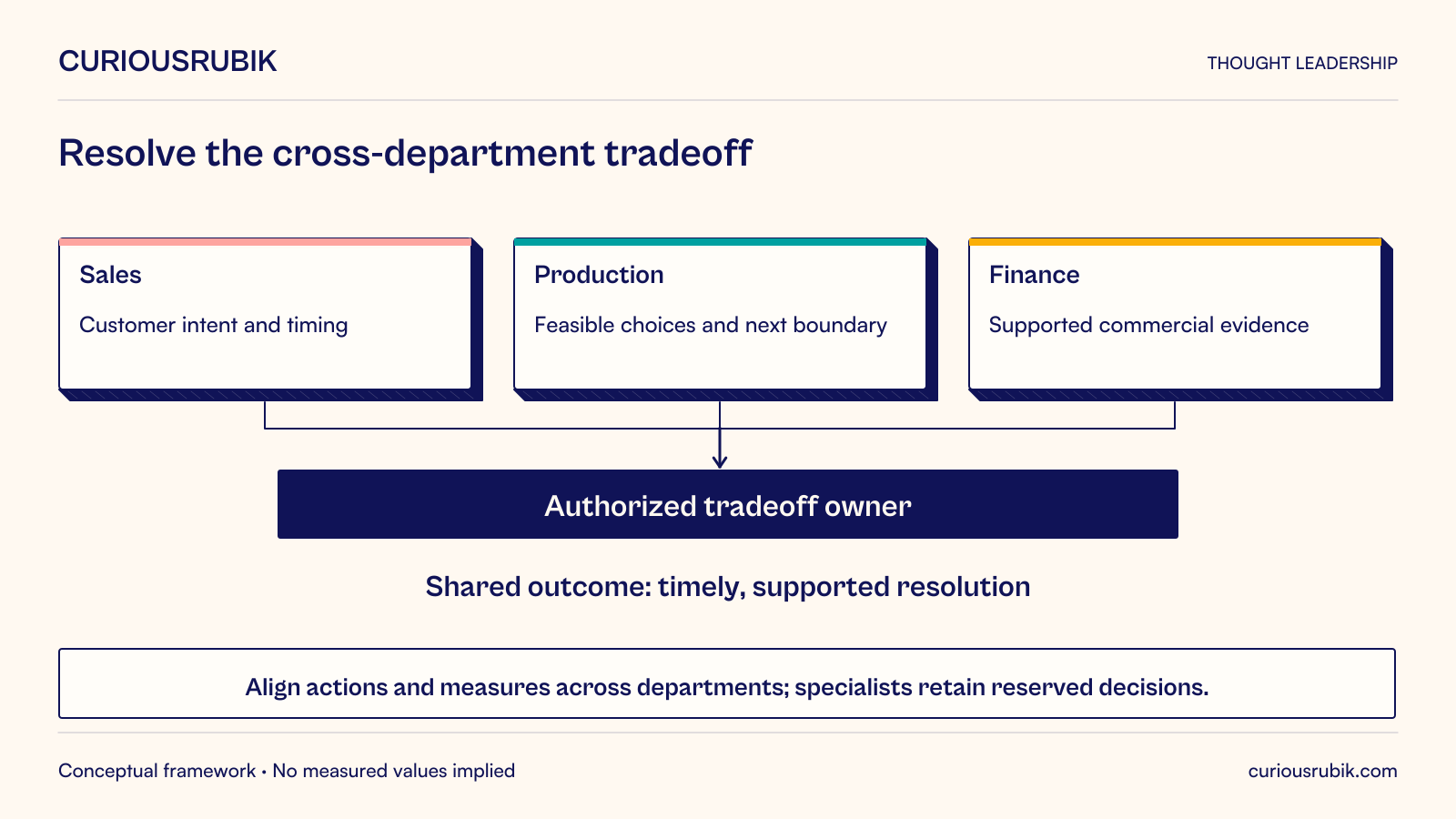
Sales wants to reassure a customer immediately. Production wants to keep an already scheduled job moving. Finance wants evidence before agreeing the commercial disposition. Each position can be reasonable, yet the customer may wait while the departments defend different measures of success.
Operational silos become damaging when those local priorities prevent the enterprise from making a coherent decision. Shared data helps, but it does not determine whose objective should prevail or who may accept the tradeoff. Removing functional expertise is not the answer either; the business still needs sound commercial, production, and financial judgment.
A practical way forward is to organize material cross-department decisions around a shared outcome, a common evidence packet, and explicit tradeoff authority. The hypothetical custom-fabrication cancellation below shows how that can work. The focus is the management decision and incentives, not a technical map of transaction states or a claim about contractual cancellation rights.
Choose a recurring case that crosses departments and has a material consequence. Trace what each team is trying to protect, which measure influences its behavior, and what it needs from the others. A slow handoff may be the result of incompatible priorities rather than poor communication.
Ask each team what a successful outcome looks like. Sales may emphasize a timely customer answer, production may emphasize schedule stability, and finance may emphasize a supported commercial result. Those goals can coexist, but not every case permits all of them to be optimized simultaneously.
Identify who currently resolves the conflict. If the answer is whoever has the strongest informal relationship or escalates most loudly, the business has an implicit decision rule. That rule may be fast for familiar cases and unfair or unreliable for others.
Keep the analysis specific. “Departments do not collaborate” is a diagnosis too broad to act on. “No role can decide whether to stop this job before the next irreversible production step” exposes a concrete authority and timing problem.
Imagine a hypothetical company fabricating branded display stands. A customer asks to cancel an order after materials have been prepared but before the next significant production step. The actual commercial rights and obligations require review under the company’s approved process; the example assumes no particular legal outcome.
Sales wants to preserve the relationship and provide a quick answer. Production has allocated a work slot and is measured on schedule adherence. Finance needs a credible estimate of work already incurred, recoverable materials, and the proposed commercial treatment. Each team can appear responsive internally while the overall decision remains unresolved.
The company establishes a short cross-functional disposition review for this class of case. Sales brings the customer’s request and relevant timing. Production brings the current work position, the next decision boundary, and feasible alternatives. Finance brings the information needed to assess the proposed treatment. Qualified commercial or legal owners participate where the actual issue requires them.
The review compares genuine options: stop and retain usable material, redirect the slot to other authorized work, or continue only if the approved commercial decision supports that course. It does not assume that keeping the line busy is best or that an immediate concession is always the right customer response.
The designated tradeoff owner selects an authorized course, with the necessary specialist decisions preserved. The result changes the production instruction, customer response, and financial follow-up under the approved process. The meeting is useful because it resolves the conflicting priorities before the next material consequence, not because everyone has seen the same dashboard.
Afterward, management reviews whether departmental measures encouraged delay or premature promises. If stopping an unsuitable job always harms the production team’s score, the organization should revise how that legitimate decision is recognized. Otherwise, the same silo behavior will return despite a new meeting format.
Use an outcome that includes the recipient’s need and the enterprise’s obligations. For the cancellation case, that may be a timely, authorized resolution with a clear account of the operational and commercial consequences. It should not be reduced to one department closing its task.
Agree which measures are diagnostic and which represent the complete result. Local schedule adherence or response time can help explain performance, but neither alone establishes a satisfactory resolution. Retain useful local measures while preventing them from becoming conflicting definitions of success.
Make the tradeoff rule explicit where repeatable. Some cases may fit an approved policy and remain local. Others require cross-functional judgment. Do not convene a group for every routine transaction merely to demonstrate collaboration.
Review whether the shared outcome is actually within the participants’ influence. A team cannot be accountable for a customer result if it lacks access to the relevant decision-maker or the authority to change the work. Align responsibility with a legitimate route to act.
Define the trigger for joint review, the required participants, minimum evidence, and latest useful decision point. Keep the forum small enough to decide and broad enough to represent the material consequences. Attendance without authority creates another waiting room.
Use a coordinator to assemble the case and track follow-through, but do not assume coordination itself grants commercial or technical authority. The organization must identify who can settle the remaining tradeoff within its approved delegation.
Malone and Crowston’s coordination research examines how dependencies between activities can be managed, including shared resources and producer-consumer relationships. It offers a useful lens for boundary design, not proof that a meeting or shared platform eliminates silos. The Interdisciplinary Study of Coordination, 1994
Establish a fallback when required evidence or authority is unavailable. The business should know what work can pause, what must continue under existing rules, and who can escalate. Silence should not be interpreted as permission to make the most convenient local choice.
Rehearse a case in which a normal participant is absent and another in which the departments disagree on the preferred option. The process should still identify legitimate cover or escalation, preserve the unresolved question, and prevent an unsupported promise. A forum that works only when its original participants personally agree has not yet replaced the informal coordination on which the business depended.
Look for measures that count local completion while exporting unresolved work. A sales team may mark a request handled when it sends it to operations. Operations may close its task after supplying an estimate, while finance still lacks the decision needed to act. The customer has not necessarily received a resolution.
Measure end-to-end elapsed time and unresolved cases under consistent boundaries. Include the cost of repeated clarification and work caused by conflicting instructions. Those observations help identify where local success conceals enterprise failure.
Avoid replacing every departmental measure with one broad enterprise score. Specialists still need measures that reflect their responsibilities and quality. The design should connect them to the shared outcome and recognize legitimate tradeoffs.
Review unintended incentives after changes. A target for rapid joint decisions can encourage premature closure if evidence is weak. Pair speed with correctness, appropriate authority, and reopened cases. The goal is a better decision process, not a faster way to suppress disagreement.
Bring teams together to examine representative cases, including ones that worked well. Seeing the constraints another department faces can change an assumption that looks unreasonable from a distance. The conversation is more useful when grounded in evidence rather than a general appeal for teamwork.
Create opportunities for people to observe adjacent work where appropriate. A commercial coordinator who understands production decision timing can request information earlier. A production planner who understands the customer commitment can distinguish a genuine urgent decision from an ordinary preference.
Keep disagreement legitimate. Finance should be able to challenge unsupported commercial treatment, and operations should be able to challenge an impossible promise. Cross-functional work should improve the quality of that disagreement and its resolution, not require every specialist to agree with the most influential voice.
Capture reusable lessons. If several cancellation cases reveal the same missing information, improve the originating process. If the conflict is driven by policy, escalate that policy rather than repeatedly negotiating the same exception among individuals.
A shared case view can hold the relevant facts, options, decision, and owner. It should make uncertainty visible and keep the current evidence accessible to authorized participants. The technology supports the operating agreement; it does not create the tradeoff policy.
Automate stable coordination where useful, such as requesting required evidence, alerting the right owner, and tracking unresolved actions. Avoid automating a final disposition when the business has not agreed the rule or authority.
Preserve appropriate information boundaries. Cross-functional visibility does not require unrestricted access to every customer, employee, or financial record. Provide the information each participant needs for the decision under the approved access model.
The fabrication company can begin with one recurring conflict and test whether its new review produces a timely, supported decision that reaches every affected team. If the old incentives remain or authority is still unclear, more collaboration software will add little. Operational silos diminish when departments can protect their expertise while participating in a coherent enterprise choice, with shared evidence and consequences they are prepared to own together.