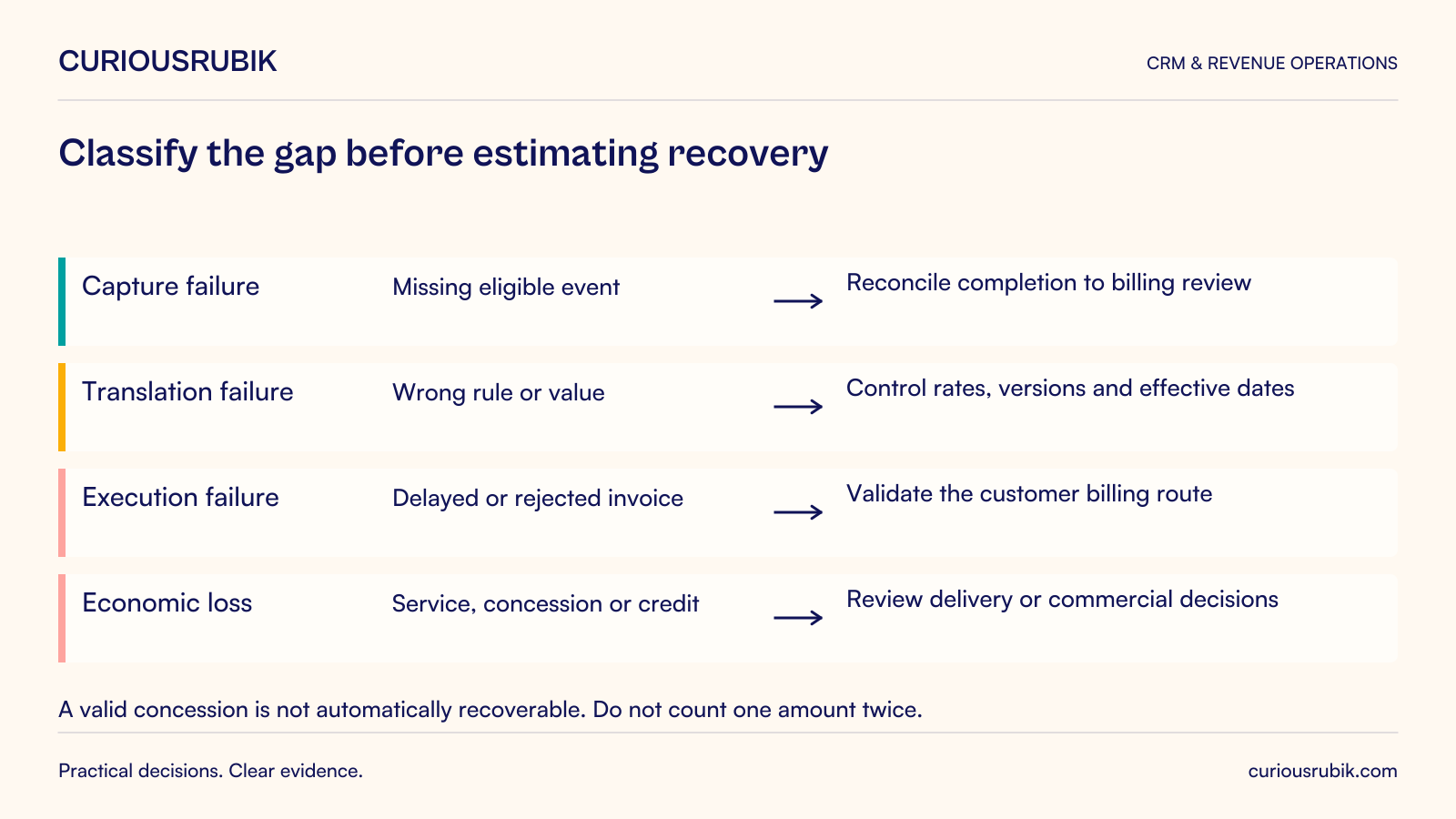
A missing invoice, an unauthorized discount and a customer credit issued after a service failure can all reduce expected receipts. They should not be diagnosed as the same problem. One may be an operational omission, another a control failure and another a legitimate response to an obligation the business did not fulfill.
For a CFO or revenue-operations leader, the first step in reducing leakage is to define what the business was entitled and able to earn under the actual arrangement. Then compare that baseline with what was delivered, billed, adjusted and collected. A program that labels every difference from the original sales target as leakage will overstate the opportunity and may encourage inappropriate billing.
The title expresses an improvement objective, not a promise that every loss can be eliminated. The practical goal is to prevent avoidable gaps, detect them early and recover amounts only when the underlying terms, evidence and customer situation justify doing so.
A quoted list price is not automatically the amount owed by the customer. Discounts, rebates, amendments, service credits and volume terms may be valid parts of the agreement. Some commercial expectations may never have become commitments at all.
Build the baseline from the authoritative accepted arrangement and subsequent authorized changes. Preserve the relevant version, effective dates, included services, quantities, billing conditions and responsibilities. Finance and the appropriate commercial or legal owner should resolve ambiguity rather than asking an analyst to infer entitlement from a CRM amount.
Separate operational analysis from accounting treatment. An unbilled item, a receivable, a forecast opportunity and recognized revenue are different concepts. IFRS 15’s core model connects recognition to promised goods or services and performance obligations; it does not equate every sales expectation or invoice with revenue. The correct treatment depends on the applicable framework and facts. IFRS 15 overview.
The leakage register should therefore use precise descriptions such as “completed service awaiting billing review” or “unapproved rate difference,” rather than labeling every item “lost revenue.” This improves both investigation and reporting.
The first gap is a capture failure: eligible work or a valid commercial event does not enter the process that should review it for billing. For example, an approved additional visit may be recorded in a field-service application without reaching the contract administrator.
The second is a translation failure: the event arrives, but the wrong rate, quantity, entity, currency or effective period is applied. A price update can exist in one system while another continues using an older rule. The remedy may involve master-data ownership and version control rather than more collection activity.
The third is an execution failure: a valid invoice or request is delayed, rejected or sent through a route the customer cannot process. Missing purchase-order references or incorrect customer entities can create disputes even when the underlying work is legitimate.
The fourth is an economic loss requiring a different intervention: a service failure, an approved concession or a credit issue. These may deserve attention, but cannot all be recovered through better billing. Some arise from the value proposition, delivery quality or commercial risk accepted by management.
These categories are a proposed diagnostic aid. An item can involve more than one cause. Choose a primary classification for a reconciled amount and retain other explanatory tags without adding the same amount repeatedly to the opportunity total.
Consider a hypothetical facilities-maintenance provider. All figures are invented for explanation. Its customer contract includes a standard monthly service and separately approved additional visits at an agreed rate. A customer authorizes four additional visits at $500 each, and completion evidence exists for all four.
The operational record contains $2,000 of additional approved work. Only three visits reach the billing-review queue, so the initial capture gap is one $500 visit. This is a candidate for investigation, not an automatic instruction to charge the customer. The reviewer must confirm authorization, completion, absence of prior billing and any subsequent agreement affecting the amount.
The three recorded visits are then billed using an obsolete $450 rate. If the $500 rate is confirmed as applicable, the translation difference is $150 across those three visits. The candidate differences total $650: the missing $500 visit plus three $50 rate differences. They do not total $2,000, and the unrecorded visit should not also receive a separate $50 difference in this calculation.
Now suppose the company grants a properly approved $200 credit for a documented failure in the standard monthly service. That credit belongs in the commercial reconciliation, but it is not added to the $650 billing-error opportunity. Its remedy concerns service performance or contract economics. Treating it as recoverable leakage could produce an unjustified collection request.
Finally, suppose one invoice is paid late. The outstanding amount and delay may matter to cash management, but should not be counted again as a permanent revenue loss merely because the earlier billing process had defects. The register needs distinct amount, timing and recovery-status fields.
For each item, record the customer and contract reference, source event, expected treatment, actual treatment, difference, evidence, owner and next action. Add the confidence level and reason: confirmed mismatch, plausible mismatch awaiting evidence, or unresolved commercial interpretation.
Keep confirmed, investigatory and hypothetical amounts separate. A management report should not combine them into a single recovery target. Also distinguish gross identified difference from approved correction, invoice adjustment, cash collected and ongoing prevention. Those are separate stages, not interchangeable measures of success.
Where an amount involves currency conversion, document the rate and date convention used. Where a period spans a price change or contract amendment, identify the applicable effective dates. A technically correct comparison between incompatible periods can still produce a false exception.
Record the customer’s explanation. A rejected invoice may reveal that the service record is wrong or that a salesperson agreed a change that was never transmitted internally. The objective is a truthful commercial record, not maximizing the amount the investigation can claim to have found.
Large historical items deserve attention, but the best improvement target may be a smaller recurring failure with a clear cause. Compare frequency, amount, customer consequence, investigation effort and ability to prevent recurrence.
For capture failures, reconcile operational completion records to billing-review records with explicit timing allowances. For translation failures, control authoritative rates and effective dates, and test representative boundary cases. For execution failures, validate customer billing requirements before the first invoice. For economic losses, examine the commercial or delivery decision that produced them.
Do not assume that automation is the first remedy. If employees cannot determine which rate applies, automating the current lookup may make the ambiguity faster and less visible. Resolve the ownership and rule first, then automate a bounded, testable decision.
Design exception handling with a clear stop condition. An uncertain item should enter a review queue with an owner; it should not generate repeated invoices or customer messages while the underlying entitlement is unresolved.
A recovery action can affect a customer relationship and may involve contractual or accounting judgment. Have the authorized team confirm the evidence, proposed correction and communication before acting. The operational analyst’s identification of a mismatch is not itself approval to invoice, collect or reverse an adjustment.
Consider practical recoverability as well as theoretical entitlement. The business may choose a documented commercial resolution, subject to its approval policy, because the evidence is incomplete or the cost of dispute is disproportionate. That decision should remain visible rather than being disguised as a data correction.
Feed the outcome back into the detection rule. If a category repeatedly produces false positives, change the rule or required input. If valid exceptions repeatedly depend on one employee’s memory, improve the record and decision ownership. A control that overwhelms the team with irrelevant cases can delay the cases that matter.
Report confirmed corrections and actual collection separately from modeled future prevention. Future avoided leakage is an estimate requiring a baseline, volume assumption and evidence that the fix remains effective. A one-time recovery does not automatically recur every month.
Measure the operational side too: time from service completion to billing readiness, rate-rule mismatch frequency, rejected invoices and unresolved exception age. Pair these with customer disputes or correction reversals so that a drive for faster billing does not reduce accuracy.
Avoid double counting across sales, finance and operations programs. If a data fix prevents an incorrect invoice and reduces collection effort, explain both effects, but do not record the same invoice value as a recovered sale, an avoided loss and an efficiency saving.
A credible leakage program begins with a few traceable transactions and ends with a better-controlled commercial lifecycle. Choose one offering, reconcile accepted terms to operational events and billing outcomes, and separate confirmed omissions from valid concessions. The most valuable result is a process that can explain what the customer owes, why, and what the business must do to earn and collect it properly.