Enterprise data is AI-ready when a specific version can support a defined task, with known provenance, permitted use, representative evidence, and reproducible evaluation. Readiness is not a property of a storage platform or a large file count. The release must preserve what each observation means and which conditions the data can actually represent.
For a data-product owner preparing a vision dataset of outbound cartons, the immediate decision is whether a proposed release faithfully represents the physical cartons and capture conditions needed for development. Several photographs of one carton are related observations, not several independent cartons. Images taken after a repair describe a different state from images taken before it.
The task considered here is classifying visible external condition from prescribed views to support a bounded analytical use. It does not certify package integrity, detect hidden defects, or authorize automatic acceptance. The article focuses on preparing and releasing the dataset, rather than designing the inspection response process.
Specify the physical object, required views, capture stage, and intended output. A carton identifier should link its photographs, capture metadata, and annotation record. A file identifier should distinguish each image without pretending that every file is an independent example.
Define which surfaces must be visible and which conditions make a view unusable. An image can be technically readable while showing the wrong side, a heavily occluded surface, or a carton too small in the frame to assess. File integrity and task suitability are separate checks.
Preserve relationships to product family, production lot, camera, location, and capture session where relevant and permitted. These attributes help explain whether an apparent model result reflects the intended visual evidence or an incidental background or acquisition pattern.
NIST’s January 2023 AI Risk Management Framework explicitly includes data availability, representativeness, and suitability in its mapping considerations. It provides a risk-management reference; it does not establish that a particular collection of images is fit for this task. NIST AI RMF 1.0, MAP 2.3
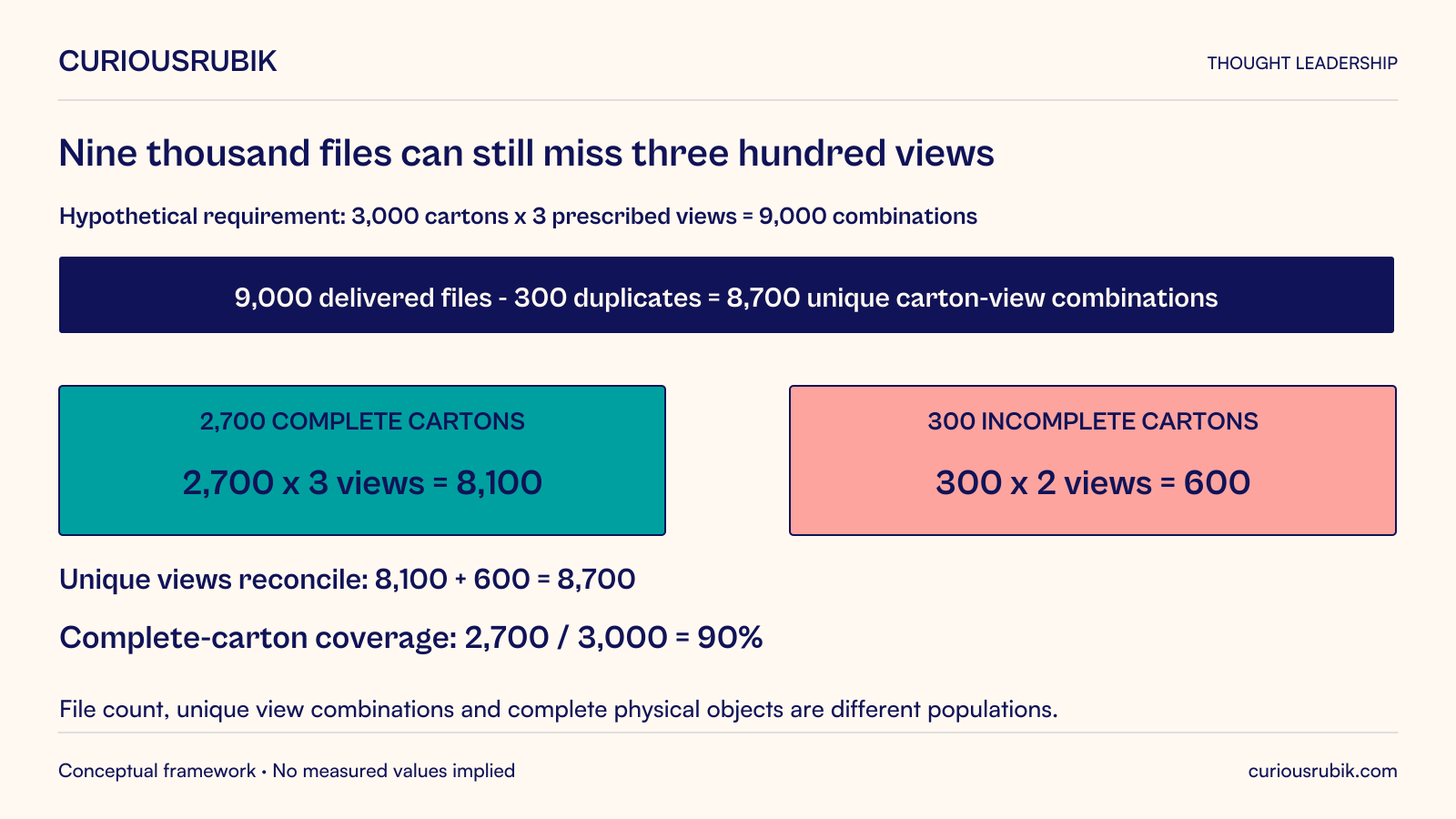
Suppose a hypothetical collection covers three thousand cartons and requires three distinct prescribed views per carton. The expected population is nine thousand unique carton-view combinations. The delivery also contains nine thousand image files, so a file-count check appears to pass.
A manifest review finds three hundred duplicate files occupying already represented carton-view combinations. There are only 8,700 unique combinations. Three hundred cartons are each missing one required view; the remaining 2,700 cartons have all three.
The complete-carton population therefore contains 8,100 unique images: 2,700 multiplied by three. The three hundred incomplete cartons contain six hundred usable views in total, while the three hundred duplicate files remain separately identified. These categories account for all nine thousand delivered files without inventing the missing views.
If the release requires complete three-view examples, it can include 2,700 cartons and hold three hundred as incomplete. That is 90 percent of the intended carton population. It is not evidence that the dataset is 100 percent complete merely because the raw file count equals the expected view count.
The next question is why views are missing. If the missing angle is concentrated at one camera or for one product shape, excluding those cartons may systematically narrow the release. The data owner should report that limitation and decide whether recapture, a narrower task, or a separately defined partial-view dataset is appropriate.
All quantities are hypothetical. The example demonstrates why release acceptance should reconcile physical objects, required views, usable evidence, duplicates, and exclusions as distinct populations.
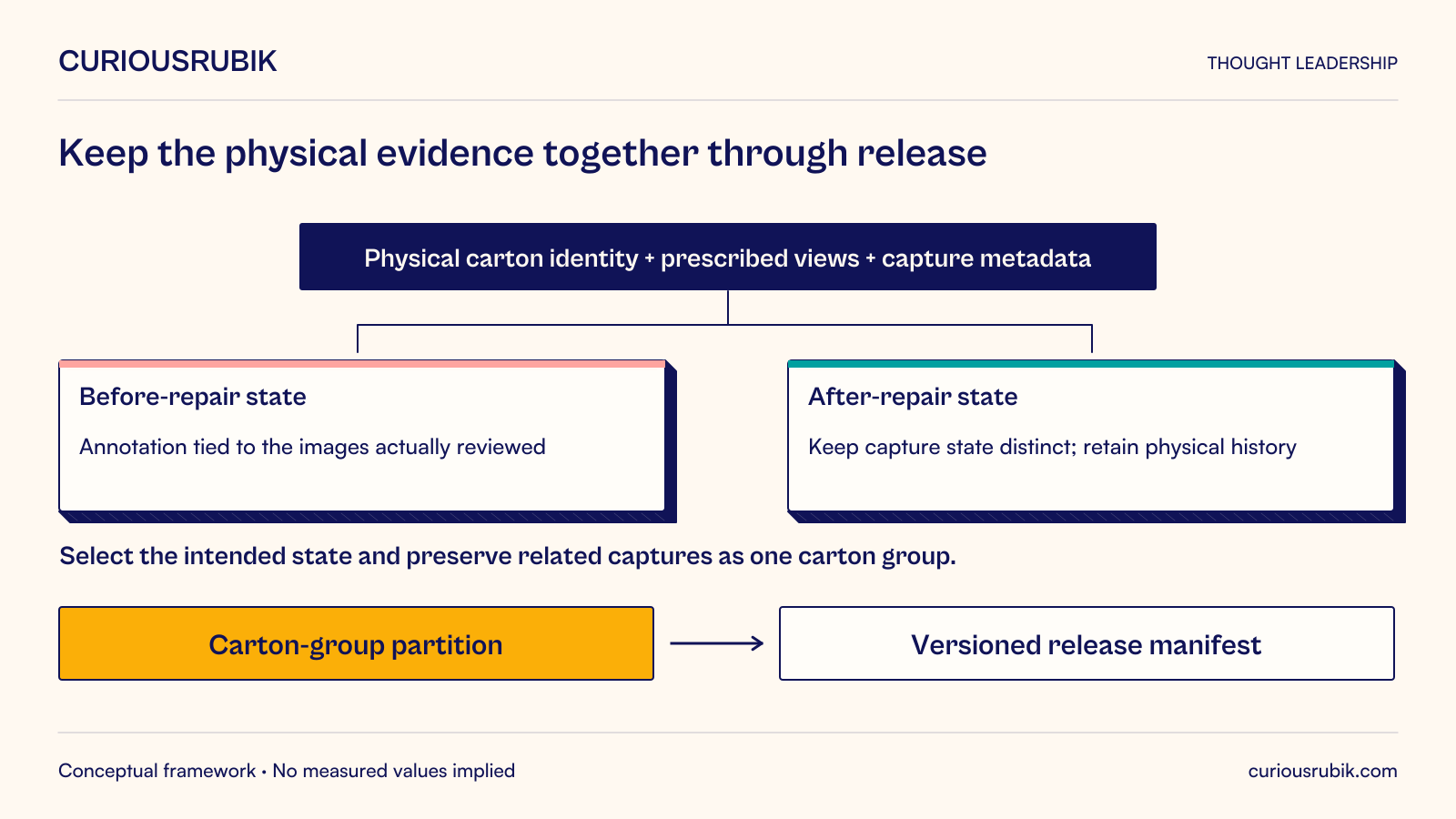
A carton may be photographed, repaired or repacked, and photographed again. The images belong to the same physical history but represent different states. A release needs a capture-stage field and an evidence trail that establishes which state each image records.
Do not pair an original-condition label with a post-repair image because both share the same carton identifier. Nor should a later acceptable image silently replace the earlier evidence. Preserve the relationship among the original capture, intervention, and later capture so the dataset can select the intended state deliberately.
Check the labeling interface as well as the storage model. If reviewers see a mixture of stages without clear context, they may produce a label that is reasonable for one image and wrong for the released example. The annotation record should identify exactly which images were reviewed.
Where stage information cannot be established, mark the uncertainty. A guessed timestamp sequence may be insufficient if clocks differ or uploads are delayed. The release can exclude or separately classify such examples, but it should account for them and explain the resulting coverage gap.
Define the target in terms of visible evidence. “No visible damage in the prescribed views” is a narrower statement than “the carton is undamaged.” An occluded flap cannot support a confident label about whether that flap is sealed.
The annotation guide should distinguish observable condition, ambiguous evidence, and unobservable condition. Reviewers need examples of each and a route to resolve disagreements. Some disagreements will reveal inadequate views or an unclear target rather than a need for a more forceful labeling rule.
If the task uses mutually exclusive classes, specify how overlapping conditions are handled. A carton can have both surface damage and an open flap. The dataset may need multiple labels, an approved precedence rule, or a different task formulation. Do not force exclusivity merely because a training interface expects one label.
Audit a sample of annotations against the actual released views. Check that the label refers to the right carton, capture stage, and visible region. A perfectly consistent annotation format can still connect the wrong evidence to the wrong target.
All views and relevant repeated captures of the same physical carton should be treated as a related group when constructing development and evaluation populations. Randomly distributing image files can put one view in training and another view of the same carton in evaluation.
That split may allow the model to exploit familiar marks, backgrounds, or object-specific features. It would not test performance on a genuinely new carton in the way the intended release claims. Grouping by carton is therefore a basic design requirement for that evaluation purpose.
Additional grouping depends on intended use. If the model must work on new product families, lots, cameras, or locations, the evaluation needs to examine those changes. Holding out a camera can test a different question from holding out cartons photographed by familiar cameras. Document which question each partition answers.
Do not promise generalization beyond the tested conditions. A dataset from one lighting arrangement or packaging material may be valuable for a bounded task while providing little evidence about another. The release should expose that boundary instead of treating an overall score as proof of broad readiness.
Report the distribution of relevant conditions across development and evaluation partitions: product family, camera, capture stage, view availability, and annotation category where appropriate. Small or absent populations need explicit attention.
An aggregate result can hide poor performance on a rare visible condition. That observation should trigger investigation of the dataset’s coverage, label evidence, and task observability. It should not automatically be blamed on the model or treated as a reason to collect more examples of the already dominant class.
Keep excluded populations visible in the release report. The three hundred incomplete cartons in the hypothetical example are not part of the complete-view evaluation, but they remain part of the operational capture process the organization may eventually want to support. Removing them from the denominator without explanation would overstate coverage.
Distinguish development experimentation from a production acceptance claim. A dataset can be suitable for exploring a model while still lacking the population coverage or evidence needed to support deployment. Its release status should make that difference clear.
The manifest should connect carton IDs, image IDs, view types, capture stages, annotation versions, source references, and partition assignments. Record the selection and exclusion rules, transformations, permitted uses, and known limitations. Preserve the procedure needed to rebuild the release.
Use version identifiers and content checks to distinguish releases and detect unintended file changes. A renamed folder is not sufficient evidence that two evaluations used the same data. Record annotation corrections separately from image-processing changes so their effects can be investigated.
W3C’s Data on the Web Best Practices addresses provenance, quality information, and versioning for shared datasets. These are useful foundations for a release manifest, while the acceptance criteria for carton imagery remain task-specific. W3C Data on the Web Best Practices, Sections 8.4–8.6
Confirm permitted use and processing destinations with the appropriate owners. Images may contain labels, people, customer information, or commercial details beyond the carton condition. Minimize unnecessary content and control access without assuming that possession of the files grants unlimited reuse rights.
Identify what reopens acceptance: a new camera setup, changed lighting, different packaging material, altered view protocol, revised annotation policy, or a new intended use. The underlying files can remain unchanged while their suitability for the new task changes.
If a defect is discovered, trace affected releases, evaluations, and models. Correcting an annotation file does not automatically update conclusions previously drawn from it. The responsible teams need to decide which results must be rerun or withdrawn.
There are tradeoffs. More views increase acquisition and review effort. Stricter completeness rules can improve interpretability while excluding important operational conditions. Rich provenance supports reconstruction but requires disciplined storage and access management. Choose these tradeoffs explicitly for the bounded task.
Before releasing the next dataset, ask an independent reviewer to reconstruct one carton from source capture through annotations and partition assignment. Then reconcile the whole population of objects, views, duplicates, and exclusions. An AI-ready release is credible when another team can reproduce what the data contains and understand exactly which claims its evidence can support.