An integration creates a path for data and authority to move between systems. Securing each application separately does not establish that the combined path grants only the intended access. A connector can authenticate successfully while carrying excessive privilege, accepting untrusted business attributes, or exposing data to an unnecessary destination.
For a security and integration lead, the immediate decision is how to bound each workload’s authority across the full flow. The design should identify the calling identity, permitted source data, destination operations, execution environment, and evidence available for review. A diagram showing only applications and arrows omits the permissions that make those arrows consequential.
Start with the integrations that can change important records or move sensitive information. Trace their actual identities and grants before selecting additional security products. The first useful improvement may be removing an unnecessary permission or separating a privileged execution path.
For every material flow, record the producer, consumer, workload identity, authentication method, permitted operations, data scope, credential owner, and operating owner. Include intermediate platforms and queues, not only the source and final destination.
Distinguish the identity of the integration from the identity of a user whose action initiated it. Some operations run under a service’s own bounded authority; others must preserve a delegated user’s context. The receiving system needs an explicit rule for which authority applies.
Do not infer trust from network placement. NIST’s Zero Trust Architecture states that network location or asset ownership alone does not grant implicit trust. Its relevance here is the need to evaluate access to the resource, not a requirement to buy a particular platform. NIST SP 800-207, Introduction and Tenets
The authority map should reveal where a narrow business purpose has become broad technical access. A shipment-status publisher may need to update a defined projection; it should not automatically receive administration rights over unrelated customer, product, or financial records.
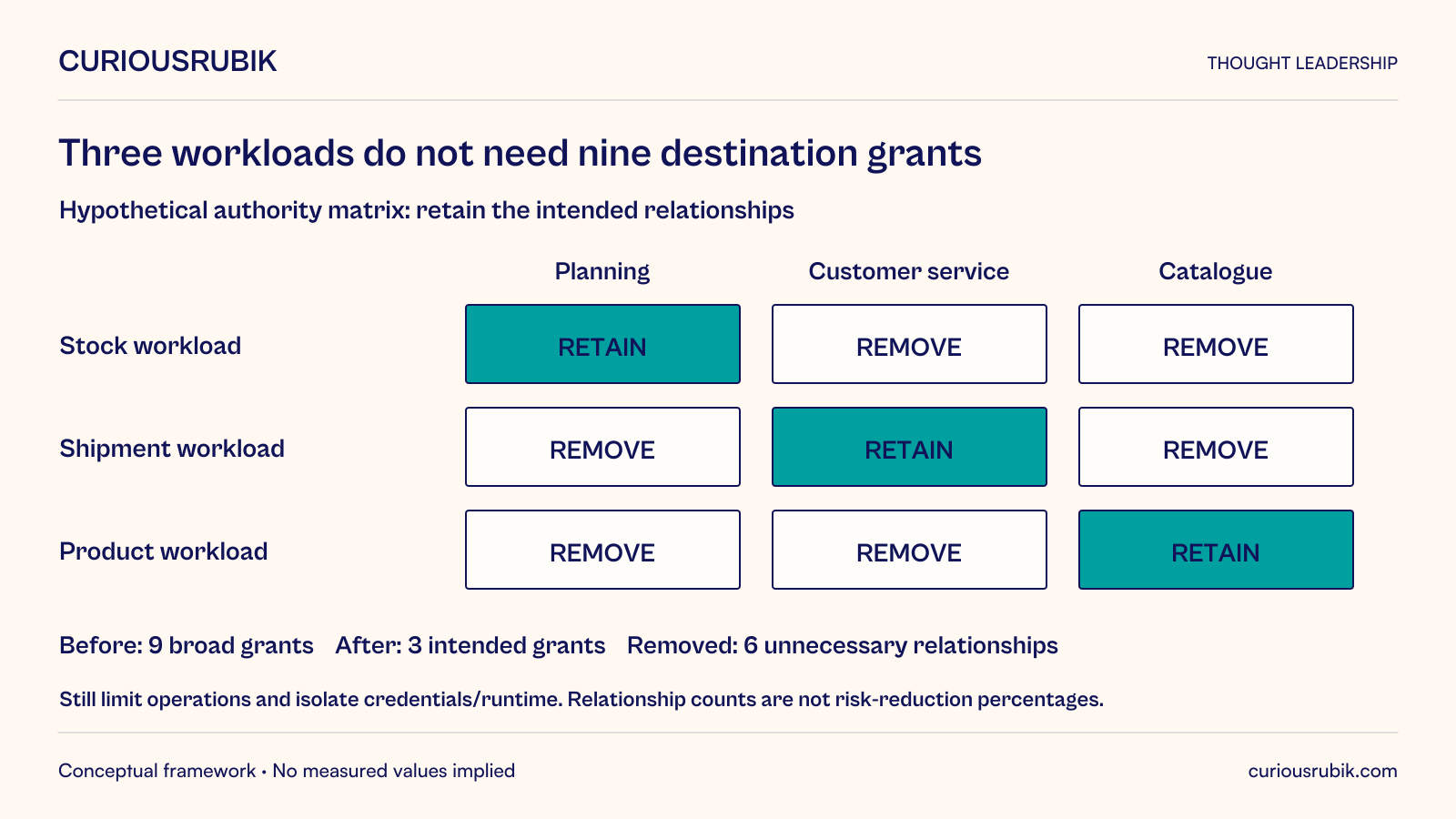
Suppose a hypothetical organization has three integration workloads: warehouse stock to planning, shipment status to customer service, and product descriptions to the catalogue. Each workload has its own identity, but each identity has been granted access to all three destination applications for convenience.
That creates nine identity-to-destination grants. The intended flows require only three of those relationships: each workload to its specified destination. Removing the six unnecessary relationships narrows the access map, assuming no additional legitimate use has been overlooked.
The work is not finished at three grants. Each remaining relationship also needs an appropriate operation and data scope. The stock workload may write only the planning stock projection, the shipment workload only the relevant status records, and the product workload only approved catalogue attributes under its contract.
Nor do three separate identity names establish isolation. If one shared runtime lets any flow read every credential or execute arbitrary privileged configuration, compromise of one component may still reach the other identities. The execution and secret-access boundaries must support the intended separation.
This example is hypothetical. Nine grants reduced to three is a count of unnecessary relationships removed, not a claim of a two-thirds reduction in risk. The consequence of each remaining permission and the strength of the surrounding controls still matter.
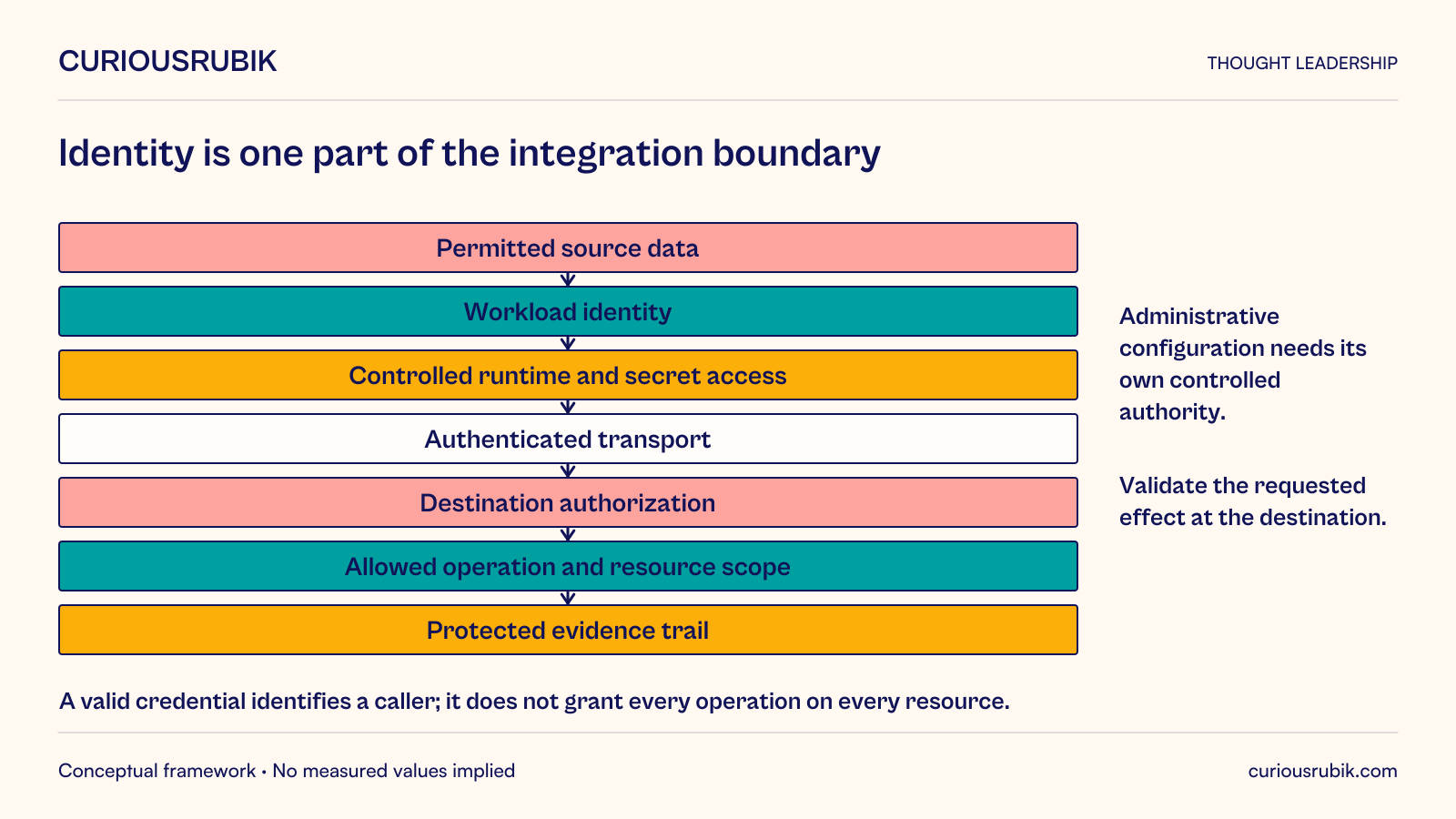
Authentication establishes an identity under a defined mechanism. Authorization determines whether that identity may perform the requested operation on the relevant resource. A valid credential should not convert every supplied object identifier or field value into trusted instruction.
The destination should enforce the contract at its trusted boundary. For a status update, validate the record identity, permitted transition, relevant source authority, and fields the workload may change. Reject or route unsupported changes rather than accepting a general-purpose record update simply because it came through an approved connector.
OWASP ASVS 4.0.3 includes authenticated component communications and least-necessary component privileges. Its access-control requirements also call for trusted-layer enforcement and protection of policy attributes. These principles support a bounded integration contract; they do not prove that a connector’s default configuration is appropriate. OWASP ASVS 4.0.3, V1.2 and V4.1
Treat authorization-relevant metadata carefully. If a message includes an entity, location, or scope field, establish whether that value is independently checked or trusted from a controlled source. An integration should not be able to widen its authority merely by changing a field in its payload.
Secure transport and endpoint authentication help protect communication. They do not establish that the business content is correct or that the sender is entitled to request every action. The receiver still needs schema, semantic, and authorization checks appropriate to the flow.
For asynchronous work, preserve the originating context needed to evaluate the request and investigate it later. Define how the consumer treats a message whose authority or business validity has changed while it waited. The policy may depend on whether the message records a completed fact or requests a future action.
Avoid placing executable instructions or unrestricted configuration inside ordinary data messages. If the integration legitimately supports a command, define a bounded command set and validate its parameters through the authorized service. The ability to deliver data should not imply the ability to run arbitrary operational logic.
Limit topic, queue, and subscription access to intended producers and consumers. A shared broker can simplify transport while making broad read access easy to overlook. Data minimization should apply to payloads and subscriptions, not only to the original application screen.
Each workload credential needs a responsible owner, a defined purpose, a supported storage mechanism, and a process for replacement and revocation. Avoid embedding secrets in source code, broad-access configuration files, logs, or message payloads.
Use the organization’s approved identity and secret-management capabilities. Where short-lived workload credentials are supported and appropriate, evaluate them against availability and operational requirements. Where longer-lived credentials remain necessary, their scope, access, rotation, and incident response need explicit control.
Test replacement before an emergency. Confirm that a credential can be changed without an undocumented manual step, that the old credential is no longer effective when intended, and that failed authentication creates a clear operational signal. A rotation procedure that nobody can execute safely tends to be deferred.
Account for environments. Development and test flows should not gain production authority through reused credentials or a copied connection definition. Promotion should apply the reviewed logic with the correct environment-specific identities and destinations.
An operator who can monitor a flow does not necessarily need to edit its destination, expand its permissions, or replace its code. Identify the consequential configuration actions and apply appropriate approval, access, and evidence requirements.
A change to a destination URL, resource scope, transformation, or service identity can alter the security boundary without changing the business application’s code. Include these changes in the controlled release process and test their effects.
Review shared administrative paths. Platform administrators may be able to retrieve credentials, impersonate workloads, or alter audit settings. Those capabilities require an accountable operating model. Renaming the account or placing it behind the corporate network does not reduce its effective authority.
NIST SP 800-53 Revision 5 addresses access enforcement and least privilege as distinct controls. The catalogue supports tailoring privileges to authorized work; it does not prescribe an identical permission model for every integration estate. NIST SP 800-53 Revision 5, AC-3 and AC-6
Test the intended operation and the nearby operations that should remain denied. The shipment workload should be unable to alter product descriptions or use an unrelated entity scope. The test environment should be unable to reach production through its normal identity.
Perform these tests in an authorized environment with controlled data. The purpose is to verify the designed boundary, not to probe third-party systems without permission. Record expected outcomes and preserve the tests as regression evidence when connections or policies change.
Log the workload identity, operation, relevant resource reference, outcome, and correlation information needed for investigation. Protect the logs and minimize sensitive payload content. An evidence trail should help establish which authority was used without becoming another uncontrolled data store.
Monitor unexpected grant changes and unusual use according to the risk. A denied request is not automatically malicious, but repeated attempts outside a workload’s purpose may justify investigation. Assign an owner who can distinguish a configuration defect from a security incident and take the authorized containment action.
Review the authority map when a flow is repurposed, a new destination is added, an application changes its API, or a shared runtime is reorganized. A permission granted for a temporary migration should not become permanent by default.
There are tradeoffs. Narrower identities and execution boundaries add configuration and support work. Excessively fragmented policies can become difficult to maintain. Choose boundaries that match meaningful differences in data, consequence, and ownership, and make those boundaries testable.
Start with one broad integration identity. List every destination and operation it can reach, compare that access with its actual purpose, and verify both allowed and denied behavior. Integration security improves when the authority crossing each boundary is explicit, limited, and supported by the runtime that carries it.