An automation business case often begins with minutes saved per transaction. That is a useful input, but it is several decisions away from return on investment. The organization still has to establish which work disappears, what new work is created, how released capacity is used, and whether any cash expenditure actually changes.
A credible ROI model follows the benefit from operational change to economic consequence. It also compares the result with what would have happened without the investment, includes the full operating cost, and respects the timing of adoption.
For a CFO or automation sponsor, the central decision is whether the proposed intervention creates enough attributable value to justify its cost and risk. The calculation should make that decision clearer, including when the answer is that the project is operationally useful but does not meet the claimed financial threshold.
Define the process, population, time horizon, and alternative. The comparison might be the current process, a planned replacement, a simpler configuration change, or a different operating design.
“Do nothing” is not always the same as maintaining today’s cost forever. Demand may grow, a contract may expire, or an unsupported tool may require replacement. Include justified changes in the baseline and distinguish them from assumptions that favor the proposed project.
Use the same scope for costs and benefits. A benefit estimate covering several departments should include the effort those departments contribute to design, testing, data repair, and continuing operation.
Choose a meaningful horizon. A short-lived workflow may not justify a long assumed benefit stream. Conversely, a durable process may require periodic upgrades or rule changes that belong in later-year costs.
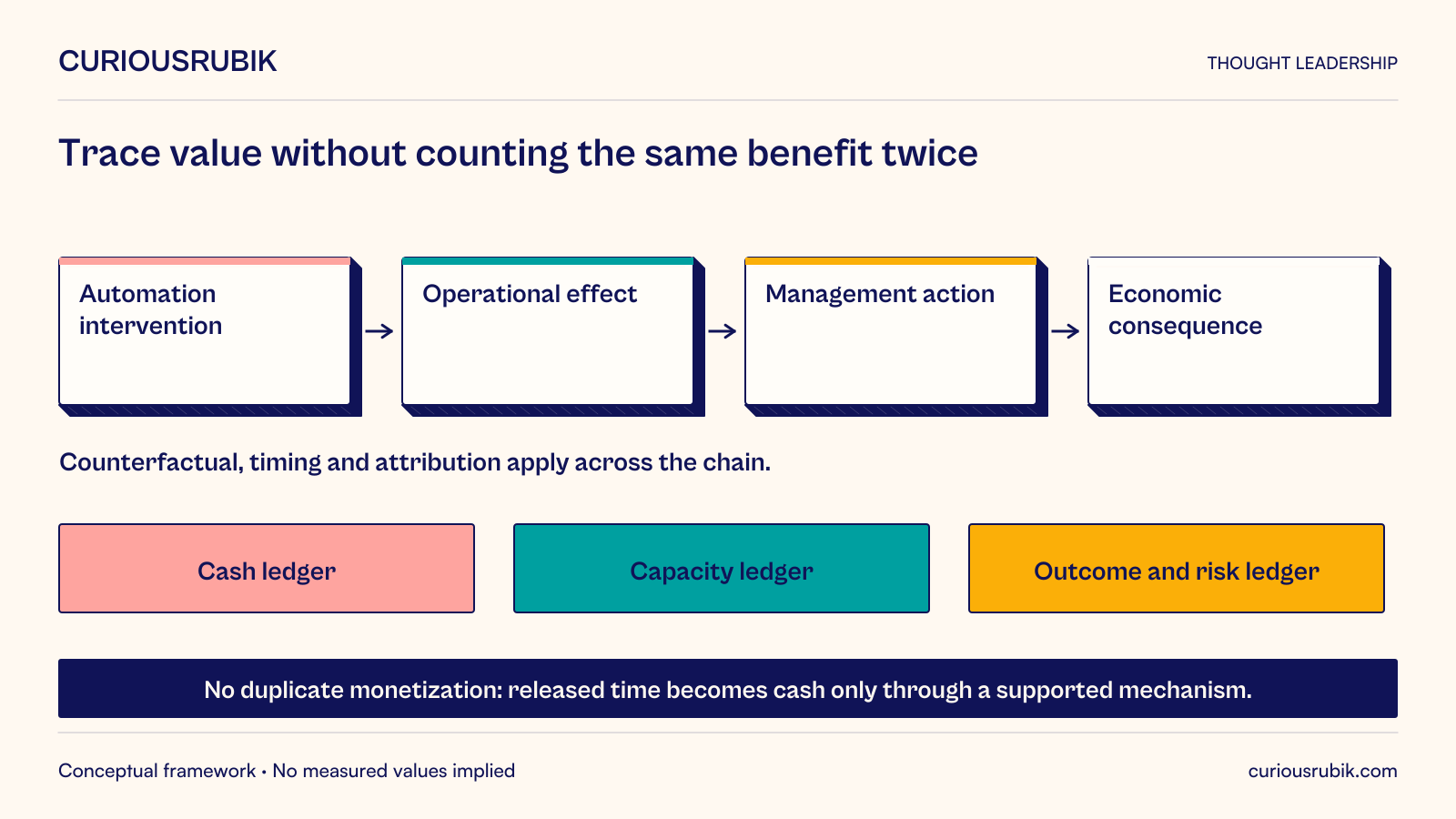
For each benefit, connect the intervention, operational effect, management action, and economic result. This is a working heuristic for business-case discipline, not a financial reporting standard.
For example, automated preparation reduces handling time. A manager reallocates the released capacity to an existing backlog. The business completes more work without a planned overtime increase. Only the final, evidenced step establishes the relevant cash effect.
Another intervention may improve traceability or reduce customer repetition without a defensible cash saving. Record that benefit separately. It can influence the decision without being assigned an arbitrary monetary value.
Name an owner for each link. The technical team may deliver the time-saving capability, but an operational manager controls redeployment and finance validates the cost consequence. A software implementation cannot independently realize a staffing benefit that management never acts on.
Maintain a cash ledger, a capacity ledger, and an outcome-and-risk ledger. This separation is an author-proposed modeling practice, not a prescribed accounting treatment.
The cash ledger records incremental cash costs and benefits relative to the alternative: implementation payments, operating charges, actual avoided overtime, or a contract that can genuinely be discontinued. Include timing and conditions.
The capacity ledger records hours, skills, and workload released or added. It should show where capacity appears and whether it is usable. Fragmented minutes across many people may improve responsiveness but may not support a headcount reduction.
The outcome-and-risk ledger captures service quality, reliability, traceability, and exposure that cannot be monetized credibly. Explain the mechanism and evidence rather than forcing every consequence into the cash calculation.
Avoid double counting. If reduced overtime already monetizes part of the released staff time, do not add the same hours again at a fully loaded labor rate as another financial benefit.
Consider a hypothetical training provider automating enrollment reconciliation. The proposal assumes an initial implementation cost of US$72,000 and recurring operating cost of US$24,000 per year.
At full adoption, management expects to avoid US$36,000 of annual overtime and discontinue a separate US$12,000 reconciliation service, provided the service contract can end and the new process covers its required work. These are hypothetical cash assumptions, not industry benchmarks or observed results.
Full-year gross cash benefit is therefore US$48,000, with US$24,000 net benefit after recurring cost. Dividing the initial US$72,000 by that steady-state annual net amount gives a simple three-year payback. That shortcut assumes full benefits from the start and ignores discounting.
The actual planning scenario expects only half the gross benefit in year one because rollout and contract transition take time. Year-one benefit is US$24,000 against US$24,000 running cost, producing no net operating cash benefit. Years two and three each produce US$24,000 net.
Across three years, gross cash benefits total US$120,000. Initial and recurring costs total US$144,000. The undiscounted net result is negative US$24,000, and simple ROI defined as net benefit divided by total cost is approximately negative 16.7 percent. Under unchanged assumptions, cumulative undiscounted cash reaches breakeven at the end of year four, not year three.
The provider may still value better enrollment accuracy or faster resolution. Those benefits belong in the separate outcome ledger unless credible monetization is available. The example shows why ramp-up and benefit conditions can change an apparently attractive payback claim.
Operating cost extends beyond licenses or platform charges. Include exception review, monitoring, source-data correction, rule maintenance, support, testing after changes, and access administration.
Estimate business participation as well as external fees. Employees who design rules, test scenarios, or reconcile records are using scarce capacity. Keep that capacity visible even when it does not create an additional cash payment.
Account for transition overlap. The old process may need to run in parallel until the new one is dependable. A supplier contract may have a notice period. Training and support demands can be concentrated during the period when benefits are still limited.
Include retirement and replacement where relevant. An automation tied to a changing interface may require recurring repair or eventual redesign. Do not assume an indefinite benefit stream from a solution whose dependencies have a short life.
A before-and-after comparison can be misleading if demand, staffing, case mix, policy, or service expectations changed at the same time. Record those changes and select an evaluation design appropriate to the decision.
The National Audit Office’s 2022 evaluation framework explains the need for a clear counterfactual when assessing impact: what would have happened without the intervention? Its public-policy context differs from an enterprise automation project, but the causal question remains relevant. NAO, Evaluating government spending: an audit framework.
Where feasible, compare similar groups or phase the rollout in a way that supports learning. Randomized evaluation may be appropriate for some low-risk interventions, but it is not universally practical or ethical. Do not withhold required controls or services merely to create a comparison group.
Use evidence proportionate to the commitment. A small pilot may establish feasibility and handling-time changes while remaining too small to prove a rare risk reduction. State those limits rather than converting uncertain observations into a precise annual benefit.
Sensitivity analysis should focus on the variables that matter: adoption, transaction volume, avoidable effort, exception rate, operating cost, and benefit timing. Avoid a decorative best/base/worst presentation in which every assumption moves together without a coherent explanation.
Ask what would need to be true for the project to meet the required threshold. In the training example, the answer might involve lower initial cost, faster contract exit, or an additional evidenced cash benefit. That identifies what to investigate or negotiate.
Use scenarios for materially different operating conditions. A new service model, acquisition, or major volume change may alter both benefit and cost. Keep those scenarios distinct from ordinary estimation uncertainty.
For multi-year decisions, finance should choose an appropriate discounted-cash-flow method and discount rate consistent with the organization’s policy. Do not import a public-sector rate or an arbitrary vendor rate into a commercial case without justification. Simple ROI and payback are useful summaries, but neither fully represents timing or risk.
Some projects are necessary to meet an obligation or replace an unsustainable process. In those cases, the decision may be which feasible option achieves the requirement at an acceptable cost, rather than whether the requirement produces a positive standalone ROI.
HM Treasury’s 2022 value-for-money guidance illustrates the role of non-monetisable factors and why a higher benefit-cost ratio does not automatically identify the preferred option. The relevant lesson is to make these judgments explicit rather than hide them inside a single number. HM Treasury, Value for Money guidance.
Document the reason for proceeding when the cash case is weak. Better resilience or reduced dependence on one employee may justify investment, but it should be presented as that decision. Inflating labor savings to make the ratio attractive weakens later accountability.
Preserve the approved baseline, assumptions, and calculation definitions. Record actual adoption, volumes, exception work, and operating cost over the relevant business cycle.
Ask benefit owners to show the management actions that realize value. Was overtime actually reduced? Did a contract end? Was a planned hire avoided under comparable demand? Did released capacity serve an existing backlog or improve response?
Compare results with the case and explain differences. A lower benefit may reflect a faulty assumption, incomplete adoption, a new operating requirement, or a changed external condition. Each explanation leads to a different response.
Do not keep a project alive merely because its initial cost is sunk. Evaluate future benefits and costs when deciding whether to expand, repair, or retire it. Equally, do not abandon a useful intervention because its original business case used the wrong measure; reassess it honestly.
Request a transparent model with editable assumptions, a clear cost boundary, benefit owners, and separate treatment of cash, capacity, and nonfinancial outcomes. Ask vendors to show how their estimate changes when exceptions increase or adoption is delayed.
Require evidence behind handling-time claims and verify that the proposed workflow removes the measured work rather than moving it to another team. Agree how actual results will be assessed before implementation begins.
A sound automation ROI model is a management agreement about how value will be created and verified. The arithmetic matters, but its credibility comes from traceable assumptions, realistic timing, and the willingness to show an unfavorable result when the evidence requires it.