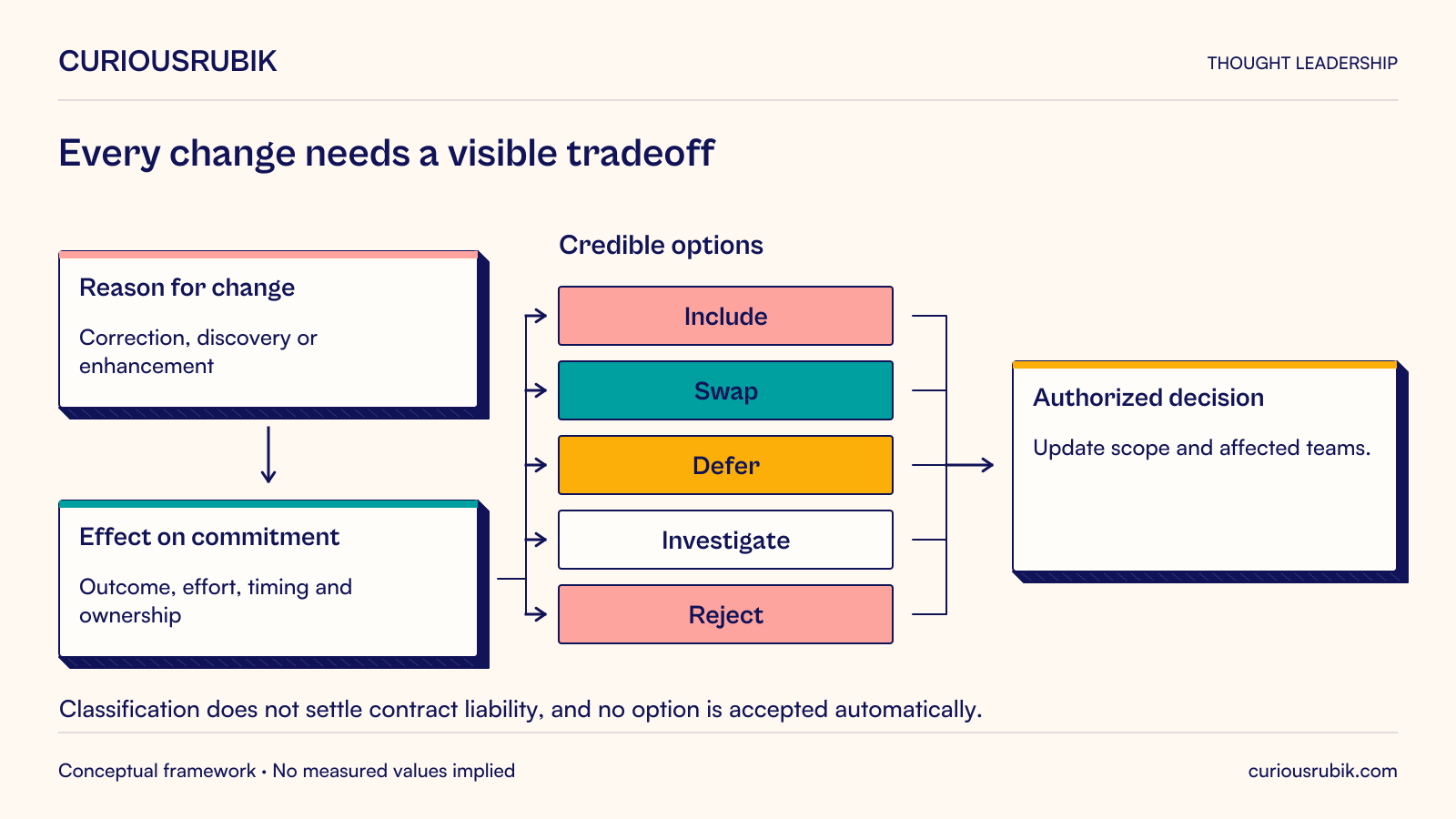
A project can protect its original scope and still deliver the wrong result. It can also accept every sensible suggestion and exhaust the capacity needed to finish. The sponsor’s task is to distinguish changes that preserve the intended outcome from changes that expand the commitment, then make the tradeoffs explicit.
Scope creep is best understood as growth in work or obligations without a corresponding decision about value, resources, timing and responsibility. The problem is not simply that requirements change. It is that the organization absorbs the consequences informally while continuing to report against an obsolete plan.
For an implementation leader, the practical remedy is a change process that is easy enough to use, rigorous enough for consequential decisions and connected to the actual release boundary. It should support justified learning while making unapproved expansion visible.
A baseline should describe the business outcome, included capabilities, affected users and entities, key constraints and acceptance evidence. A list of screens or configuration tasks is insufficient when a later dispute concerns whether the process is usable end to end.
Record exclusions and assumptions as carefully as inclusions. If historical data is excluded, explain how the business will access it when needed. If an interface depends on a supplier providing a particular capability, retain that assumption and its evidence. A hidden dependency can become apparent scope growth when it was really an unpriced condition of the original plan.
Distinguish the release baseline from the longer-term ambition. An organization may want several capabilities eventually while funding only a subset now. A roadmap item should not enter the current sprint or configuration backlog merely because it appears somewhere in the vision.
Give the baseline an owner and version. When approved changes alter it, update the reference used by delivery, testing, procurement and business stakeholders. Otherwise, each team can correctly follow a different version of the commitment.
Begin with why the work is being proposed. A defect correction addresses behavior that fails an agreed requirement. A clarification resolves ambiguity. A discovered dependency may be necessary to achieve the original outcome. An enhancement adds value beyond the current commitment. An external change may require adaptation to a new constraint.
These categories help structure analysis, but they do not automatically settle contractual responsibility, price or approval. Those questions depend on the actual agreement and facts. The delivery team should not use a convenient label to decide them informally.
Ask what would happen if the change were rejected. Would the release fail its acceptance criteria, create an unmanageable operating burden, remain usable with a documented limitation or simply miss an additional opportunity? This question connects the request to the business result rather than the enthusiasm of its sponsor.
Also ask whether the proposed implementation is the smallest credible response. A legitimate need can arrive packaged as an unnecessarily large solution. The team should be allowed to suggest a simpler process, configuration or staged approach that meets the required outcome.
For a material change, identify affected requirements, design, interfaces, data, tests, training and support. Estimate the additional work and any work that can be removed. State the uncertainty in those estimates and the dependencies that could change them.
NASA’s 2016 Systems Engineering Handbook describes requirements management as maintaining traceability and evaluating changes across the product lifecycle, including their effects on related design and test artifacts. The enterprise application lesson is to follow the consequences beyond the modified feature. This is an adaptation of engineering discipline, not a requirement that a commercial project adopt NASA’s full governance process. NASA Systems Engineering Handbook, section 6.2.
Keep effort and schedule separate. Eight person-days of work do not necessarily add eight calendar days. The effect depends on the available skills, parallel work, dependencies and critical path. Equally, a small task can delay a release if it needs a scarce reviewer or must precede a long test sequence.
Include operating consequences. A quick customization may create recurring support work. A manual workaround may be acceptable for a short period but need an owner and expiry condition. The change decision should cover the responsibility being created, not only the development estimate.
Consider a hypothetical customer-portal implementation. All effort figures are invented for explanation. The release has 30 person-days of relevant capacity remaining. Twenty are already committed to finishing and testing the agreed scope, leaving ten unallocated person-days under the current plan.
A test reveals that order cancellations do not reach the operational system correctly for a defined case. The accepted release outcome requires customers to cancel eligible orders reliably. The team estimates six additional person-days to correct and test the affected path. Management must confirm the evidence and responsibility, but simply rejecting the work as scope creep would leave the agreed outcome unmet.
At the same time, a stakeholder proposes personalized product recommendations estimated at eight person-days. The idea may be valuable, but it was not part of the current release commitment. Accepting both changes would require 34 person-days in total: twenty already committed, six for the correction and eight for the enhancement. That exceeds the stated capacity by four person-days.
The sponsor has several options. Defer recommendations, remove other work whose benefit can safely wait, add genuinely available qualified capacity or change the release commitment. The arithmetic identifies the resource conflict; it does not by itself establish the calendar delay or prove that extra people would solve it.
Suppose the team instead proposes a smaller recommendation experiment after launch, using an existing reporting capability and a defined learning objective. That option can preserve the idea without inserting an untested feature into a constrained release. The decision record should explain what was deferred and when its value will be reconsidered.
The program has controlled scope without treating a necessary correction and a new opportunity as equivalent requests.
Not every change needs a steering committee. Define bounded authority for routine clarifications and low-consequence adjustments, with escalation for changes affecting material cost, release outcomes, controls, architecture or external commitments.
The boundaries should be understandable to delivery teams. “Escalate important changes” is vague. A policy can instead specify which types of consequence require a particular owner, while allowing the project lead to resolve changes that remain within approved limits.
Provide a route for urgent decisions. A process that only meets monthly may encourage teams to proceed informally when a dependency blocks daily work. A delegated decision-maker can act within stated authority and record the decision for later visibility.
Avoid approval theater. A committee cannot make a useful decision if the request contains only a feature description and an optimistic effort number. Require the business reason, options, affected commitments, evidence and accountable owner at a level proportionate to the consequence.
Small requests can collectively create a large commitment. Maintain a ledger of approved, deferred, rejected and pending changes, showing their effect on the current release and operating model. Review the cumulative effect rather than treating each request as isolated.
Track what was removed as well as what was added. A claimed scope swap is incomplete if the team stops building a feature but retains its integration, test and support obligations. Confirm the actual work and benefit that leave the release.
Keep uncertainty visible. A change approved for investigation is not the same as approval to implement whatever solution the investigation finds. Define the next decision and the evidence needed before expanding the commitment.
Look for patterns in the ledger. Repeated requests from one process may indicate an incomplete initial model. Frequent emergency changes may indicate late stakeholder involvement or a slow decision path. The process should improve planning, not merely document exceptions.
Deferral should have a reason and a return condition. An item may wait until a dependency is resolved, a user need is validated or the organization has capacity to operate it. A backlog without those conditions can become a storage location for promises nobody intends to revisit.
Identify whether deferral changes the benefit case. If a release omits the capability that produces most of the expected value, keeping the original benefits forecast is misleading. Reassess the outcome and decide whether the remaining release still deserves investment.
Communicate changes to the people affected. Testing needs the current acceptance boundary. Training needs the actual workflow. Operations needs the supported limitations. A well-recorded steering decision that never reaches these teams does not control scope in practice.
The objective is a delivery commitment that remains both valuable and credible as evidence changes. Start by reviewing a few recent additions and asking whether each had an explicit decision about its consequences. Where work entered through informal agreement, restore that decision now. A disciplined change process gives useful ideas a fair hearing while protecting the capacity needed to deliver the promise the business has already made.