A system can remain available throughout launch while the business falls behind. Employees work more slowly, questions interrupt specialists, exceptions take longer to resolve, and a backlog grows faster than the organization can clear it.
Reducing disruption therefore requires protecting operating capacity as well as technical availability. The launch plan must account for demand, learning effort, transition work, fallback capacity, and the time needed to recover accumulated work.
For a COO, the central decision is how much change the business can absorb while continuing to meet its important commitments. A phased rollout, a carefully bounded service reduction, or a temporary pause in discretionary work may be more responsible than insisting that every activity continue unchanged from the first hour.
Start with the business outcomes whose interruption would matter most: accepting orders, dispatching work, providing essential customer information, or completing time-sensitive internal obligations.
Define the minimum acceptable service for each. Some activities can tolerate a delay; others need a controlled manual route or continued operation in an existing system. The choice depends on customer commitments, safety, legal obligations, and operational consequences.
Do not rank importance solely by transaction value. A low-value transaction can unlock a critical physical activity or prevent a large downstream delay. Include dependencies and the effect on customers or employees.
Agree who can change the operating plan if performance deteriorates. A support team should not have to decide informally which customers or processes will receive attention when capacity becomes constrained.
The business faces several simultaneous demands: ordinary production work, learning the new process, resolving defects, correcting data, and reconciling temporary arrangements. The same experts may be needed for all of them.
Estimate capacity by role and time period. Identify where a person appears in both the cutover plan and the next operating shift. Include absence cover and the effort of helping others.
The National Audit Office’s operational-services guidance emphasizes understanding demand variation, process flow, dependencies, and the skills and tools required to meet demand. Those principles are directly useful when planning the temporary operating conditions around launch. NAO, How to improve operational services.
Use scenarios rather than one optimistic assumption. Consider slower handling, a higher-than-expected exception rate, or a key dependency becoming unavailable. Identify which condition would require a change in scope or service level.
A phased launch can limit the number of users or transactions exposed to a problem, but the phase boundary must reflect real dependencies.
A branch may look independent while sharing inventory, customer credit, or a central scheduling team. Running old and new processes across that boundary can create additional reconciliation and confusion.
Evaluate possible cohorts by operational separability, representativeness, support capacity, and reversibility. A small pilot containing only easy work may provide little evidence for the next wave. A representative pilot that overwhelms the available support defeats its purpose.
Define the conditions for expanding, holding, or narrowing the rollout. Calendar dates can guide planning, but observed operating performance should influence the decision.
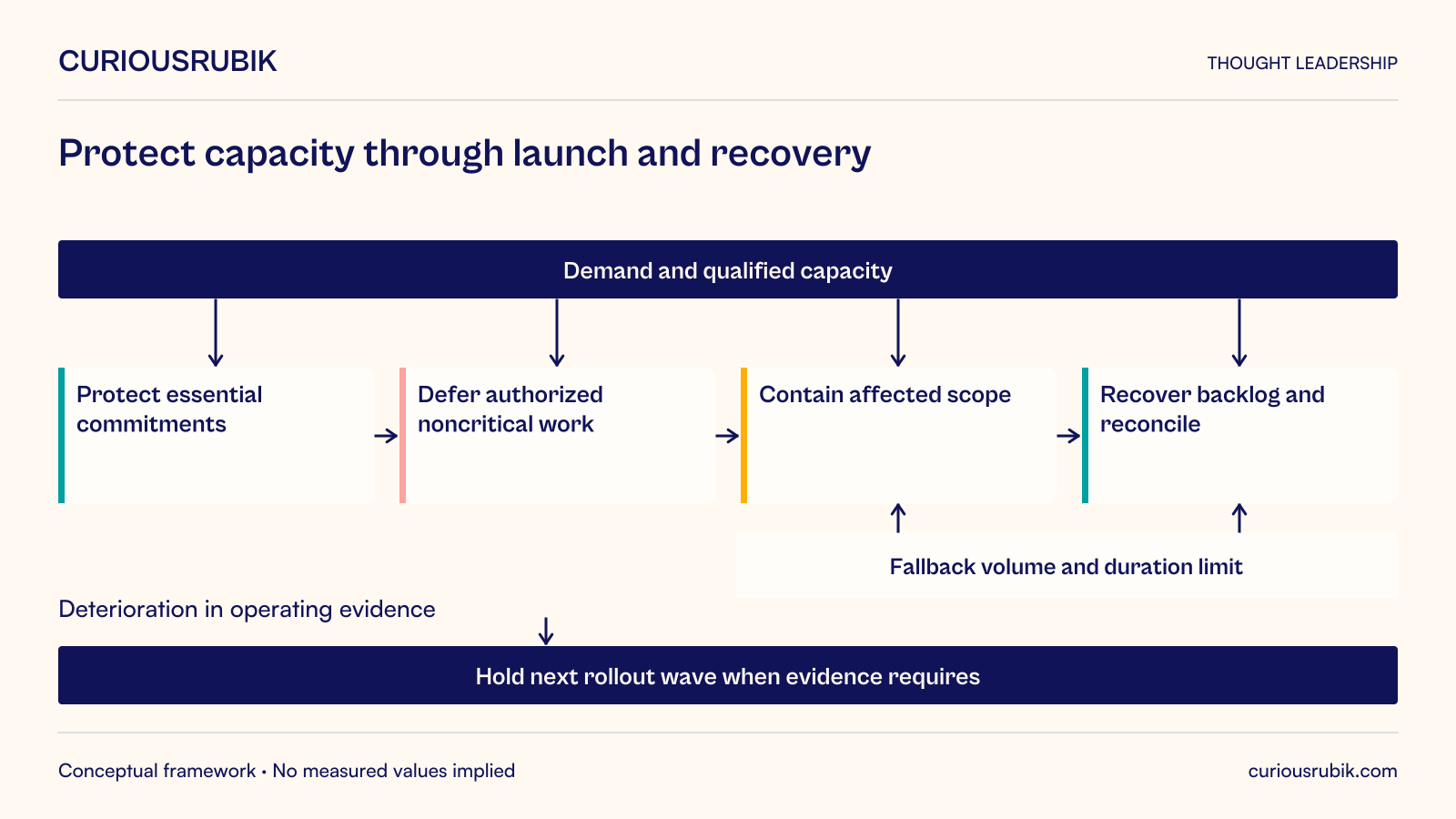
A practical working heuristic groups launch actions into protect, defer, contain, and recover. This is a proposed operating tool, not a standard.
Protect the commitments that must continue. Defer discretionary changes or low-urgency work where authorized and reasonable. Contain the affected population when a problem emerges. Recover the backlog and reconcile temporary work before normal expansion resumes.
Each action needs an owner, trigger, communication, and exit condition. “Use manual processing if needed” is incomplete without knowing who can do it, at what volume, with which controls, and for how long.
A technical overload strategy may preserve important work by limiting or degrading less critical demand. The SRE treatment of overload illustrates that principle for computing services. Applying it to business operations requires explicit service and authority decisions rather than blindly copying technical thresholds. Site Reliability Engineering, Handling Overload.
Consider a hypothetical company collecting and returning linen for hotels. It is replacing the system used for customer schedules, work tracking, and dispatch preparation. Physical collections continue during the transition.
The company identifies daily dispatch accuracy as a protected outcome. It reduces discretionary master-data changes during the launch window and avoids introducing unrelated route redesign at the same time. These choices reduce competing change without pretending the business can stop operating.
The first rollout cohort includes a defined route group whose records can be separated and reconciled. Shared customers and cross-site work are examined before the cohort is approved. The team retains a controlled reference for existing commitments and records changes through one authorized channel.
If the new dispatch view becomes unreliable, a trained team can use a limited fallback for the protected route group. The fallback has unique records, confirmation steps, and a maximum sustainable workload based on rehearsal. It is not an unlimited promise to operate manually for the whole business.
The company monitors dispatch completion, unresolved record differences, support demand, and work waiting for correction. If the fallback workload approaches its capacity, the operating owner can hold the next rollout wave and adjust noncritical work through the approved process.
After the system is restored, the team reconciles physical collections and deliveries with the new records before resuming normal reporting. The backlog-clearance plan includes qualified capacity rather than assuming staff can absorb it alongside the next day’s ordinary work.
This hypothetical scenario illustrates service protection and recovery. It claims no measured reduction in disruption and does not prescribe a particular operating limit for laundry businesses.
A manual workaround is a process with its own throughput, skills, error risks, and coordination needs. Test it with representative work before relying on it.
Measure active handling, verification, and reconciliation effort. Determine which roles can perform it and how long they can sustain it without unacceptable fatigue or displacement of other critical work.
Keep the fallback scope narrow enough to control. It may support a specific transaction type or customer group while other work waits. Make that boundary visible to staff and customer-facing teams.
Define the return path. Temporary records need stable identifiers and a method for entering or reconciling them without duplication. A fallback that preserves service for a day but creates an unmanageable week of corrections has moved the disruption rather than contained it.
Prepare role-specific guidance for the tasks users will perform immediately. Make known limitations and the correct support route easy to find. A generic training library may be too slow to use during a live transaction.
Use a triage role to gather evidence and group related issues. Specialists should not have to rediscover the same problem through many separate interruptions.
Distinguish questions from defects without dismissing either. Repeated questions may reveal confusing design or missing instructions. A user who cannot complete an essential task still needs help even when the software is technically behaving as specified.
Avoid assigning every expert to continuous meetings. Reserve focused time for diagnosis, fixes, and operational decisions. Coordination should support the work rather than consume the people needed to perform it.
Users need to know what is available, what may be delayed, what they should do, and when they will receive another update. Internal technical detail is useful only when it changes those actions.
Prepare communication for expected states: normal operation, limited scope, delayed processing, fallback operation, and restoration. Use confirmed facts and distinguish estimates from commitments.
Coordinate messages across teams. A customer should not be told that service is restored while the operating team is still reconciling a backlog that affects their transaction.
Explain temporary changes early where practical and authorized. Avoid surprising staff or customers with new submission rules at the moment they need to act. Communication is part of managing demand and expectations, not merely a report on technical progress.
A low ticket count can reflect low usage, unreported problems, or employees using unofficial workarounds. Observe actual business flow.
Track incomplete work, aging queues, repeated corrections, delayed commitments, and the volume handled outside the normal system. Segment by the rollout cohort and relevant work type.
Compare capacity with incoming demand. If a backlog is growing, understand whether the cause is learning, defects, data quality, or a policy decision. Adding more technical support will not resolve every cause.
Use predefined intervention points to prompt a decision. The point is not to create arbitrary red lines, but to ensure that deteriorating conditions lead to an authorized response before the business loses control of the workload.
When the immediate problem is fixed, accumulated work still needs attention. Some records may be duplicated, incomplete, or inconsistent with physical events.
Prioritize backlog recovery according to business consequence and age. Protect ordinary work from being starved while old cases are corrected. The required balance may change as deadlines approach.
Reconcile the temporary channels and close them deliberately. If people continue using a fallback after normal operation returns, the organization can create a second unmanaged process.
Review what caused the disruption and whether the next rollout wave should change. A successful recovery is useful evidence, but it does not automatically justify expanding the same design without addressing the cause.
Require a clear account of protected commitments, rollout boundaries, temporary demand choices, fallback capacity, and backlog recovery. Ask which people are required in more than one place at the same time.
Ask suppliers to demonstrate how the business will operate through a degraded state, not only how the software will be restored. Verify that support and communications align with the actual operating plan.
The aim is not an unsupported promise of zero disruption. It is a controlled transition in which the business understands its limits, protects important commitments, and can respond before a manageable problem becomes an uncontrolled backlog.