The replacement system is live, ordinary users have moved and the old application appears quiet. Yet a monthly report still reads its database, an unresolved customer case depends on an attachment stored there and a service account continues to run a scheduled job. Turning off the application may be easy. Ending the business’s dependence on it is a different task.
System retirement is the controlled removal of an existing operational capability and its supporting components once the continuing obligations have a verified home. It is more than completing a migration or deciding that the old platform is expensive.
The retirement decision should answer three questions: what still depends on the system, which evidence or services must remain available, and who can demonstrate that those needs will be met after shutdown. The approach below is a practical planning method, not a universal retention schedule or a substitute for qualified legal, records or security advice.
A system name often represents several things: an application, databases, document storage, reports, interfaces, scheduled jobs, infrastructure and third-party arrangements. Some components may be shared with services that will continue. Retiring the named application does not automatically authorize removal of every related component.
Build an inventory around the actual boundary. Identify which components will be removed, which will be retained temporarily and which will remain as shared services under a different owner. Record the evidence supporting each classification and the person responsible for the decision.
NIST SP 800-53 Revision 5’s CM-8 control addresses accurate system-component inventories, and CM-8(1) specifically addresses updates during installation and removal. That security-control reference supports keeping the component account current through retirement. It does not determine the organization’s business retention obligations. NIST SP 800-53 Revision 5, CM-8.
Include dependencies that are not obvious from the user interface. A reporting tool may use a direct database connection. A scheduled extract may populate another team’s spreadsheet. A document link may point to storage outside the application’s main backup. Support staff may rely on an old code table to interpret historical transactions.
Discovery needs both technical evidence and business inquiry. Connection logs can reveal active consumers, while interviews and operating calendars can reveal infrequent uses that a short observation period misses. Neither source alone is a complete dependency assessment.
Consider a hypothetical equipment supplier retiring a legacy warranty administration system. New cases are handled elsewhere, but older cases include unresolved decisions, issued remedies and supporting documents. The business needs to distinguish work that must continue from information that must remain interpretable.
An unresolved case requires an accountable operating process. Moving its rows into an archive does not give anyone the ability or authority to complete the decision. Identify the current state, next action, owner and supporting evidence, then prove that the receiving process can handle it.
A completed case may require historical retrieval rather than ongoing workflow. The archive should preserve the relationships needed to understand what happened: the relevant product or contract, the case identity, decisions, documents and their applicable versions. A folder of attachments without those relationships may be difficult to use when a later inquiry arrives.
Do not assume that every old record must be copied forever. Determine retention, access, holds and disposal requirements with the responsible records, privacy and legal roles. Different record categories may require different treatment. An active hold or unresolved obligation can change what may be disposed of; the retirement team should not invent those rules.
For each continuing need, name the destination and the acceptance test. “Export completed” is evidence of a technical activity. “An authorized user can retrieve and interpret the complete case without the old application” is evidence closer to the actual business requirement.
Test retrieval in the environment that will actually remain. If the archive demonstration secretly uses the old application’s search service, database logic or authentication dependency, the application is not yet dispensable.
Select examples that exercise the important record types and relationships. In the warranty case, include a case with several documents, a corrected decision, a linked replacement and an open dispute where appropriate. Use a risk-based test population and document its limits; a few successful searches do not prove that every historical record is complete.
Check meaning as well as presence. Codes, units, dates and status values may require explanatory reference data. A value of “C” is not useful evidence if nobody can establish whether it meant closed, cancelled or conditionally approved in that version of the system.
Check access and support too. Authorized users should be able to perform the required retrieval, while unrelated or excessive access remains restricted. Define who responds when a document cannot be found, when an interpretation is disputed or when the archive software needs maintenance.
A backup serves a different purpose from an operational archive. It may be appropriate for recovery but too difficult to search for routine historical inquiries. Restoring it may also require software, infrastructure or licenses that are planned for removal. If backup restoration is part of the retained capability, demonstrate that path and assign its continuing cost and ownership.
Telling teams that a system will close is necessary but insufficient. Each identified consumer should have an agreed disposition: move to a replacement, stop because the output is no longer needed, or remain temporarily under an explicit exception.
For the monthly report, identify the business question it answers and the authoritative source after retirement. Reproducing the old report’s layout may not be necessary, but losing the decision it supports may be unacceptable. Have the report owner test the replacement using the relevant period and reconciliation conditions.
For integrations and scheduled jobs, verify both sides. A retired producer should not leave a consumer waiting indefinitely for data that will never arrive. A disconnected consumer should not leave an old job exporting information to an unattended destination. Remove obsolete alerts and operational instructions only when their replacements or closure conditions are confirmed.
Observation can help find missed dependencies, but silence needs context. A quarterly process will not appear during a quiet week. Select the observation period based on the known operating cycles and consequences, and supplement it with targeted tests where waiting for the next cycle is impractical.
Temporary read-only operation can reduce risk during a transition, but it should have a defined purpose, owner, review date and exit condition. Otherwise, “temporary” can become an indefinite second system with continuing security, licensing and support obligations.
The shutdown plan should specify the sequence, responsible roles, evidence to check and conditions that stop the change. Consider active sessions, queued work, scheduled tasks, external connections and the final state of retained records. The sequence depends on the system and cannot be reduced to a universal checklist of commands.
Define what recovery means at each stage. Before destructive removal, restarting a service may be possible under a tested plan. After storage disposal, license termination or irreversible changes to dependent systems, that option may no longer exist. Make those points explicit so approval is informed.
Do not confuse retaining a recovery option with keeping an ungoverned live copy. Any retained environment needs appropriate access, monitoring, maintenance and an owner. If the system is unsupported or cannot be safely maintained, the responsible specialists need to assess the available alternatives and residual risk.
Credentials and access deserve their own closure account. Identify obsolete user accounts, service identities, certificates and secrets associated with the retired capability. Authorized security teams should remove or change them through approved procedures while checking that shared services will not be broken. An application that no longer starts can still leave usable access paths behind.
Data disposal and media handling must follow the organization’s approved requirements and the actual storage technology. Preserve evidence of authorized completion where needed. This is not a recommendation to delete records simply because the software has been replaced.
Retirement acceptance should bring together business, records, security, technical and service ownership. Each role confirms the obligations within its authority, with unresolved exceptions visible rather than buried in a project closure note.
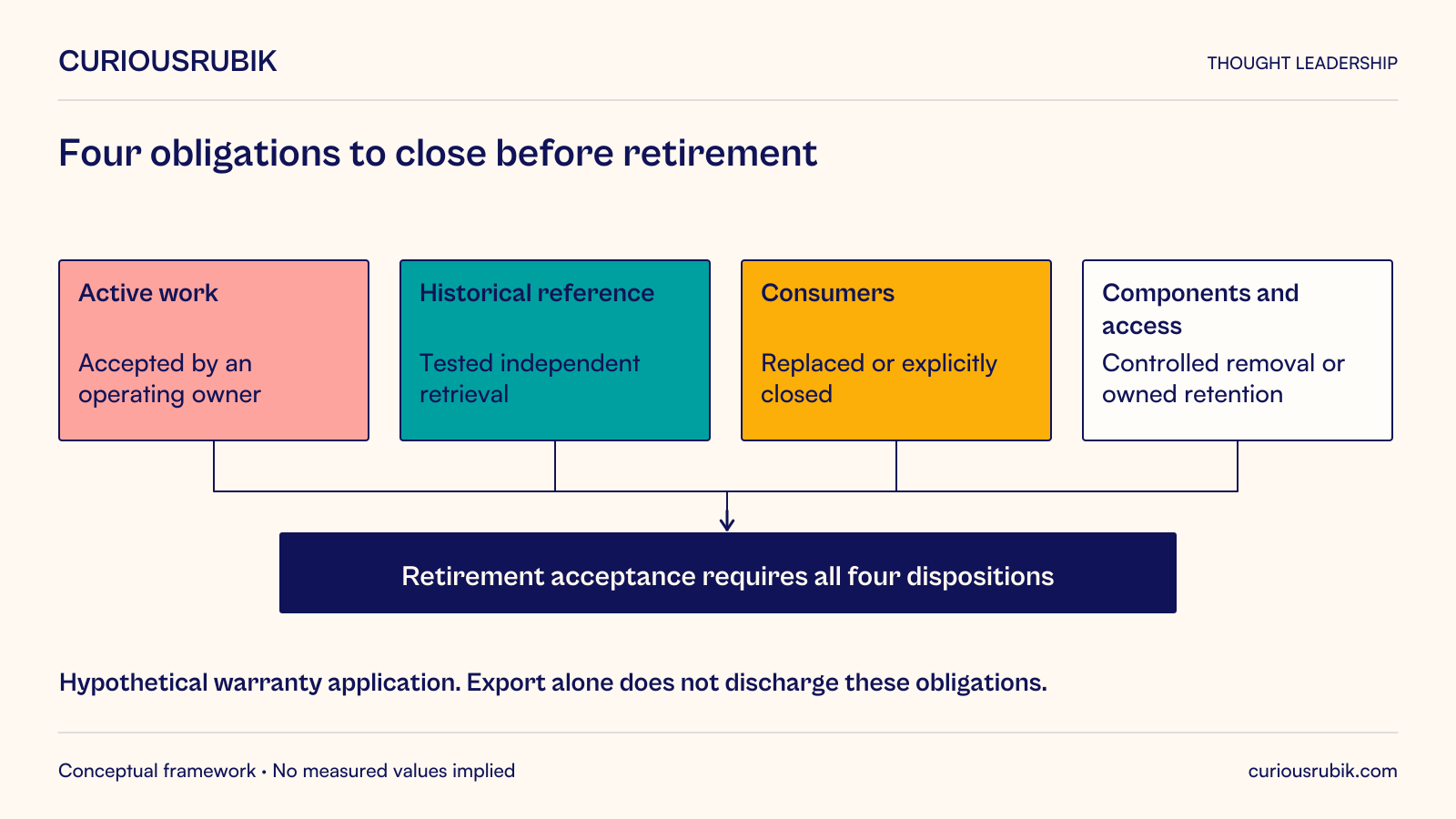
For the hypothetical warranty system, acceptance might require proof that active cases have operating owners, historical case retrieval works independently, reports and interfaces have verified dispositions, and obsolete components and access have been removed or explicitly retained. The evidence should identify what was tested, by whom and what limitations remain.
Update inventories, support catalogues, recovery plans and supplier arrangements to match the final state. Confirm any expected cost reduction against the actual contractual and operational outcome. Ending user access does not necessarily end a subscription, infrastructure charge or shared support expense.
The archive and any retained services still need funding and ownership. Assign review of access, readability, supportability and eventual disposal under the applicable policy. A successful retirement can reduce the operating footprint while leaving a smaller, deliberately managed information obligation.
Finally, keep a concise retirement record: the scope removed, continuing destinations, approvals, verification results, exceptions and responsible owners. That record helps a future team answer why the application no longer exists and where its important obligations went.
An enterprise system is safely retired when the organization can perform its continuing work and explain its retained evidence without relying on an abandoned operational dependency. The power switch is only one step in reaching that state.